Why in the News
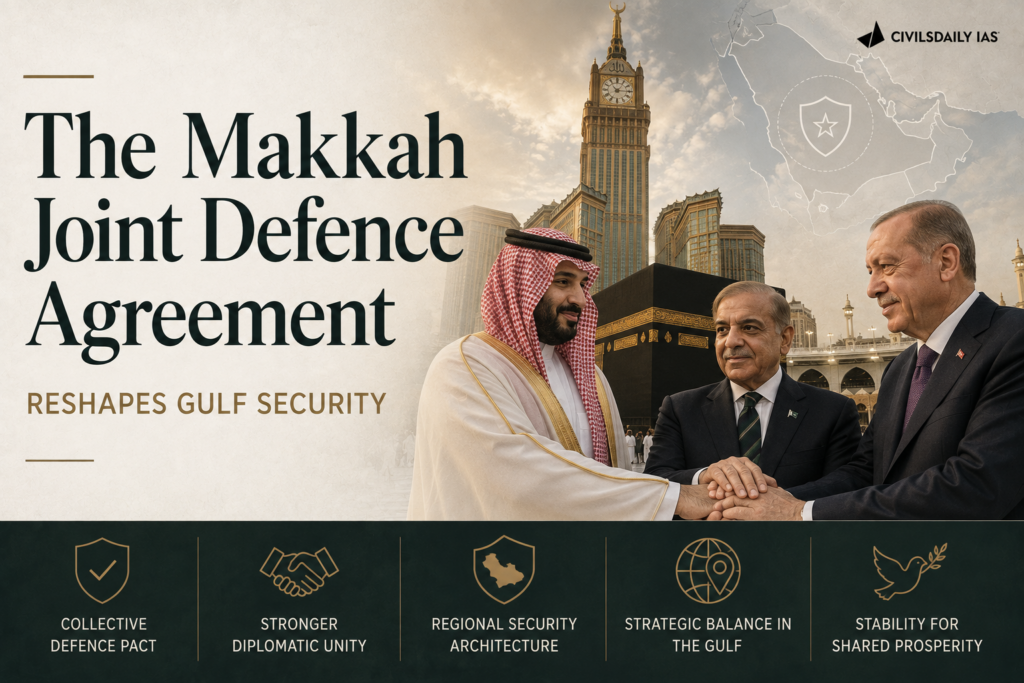
The Makkah Joint Defence Agreement, a Saudi Arabia-Pakistan-Turkey mutual-defence pact signed on 7 August 2026, is framed as a NATO-style collective-security bloc. It carries stakes for the Strait of Hormuz and Indian energy security.
What is a collective defence pact?
- Definition: A collective defence pact treats an armed attack on one member as an attack on all, obliging mutual assistance.
- Model: The template is NATO’s Article 5, which the new pact echoes for the Gulf and West Asia.
Why does it matter for India?
- Nuclear linkage: It ties a nuclear-armed neighbour, Pakistan, to a Gulf power and a NATO member, altering the regional balance.
- Energy chokepoint: Instability around the Strait of Hormuz threatens India’s crude and LNG imports.
- Strategic autonomy: India must balance ties with Gulf states, Israel, and Iran without being drawn into bloc politics.
Conclusion
A new security triangle in West Asia complicates India’s balancing act in an energy-critical region. The next milestone is whether it acquires an operational command structure.
“[2023, GS2, 15 marks] The expansion and strengthening of NATO and a stronger US-Europe strategic partnership works well in India. What is your opinion about this statement? Give reasons and examples to support your answer.”
