Mains Ready By December. Smash Mains & Smash PYQ Admissions Open

GS Paper: GS2-18.Bilateral, regional and global groupings and agreements involving India and/or affecting India’s interests.

  • Importance of Tibetan Democracy Day

    A little more than six decades ago, Tibetan Democracy Day was marked with the inauguration of the Tibetan government-in-exile in Dharamshala on September 2.

    Tibetan Democracy Day

    • In February 1960, a little less than a year after he crossed over into India, the Fourteenth Dalai Lama outlined in Bodh Gaya, where The Buddha attained Enlightenment, a detailed program of democratic practice for exiled Tibetans.
    • According to the website of the Tibetan Parliament-in-Exile (TPiE), he advised them to set up an elected body with three exiled representatives each from the three provinces, and one each from the four religious schools of Tibetan Buddhism.
    • After elections were held, 13 elected representatives, called ‘Deputies’, were designated as the ‘Commission of Tibetan People’s Deputies’ (CTPD). They took oath on September 2, 1960.
    • Subsequently from 1975 onward, this date began to be formally observed as Tibetan Democracy Day.

    Parliament-in-Exile

    • The TPiE is the highest legislative body of the Central Tibetan Administration (CTA).
    • It is described as one of the three pillars of Tibetan democratic governance — the others being the Judiciary and the Kashag, or Executive.
    • The website of the TPiE underlines the Dalai Lama’s commitment to the democratic principle — it quotes the Dalai Lama from the Foreword to the Constitution for Tibet, drafted in 1963:
    • The CTA is based in Dharamsala, Himachal Pradesh.
    • Elections are held every five years to elect Members of the TPiE, and their Sikyong (Prime Minister). The 16th TPiE was elected in 2016.
    • This was the second direct election after the Dalai Lama distanced himself from the political functioning of the TPiE in 2011.

    The Government-in-Exile

    • On March 10, 1963, the Dalai Lama promulgated the Constitution of the Tibetan Government-in-Exile (TGiE).
    • From 1991 onwards, TPiE became the legislative organ of the CTA, the Tibetan Supreme Justice Commission became the judicial organ, and the Kashag the executive organ.
    • The TGiE is not recognised officially by any country, including India.
    • However, many countries, including the US, deal directly with the Sikyong and other Tibetan leaders through various forums.
    • The TPiE says its democratically elected character helps it manage Tibetan affairs, and raise the Tibetan issue across the world.
    • The current Sikyong (known as Kalön Tripa until 2012) of the CTA is Lobsang Sangay, who has been the head of the Kashag or Cabinet (first as Kalön Tripa and then as Sikyong) since 2011.

    What is India’s official policy towards the CTA?

    • India considers the Dalai Lama as a revered religious leader and an honored guest, but it does not encourage political activities by Tibetans.
    • It does not recognize any separate government of Tibet functioning in India.


    UPSC 2023 countdown has begun! Get your personal guidance plan now! (Click here)

  • G20 presidency opportunities for India’s growth and prosperity

    G20 Context

    • India’s presidency of the G20 grouping next year arguably the sole remaining effective forum for global governance presents an enormous opportunity to accelerate sustainable growth within India, in the emerging world, and beyond.

    About G20

    • Formed in 1999, the G20 is an international forum of the governments and central bank governors from 20 major economies.

    Features

    • Collectively, the G20 economies account for around 85 percent of the Gross World Product (GWP), 80 percent of world trade.
    • To tackle the problems or the address issues that plague the world, the heads of governments of the G20 nations periodically participate in summits.
    • In addition to it, the group also hosts separate meetings of the finance ministers and foreign ministers.

    Objectives

    • Stability: The Group was formed with an aim of studying, reviewing, and promoting high-level discussion of policy issues pertaining to the promotion of international financial stability.
    • Fiscal responsibilities: The forum aims to pre-empt balance of payments problems and turmoil on financial markets by improved coordination of monetary, fiscal, and financial policies.
    • Universal Support: The forum seeks to address issues that go beyond the responsibilities of any one organisation.

    G20Is India ready for G20 leadership?

    • At some levels, India is ready.
    • Indian business and industry is becoming a noteworthy competitor globally.
    • The country’s domestic economy is starting to pick up, thanks to structural economic reforms.
    • The central government is economically stronger, and the states are starting to learn about economic independence, making them more aligned with their global counterparts.

    Punchline

    It is said that “those who hold the pen, write the rules”.

    The time has come for India to both hold the pen and write the rules for a more equitable global economics and governance.

    Issues and Challenges

    • India need to have a clear global financial agenda.
    • The country should also have the capacity to lead the G20 year intellectually, financially, managerially and administratively.
    • Geopolitically, India is more internationally engaged but less so geoeconomically.
    • Its narrow focus is on the World Bank, IMF, WTO and foreign investment issues.
    • But India has much to contribute on issues like reconfiguration of global financial regulations, design of a new framework for trade in services and the digital economy and establishing better cross-border standards for transparency in financial flows.
    • To make its G20 year a success, India has to address organisational challenges, where the country has an infrastructure, management and intellectual gap.

    G20What could India bring to the table?

    • Mediation: Firstly, it remains pertinent for the world that escalating tensions between Russia and Ukraine come to a halt. Maintaining its balanced stance, India needs to neutralise this situation by introducing peace talks between the two nations.
    • Open trade: It’s about time for India to raise its voice in support of a transparent New Economic Order and building a prosperous and just world. Unreasonable bans on certain commodities from various countries limits commerce between states when trade liberty exists.
    • Collaboration around science and technology: The global agenda has been tilted towards investment, whereas science and technology are the driving force for economic diversification, sustainably urbanising the world, and ushering the hydrogen economy and new crop varieties as the answer to both human well-being and global climate change.
    • Redefining digital access as universal service: Harnessing the potential of the digital-information-technology revolution requires redefining digital access as a “universal service” that goes beyond physical connectivity to sharing specific opportunities available.

    Conclusion

    • India’s presidency must leave the grouping with the agility and energy to respond to new realities, and it must create a future-ready multilateralism through a novel and robust institutional architecture.

    Mains question

    Q. It is said that “those who hold the pen, write the rules”. The time has come for India to both hold the pen and write the rules for a more equitable global economics and governance. Discuss in the context of India’s presidency of G20 summit with challenges and opportunities ahead.


    UPSC 2023 countdown has begun! Get your personal guidance plan now! (Click here)

  • India-Srilanka Relations


    Context

    The present economic crisis in Sri Lanka has pushed it closer to India for immediate relief.

    Reasons for the Crisis

    The first wave of the pandemic in 2020 offered early and sure signs of distress.

    • In-migration: Thousands of Sri Lankan laborers in West Asian countries were left stranded and returned jobless.
    • Shut-down: Garment factories and tea estates could not function, as infections raged in clusters. Tourism sector to saw a big dip.
    • Domestic job losses: Thousands of youth lost their jobs in cities as establishments abruptly sacked them or shut down.
    • Forex decline: It meant that all key foreign exchange earning sectors, such as exports and remittances, along with tourism, were brutally hit.

    Reasons behind crisis

    • The Easter bomb blasts of April 2019 in churches in Colombo resulting in 253 casualties,consequently, dropped the number of tourists sharply leading to a decline in foreign exchange reserves.
    • The newly led government by Gotabaya Rajapaksa in 2019 promised lower tax rates and wide-ranging SoPs for farmers during their campaign.
    • No strategy: The lack of a comprehensive strategy to respond to the crisis then was coupled with certain policy decisions last year.
    • Ill-advised policies: It included the government’s abrupt switch to organic farming —widely deemed “ill-advised”, further aggravated the problem.
    • Food hoarding: The government declared emergency regulations for the distribution of essential food items. It put wide import restrictions to save dollars which in turn led to consequent market irregularities and reported hoarding.
    • Continuous borrowing: Fears of a sovereign default rose by the end of 2021, with the country’s foreign reserves plummeting to $1.6 billion, and deadlines for repaying external loans looming.

    Brief background of India-SL relations

    • India is the only neighbor of Sri Lanka, separated by the Palk Strait; both nations occupy a strategic position in South Asia and have sought to build a common security umbrella in the Indian Ocean.
    • There are deep racial and cultural links between the two countries. Both share a maritime border.
    • The India- SL relations have been however tested by the Sri Lankan Civil War and by the controversy of Indian intervention during the war.
    • In recent years Sri Lanka has moved closer to China, especially in terms of naval agreements.
    • India has signed a nuclear energy deal to improve relations and made a nuclear energy pact with Sri Lanka in 2015.

    India’s role in the Lankan Civil War

    • In the 1970s–1980s, the RAW and the state government of Tamil Nadu were believed to be encouraging the funding and training for the Liberation Tigers of Tamil Eelam (LTTE), a separatist insurgent force.
    • In 1987, faced with growing anger amongst its own Tamils, and a flood of refugees India intervened directly in the conflict for the first time.
    • This was after the Sri Lankan government attempted to regain control of the northern Jaffna region by means of an economic blockade and military assaults; India supplied food and medicine by air and sea.

    Why did India intervene?

    • Indian intervention in Sri Lankan civil war became inevitable as that civil war threatened India’s unity, national interest and territorial integrity.

    Outcomes

    • The peace accord assigned a certain degree of regional autonomy in the Tamil areas with a body controlling the regional council and called for the Tamil militant groups to lay down their arms.
    • Further India was to send a peacekeeping force, named the IPKF to Sri Lanka to enforce the disarmament and to watch over the regional council.
    • The accord failed over the issue of representations. The result was that the LTTE now found itself engaged in military conflict with the Indian Army.

    Areas of cooperation

    (1) Political Relations

    • Regular Exchange: Political relations between the two countries have been marked by high-level exchanges of visits at regular intervals.
    • Bilateral Cooperation: A joint statement covering all areas of bilateral cooperation, titled ‘MitratvaMaga’ was issued following the Virtual Summit of 2020.

    (2) Commercial Relations

    • ISFTA: The India-Sri Lanka Free Trade Agreement (ISFTA) in 2000 contributed significantly towards the expansion of trade in areas such as infrastructure, connectivity, transportation, housing, health, livelihood and rehabilitation, education, and industrial development.
    • Trading Partner: India has traditionally been among Sri Lanka’s largest trade partners and Sri Lanka remains among the largest trade partners of India in the SAARC.
      • In 2020, India was Sri Lanka’s 2nd largest trading partner with the bilateral merchandise trade amounting to about USD $ 3.6 billion.
    • India and Sri Lanka are member nations of several regional and multilateral organizations such as the South Asian Association for Regional Cooperation (SAARC), South Asia Co-operative Environment Programme, South Asian Economic Unionand BIMSTEC.
    • India is Sri Lanka’s third-largest export destination, after the US and UK.
    • Exports: Sri Lankan exports to India have increased substantially since 2000 when ISLFTA came into force.
    • FDI: India is also one of the largest contributors to Foreign Direct Investment in Sri Lanka. According to BoI, FDI from India amounted to about US$ 1.7 billion during the period 2005 to 2019.

    (3) Development Cooperation

    • Grants: The overall commitment by GOI is to the tune of more than USD 3.5 billion.
      • Demand-driven and people-centric nature of India’s development partnership with Sri Lanka have been the cornerstone of this relationship.
    • The Indian Housing Project: India has so far committed to construct close to 62,500 houses in Sri Lanka, making it one of the largest projects undertaken by GoI abroad.
    • Emergency Ambulance Service: The Service which was initially launched in July 2016 is now expanded to all the Provinces.
      • At a total cost of more than USD 22.5 million, close to 300 ambulances were provided by GOI under this project.
    • Other Projects: India is also involved in projects for renovation of Palaly Airport, Kankesanthurai Harbor, construction of a Cultural Centre in Jaffna, interconnection of electricity grids between the two countries, construction of a 150-bed hospital in Dickoya and setting up a coal power plant in Sampur as a joint venture between National Thermal Power Corporation (NTPC) and Ceylon Electricity Board (CEB).
    • Latest Development: India-SL agreed for joint development of Trincomalee Oil Tank farmed in 2022 after 35 years of wait.

    (4) Projects under Lines of Credit

    • Sectors: 11 Lines of credit (LOC) have been extended to Sri Lanka by the Export Import Bank of India in the last 15 years.
      • Important sectors under these LOCs include: Railway, transport, connectivity, defense, solar.
    • Infrastructure: Some important Projects completed are- supply of defense equipments; up-gradation of the railway line from Colombo to Matara; track laying by IRCON on Omanthai-Pallai sector; reconstruction of the Railway line; signaling and telecommunication system; supply of engine kits for buses, diesel locomotives railways, DMUs, Carrier and fuel tank wagons etc.
    • Rehabilitation: A project for the rehabilitation of the Kankesanthurai harbor is being executed under a LOC of USD 45.27 million, bringing immense economic benefits to the Northern region of Sri Lanka.
    • Solar Energy: A US$ 100 million LoC for undertaking solar projects in Sri Lanka has been signed for rooftop solar units for Government buildings, rooftop solar units for low-income families and a floating solar power plant.
    • Security: In 2019, a LOC of USD 400 million for development and infrastructure projects and USD 50 million for security and counter-terrorism were announced.
      • These LOC Agreements are currently under discussion.

    (5) Cultural relations

    • India and Sri Lanka have a shared legacy of historical, cultural, religious, spiritual and linguistic ties that is more than 2,500 years old.
    • In contemporary times, the Cultural Cooperation Agreement signed by the Government of India and the Government forms the basis for periodic Cultural Exchange Programmes between the two countries.

    (6) People-to-people ties: Buddhism

    • Buddhism is one of the strongest pillars connecting the two nations and civilizations from the time when Emperor Ashoka sent his children Arhat Mahinda and Sangamitta to spread the teachings of Lord Buddha at the request of King Devanampiya Tissa of Sri Lanka.
    • Underlining the deep people-to-people connect and shared Buddhist heritage, the venerated relics of Lord Buddha from Kapilawasthu discovered in 1970 in India have been exhibited two times in Sri Lanka.
    • India in 2020, announced USD 15 million grant assistance for the protection and promotion of Buddhist ties between India and Sri Lanka.
      • It may be utilized for the construction/renovation of Buddhist monasteries, education of young monks, strengthening engagement of Buddhist scholars and clergy, development of Buddhist heritage museums, etc.
    • Transport- In July 2020, the GoI declared the Kushinagar Airport in India, the place of Lord Buddha’s Mahaparinibbana, as an international airport, to allow Buddhist pilgrims from around the world to visit the revered site associated with Lord Buddha with ease.
    • The Swami Vivekananda Cultural Centre (SVCC)– since its inception in 1998, is actively promoting awareness of Indian culture by offering classes in Bharatnatyam, Kathak, Hindustani and Carnatic vocal, Violin, Sitar, Tabla, Hindi and Yoga.

    (7) Tourism

    • e-Visa- Tourism also forms an important link between India and Sri Lanka. GoI formally launched the e-Tourist Visa (eTV) scheme for Sri Lankan tourists on 14 April 2015.
    • Visa Fee- Subsequently, in a goodwill gesture, the visa fee for eTV was sharply reduced. In 2019, out of the total 1.91 million tourists, 355,000 tourists arrived from India.
    • Sri Lankan tourists too are among the top ten sources for the Indian tourism market.
    • Visa on arrival- On 24 July 2019 Sri Lanka included India in the free visa on arrival scheme and commenced the scheme on 1 August 2019.

    Plummeting relations

    • The ties began to worsen between the two since February, 2021 when Sri Lanka backed out from a tripartite partnership with India and Japan for its East Container Terminal Project at the Colombo Port, citing domestic issues.
      • However, later, the West Coast Terminal was offered under a public private partnership arrangement to Adani Ports and Special Economic Zones Ltd.
    • Sri Lanka in a state of economic emergency: Sri Lanka is running out of foreign exchange reserves for essential imports like food. It has recently declared a state of economic emergency.
    • Covid Impact:
      • Sri Lanka increased policy rates after the covid pandemic in response to rising inflation in August 2021 caused by currency depreciation.
      • Tourism sector has suffered since the Easter Sunday terror attacks of 2019, followed by the pandemic.
      • Earnings fell from $3.6 billion in 2019 to $0.7 billion in 2020, even as FDI inflows halved from $1.2 billion to $670 million over the same period.
      • Sri Lanka’s fragile liquidity situation has put it at high risk of debt distress. Its public debt-to-GDP ratio was at 109.7% in 2020, and its gross financing needs remain high at 18% of GDP.
      • Its gross official reserves slipped to $2.8 billion, which is equivalent to just 1.8 months of imports. More than $2.7 billion of foreign currency debt will be due in the next two years.

    Major outstanding issues

    1. Fishing disputes
    • There have been several alleged incidents of Sri Lankan Navy personnel firing on Indian fishermen fishing in the Palk Strait, where India and Sri Lanka are only separated by 12 nautical miles.
    • The issue started because of Indian fishermen having used mechanized trawlers, which deprived the Sri Lankan fishermen (including Tamils) of their catch and damaged their fishing boats.
    • The Sri Lankan government wants India to ban use of mechanized trawlers in the Palk Strait region, and negotiations on this subject are undergoing.
    • So far, no concrete agreement has been reached since India favors regulating these trawlers instead of banning them altogether.
    2.Alleged political interference
    • A media report from Colombo soon after Rajapaksa’s defeat in the January 8 elections of 2015 had said that an Indian Intelligence official was instrumental in uniting rival political parties — the Sri Lanka Freedom Party (SLFP) and the United National Party (UNP) — against him during the polls.
    • In October 2018, President Sirisena alleged that Indian intelligence agencies were plotting his assassination.
    3.Katchatheevu Island
    • It is an uninhabited island that India ceded to Sri Lanka in 1974 based on a conditional agreement called “Kachchativu island pact”.
    • Later on, Sri Lanka declared Katchatheevu, a sacred land given the presence of a Catholic shrine.
    • But Tamil Nadu claimed that Katchatheevu falls under the Indian Territory and Tamil fishermen have traditionally believed that it belongs to them and therefore want to preserve the right to fish there.
    4.China factor
    • Sri Lanka has a history of taking independent decisions even if they cause misgivings in India.
    • In the period of low profile relationship between the two nations, Sri Lanka apparently started favoring China over India.
    • China is Sri Lanka’s largest bilateral creditor: China’s loans to the Sri Lankan public sector amounted to 15% of the central government’s external debt, making China the largest bilateral creditor to the country.
      • Sri Lanka has increasingly relied on Chinese credit to address its foreign debt burden.
    • China’s Exports surpasses India: China’s exports to Sri Lanka surpassed those of India in 2020 and stood at $3.8 billion.
      • India’s exports were $3.2 billion.
    • Infrastructural Investment by China: Owing to Sri Lanka’s strategic location at the intersection of major shipping routes, China’s investment stands at $12 billion between 2006 and 2019.
      • Unable to service its debt, in 2017, Sri Lanka lost the unviable Hambantota port to China for a 99-year lease.
      • Sri Lanka passed the Colombo Port City Economic Commission Act, which provides for establishing a special economic zone around the port and also a new economic commission, to be funded by China.
      • The Colombo port is crucial for India as it handles 60% of India’s trans-shipment cargo.

    Why is Sri Lanka important to India?

    • India is Sri Lanka’s closest neighbor. Both sides have built upon a legacy of intellectual, cultural, religious and linguistic interaction.
    • Sri Lanka has always been politically and economically important to India given its strategic geographical position in the Indian Ocean. The relationship has been marked by close contacts at all levels.
    • Sri Lanka sits at the epicenter of the arc connecting the Persian Gulf to the Strait of Malacca. An island nation with an economy that’s mainly reliant on tourism and tea exports, Sri Lanka’s blessed geography puts it at a crucial juncture of the busy shipping lanes of the Indian Ocean.
    • India also has a vital strategic stake in Sri Lanka for its own security interests. An unfriendly Sri Lanka or a Sri Lanka under influence of a power unfriendly to India would strategically discomfit India.
    • For the Indian Navy, Sri Lanka is important as the switching of naval fleets from the Bay of Bengal to the Arabian Sea and vice versa requires the fleets to go around the island nation.
    • Both countries share a common broad understanding on major issues of international interest and experience common social-political problems relating to community divides.

    How India has helped to boost Sri Lanka’s economy

    • Grants: The overall commitment by GOI is to the tune of more than USD 3.5 billion. Demand-driven and people-centric nature of India’s development partnership with Sri Lanka have been the cornerstone of this relationship.
    • The Indian Housing Project: India has so far committed to construct close to 62,500 houses in Sri Lanka, making it one of the largest projects undertaken by GoI abroad.
    • Other Projects: India is also involved in projects for renovation of Palaly Airport, Kankesanthurai Harbor, construction of a Cultural Centre in Jaffna, interconnection of electricity grids between the two countries, construction of a 150-bed hospital in Dickoya and setting up a coal power plant in Sampur as a joint venture between National Thermal Power Corporation (NTPC) and Ceylon Electricity Board (CEB).
    • Latest Development: India-SL agreed for joint development of Trincomalee Oil Tank farmed in 2022 after 35 years of wait.

    sri lanka

    Impact of recent Economic crisis on India

    • Export:
      • Sri Lanka’s share in India’s total exports has declined from 2.16 percent in FY15 to just 1.3 percent in the first 10 months of FY22.
    • Shipping:
      • If the current situation in the island nation persists, it could cause a major disruption to the normal functioning of the Colombo Port.
      • This would be detrimental to India’s interest.
      • The port handles over 30 percent of India’s container traffic and 60 percent of its trans-shipment.
    • Investments:
      • India has had a substantial investment in Sri Lanka in areas including real estate, manufacturing, and petroleum refining. They all might be adversely affected if the crisis continued.
    • Migration:
      • Also, the continuing Sri Lankan crisis could compel many Sri Lankans to leave for India for their survival.
      • Already, scores of them have fled from the island nation to India.

    Opportunities for India for deeper engagement

    • Dairy sector: Sri Lanka imports a considerable quantity of milk powder. On average, Colombo annually imports dairy products worth $315 million. . India can help Sri Lanka develop its dairy sector.
    • Poultry sector: In this area, through its host of agricultural universities, India can share its knowledge on ways to increase both production and productivity.
    • Energy sector: Considering how the problem on the energy front exploded into a major political crisis in Sri Lanka, India’s participation in energy projects will be desirable.
    • Education sector: School education is another area where India’s presence could be more felt. India can expand its scheme of establishing smart classrooms and modern computer labs to cover all those institutions teaching children of hill country Tamils, the most underprivileged section in society.

    sri lanka

    Challenges

    • Possibility of greater economic collaboration: Whether this bonhomie can lead to greater economic collaboration between Sri Lanka and south India, not necessarily Tamil Nadu alone, given the historical baggage, is anybody’s guess.
    • Baggage of history: Some sections of the Sinhalese still hold the view that India had been a threat to them and it can still be a threat to them.
    • Modest investment in development: Despite India’s open willingness to take part in the development of Sri Lanka after the civil war, the scale of its involvement has been modest.
    • Incomplete projects due to lack of political will: After the cancellation of the tripartite agreement, India was later provided with projects such as the West Container Terminal, the Trincomalee oil tank farm and a couple of renewable projects, there were several proposals that envisaged India’s participation but did not see the light of day.

    Way forward

    • Infrastructure development: Even now, there is enormous scope for collaboration between the two countries in the area of infrastructure development.
    • Cross-border energy trade: The economic crisis has revived talk of linking Sri Lanka’s electricity grid with that of India.
    • Facilitating people-to-people interaction: The apprehension in the minds of sections of the Sinhalese majority about India being a threat can be dispelled only by facilitating greater people-to-people interaction, including pilgrimages by monks and other sections of  society to places of Buddhist importance not only in north India but also in the south (Andhra Pradesh).
    • No china factor indeed: Labeling governments in Sri Lanka as “pro-China” or “pro-India” is irrelevant. It is evident that China’s economic and strategic salience in the subcontinent is not tied to the regime leadership. Previous Lankan President Maithripala Sirisena who considered as pro-India came to power criticizing the Chinese projects in Sri Lanka, but within two years into power, it extended full backing to the Chinese projects.

    Conclusion

    • Given the history of bilateral ties, instances such as the Hambantota controversy are bound to arise. But what should not be glossed over is that a politically and economically stable Sri Lanka will be in India’s interest too.

    Mains question 

    Q. There is no such thing as charity in international politics. Critically analyse this statement showing how India can reap benefits of economic cooperation with Sri Lanka.


  • Russia blocks agreement on Nuclear Non-proliferation Treaty (NPT)

    Russia has blocked the agreement on the final document of a four-week review of the Nuclear Non-proliferation Treaty (NPT).

    Why in news?

    • The NPT review conference is supposed to be held every five years but was delayed because of the COVID-19 pandemic.
    • This marked the second failure of its 191 state parties to produce an outcome document.
    • The last review conference in 2015 ended without an agreement because of serious differences over establishing a Middle East zone free of weapons of mass destruction.

    About Nuclear Non-proliferation Treaty (NPT)

    • Between 1965 and 1968, the treaty was negotiated by the Eighteen Nation Committee on Disarmament, a United Nations-sponsored organization based in Geneva, Switzerland.
    • Opened for signature in 1968, the treaty entered into force in 1970.
    • The NPT is an international treaty whose objective is
    1. To prevent the spread of nuclear weapons and weapons technology
    2. To promote cooperation in the peaceful uses of nuclear energy and
    3. To further the goal of achieving nuclear disarmament and general and complete disarmament
    • The treaty defines nuclear-weapon states as those that have built and tested a nuclear explosive device before 1 January 1967; these are the United States (1945), Russia (1949), the United Kingdom (1952), France (1960), and China (1964).

    Non-members of the treaty

    • Four UN member states have never accepted the NPT, three of which possess or are thought to possess nuclear weapons: India, Israel, and Pakistan.
    • In addition, South Sudan, founded in 2011, has not joined.

    Issues in Nuclear Disarmament

    • Notion of Nuclear ‘Haves’ and ‘Have-Nots’: The proponents of disarmaments are themselves nuclear armed countries thus creating a nuclear monopoly.
    • Concept of Peaceful Nuclear Explosion (PNE): conducted for non-military purposes such as mining.

    Why didn’t India join NPT?

    • India is one of the only five countries that either did not sign the NPT or signed but withdrew, thus becoming part of a list that includes Pakistan, Israel, North Korea, and South Sudan.
    • India always considered the NPT as discriminatory and had refused to sign it.
    • India maintains that they are selectively applicable to the non-nuclear powers and legitimised the monopoly of the five nuclear weapons powers.

    India’s commitment for de-nuclearization

    India has always batted for a universal commitment and an agreed global and non-discriminatory multilateral framework.

    • It has outlined a working paper on Nuclear Disarmament submitted to the UN General Assembly in 2006.
    • India participated in the Nuclear Security Summit process and has regularly participated in the International Conferences on Nuclear Security organised by the International Atomic Energy Agency (IAEA).
    • India is also a member of the Nuclear Security Contact Group (but has signed off the Nuclear Non-Proliferation Treaty (NPT)).
    • India has expressed its readiness to support the commencement of negotiations on a Fissile Material Cut-off Treaty (FMCT).
    • India couldn’t join the Comprehensive Nuclear-Test-Ban Treaty (CTBT) due to several concerns raised by India.
    • India has piloted an annual UNGA Resolution on “Measures to Prevent Terrorists from Acquiring Weapons of Mass Destruction” since 2002, which is adopted by consensus.

    Way forward

    • India has actively supported and contributed to the strengthening of the global nuclear security architecture.
    • There is a need for the international community to pay closer attention to the illicit proliferation of networks of nuclear weapons, their delivery systems, components and relevant technologies.
    • India hopes that the international community will continue to work towards realising our collective aspiration for a nuclear weapon-free world.


    UPSC 2023 countdown has begun! Get your personal guidance plan now! (Click here)

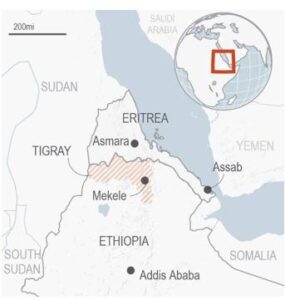
  • Tigray Crisis in Ethiopia

    The director-general of the World Health Organization (WHO), described the Tigray crisis region as the “worst humanitarian disaster on earth”.

    What is the news?

    • Ethiopia has been on the brink of a civil war.
    • On Nov 4 2020, Prime Minister Abiy Ahmed declared war on the country’s Tigray region.
    • The Tigray region is ruled by the Tigray People’s Liberation Front (TPLF).
    • The war was declared in response to the TPLF’s attack on a federal military base in Tigray.

    Tigray Crisis: A backgrounder

    • The animosity between Tigrayans and Eritrea goes back to the Ethiopian-Eritrean war that occurred between 1998 and 2000.
    • It occurred approximately two decades ago was extremely brutal and resulted in the deaths of thousands of soldiers.
    • The roots of this crisis can be traced to Ethiopia’s system of government. Since 1994, Ethiopia has had a federal system in which different ethnic groups control the affairs of 10 regions.
    • The Tigray People’s Liberation Front (TPLF) – was influential in setting up this system.
    • It was the leader of a four-party coalition that governed Ethiopia from 1991, when a military regime was ousted from power.
    • Under the coalition, Ethiopia became more prosperous and stable, but concerns were routinely raised about human rights and the level of democracy.

    How did it escalate into a crisis?

    • Eventually, discontent morphed into protest, leading to a government reshuffle that saw Mr Abiy appointed PM.
    • Abiy liberalized politics, set up a new party (the Prosperity Party), and removed key Tigrayan government leaders accused of corruption and repression.
    • Meanwhile, Abiy ended a long-standing territorial dispute with neighbouring Eritrea, earning him a Nobel Peace Prize in 2019.
    • These moves won Abiy popular acclaim, but caused unease among critics in Tigray.
    • Tigray’s leaders see Abiy’s reforms as an attempt to centralize power and destroy Ethiopia’s federal system.

    How bad is the humanitarian situation?

    • Tigray and its neighbouring regions are facing starvation.
    • There is an absence of medical facilities, no access to their own money due to shut-down banking services, ethnic and physical violence, and raids at the hands of warring forces.
    • The government declared a ceasefire on humanitarian grounds but in an effort to break the TPLF in June last year, imposed a blockade on Tigray.
    • This made it impossible to deliver humanitarian, economic, and medical assistance to Tigrayans.

    Also read:

    [Burning Issue] Ethiopian Crisis and the Geopolitics

    UPSC 2023 countdown has begun! Get your personal guidance plan now! (Click here)

  • What’s at stake in talks for a UK-India Free Trade Agreement (FTA)?

    India and the UK recently revived talks for a Free Trade Agreement (FTA) to encourage trade and investment. The FTA between India and UK is expected to be signed by October.

    What is a Free Trade Agreement (FTA)?

    • It is an agreement between two or more countries to minimize barriers to imports and exports of products and services among them.
    • It includes reducing tariffs, quotas, subsidies or prohibitions which could limit exchange of goods and services across borders.
    • The FTA might allow free trade among the two nations with a few exceptions.
    • This involves a formal and mutual agreement signed between two or more countries.
    • The agreement could be comprehensive and include goods, services, investment, intellectual property, competition, government procurement and other areas.

    What is the status of the India-UK FTA?

    • India and the United Kingdom have a multi-dimensional strategic partnership and are actively engaged in bilateral trade.
    • The two countries agreed to begin formal negotiations for an FTA in January 2022, aiming to advance trade and investment relations between them.
    • The fifth round of FTA talks concluded on 29 July, and the expectation is that negotiations would be completed and the stage set for the FTA by October.
    • The FTA is important for both countries as it would provide a boost and create a robust framework of overall trade and investment between the two countries.

    Which are the countries with which India has FTAs?

    • As of April 2022, India had 13 FTAs, including the South Asian Free Trade Area, and with Nepal, Bhutan, Thailand, Singapore, Japan and Malaysia.
    • The 13 also include the agreements with Mauritius, UAE and Australia signed during the last five years.
    • Additionally, India has also signed six limited Preferential Trade Agreements.

    What is the level of India-UK trade?

    • Bilateral trade stands at $50 billion (ie approx. $35 billion in services and $15 billion in merchandise).
    • India is UK’s 12th largest trading partner and accounts for 1.9% of UK’s total trade in four quarters to the end of 2022.
    • UK is the seventh largest export destination for India.
    • The trade balance maintained by India with UK has largely been a surplus.
    • Top three services exported from India to UK are technical, trade-related and other business services, professional and management consulting services and travel.

    How will an FTA with UK benefit India?

    • Apart from reducing tariffs, the FTA also looks at lowering non-tariff barriers, particularly technical  barriers to trade around rules of origin, investor  protection and IPR.
    • MoUs on joint recognition of certain educational qualifications and an outline pact on healthcare workforce have already been signed.
    • Also, both UK and India have set up panels for a totalization deal being advocated by India and permitting Indian legal services for the UK.

    Back2Basics: Types of Trade Agreements

    (1) Free Trade Agreement – discussed above

    (2) Preferential Trade Agreement

    • In this type of agreement, two or more partners give preferential right of entry to certain products.
    • This is done by reducing duties on an agreed number of tariff lines.
    • Here a positive list is maintained i.e. the list of the products on which the two partners have agreed to provide preferential access.
    • Tariff may even be reduced to zero for some products even in a PTA.
    • India signed a PTA with Afghanistan.

    (3) Comprehensive Economic Partnership Agreement

    • Partnership agreement or cooperation agreement are more comprehensive than an FTA.
    • CECA/CEPA also looks into the regulatory aspect of trade and encompasses and agreement covering the regulatory issues.
    • CECA has the widest coverage. CEPA covers negotiation on the trade in services and investment, and other areas of economic partnership.
    • It may even consider negotiation on areas such as trade facilitation and customs cooperation, competition, and IPR.
    • India has signed CEPAs with South Korea and Japan.

    (4) Comprehensive Economic Cooperation Agreement

    • CECA generally cover negotiation on trade tariff and Tariff rate quotas (TRQs) rates only.
    • It is not as comprehensive as CEPA.
    • India has signed CECA with Malaysia.

    (5) Framework Agreement

    • Framework agreement primarily defines the scope and provisions of orientation of the potential agreement between the trading partners.
    • It provides for some new area of discussions and set the period for future liberalisation.
    • India has previously signed framework agreements with the ASEAN, Japan etc.

    (6) Early Harvest Scheme

    • An Early Harvest Scheme (EHS) is a precursor to an FTA/CECA/CEPA between two trading partners. For example, early harvest scheme of RCEP has been rolled out.
    • At this stage, the negotiating countries identify certain products for tariff liberalization pending the conclusion of actual FTA negotiations.
    • An Early Harvest Scheme is thus a step towards enhanced engagement and confidence building.


    Also read

    [Sansad TV] Perspective: Free Trade Agreement


    UPSC 2023 countdown has begun! Get your personal guidance plan now! (Click here)

  • Indian team deliberating on Ocean Diversity Pact

    A delegation from India and other member countries of the UN are in New York to deliberate on a one-of-its-kind agreement to conserve marine biodiversity in the high seas, namely the oceans that extend beyond countries’ territorial waters.

    What is the news?

    • The agreement follows a resolution by the UN General Assembly.
    • The pact is expected to be the final in a series set in motion since 2018 to draft an international legally binding instrument under the 1982 United Nations Convention on the Law of the Sea (UNCLOS).

    Why need Ocean Diversity Pact?

    (1) Deciding on rights of explorers

    • A key aspect of the agreement is deciding on the rights of companies that undertake exploration for biological resources in the high seas.
    • It is under discussion if companies have absolute rights on any discovery or extraction in these regions or should they share their gains, in terms of intellectual property and royalties with an UN-prescribed body.

    (2) Regulation for exotic items

    • The focus of mining activity in the sea has been for gas hydrates, precious metals and other fossil fuel
    • However, with advances in biotechnology and genetic engineering, several companies see potential in exotic microbes and other organisms — several of them undiscovered — that abide in the deep ocean and could be used for drugs and vaccines.

    (3) ‘Blue Economy’ policy of India

    • The Union Cabinet approved a ‘Blue Economy’ policy for India, a nearly ₹4,000-crore programme spread over five years.
    • This among other things will develop a manned submersible vessel as well as work on bio-prospecting of deep-sea flora and fauna including microbes.
    • Studies on sustainable utilisation of deep sea bio-resources will be the main focus.

    What is UNCLOS?

    • UNCLOS is sometimes referred to as the Law of the Sea Convention or the Law of the Sea treaty.
    • It came into operation and became effective from 16th November 1982.
    • It defines the rights and responsibilities of nations with respect to their use of the world’s oceans, establishing guidelines for businesses, the environment, and the management of marine natural resources.
    • It has created three new institutions on the international scene :
    1. International Tribunal for the Law of the Sea,
    2. International Seabed Authority
    3. Commission on the Limits of the Continental Shelf

    Note: UNCLOS does not deal with matters of territorial disputes or to resolve issues of sovereignty, as that field is governed by rules of customary international law on the acquisition and loss of territory.

    Major conventions:

    There had been three major conferences of UNCLOS:

    1. UNCLOS I: It resulted in the successful implementation of various conventions regarding Territorial Sea and Contiguous Zones, Continental Shelf, High Seas, Fishing Rights.
    2. UNCLOS II: No agreement was reached over breadth of territorial waters.
    3. UNCLOS III: It introduced a number of provisions. The most significant issues covered were setting limits, navigation, archipelagic status and transit regimes, exclusive economic zones (EEZs), continental shelf jurisdiction, deep seabed mining, the exploitation regime, protection of the marine environment, scientific research, and settlement of disputes.

    The convention set the limit of various areas, measured from a carefully defined baseline.

    These terminologies are as follows:

    (1) Baseline

    • The convention set the limit of various areas, measured from a carefully defined baseline.
    • Normally, a sea baseline follows the low-water line, but when the coastline is deeply indented, has fringing islands or is highly unstable, straight baselines may be used.

    (2) Internal waters

    • It covers all water and waterways on the landward side of the baseline.
    • The coastal state is free to set laws, regulate use, and use any resource. Foreign vessels have no right of passage within internal waters.
    • A vessel in the high seas assumes jurisdiction under the internal laws of its flag State.

    (3) Territorial waters

    • Out to 12 nautical miles (22 km, 14 miles) from the baseline, the coastal state is free to set laws, regulate use, and use any resource.
    • Vessels were given the Right of Innocent Passage through any territorial waters.
    • “Innocent passage” is defined by the convention as passing through waters in an expeditious and continuous manner, which is not “prejudicial to the peace, good order or the security” of the coastal state.
    • Fishing, polluting, weapons practice, and spying are not “innocent”, and submarines and other underwater vehicles are required to navigate on the surface and to show their flag.
    • Nations can also temporarily suspend innocent passage in specific areas of their territorial seas, if doing so is essential for the protection of their security.

    (4) Archipelagic waters

    • The convention set the definition of “Archipelagic States”, which also defines how the state can draw its territorial borders.
    • All waters inside this baseline are designated “Archipelagic Waters”.
    • The state has sovereignty over these waters mostly to the extent it has over internal waters, but subject to existing rights including traditional fishing rights of immediately adjacent states.
    • Foreign vessels have right of innocent passage through archipelagic waters, but archipelagic states may limit innocent passage to designated sea lanes.

    (5) Contiguous zone

    • Beyond the 12-nautical-mile (22 km) limit, there is a further 12 nautical miles (22 km) from the territorial sea baseline limit, the contiguous zone.
    • Here a state can continue to enforce laws in four specific areas (customs, taxation, immigration, and pollution) if the infringement started or is about to occur within the state’s territory or territorial waters.
    • This makes the contiguous zone a hot pursuit area.

    (6) Exclusive economic zones (EEZs)

    • These extend 200 nm from the baseline.
    • Within this area, the coastal nation has sole exploitation rights over all natural resources.
    • In casual use, the term may include the territorial sea and even the continental shelf.

    (7) Continental shelf

    • The continental shelf is defined as the natural prolongation of the land territory to the continental margin’s outer edge, or 200 nautical miles (370 km) from the coastal state’s baseline, whichever is greater.

    India and UNCLOS

    • As a State party to the UNCLOS, India promoted utmost respect for the UNCLOS, which established the international legal order of the seas and oceans.
    • India also supported freedom of navigation and overflight, and unimpeded commerce based on the principles of international law, reflected notably in the UNCLOS 1982.
    • India is committed to safeguarding maritime interests and strengthening security in the Indian Ocean Region (IOR) to ensure a favorable and positive maritime environment.


    UPSC 2023 countdown has begun! Get your personal guidance plan now! (Click here)

  • Lessons for India from the Taiwan standoff

    Context

    The brief visit by the United States House Speaker, Nancy Pelosi, to Taiwan, against stern warnings issued by China, has the potential to increase the already deteriorating relationship between the U.S. and China. For those of us in India watching the events as they unfold around Taiwan, there are valuable lessons to be learnt.

    Background

    • The crisis that began with the visit of Ms. Pelosi to Taipei is still unfolding and there is little clarity today on how it will wind down.
    •  For China, its claims about a rising superpower might ring hollow if it is unable to unify its claimed territories, in particular Taiwan.
    • For the U.S., it is about re-establishing steadily-diminishing American credibility in the eyes of its friends and foes.
    • For Taiwan, it is about standing up to Chinese bullying and making its red lines clear to Beijing.
    • Lessons for India: To be fair, there is growing recognition in New Delhi that it is important to meet the challenge posed by a belligerent China, but there appears to be a lack of clarity on how to meet this challenge.
    • To that extent, the Taiwan crisis offers New Delhi three lessons, at the very least.

    Takeaways for India

    1] Articulate red lines

    • The most important lesson from the Taiwan standoff for policymakers in New Delhi is the importance of articulating red lines and sovereign positions in an unambiguous manner.
    •  New Delhi needs to unambiguously highlight the threat from China and the sources of such a threat.
    • Any absence of such clarity will be cleverly utilised by Beijing to push Indian limits, as we have already seen.
    • Stop confusing international community: Even worse, ambiguous messaging by India also confuses its friends in the international community.
    • If India does not clearly articulate that China is in illegal occupation of its territory, how can it expect its friends in the international community to support India diplomatically or otherwise?
    • In other words, India’s current policy amounts to poor messaging, and confusing to its own people as well as the larger international community, and is therefore counterproductive.

    2] Avoid appeasement

    • Taiwan could have avoided the ongoing confrontation and the economic blockade during Chinese retaliatory military exercises around its territory by avoiding Ms. Pelosi’s visit to Taipei, or perhaps even keeping it low key.
    • Appeasement of China, Taiwan knows, is not the answer to Beijing’s aggression.
    •  India’s policy of meeting/hosting Chinese leaders while the Chinese People’s Liberation Army (PLA) continue(d) to violate established territorial norms on the LAC is a deeply flawed one.
    • Unilaterally catering to Chinese sensitivities even during the standoffs between the two militaries is a mistake.
    • For instance, the parliamentary delegation visits and legislature-level dialogues between India and Taiwan have not taken place since 2017.
    • Soft-peddling of the Quad was a mistake: During the 2000s, India (as well as Australia) decided to soft-peddle the Quad in the face of strong Chinese objections.
    • It is only in the last two years or so that we have witnessed renewed enthusiasm around the Quad.
    • In retrospect, appeasing Beijing by almost abandoning the Quad was bad strategy.

    3] Economic relationship is a two way process

    • Given that the economic relationship is a two-way process and that, as a matter of fact, the trade deficit is in China’s favour, China too has a lot to lose from a damaged trade relationship with India.
    • More so, if the Taiwan example (as well as the India-China standoff in 2020) is anything to go by, trade can continue to take place despite tensions and without India making any compromises vis-à-vis its sovereign claims.
    • India for sure should do business with China, but not on China’s own terms.

    Conclusion

    The recent crisis offers valuable lessons for India in its dealing with China.

    UPSC 2023 countdown has begun! Get your personal guidance plan now! (Click here)

  • A new global vision for G20

    Context

    While India has taken a clear view of the role of the G20, there is concern that the agenda, themes and focus areas which India will set for 2023 lack vision.

    What is G-20?

    • Formed in 1999, the G20 is an international forum of the governments and central bank governors from 20 major economies.
    • Collectively, the G20 economies account for around 85 percent of the Gross World Product (GWP), 80 percent of world trade.
    • To tackle the problems or address issues that plague the world, the heads of governments of the G20 nations periodically participate in summits.
    • In addition to it, the group also hosts separate meetings of the finance ministers and foreign ministers.
    • The G20 has no permanent staff of its own and its chairmanship rotates annually between nations divided into regional groupings.

    Significance of G20 in shaping global order

    • The G20 plays an important role in shaping and strengthening global architecture and governance on all major international economic issues.
    • It recognises that global prosperity is interdependent and economic opportunities and challenges are interlinked.
    • The challenge is to craft new approaches to overcome the acute global discord.

    Why we need new model of cooperation

    • Multilateral commitments are faltering: Governance in a world that is steadily becoming more equal needs institutional innovation.
    • This is because the role of the United Nations and the World Trade Organization in securing cooperation between donor and recipient country groups is losing centrality.
    •  There are now three socio-economic systems — the G7, China-Russia, and India and the others — and they will jointly set the global agenda.
    • Strategic competition: Ukraine conflict, rival finance, the expanding influence of the trade and value chains dominated by the U.S. and China, and the reluctance of developing countries to take sides in the strategic competition as they have a real choice requires fresh thinking.
    • Preventing the clash of ideas through reorientation: The primary role of the G20, which accounts for 95% of the world’s patents, 85% of global GDP, 75% of international trade and 65% of the world population, needs to be reoriented to prevent a clash of ideas to the detriment of the global good.
    • The solution lies in a new conceptual model seeking agreement on an agenda limited to principles rather than long negotiated anodyne text.

    What should be on agenda when India hosts G20 in 2023

    1] Underlining the need for new framework

    • Redefining common concerns: First, the presumed equality that we are all in the same boat, recognised in the case of climate change, needs to be expanded to other areas with a global impact redefining ‘common concerns’.
    • Second, emerging economies are no longer to be considered the source of problems needing external solutions but source of solutions to shared problems.
    • Third, the BRICS provides an appropriate model for governance institutions suitable for the 21st century where a narrow group of states dominated by one power will not shape the agenda.
    • Ensuring adequate food, housing, education, health, water and sanitation and work for all should guide international cooperation.
    • Principles of common but differentiated responsibilities for improving the quality of life of all households can guide deliberations in other fora on problems that seem intractable in multilateralism based on trade and aid.

    2] Collaboration around science and technology

    •  The global agenda has been tilted towards investment, whereas science and technology are the driving force for economic diversification, sustainably urbanising the world, and ushering the hydrogen economy and new crop varieties as the answer to both human well-being and global climate change.
    •  A forum to exchange experiences on societal benefits and growth as complementary goals would lead to fresh thinking on employment and environment.

    3] Redefining digital access as universal service

    • Harnessing the potential of the digital-information-technology revolution requires redefining digital access as a “universal service” that goes beyond physical connectivity to sharing specific opportunities available.
    • For global society to reap the fruits of the new set of network technologies, open access software should be offered for more cost-effective service delivery options, good governance and sustainable development.

    4] Collaboration in space technology

    • Space is the next frontier for finding solutions to problems of natural resource management ranging from climate change-related natural disasters, supporting agricultural innovation to urban and infrastructure planning.
    • Analysing Earth observation data will require regional and international collaboration through existing centres which have massive computing capacities, machine learning and artificial intelligence.

    5] Collaboration in health sector

    • Public health has to learn from the COVID-19 fiasco with infectious diseases representing a market failure.
    • A major global challenge is the rapidly growing antimicrobial resistance which needs new antibiotics and collaboration between existing biotechnology facilities.

    6]  Avoiding strategic competition

    • Overriding priority to development suggests avoiding strategic competition.
    • Countries in the region will support building on the 1971 UNGA Declaration designating for all time the Indian Ocean as a zone of peace and non-extension into the region of rivalries and conflicts that are foreign to it.

    7] Reviving Global Financial Transaction Tax

    •  A Global Financial Transaction Tax, considered by the G20 in 2011, needs to be revived to be paid to a Green Technology Fund for Least Developed Countries.

    Conclusion

    Given the significance of G20 for the global order it should lead the way in formulating the new framework based on collaboration in areas such as science and technology, innovation and away from aid and trade.

    UPSC 2023 countdown has begun! Get your personal guidance plan now! (Click here)

  • India’s response to Sri Lanka and Myanmar crises is a study in contrast

    Context

    There is a stark contrast contrast between the Indian response to the crisis in Sri Lanka and the dawning civil war in Myanmar.

    Crisis in Myanmar

    • According to UN human rights monitors, over 2,000 people have been killed, around 14,000 are in prison, including 90 lawmakers, over 7,00,000 are refugees and half a million internally displaced.
    • Humanitarian aid to coup opponents is blocked.
    • The economy is in free fall.
    • Though the international community has not accepted the junta or its nominees as official representatives of Myanmar, it has not recognised the unity government as the legitimate successor of the pre-coup elected administration either.
    • Its armed wing, the recently-formed People’s Defence Force (PDF), exists in a shadowy limbo.
    • If it is too weak to impose significant costs on the junta, one root cause is the lack of support from neighbours.
    • As against Europe’s military support for Ukraine’s defence, no Asian country has stepped up to support the unity government and PDF.
    • Role of ASEAN:  It is ASEAN which shouldered the responsibility to mediate in Myanmar, whereas India took the initiative with Sri Lanka.
    • But ASEAN has been largely unsuccessful.
    • The five-point consensus that the junta agreed on with the regional grouping included an immediate end to violence and resumption of negotiations between the ousted administration and the Tatmadaw.
    • ASEAN’s reaction has been weak at best.
    • The US, EU, Australia and Canada announced targeted sanctions on the junta, and the EU imposed an embargo on arms sales to the country. ASEAN did not.

    India’s response and issues with it

    • The contrast between the Indian response to the crisis in Sri Lanka and the dawning civil war in Myanmar could not be starker.
    • There is no support from the India administration for Mizoram’s aid effort, and apparently there is no Indian policy vis a vis the coup either.
    • Cooperation against cross-border insurgency: Given our land and sea borders with Myanmar, and the troubled history of cross-border insurgencies between our two countries, the India’s inertia is alarming, though not entirely surprising.
    • Successive Indian administrations maintained relations with the junta in the hope that they would cooperate against cross-border Indian armed groups.
    • But these insurgencies have reduced.
    • In fact, over the 10 years of Myanmar’s partial democracy, from 2011 to 2021, cross-border support for Indian insurgents dipped sharply.
    • Direct security interest: In other words, we have a direct security interest in the restoration of our neighbour’s democracy.

    Way forward

    • Stringent sanctions: Sanctions that will starve the junta are a first step that Myanmar’s neighbours are yet to try.
    • While ASEAN has the initiative, all Myanmar’s neighbours need to unite on sanctions, especially nations such as Japan, Australia and India that are members of the Quad along with the US.
    • Myanmar ought to have topped the recent Quad summit’s agenda and it is shameful that it did not.
    • It is still not too late to call a virtual emergency meeting of Quad heads of state, along with ASEAN heads of state, to agree to stringent sanctions.

    Conclusion

    Our neighbourhood is more unstable today than it has been for decades. Four of our bordering countries are in free fall, while China’s grip comes closer to our shores by the hour. Can India afford to fiddle while wildfires ignite around us?

    UPSC 2022 countdown has begun! Get your personal guidance plan now! (Click here)