Mains Ready By December. Smash Mains & Smash PYQ Admissions Open

GS Paper: GS2-18.Bilateral, regional and global groupings and agreements involving India and/or affecting India’s interests.

  • India-South Korea Relations

    Context

    • During the past five years, India and South Korea have experienced considerable divergence in their respective national objectives.

    Background
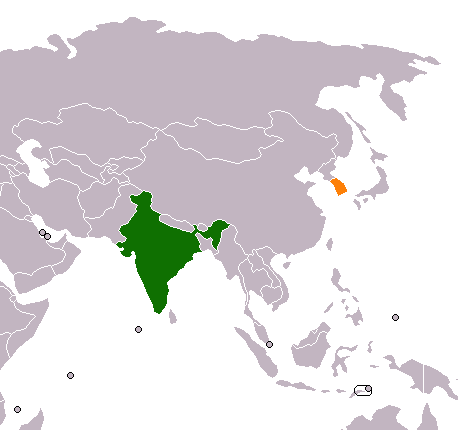
    India–South Korea relations - Wikipedia

    • Bilateral relations between India and South Korea, officially known as the Republic of Korea, were established in 1962 and upgraded to Ambassador-level in 1973.
    • South Korea’s open market policies found resonance with India’s economic liberalization, and its ‘look east policy’ and ‘act east policy’.
    • The relations has become truly multidimensional, spurred by a significant convergence of interests, mutual goodwill and high level exchanges.
    • During PM Modi’s visit to ROK in May 2015, the sides elevated the ties to ‘Special Strategic Partnership’.
    • President Moon’s India visit marked the 45th anniversary of bilateral diplomatic ties.

    Why India is important for South-Korea?

    • One of the points that the Koreans have been making to India is that they see India as a country that is now strategically important to them
    • South Korea also finds in India a very acceptable partner.
    • India doesn’t have edges which can create problems for them. They are aware of one factor which they have grown up with, which is the Pakistan factor.
    • With new issues cropping up in ties with China and America, export-driven South Korea must find new markets.
    • South Korea’s economic growth has slowed, presenting it with important challenges.
    • South Korea is targeting economies with the greatest growth potential like India.
    • South Korea is too heavily dependent on China’s market. So diversification is essential for South Korea..
    • Need cooperation for development in third countries, like capacity building programmes in Africa

    India – South Korea Relations

    • Political:
      • In May 2015, the bilateral relationship was upgraded to ‘special strategic partnership’.
      • India has a major role to play in South Korea’s Southern Policy under which Korea is looking at expanding relations beyond its immediate region.
      • Similarly, South Korea is a major player in India’s Act East Policy under which India aims to promote economic cooperation, cultural ties and develop strategic relationships with countries in the Asia-Pacific.
    • Regional Stability:
      • The regional tensions in South Asia especially between India and China create a common interest for India and South Korea.
      • This could be a collaborative approach for regional stability.
    • Nuclear: 
      • South Korea’s key interest in managing their nuclear neighbour (North Korea) is similar to India’s considerations toward Pakistan.
      • The US alliance system, established with South Korea and Japan, puts pressure on North Korea to cap its nuclear programme.
      • Containing North Korea is beneficial to India’s economic and regional ambit in East Asia.
      • It also adds to its approach to the nuclear non-proliferation regime as a responsible nuclear state.
    • Economic:
      • The current bilateral trade between India and South Korea is at USD 21 billion and the target that has been set is USD 50 billion by the year 2030.
      • India and South Korea have signed the Comprehensive Economic Partnership Agreement (CEPA), 2010 which has facilitated the growth of trade relations.
      • To facilitate investment from Korea, India has launched a “Korea Plus”facilitation cell under ‘Invest India’ to guide, assist and handhold investors.
    • Diplomatic:
      • There is a long-lasting regional security dilemma with the continued verbal provocations and a conventional arms race.
      • Thus, despite the alliance system, Seoul appears to be searching for a stronger diplomatic stand on imminent regional issues beyond the alliance system.
      • South Korea’s approach to India comes with strategic optimism for expanding ties to ensure a convergence of interest in planning global and regional strategic frameworks.
    • Cultural:
      • Korean Buddhist Monk Hyecho or Hong Jiao visited India from 723 to 729 AD and wrote the travelogue “Pilgrimage to the five kingdoms of India” which gives a vivid account of Indian culture, politics & society.
      • Nobel Laureate Rabindranath Tagore had composed a short but evocative poem – ‘Lamp of the East’ – in 1929 about Korea’s glorious past and its promising bright future.

    Challenges

    • Stagnation in Economic relationship:
      • The economic partnership is struck at $22 billion annually.
      • Also, the defence partnership appears to have receded from great all-round promise to the mere sale and purchase of weapon systems.
      • Trade between the two countries was sluggish and there was no major inflow of South Korean investment into India.
      • No upgrade in CEPA: India and South Korea were also trying to upgrade their Comprehensive Economic Partnership Agreement (CEPA) agreement, but to no avail.
    • Cultural Prejudices on both sides preventing people-to-people ties
      • Cold War Era perception: There may be a widespread perception among South Koreans of India as a third world country, rife with poverty and hunger.?
      • Indian Diaspora: Within South Korea, the integration of Indians in the local population is far from complete, with some instances of racial prejudice or discrimination toward Indians
      • Inadequate acknowledgment of Korean Culture: To a certain extent Indians are unable to distinguish between the cultural and social characteristics of South Koreans from that of Japanese/Chinese.
    • Unfulfilled potential of Cultural Centres
      • Indian Culture Centre (ICC) was established in Seoul 10 years ago?to promote people-to-people contacts.
      • However, ICC has to reach an exponentially wider audience and its focus has to expand beyond the urban, English-speaking elite of Seoul.
      • The same may be applicable to South Korean culture centres in India.
    •  Divergence in objectives
    • During the past five years, India and South Korea have experienced considerable divergence in their respective national objectives.
    • There was a clear drift by South Korea away from multilateral security initiatives led by the United States, such as the Quad (the U.S., Australia, India and Japan); meanwhile, India has been actively participating in them.

    Change in Korean foreign and security policies and opportunities for India

    • The newly elected Korean President, Yoon Suk Yeol, has brought about a paradigm shift in South Korean foreign and security policies.
    • He has proposed that South Korea should step up to become a “global pivotal state, anchored in liberal values and a rules-based order”.
    • Opportunities for India: South Korea’s new willingness to become a global pivotal state and play an active role in regional affairs is bound to create multiple opportunities for a multi-dimensional India- Korea partnership.
    • South Korea’s strategic policy shift to correct its heavy tilt towards China is bound to bring new economic opportunities for both countries.
    • The trade target of $50 billion by 2030, which looked all but impossible a few months ago, now seems within reach.
    • Convergence of capabilities: The emerging strategic alignment is creating a new convergence of capabilities and closer synergy in new areas of economic cooperation such as public health, green growth, digital connectivity, and trade, among others.
    • With the strategic shift in South Korea’s defence orientation, new doors of cooperation for defence and security have emerged.
    • Defence cooperation: Advanced defence technologies and modern combat systems are the new domains for the next level of defence cooperation between the two countries.
    • A Roadmap for Defence Industries Cooperation between the Republic of India and the Republic of Korea (ROK) was signed in 2020.
    • Maritime security: South Korea’s participation in additional maritime security activities in the Indian Ocean, such as the annual Malabar and other exercises with Quad countries, will further strengthen India’s naval footprint in the Indo-Pacific region.
    • Defence policy coordination: The shift in South Korean policies will enable a strong India, South Korea and Japan defence policy coordination that could effectively forge new joint regional security policies.

    Challenges

    • Chinese pressure: The Chinese leadership is adversely impacted by policy changes brought in by the Yoon administration.
    • The real challenge for global geopolitics is this: can South Korea withstand the inevitable Chinese pressure and stick to its new alignment?
    • Tension with North Korea: South Korea’s peace process with North Korea has completely collapsed.
    • In the coming days, as North Korea conducts more missile and nuclear tests, it may lead to regional tension.
    • Any breakout of hostilities on the Korean Peninsula can derail South Korea’s Indo-Pacific project.

    Way forward

    • Strategic partnership: India has evolved excellent strategic partnerships with Japan, Vietnam and Australia.
    • South Korea could be the fourth pillar in India’s Indo-Pacific strategy along with Japan, Australia, and Vietnam.
    • This can bring about a paradigm shift in India’s position and influence in the region.
    • The time has come for the Indian and South Korean bilateral partnership to be strategically scaled up at the political, diplomatic and security domain levels.
    • With South Korea’s emergence as a leader in critical technologies, cybersecurity and cyber-capacity building, outer space and space situational awareness capabilities, South Korea can contribute immensely to enhance India’s foundational strengths in the Indo-Pacific.
    • India can help South Korea withstand Chinese pressure and North Korean threats.
    • This new partnership can have a long-term positive impact for both countries and the Indo-Pacific region.
    • It is an opportunity that neither country can afford to miss.

    Conclusion

    An independent, strong, and democratic South Korea can be a long-term partner with India, that will add significant value to India’s Indo-Pacific strategy.


  • India’s new West Asia approach is a welcome break with past diffidence

    Context

    The first summit this week of I2U2, which brings together India, Israel, the United Arab Emirates and the United States – is exploratory in nature.

    I2U2 forum

    • Following the Abraham Accords between Israel and the UAE, I2U2 was founded in October 2021 to address marine security, infrastructure, and transportation challenges in the region.
    • It was known as the ‘International Forum for Economic Cooperation’at the time. At that time, UAE had referred to the new grouping as the ‘West Asian Quad’.
    • I2U2 seeks to empower the partners and encourages them to collaborate more closely, resulting in a more stable region.
    • India is seen as a large consumer market as well as a large producer of high-tech and highly sought-after items in the United States.
    • This has led India to enhance its relationship with Israel without jeopardising its ties with the UAE and other Arab states.

    How I2U2 matters to India

    • India can contribute to peace and prosperity in the region: The initiative signifies the US bet that India can contribute significantly to peace and prosperity in the region.
    • West Asian engagement: It also underlines a new political will in Delhi to break the old taboos on India’s West Asian engagement.
    • Consolidation of  India’s Middle East Policy: The I2U2 marks the consolidation of a number of new trends in India’s Middle East policy that acquired greater momentum in the past few years.
    • What stands out sharply in India’s new thinking in the Middle East is that the summit involves three countries that Delhi had traditionally kept a safe political distance from.

    India-Israel relations

    • Although India was one of the first countries to extend recognition to Israel in 1950, Jawaharlal Nehru held back from establishing full diplomatic relations with the Jewish state.
    •  PV Narasimha Rao reversed that policy in 1992 but he did not travel to Israel nor did he receive an Israeli prime minister.
    • Atal Bihari Vajpayee of the BJP, which had a more empathetic view of Israel, hosted Israeli PM Ariel Sharon in 2003.
    • While the relationship steadily expanded, there was ideological reluctance in Delhi to give the partnership a political profile.
    • In the past few years India imparted a political character to the Israel ties.
    • No backlash from the Arab countries: There was little negative reaction to the more open pursuit of India’s ties with Israel.
    • The problem was never with the Middle East but Delhi’s ideological preconceptions that distorted India’s view of the region.
    • Turkey, now a champion of political Islam, had diplomatic ties with Israel since 1949.
    • Egypt normalised ties in 1980.
    • Under the Abrahamic accords promoted by the Trump Administration, the UAE, Bahrain, Sudan and Morocco set up formal ties with Israel in 2020.

    India’s relations with the Arab countries

    • India’s engagement with Israel was matched by effort to deepen India’s ties with the Arab world.
    •  During his first visit to Israel in 2018, Prime Minister Mode also became the first Indian PM to visit Palestine.
    • Even more important has been the transformation of India’s relations with the Gulf Kingdoms, especially the UAE and Saudi Arabia.
    • India’s traditional preference in the Arab world was for engaging the republics.
    • Engagement with monarchies: Delhi remained wary of engagement with the monarchies, telling itself that they were pro-Pakistan.
    •  No Indian PM visited Saudi Arabia between 1982 and 2010 and UAE between 1981 and 2015.
    • After 2015 India developed strong ties with these governments without a reference to Pakistan.
    • Despite Delhi’s ideological posturing, the Middle East had long ceased to be a political priority for India.
    • In contrast with the past, recently the prime minister has travelled four times to the UAE alone, negotiated a free trade agreement with it, and has ambitious plans for the transformation of bilateral relations.
    • The UAE has also backed India’s 2019 constitutional changes in Kashmir and is ready to invest in the union territory.

    Change in India’s approach to the region

    • India-US ties: For political Delhi, the US and Western policies in the region were a main part of the problem.
    • The immediate focus of Nehru’s policy after independence was to actively oppose US moves in the region in the name of promoting an “area of peace”.
    • That policy had no lasting impact as many regional countries sought active economic, political, and security cooperation with the US and the West.
    • The I2U2 then marks a big break from the anti-Western tradition in India’s approach to the region.
    • Negotiating the terms of joint engagement: In the past, standing up to the West in the Middle East was part of India’s approach, India now is prepared to confidently negotiate the terms of a joint engagement.

    Conclusion

    India’s participation in the West Asian Quad brings Delhi in line with other major powers– including Europe, China, and Russia – to try and engage all parties in the region. The I2U2 sets the stage for a new and dynamic phase in India’s relations with the Middle East.

    UPSC 2023 countdown has begun! Get your personal guidance plan now! (Click here)


    Back2Basics: Abraham Accords

    • The Israel–UAE normalization agreement is officially called the Abraham Accords Peace Agreement.
    • It was initially agreed to in a joint statement by the United States, Israel and the United Arab Emirates (UAE) on August 13, 2020.
    • The UAE thus became the third Arab country, after Egypt in 1979 and Jordan in 1994, to agree to formally normalize its relationship with Israel as well as the first Persian Gulf country to do so.
    • Concurrently, Israel agreed to suspend plans for annexing parts of the West Bank.
    • The agreement normalized what had long been informal but robust foreign relations between the two countries.
  • Japan with India, for Indo-Pacific

    Context

    The article recounts the contribution of Japan’s former Prime Minister Shinzo Abe in strengthening India-Japan ties.

    Indo-Japan ties: Background

    • Japan-India ties are 70 years old this year.
    • For the first five post-war decades of the 20th century, bilateral ties were friendly.
    • India was not among the signatories of the 1951 San Francisco Peace Treaty, which brokered post-war relations between the defeated Axis power and the Allies.
    • Instead, Delhi established an independent peace treaty and bilateral relations with Japan.
    • Nehru’s decision to accept Japanese Overseas Development Aid, the first country to do so, also generated a lot of goodwill in the bilateral relationship. Several collaborations took place.
    • But it was only in the 21st century that bilateral ties climbed up to the next level.

    India-Japan ties during Shinzo Abe’s premiership

    • While Prime Ministers Yoshiro Mori had signed the Global Partnership for the 21st Century Agreement in 2000, to Abe goes much of the credit for the transformation of India-Japan ties in the last two decades.
    • This period witnessed the Japanese funding for ambitious projects such as the Mumbai-Delhi Industrial Corridor and the Mumbai-Ahmedabad bullet train.
    • The two countries upgraded the relationship to a Special Strategic and Global Partnership.
    • After a waiver to India from the Nuclear Suppliers Group following the India-US civil nuclear deal, Abe — and his Liberal Democratic Party successors — had begun to consider a similar deal with India, and a round of negotiations was held in that period.
    • The deal was eventually signed in 2016, and became operational a year later.
    •  It was during his tenure that the Japanese Maritime Self Defence Force (constitutionally, the Japanese military exists only for self-defence purposes) began naval exercises with friendly powers — India and Japan held their first naval exercise in December 2013 — and the country appointed its first National Security Advisor.

    Conclusion

    Abe believed that he was both destined and better equipped than many of his peers to play a transformational role in Japan’s politics and foreign affairs. He certainly achieved that with India. His passionate advocacy of closer ties with India will be missed.

    UPSC 2023 countdown has begun! Get your personal guidance plan now! (Click here)

  • India-Japan ties under Shinzo Abe

    Shinzo Abe, the former Prime Minister of Japan, was shot dead.

    Japan under Abe

    • Abe, one of the most consequential leaders of Japan in its post-war history — was the country’s longest serving PM.
    • During his time in office, Abe was a great friend of India, and a relationship that he invested personally in.
    • He also had a special rapport with PM Modi, which came out on multiple occasions.

    Transformation in India-Japan ties

    (1) Personal visits

    • During his first stint in 2006-07, Abe visited India and addressed Parliament.
    • He visited India thrice: in January 2014, December 2015, and September 2017.
    • No other Prime Minister of Japan has made so many visits to India.
    • He was the first Japanese PM to be Chief Guest at the Republic Day parade in 2014.

    (2) Bilateral talks

    • The foundation for “Global Partnership between Japan and India” was laid in 2001, and annual bilateral summits were agreed in 2005, Abe accelerated the pace of ties since 2012.
    • In August 2007, when Abe visited India for the first time as PM, he delivered the now-famous “Confluence of the Two Seas” speech — laying the foundation for his concept of Indo-Pacific.
    • This concept has now become mainstream and one of the main pillars of India-Japan ties.

    (3) Nuclear deal

    • In September 2014, Modi and Abe agreed to upgrade the bilateral relationship to “Special Strategic and Global Partnership”.
    • The relationship grew and encompassed issues from civilian nuclear energy to maritime security, bullet trains to quality infrastructure, Act East policy to Indo-Pacific strategy.
    • When Modi went to Japan in 2014, the Indo-Japan nuclear deal was still uncertain, with Tokyo sensitive about a pact with a non-Nuclear-Proliferation-Treaty member country.
    • Abe convinced the anti-nuclear hawks in Japan to sign the agreement in 2016.

    (4) Defence cooperation

    • While the security agreement was in place since 2008, under Abe the two sides decided to have Foreign and Defence Ministers’ Meeting (2+2).
    • They started negotiations on the Acquisition and Cross-Servicing Agreement — a kind of military logistics support pact.
    • In November 2019, the first 2+2 was held in New Delhi.
    • A pact for transfer of defence equipment and technology was also signed in 2015, an uncommon agreement for post-War Japan.

    (5) Indo-Pacific narrative

    • During Abe’s tenure, India and Japan came closer in the Indo-Pacific architecture.
    • Abe had spelt out his vision of the Confluence of the Two Seas in his 2007 speech when the Quad was formed.
    • It collapsed soon, but in October 2017, as Chinese aggression grew in the Pacific, Indian Ocean, and India’s borders in Doklam, it was Abe’s Japan that really mooted the idea of reviving the Quad.

    (6) Development cooperation

    • During Abe’s visit in 2015, India decided to introduce the Shinkansen System (bullet train).
    • Under Abe’s leadership, India and Japan also formed the Act East Forum and are engaged in projects in the Northeast, closely watched by China.
    • The two countries also planned joint projects in Maldives and Sri Lanka among others to counter Beijing’s influence.

    (7) Stand against China

    • Since 2013, Indian and Chinese soldiers have had four publicly known border-stand-offs — April 2013, September 2014, June-August 2017, and the ongoing one since May 2020.
    • Abe’s Japan has stood with India through each of them.
    • During the Doklam crisis and the current stand-off, Japan has made statements against China for changing the status quo.

    Conclusion: A leader India always missed

    • Abe was a valuable G-7 leader for India, focused on strategic, economic and political deliverables, and not getting distracted by India’s domestic developments — much to New Delhi’s comfort.
    • Having hosted Modi at his ancestral home in Yamanashi, the first such reception extended to a foreign leader, Abe was feted at a roadshow in Ahmedabad.
    • Quite befittingly, the Indian government in January 2021 announced the Padma Vibhushan, the country’s second-highest civilian honour, for Abe.


    UPSC 2023 countdown has begun! Get your personal guidance plan now! (Click here)

  • CAATSA: the US law to sanction transactions with Russia

    A US senator has said the US government must not impose sanctions on India under the Countering America’s Adversaries through Sanctions Act (CAATSA) for its purchase of S-400 missile weapons system from Russia.

    What is the CAATSA?

    • CAATSA is a law that came into effect in the US in 2017, meant to punish countries having deep engagements with Russia, North Korea, and Iran using economic sanctions.
    • It said countries having a “significant transaction” with Russian intelligence and military agents will be subject to at least five kinds of sanctions.
    • Ordinary transactions will not invite sanctions, and the decision of who has sanctions imposed on them comes down to the interpretation of “significant transaction”.
    • This is one of the various waivers or exemptions mentioned, such as the transaction not affecting US strategic interests, not endangering the alliances it is a part of, etc.

    Could it apply to India?

    • India has purchased the S-400 Triumf missile systems, which have advanced capabilities to judge the distance from a target and launch a surface-to-air missile attack.
    • Five such systems were bought by India in 2018 for US$ 5.5 billion and in November last year, their delivery began.
    • They were deployed in Punjab.
    • However, the application of CAATSA is not limited to the S-400, and may include other joint ventures for manufacturing or developing weapons in the future, or any other kinds of major deals with Russia.

    Why did the US enact a law like CAATSA?

    • The US flagged issues of Russia’s alleged interference in the 2016 Presidential elections, and its role in the Syrian war as some of the reasons for punishing engagement with it.
    • EU countries that had even more significant ties with Russia for oil and gas supply before the Ukraine-Russia conflict in 2022, had also criticised CAATSA.

    Countries facing sanctions

    • The US has placed sanctions on China and Turkey for purchase of the S-400.
    • The sanctions included denial of export licences, ban on foreign exchange transactions, blocking of all property and interests in property within the US jurisdiction and a visa ban.

    Likely impacts after India’s purchase

    • The Biden administration has no firm indication on where it leans on India’s case.
    • However, several senators (US parliamentarians) have called upon the Biden administration to consider a special waiver for India.
    • This is on account of India’s importance as a defence partner, and as a strategic partner on US concerns over China and in the Quad.
    • Other US leaders thinks that giving a waiver to India would be the wrong signal for others seeking to go ahead with similar deals.

    Why is the S-400 deal so important to India?

    • Security paradigm: S-400 is very important for India’s national security considerations due to the threats from China, Pakistan and now Afghanistan.
    • Air defence capability: The system will also offset the air defence capability gaps due to the IAF’s dwindling fighter squadron strength.
    • Russian legacy: Integrating the S-400 will be much easier as India has a large number of legacy Russian air defence systems.
    • Strategic autonomy: For both political as well as operational reasons, the deal is at a point of no return.


    UPSC 2023 countdown has begun! Get your personal guidance plan now! (Click here)

  • Ex-NITI Aayog CEO Amitabh Kant is new G-20 Sherpa

    Former NITI Aayog CEO Amitabh Kant has been picked as India’s new Sherpa for the G-20.

    Who is a Sherpa (in IR context)?

    • A Sherpa is the personal representative of a head of state or government who prepares an international summit, particularly the annual G7 and G20 summits.
    • Between the G7 summits, there are multiple Sherpa conferences where possible agreements are laid out.
    • This reduces the amount of time and resources required at the negotiations of the heads of state at the final summit.
    • The name Sherpa—without further context—refers to Sherpa for the G7 summit, but the designation can be extended to different regular conferences where the participation of the head of state is required.
    • The Sherpa is generally quite influential, although they do not have the authority to make a final decision about any given agreement.

    Etymology

    • The name is derived from the Sherpa people, a Nepalese ethnic group, who serve as guides and porters in the Himalayas, a reference to the fact that the sherpa clears the way for a head of state at a major summit.
    • They are Tibetan Buddhists of the Nyingmapa sect, and have drawn much of their religious tradition from the Rongphu monastery, located at 16,000 feet on the north side of Mount Everest.

    About G20

    • Formed in 1999, the G20 is an international forum of the governments and central bank governors from 20 major economies.
    • Collectively, the G20 economies account for around 85 percent of the Gross World Product (GWP), 80 percent of world trade.
    • To tackle the problems or address issues that plague the world, the heads of governments of the G20 nations periodically participate in summits.
    • In addition to it, the group also hosts separate meetings of the finance ministers and foreign ministers.
    • The G20 has no permanent staff of its own and its chairmanship rotates annually between nations divided into regional groupings.

    Aims and objectives

    • The Group was formed with the aim of studying, reviewing, and promoting high-level discussion of policy issues pertaining to the promotion of international financial stability.
    • The forum aims to pre-empt the balance of payments problems and turmoil on financial markets by improved coordination of monetary, fiscal, and financial policies.
    • It seeks to address issues that go beyond the responsibilities of any one organization.

    Members of G20

    The members of the G20 consist of 19 individual countries plus the European Union (EU).

    • The 19 member countries of the forum are Argentina, Australia, Brazil, Canada, China, France, Germany, India, Indonesia, Italy, Japan, Mexico, Russia, Saudi Arabia, South Africa, South Korea, Turkey, United Kingdom and the United States.
    • The European Union is represented by the European Commission and by the European Central Bank.

    Its significance

    • G20 is a major international grouping that brings together 19 of the world’s major economies and the European Union.
    • Its members account for more than 80% of global GDP, 75% of trade and 60% of population.

    India and G20

    • India has been a member of the G20 since its inception in 1999.


    UPSC 2023 countdown has begun! Get your personal guidance plan now! (Click here)

  • Asia seeking to diversify its security partnerships

    Context

    For the first time, the prime ministers of Australia, Japan, and New Zealand as well as the president of South Korea participated in a NATO summit.

    How Ukraine war revived NATO

    • More than a decade ago — in 2010 — when NATO agreed on a strategic doctrine, it was discussing it with its Russian partners.
    • There was no reference to China in the 2010 strategic concept.
    • At that time, the West was trying to deepen ties with Russia and build expansive economic cooperation with China
    • In unveiling a new strategic conception for the alliance in the wake of the war in Ukraine, NATO has declared Russia “the most significant and direct threat to Allies’ security and to peace and stability in the Euro-Atlantic area”.
    • Not ignoring the threat from China: NATO has declared that China’s “stated ambitions and coercive policies challenge our interests, security and values.”
    • The last few months have seen a closing of ranks in NATO that is now determined to cope with the Russian threat.
    • Germany — which has long sought good political and commercial relations with Russia — has agreed to raise its defence spending and do more for European security.
    • Sweden and Finland have ended their historic neutrality and decided to join NATO.
    • The US is doubling down on its military commitments to Europe.
    • The last few decades of peace and prosperity in Europe and Asia had enormously increased the influence of Russia and China in their neighbourhoods.
    • But the imperial ambitions of both — rooted in a profound misreading of their leverage — have produced a massive geopolitical backlash.
    • Consolidation of old alliances: Rather than sharpen the contradiction between the US and its regional allies, Russian and Chinese actions have helped consolidate old alliances and gave birth to new security coalitions.

    Why small  European countries seek alliances and how it applies to Asia as well

    • Small countries seek alliances when their fears of more powerful neighbours become acute.
    • Russia’s invasion has sent countries on Moscow’s western flank looking for NATO cover.
    • Most Central European states don’t want to rely purely on a European response to the Russian challenge.
    • They suspect France and Germany are more likely to accommodate Moscow at their expense than stand up to Russia.
    • For the Central Europeans, it is the US that offers a real balance against Russia.
    • It should not be too difficult for India to understand why some Asian countries are turning to NATO.
    • After all, India’s own turn to the Quad was a direct consequence of Chinese actions on the disputed bilateral frontier.

    How China’s expansionist policies are reshaping Asian security landscape

    • Way back in 2007 — when India conducted a mere joint naval exercise with the US, Japan, Australia and Singapore — Beijing called it a precursor to an “Asian NATO”. 
    • Australia and New Zealand are a bit further away but are deeply tied to the Chinese economy.
    • For those like Japan, who face a direct threat from China, “Ukraine could well be about the future of Asian security”.
    • What has happened in case of Ukraine created fear in Asian, at a moment when China has become so much more powerful than its neighbours.
    • Improving national capability: Creation of more sophisticated national military capabilities has been the first priority of some of Beijing’s neighbours.
    • Resolution of differences: Resolving mutual differences and strengthening security cooperation — for example between Japan and South Korea — has been another.
    • Alliance with US: Boosting bilateral alliances with the US is yet another.
    • Diversification of security partnership: Even as nations in the region reboot ties with the US, Asia is also seeking to diversify its security partnerships.
    • Engagement with Europe: This has led to greater Asian engagement with Europe as well as the creation of new Indo-Pacific regional institutions – including the Quad, and the AUKUS.

    Conclusion

    Thanks to the egregious expansionism of Russia and China, the strategic integration of the Asian and European geopolitical theatres has now begun. Whether they like it or not, all countries in Europe and Asia will have to deal with the consequences.

    UPSC 2023 countdown has begun! Get your personal guidance plan now! (Click here)

  • Ukraine crisis is shaping future world order, India needs balanced outlook to its strategic policy

    Context

    Three back-to-back summits in the past fortnight have helped settle the dust on who stands where on the Russian invasion of Ukraine.

    Background of the summits

    • The BRICS summit took place on June 23-24, followed by the G-7 summit (June 26 and 27), and then the North Atlantic Treaty Organization (NATO) Summit in Madrid (June 29).
    • In order to understand what they portend for the future global world order, it is necessary to study the messages sent out by each of these groupings against the backdrop of the situation in Ukraine.
    • Most importantly, how can India, that has hitherto managed a careful balancing act between all the groupings, build a movement out of this moment of deep polarisation in the world?

    Why outcomes of BRICS Summit throws some challenges for the West

    • The fact that India agreed to join the summit showed India’s commitment to BRICS as an alternate grouping of economies spotlighted India’s refusal to shun Russia, and agreement to set aside the two-year stand-off with China in favour of multilateral meetings such as BRICS and the Shanghai Cooperation Organisation (SCO).
    • The BRICS Beijing Declaration was a consensus document, as each member cited differing “National Positions” on the Ukraine issue.
    • Economic initiatives: BRICS’s New Development Bank (NDB), has approved about 17 loans totalling $5 billion for Russian energy and infrastructure projects, the “Contingent Reserve Arrangement” (CRA).
    • A BRICS Payments Task Force (BPTF) for coordination between their central banks for an alternative to the SWIFT payments system, was proposed.
    • Mr. Putin also proposed building a global reserve currency based on a “basket of currencies” and trading in local currencies.
    • Challenges to western sanctions: The BRICS economic initiatives contain several challenges to the western-led sanctions regime against Russia
    • Russia also committed to providing more oil and coal supplies to BRICS countries, which will no doubt raise red flags in the West.
    • The possible admission of countries such as Argentina and Iran that have applied to the BRICS mechanism will also sound alarm in the West.

    G7 Summit and India’s flexibility

    • A day after BRICS, Mr. Modi left for the G-7 Summit in Germany, proof of India’s flexibility in dealing with both sides of the conflict.
    • In a number of statements, the G-7 targetted Russia’s war in Ukraine and China’s economic aggression.
    • Its outreach documents — on “Resilient Democracies” and “Clean and Just Transitions towards Climate Neutrality” — the only ones that India and other invitees signed on to, were devoid of any mentions of either.

    Key takeaways from NATO Summit

    • Reference to China: NATO for the first time, made a reference to “systemic competition” from China as a challenge to NATO “interests, security and values”.
    • Presence of US allies: The presence of the U.S.’s trans-Atlantic and trans-Pacific military allies at one conference sent out a clear message against a perceived Russia-China alliance.
    • US’s growing focus: The launch of another Indo-Pacific coalition — of “Partners in the Blue Pacific” (PBP), i.e., the U.S., the U.K., Australia, New Zealand and Japan, in addition to last year’s Australia-U.K.-U.S. (AUKUS), is another signal of the U.S.’s growing focus on countries that it has military alliances with, against its adversaries.
    • No consideration of Russian sensitivities: Apart from the Indo-Pacific partners at the summit, there were leaders of the five countries that have applied to join NATO.
    • The direct message was that NATO would no longer consider Russian sensitivities on the subject of NATO expansion.

    What is the strategy adopted by India?

    • The outcome of all three summits points to a growing polarisation, even battle lines being drawn, between the Western Atlantic-Pacific axis and the Russia-China combine.
    • Neutral stand on Ukraine crisis: India has adopted a singular strategy, albeit a defensive one, that does not condone Russia for its attacks on Ukraine, but one that does not criticise it either.
    • India has joined China as global economies that have most increased their intake of Russian oil, and where India continues to source fertilizer, cement and other commodities from Russia.
    • Strategic tilt towards the U.S. India is working to diversify its defence purchases from Russia, hostilities with China are high, and a strategic tilt towards the U.S. and Quad partners in the Indo-Pacific is growing.
    • Balancing Act: On the multilateral stage, too, India remains a balancing voice in the room: along with Brazil and South Africa, India ensured that the BRICS Beijing declaration did not carry the Russian position on the Ukraine war or any criticism of the West.
    • While making certain with other partners of the global South that the G-7 outreach documents carried no criticism of Russia and China.

    Way forward for India

    • It is time for New Delhi to seize the moment for leadership in a world that is becoming increasingly uncomfortable with the growing polarisation and the disruption due to the Ukraine war.
    • India is not alone.
    • At the United Nations General Assembly, for example, a majority of 141 countries voted to castigate Russia for its invasion of Ukraine, but much fewer, only 93, voted to oust Russia from the Human Rights Council.
    • This represents a large pool of independently-minded countries that do not see it in their own national interest to blandly choose one side over another.
    • India’s national interests would be better served by building a community of those like-minded countries (from South America to Africa, the Gulf to South Asia and to the Association of Southeast Asian Nations), who cannot afford the hostilities, and want to avoid the possibility of a global war at all costs.
    • In 1955, it was in such a similar moment that India took leadership along with countries such as Indonesia and Egypt at the Asian-African Conference of 29 newly independent nations, at Bandung that eventually led to the Non-Aligned Movement (NAM).

    Conclusion

    This is the time to rethink India’s role in reducing the polarisation and bringing the objective and balanced outlook Nehru spoke of, to the forefront of India’s strategic policy.

    UPSC 2023 countdown has begun! Get your personal guidance plan now! (Click here)

  • The perils of multilateralism

    Context

    At a time when the world is trying to grapple with the impact of unprecedented problems which arose in the first two decades of the 21st century, the various intergovernmental organisations and groupings, which are undergoing fundamental changes, may not be fertile places for building peace.

    Contradiction in the BRICS

    • The 14th virtual BRICS summit hosted by China (June 23-24) was a clear attempt by China to hijack the grouping, going by a blueprint it has prepared for the new world order.
    • Not a political grouping: BRICS was not meant to be a political grouping when the acronym, BRIC, was coined by Goldman Sachs economist Jim O’Neill in 2001.
    • Economic grouping: Seeing the possibility of developing a non-western global economic system, China welcomed the idea of BRICS as the nucleus of a new economic grouping and invested energy and resources in building it.
    •  Two permanent members of the Security Council together with three aspirants to permanent membership underscored the contradictions in composition.
    • No support for permanent membership: The fundamental question of support for the three countries to secure permanent membership was fossilised on China’s position that the role of the developing countries should be enhanced, implying that there shall be no expansion of the permanent membership of the Security Council.
    • But the grouping focused on possibilities of cooperation among them by developing institutions such as the New Development Bank, the BRICS Contingent Reserve Arrangement and cooperation in certain sectors.
    • India-China relations: The entire fragile framework of limited cooperation was shattered with the bloodshed at Galwan, when China unilaterally sought to alter the situation on the Line of Actual Control (LAC).
    • China showed no enthusiasm to bring India into the Asia-Pacific Economic Cooperation (APEC) even after India met the criteria of a liberalised economy.
    • Expansion for friends: The way China brought in 13 like-minded countries through the back door for a high-level dialogue on global development smacked of unfair means to expand the group with their friends.

    What was achieved by India at G7 meeting

    • India’s presence at G7 meetings are not rare and Germany invited the India to attend the G7 summit in Bavaria.
    • The G7 made its own statement on the Ukraine war on expected lines and India was only involved in other issues such as environment, energy, climate, food security, health, gender equality and democracy.
    • Since it was a war summit, it did not produce any results on other major issues.
    • Curtailing energy supplies from Russia would hurt Germany, France, Japan and others, but they could not get any exemption.
    • India’s gain has been the opportunity it got to interact with world leaders, though it was tinged with the disappointment that India, as a Quad member, did not condemn Russia’s action in Ukraine.

    Conclusion

    Multilateral negotiations will be increasingly difficult in the present chaotic global situation. It is only by working bilaterally with potential allies that India can attain the status of a pole in the new world with steadfast friends and followers.

    UPSC 2023 countdown has begun! Get your personal guidance plan now! (Click here)

  • Strains on India-Russia Defence Cooperation

    As the war in Ukraine stretches over four months with no end in sight, it has given rise to apprehensions on Russia’s ability to adhere to timely deliveries of spares and hardware to India.

    History of the bilateral defence ties

    • India was reliant, almost solely on the British, and other Western nations for its arms imports immediately after Independence.
    • However, this dependence weaned, and by the 1970s India was importing several weapons systems from then USSR, making it the country’s largest defence importer for decades.

    A major chunk of India’s strategic arms

    • Russia has provided some of the most sensitive and important weapons platforms that India has required from time to time including nuclear submarines, aircraft carriers, tanks, guns, fighter jets, and missiles.
    • According to one estimate, the share of Russian-origin weapons and platforms across Indian armed forces is as high as 85%.
    • Russia is the second-largest arms exporter in the world, following only the United States.
    • For Russia, India is the largest importer, and for India, Russia is the largest exporter when it comes to arms transfer.

    What saw the decline?

    • Between 2000 and 2020, Russia accounted for 66.5% of India’s arms imports.
    • Russia’s share in Indian arms imports was down to about 50% between 2016 and 2020, but it still remained the largest single importer.

    Present status of defence cooperation

    • When the war began, Indian armed forces had stocks of spares and supplies for eight to ten months and the expectation was that the war would end quickly.
    • However, as it stretches on with no clear endgame, there are apprehensions on Russia’s ability to adhere to the timelines for both spares as well as new deliveries.
    • Armed forces are looking at certain alternative mitigation measures and identifying alternate sources from friendly foreign countries.
    • However, in the long term, this is also an opportunity for the private industry to step up production and meet the requirements.

    Impact of the war

    • While some timeline lapses and shipping delays were possible, there would not be any dent on the Army’s operational preparedness along the borders.
    • In addition, the armed forces have also made significant emergency procurements since the standoff in Eastern Ladakh and have stocked up on spares and ammunition.
    • However, Russia has assured India that it would adhere to delivery timelines.
    • Since the war sees no end, Russian industry would be caught up in replenishing the inventories of their own armed forces.

    What is the status of deals underway/new deals pending with Russia?

    • The defence trade between India and Russia has crossed $15 billion since 2018, in the backdrop of some big deals including the $5.43 billion S-400 long range air defence systems.
    • Other major contracts currently under implementation are construction of four additional stealth frigates in Russia and India,
    • There is a licensed production of the Mango Armor-piercing fin-stabilised discarding sabot (APFSDS) rounds for the T-90S tanks as also additional T-90S tanks, AK-203 assault rifles among others.

    Deferred deals in downtime

    • There are several big deals deferred by the Defence Ministry as part of the review of all direct import deals.
    • This is in conjunction with efforts to push the ‘Make in India’ scheme in defence.
    • Russian deals have also been deferred including the one for 21 MiG-29 fighter jets for the Indian Air Force (IAF) along with the upgradation of 59 existing Mig-29 jets.
    • This also includes the deferment of the manufacture of 12 SU-30 MKI aircraft by Hindustan Aeronautics Limited (HAL).

    What is the status of payments?

    • While India continues to remain Russia’s largest arms buyer with a major chunk of legacy hardware from Russia and the Soviet Union, the volume of imports has reduced in the last decade.
    • With Russia being shut out of the global SWIFT system for money transfers, India and Russia have agreed to conduct payments through the Rupee-Rouble arrangement.
    • With several big ticket deals including the S-400 under implementation, there are large volume of payments to be made.


    UPSC 2023 countdown has begun! Get your personal guidance plan now! (Click here)