Mains Ready By December. Smash Mains & Smash PYQ Admissions Open

GS Paper: GS2-18.Bilateral, regional and global groupings and agreements involving India and/or affecting India’s interests.

  • India should believe in the EU

    India and the EU have many things in common. And there are many areas in which both can expand the cooperation. This article explores commonalities and the areas which offer the scope for enhancing the cooperation. 

    Common interests

    • Both aim to enhance strategic autonomy and their global standing.
    • Diversifying strategic value chains is also a common interest.
    • Both seek to address the issue of climate change on an urgent basis.

    Economic ties with the EU

    • The EU is India’s largest trading partner accounting for €80 billion worth of trade in goods in 2019.
    • This is equal to 11.1% of total Indian trade.
    • The EU is also the biggest foreign investor, with €67.7 billion worth of investments made in 2018.
    • Which is equal to 22% of total FDI inflows.

    Scope for improving the economic ties

    • The EU’s investments in China amounted to €175.3 billion (2018).
    • So, India could succeed in attracting EU investment that might be moving out of China.
    • To attract this outflowing investment, India must address the mutual trust deficit.
    • Enhanced business cooperation can help both the EU and India diversify their strategic value chains.
    • Increasing people’s mobility and connectivity is another area that can create opportunities for innovation and growth.

    Talks on FTA

    • Both sides need to move further on the Free Trade Agreement.
    • A new study from the European Parliament estimates the impact of an EU-India trade agreement between €8 billion and €8.5 billion.
    • The study also mentions additional potential gains from enhanced coordination on the provision of global public goods, such as environmental standards.

    Cooperation on climate change

    • Under the new industrial strategy, the Green Deal, the EU has set an ambitious target to be carbon-emission neutral by 2050.
    • If the EU and India succeed in transforming into carbon-neutral economies by 2050, we all would gain from the investment.

    Strategic partnership with EU

    • The Indo-Pacific region is becoming contentious, so India should capitalise on its geopolitical leverage there.
    • Cooperation with like-minded, democratic powers can support this effort, especially towards assertive competitors like China.
    • The EU as a whole offers more to India than the strongest bilateral relations with individual EU member state.
    • New Delhi must learn how to maximise benefits from this strategic partnership.
    • The disruption caused by COVID-19 has been the occasion for the EU to prove its worth.
    • “Next-generation EU proposal” submitted by the European Commission has economic as well as geopolitical implications.
    • The proposal shows that the ties that bind the EU extend well beyond treaties and individual members’ self-interest.
    • The EU champions the rules-based international order, so the EU and India must act to promote sustainable reform of multilateral institutions starting from the WTO.

    Consider the question “India-EU ties with many common interests assume significance as rule-based order is being challenged by the rise of exceptionalism. Comment.”

    Conclusion

    A strong partnership would help both the EU and India become global decision-makers and tackle the challenges caused by the disruption of global order collectively.

  • Afghanistan–Pakistan Transit Trade Agreement (APTTA)

    Pakistan has allowed Afghanistan to send goods to India using the Wagah border. The decision is a part of Islamabad’s commitment under the Afghanistan-Pakistan Transit Trade Agreement (APTTA).

    A statement based question can be asked upon the agreement on terms like:

    1. Reciprocal trade with India

    2. Railways/Road/Air transit whether allowed

    About the agreement

    • The APTTA is a bilateral trade agreement signed in 2010 by Pakistan and Afghanistan.
    • It calls for greater facilitation in the movement of goods amongst the two countries.
    • The 2010 agreement supersedes the 1965 Afghanistan Transit Trade Agreement, which granted Afghanistan the right to import duty-free goods through Pakistani seaports, mostly notably from Karachi.

    Features of the agreement

    • Trade-in goods smuggled into Pakistan once constituted a major source of revenue for Afghanistan.
    • The 2010 APTTA allows for both countries to use each other’s airports, railways, roads, and ports for transit trade along designated transit corridors.
    • The agreement does not cover road transport vehicles from any third country, be it from India or any Central Asia country.
    • However, the signed Agreement permits Afghanistan trucks access to the Wagah border with India, where Afghan goods will be offloaded onto Indian trucks.
    • This agreement does not permit Indian goods to be loaded onto trucks for transit back to Afghanistan.
    • Instead, Afghan trucks offloaded at Wagah may return to Afghanistan loaded only with Pakistani, rather than Indian goods in an attempt to prevent the formation of a black market for Indian goods in Pakistan.
  • Broader strategic challenge of dealing with China

    • Identifying the nature of the threat posed by China is important to formulate a response. This article discusses the plan of action on the diplomatic, strategic and economic front to deal with Chinese aggression.

    Economic angle of China’s expansionism

    • The Chinese growth model needed to find subservient emerging markets.
    • In these markets, China can park huge debts and make investments to keep feeding China’s high growth rates.
    • Friendly foreign debt-investment markets were needed to compensate for over-investment at home.
    • The Belt and Road Initiative was rolled out as a meeting point for China’s geo-strategic and geo-economic interests.
    • China has expanded its global footprint by signing on about 100 countries to the BRI.
    • China has made aggressive moves on most of its non-submissive neighbours in the South China Sea.
    • China has also made moves against its traditional rivals like Japan and Taiwan to independent-minded nations like South Korea and Australia.
    • China sees itself as a global power whose time has come.

    India needs to play clearer role

    • Rise of China is shaking up global alignments and shaping new world order.
    • The Trump administration is increasingly being criticised for not providing global leadership.
    • India could afford to be largely non-aligned during the 20th century Cold War.
    • Our size and economic momentum necessitate that we play a clearer role in the Cold War’s 21st-century sequel.
    • India’s foreign policy has lacked a clear vision about China.
    • India has been deepening our strategic relationship with the US but without wanting to alarm China.

    India’s relation with neighbours

    • India’s relations with other neighbouring nations have also become a cause of concern.
    • Pakistan has practically become a minion state for the Chinese – the $62-billion CPEC is a case in the point.
    • Nepal is no longer on our list of all-weather friends.
    • Chinese influence is growing in Sri Lanka and Bangladesh — both signatories to the BRI.
    • And just last week, Beijing, sent another appallingly stern message to our loyal friend, Bhutan, by making ridiculous territorial claims.

    What should be India’s plan of action

    • Dealing with China will require conviction and exercising a range of military, diplomatic and economic options.
    • One forum we need to build on and provide leadership to is the Quadrilateral Security Dialogue.
    •  India should now propose the expansion of the Quad’s scope with a possible exploration of a collective defence architecture like NATO.
    • The membership of the Quad should be expanded to include Vietnam, South Korea, New Zealand, and Malaysia.
    • On the economic front, India must welcome the US proposal to expand G7 to include India, Russia, Australia and South Korea without China as a member.
    • Next area of focus should be strengthening ties with our neighbourhood.
    • Effort must be made to regain the relationship with Russia.

    Conclusion

    China must be made to choose: Is it willing to push the equally proud, equally numerous, equally historical and glorious civilisation to the south in this long-term direction for a few square kilometres of territory and a round of chest-thumping?

  • International Covenant on Civil and Political Rights (ICCPR)

    United Nations (UN) Special Rapporteurs have made public their third communication forwarded to India expressing concern over alleged excessive use of force, ill-treatment during arrests and detentions.

    Practice question for mains:

    Q.There is an urgent need for reforming the criminal justice system in India in light of rising cases of custodial torture and killings. Comment.

    What is the issue?

    The UN urged the Indian government to conduct a prompt and impartial investigation into the allegations of arbitrary killings, torture and ill-treatment and to prosecute suspected perpetrators under articles 6 and of the International Covenant on Civil and Political Rights (ICCPR), and articles 7 and 12 of the Committee Against Torture (CAT).

    What are the conventions cited by the UN?

    1) International Covenant on Civil and Political Rights (ICCPR)

    • The ICCPR is a multilateral treaty adopted by UN General Assembly Resolution on 16 December 1966, and in force from 23 March 1976.
    • The covenant commits its parties to respect the civil and political rights of individuals, including the right to life, freedom of religion, freedom of speech, freedom of assembly, electoral rights and rights to due process and a fair trial.
    • As of September 2019, the Covenant has 173 parties and six more signatories without ratification.
    • It is part of the International Bill of Human Rights, along with the International Covenant on Economic, Social and Cultural Rights (ICESCR) and the Universal Declaration of Human Rights (UDHR).
    • It is monitored by the UN Human Rights Committee (a separate body to the UN Human Rights Council).

    2) United Nations Convention Against Torture (UNCAT)

    • The UNCAT is an international human rights treaty, under the review of the UN and was adopted in 1984.
    • It aims to prevent torture and other acts of cruel, inhuman, or degrading treatment or punishment around the world.
    • The convention requires states to take effective measures to prevent torture in any territory under their jurisdiction and forbids states to transport people to any country where there is reason to believe they will be tortured.
    • Since the convention’s entry into force, the absolute prohibition against torture and other acts of cruel, inhuman, or degrading treatment or punishment has become accepted as a principle of customary international law.

    3) The Committee against Torture (CAT)

    • It is a body of human rights experts that monitors implementation of the Convention by State parties.
    • The Committee is one of eight UN-linked human rights treaty bodies.
    • All state parties are obliged under the Convention to submit regular reports to the CAT on how rights are being implemented.
    • Upon ratifying the Convention, states must submit a report within one year, after which they are obliged to report every four years.
    • The Committee examines each report and addresses its concerns and recommendations to the State party in the form of “concluding observations.”
    • Under certain circumstances, the CAT may consider complaints or communications from individuals claiming that their rights under the Convention have been violated.
  • UAE in support of Open Skies Agreement with India

    The UAE is keen to have an open sky agreement with India.

    Open Skies Agreement! Look how confusing does it sound compared to the Open Skies Treaty between the US and Russia.

    What is the Open Skies Agreement?

    • The National Civil Aviation Policy, 2016, allows the government to enter into an ‘open sky’ air services agreement on a reciprocal basis with SAARC nations as well as countries beyond a 5,000-kilometre radius from New Delhi.
    • This implies that nations within this distance need to enter into a bilateral agreement and mutually determine the number of flights that their airlines can operate between the two countries.
    • India has open sky agreements with Japan, Greece, Jamaica, Guyana, Czech Republic, Finland, Spain and Sri Lanka.
    • India also has an open sky agreement with the US, among other countries.

    Why UAE wants such an agreement with India?

    • There are about 1,068 flights a week between India and the UAE operated by the airlines of the two countries under the bilateral Air Service Agreement.
    • India has open skies policy with SAARC countries and those beyond the 5,000-km radius.
    • UAE wants India to revisit this policy.

    Must read:

    U.S. set to exit the ‘Open Skies Treaty’ Copy

  • What India should do as a stakeholder in South China Sea

    There is growing pushback from the South China Sea littoral countries against Chinese aggressive behaviour. And as a stakeholder, India should consider the options to assert its rights there.

    Legality of China’s ‘nine-dash line’

    • The Philippines invoked the dispute settlement mechanism of the UN Convention on the Law of the Sea (UNCLOS) in 2013.
    • Philippines contest the legality of China’s ‘nine-dash line’ regarding the disputed Spratlys.
    • In response, the Permanent Court of Arbitration (PCA) at The Hague decreed that the line had “no legal basis.”
    • China dismissed the judgment as “null and void.”
    • China dismissed the award as “a political farce under the pretext of law.”

    Let’s analyse the PCA verdict

    • Verdict held that none of the features of the Spratlys qualified them as islands.
    • There was no legal basis for China to claim historic rights.
    • The UNCLOS provides that islands must sustain habitation and the capacity for non-extractive economic activity.
    • Verdict implied that China violated the Philippines Exclusive Economic Zone (EEZ).

    How ASEAN countries are dealing with China

    • Given the power equations, the Philippines did not press for enforcement of the award and acquiesced in the status quo.
    • Not one country challenged China, which agreed to settle disputes bilaterally, and to continue work on a Code of Conduct with countries of the ASEAN.
    • In reality, there is a growing discontent against China.
    • While avoiding military confrontation with China, they are seeking political insurance, strengthening their navies, and deepening their military relationships with the U.S.
    • The Philippines and the ASEAN’s protest is new for China.
    • This does China little credit, and points to its growing isolation.

    Instances of  pushback from ASEAN countries

    • Indonesia protested to China about Chinese vessels trespassing into its waters close to the Nantua islands.
    • The Philippines protested to China earlier this year about violations of Filipino sovereignty in the West Philippine Sea.
    • It also extended the Visiting Forces Agreement with the U.S. which is a strategic setback for China.
    • The Philippines also wrote to the UN Secretary-General (UNSG) in March disputing China’s claim of “historic rights in the South China Sea.”
    • Indonesia too wrote to the UNSG on this issue.
    • It expressed support for compliance with international law, particularly the UNCLOS, as also for the PCA’s 2016 ruling.

    India as a stakeholder

    • India’s foreign and security policy in its larger neighbourhood covers the entire expanse of the Asia-Pacific and extends to the Persian Gulf and West Asia.
    • India straddles, and is the fulcrum of, the region between the Suez and Shanghai.
    • The South China Sea carries merchandise to and from India.
    • It follows that India has a stake in the SCS, just as China has in the Indian Ocean.

    What should be India’s response

    • India must continue to actively pursue its defence diplomacy outreach in the Indo-Pacific region.
    • As a part of this outreach, India should increase military training and conduct exercises and exchanges at a higher level of complexity.
    • India should extend Humanitarian Assistance and Disaster Relief activities.
    • India should share patrolling of the Malacca Strait with the littoral countries.
    • The Comprehensive Strategic Partnerships could be extended to Malaysia, the Philippines, Thailand, and Singapore.
    • India must also strengthen the military capacity of the tri-service Andaman and Nicobar Command. 

    Consider the question “The South China Sea is important not just to its littoral countries but to the others as well. But China’s growing inclination to change the status quo there harms the interests of other stakeholders. In light of this suggest the relevant options that India could exercise.”

    Conclusion

    As a stakeholder in the South China Sea India must explore all the options at its disposal and try to foster respect for international law and rules-based global order.


    Back2Basics: Nine-dash line


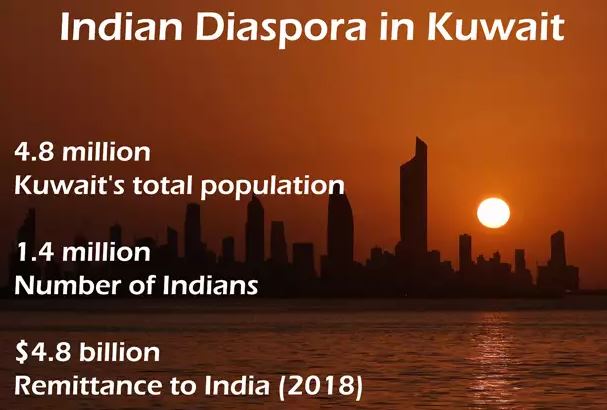
  • Issues over Kuwait Expat Bill

    A total of eight lakh Indians could be forced to leave Kuwait as it’s National Assembly committee has approved a draft expat quota bill seeking to reduce the number of foreign workers in the Gulf country.

    Do you know?

    India is the world’s top recipient of remittances with its diaspora sending a whopping $79 billion back home in 2018 a/c to the World Bank. It is followed by China (USD 67 billion), Mexico (USD 36 billion), the Philippines (USD 34 billion), and Egypt (USD 29 billion).

    What is the Expat Bill about?

    • Amid a slump in oil prices and the coronavirus pandemic, there has been a spike in anti-expat rhetoric as lawmakers and government officials call for reducing the number of foreigners in Kuwait.
    • According to the bill, Indians should not exceed 15% of the population.
    • The draft once turned to the law will impose a cap on the number of expats and gradually reduce them by almost 5% on a yearly basis.

    A demographic issue

    • Kuwait has a real problem in its population structure, in which 70% are expats.
    • The 1.3 million of the 3.35 million expats are either illiterate or can merely read and write.
    • Kuwait has also been working to reduce its dependence on foreign workers.

    A huge diaspora at stake

    • There are about 28,000 Indians working for the Kuwaiti Government in various jobs like nurses, engineers in national oil companies and a few as scientists.
    • The majority of Indians (5.23 lakh) are employed in private sectors. In addition, there are about 1.16 lakh dependents.
    • Out of these, there are about 60,000 Indian students studying in 23 Indian schools in the country.

    Impacts on Indians

    • The current population of Kuwait is 4.3 million, with Kuwaitis making up 1.3 million of the population, and expats accounting for 3 million.
    • This bill would result in 8,00,000 Indians leaving Kuwait, as the Indian community constitutes the largest expat community in the country, totalling 1.45 million.
    • As the MEA says, Indians are present in all segments of society in Kuwait and are largely considered disciplined, hardworking and law-abiding.
    • India has often in the past played up the role of the Indian community in Kuwait as an important factor in bilateral ties.

    Must read:

    India’s rising Forex Reserves

  • De-escalation begins on LAC

    Three weeks after the worst military clashes in decades, India and China have begun the process of disengagement at contentious locations along the Line of Actual Control (LAC).

    Must read:

    [Burning Issue] India-China Skirmish in Ladakh

    China is moving back

    • In the Galwan Valley, Chinese troops have shifted 2 kilometres from the site violent clashes while some tents had been removed by the PLA in the Finger 4 area of Pangong Tso.
    • India’s claim is till Finger 8 as per the alignment of the LAC.
    • Some rearward movement of vehicles was seen at the general area of Galwan, Hotsprings and Gogra.
    • Without giving the specific distances moved, the source said the pullback at each location would be confirmed after verification.

    Lessons learnt

    • The lesson for us in Doklam is that disengagement is not enough in order to declare an end to tensions at the LAC.
    • It is necessary that we define endpoints up to where the troops must withdraw to and no understanding should be reached without the restoration of status quo ante.
    • Endpoint variances reflect the potential for future troubles along the LAC.
  • Indo-Pacific region

    As India tries to diffuse the tension along the disputed northern border with China, it must focus on the other potential fronts that China could open. India Ocean could be the next one. This article examines the centrality of the Indian Ocean for China and their approach to the region.

    India’s Indo-Pacific vision

    • This vision is based on our historical associations with this region.
    • This vision also acknowledges the importance of the Indian Ocean in building prosperity in this century.
    • So, the key points of this vision are thus-
    • 1) Inclusiveness, openness and ASEAN centrality and unity.
    • 2) India does not see the Indo-Pacific Region as a strategy or as a club of limited members.
    • 3) It is not directed against any country.

    China should have equal access

    • China is not a littoral state in the Indian Ocean.
    • Historically, Chinese naval activity was limited to the East China Sea, the Bohai Sea, the Yellow Sea, and the South China Sea.
    •  In today’s context, China is the second-largest economy and the world’s largest trading nation.
    • The sea-lanes of communication in the Indian Ocean are vital to her economy and security.
    • Under international law, China should have equal access to the Indian ocean.

    China’s “Malacca Dilemma”

    • China thinks that others would block the Malacca Straits to “contain” the Chinese.
    • So, China has strategized to dominate not just the Malacca Straits, but the ocean beyond it.
    • The PLA Navy (PLAN) made its first operational deployment in the Gulf of Aden in 2008.
    • In 2009 China planned for overseas base or facility.
    • In 2010 a China State Oceanic Administration report alluded to plans to build aircraft carriers.

    BRI: Overcoming the deficiencies China face in India Ocean

    • The US hegemony and India’s regional influence in the Indian Ocean are thought of as a challenge to China.
    • So, China focused on 3 inherent deficiencies that they wanted to overcome.
    • (a) China is not a littoral state.
    • (b) Its passage through key maritime straits could be easily blocked.
    • (c) The possibility of US-India cooperation against China.
    • How to overcome these deficiencies?
    • (1) carefully selecting sites to build ports — Djibouti, Gwadar, Hambantota, Sittwe and Seychelles.
    • (2) By conducting activities in a low-key manner to “reduce the military colour as much as possible”.
    • (3) By not unnerving India and America by cooperating at first, then slowly penetrating into the Indian Ocean, beginning with detailed maritime surveys, ocean mapping, HADR, port construction and so on.

     China acting on the plans

    • The PLA’s new base in Djibouti is the prototype for more “logistics” facilities to come.
    • More port construction projects like Gwadar and Hambantota, are being offered to vulnerable countries.
    • These projects are commercially unviable but have military possibilities,
    • Chinese “civilian” vessels routinely conduct surveys in the EEZ of littoral states.
    • In January 2020 the PLA Navy conducted tripartite naval exercises with Russia and Iran in the Arabian Sea.
    • They have the largest warship building programme in the world.

    Consider the question “What constitutes India’s Indo-Pacific vision? Elaborate on the factors that explain China’s reluctance to subscribe to this vision.”

    Conclusion

    The idea of Indo-Pacific might potentially derail the carefully crafted Chinese plan. So, they now wish to cause alarm by raising fears about Great Power “strategic collision” caused by the so-called American-led “containment” strategy. It is important to look past their propaganda.

  • Italian Marines case judgement could set a dangerous precedent

    The tribunal’s judgement in the Italian marines case was in Italy’s favour. But the basis used in the judgement could set a wrong precedent. India also ensures a fair trial against the marines in Italy. So, what would be the wrong precedent and why would be trial against marines will continue in Italy? Read to know…

    Background

    • On February 15, 2012 two Italian marines were held for killing two Indian fishermen
    • Fishermen were in India’s Contiguous Zone, 20.5 nautical miles off the Kerala coast.
    • And the marines were part of a security contingent on the Enrica Lexie, an Italian commercial oil tanker.

    What is said in the judgement

    • The tribunal was established by the International Tribunal for the Law of the Sea (ITLOS).
    • ITLOS was under the provisions of the United Nations Convention on the Law of the Sea (UNCLOS).
    • Only the operative portion of the tribunal’s award is available till now.
    • It held that the marines were entitled to immunity in relation to the acts that they committed.
    • The tribunal also said that India is precluded from exercising its jurisdiction over the Marines.
    • However, the tribunal found that by firing on the fishermen Italy was guilty of “violating India’s freedom and right of navigation”.
    • The tribunal majority agreed with the Italian plea that the marines had immunity for they were state officials.

    The judgement could set the wrong precedent

    • India’s stand was that UNCLOS is not concerned with issues relating to immunity.
    • Immunity of state officials has to be governed by specific multilateral or bilateral treaties or agreements.
    • It should not be invoked to settle issues of jurisdiction.
    • Even if Italian marines are considered as state officials, they were serving on a commercial vessel.
    • Italy did so unilaterally without the cover of any multilateral or bilateral arrangement.
    • There is no convention that such persons as the marines in such cases are immune from local criminal jurisdiction.
    • Only heads of states, heads of governments and foreign ministers customarily enjoy immunity abroad apart from accredited diplomats who are covered by the
    • Countries may now enact specific laws to give immunity to their military and para-military personnel and others by declaring them state official.
    •  This can lead to an increase in tensions generally and especially between inimical states.

    What should be the next course of action for India

    • Indian government should ensure that Italy is made to pay fully for the loss of life and the suffering it has caused in this matter.
    • The government should also ensure that it closely monitors the case proceedings in the Italian court against two marines.
    • This is also a time for the executive and judicial branches of the Indian state to introspect on how they handled the whole affair politically, diplomatically and legally.

    Consider the question “The judgement of the International Tribunal for the Law of the Sea in Italian marines case was based on the immunity of state officials. What could be the implication of invoking immunity of state official in this judgement? What should be the next course of action for India?”

    Conclusion

    As a good international citizen, India has accepted the tribunal’s award. Now it must ensure that Italy fully honours it. The matter remains open.