Mains Ready By December. Smash Mains & Smash PYQ Admissions Open

GS Paper: GS2-18.Bilateral, regional and global groupings and agreements involving India and/or affecting India’s interests.

  • [26th November 2025] Hindu OpED Trump-MbS summit- $1 trillion among friends

    PYQ Relevance

    [UPSC 2021] The USA is facing an existential threat in the form of China, that is much more challenging than the erstwhile Soviet Union. Explain.

    Linkage: The Trump-MbS summit reflects the U.S. strategy of rebuilding alliances to counter China’s growing influence in West Asia, where Beijing has expanded economically and diplomatically. The revived U.S.-Saudi partnership strengthens America’s geopolitical position in a region where China had begun to outpace it.

    Mentor’s Comment

    The Trump-Mohammed bin Salman (MbS) summit marks a major inflection in West Asia’s geopolitical landscape. The article examines the renewed U.S.-Saudi alignment, its military-economic scale, its contrast with earlier strains, and its strategic implications for India. This simplified yet UPSC-rich analysis helps aspirants understand the evolving balance of power in West Asia and its global consequences.

    WHY IN THE NEWS 

    The article is significant because the U.S.-Saudi bilateral relationship has revived after years of drift, culminating in Trump’s first West Asia visit where both sides advanced $242 billion defence deals and $270 billion investment commitments, a scale unseen since the 1945 FDR-Saudi pact. The summit signals the return of transactional, high-value U.S.-Saudi cooperation, a sharp contrast to the Biden years of friction, Khashoggi tensions, and Saudi diversification toward China and Russia. This reset represents one of the largest bilateral economic-military consolidations globally, reshaping energy, security, and global power equations.

    INTRODUCTION

    The U.S.-Saudi partnership has historically shaped post-Second World War geopolitics, especially in energy and security. The Trump-MbS summit renews this legacy by combining massive defence sales, investment promises, and realignment on regional issues such as Iran, sanctions, and energy security. The revived partnership represents both strategic opportunity and geopolitical recalibration.

    What drives the renewed U.S.-Saudi strategic alignment?

    1. Historic continuity: Reconnects with the 1945 FDR-Ibn Saud “oil-for-security” pact revived in 2005 and 2025.
    2. Exceptional summit chemistry: Trump and MbS elevated bilateral commitments during Trump’s first regional visit.
    3. High-value agreements: $242 billion military commitments and $270 billion investment forum deals signal unprecedented scale.
    4. Shared interests: Addresses U.S. need for Gulf stability and Saudi need for defence, investment, and autonomy.

    How has the bilateral relationship evolved from past highs and lows?

    1. Historical tensions: 1973 oil embargo, 1980s missile purchases from China, Yemen war tensions, and the Khashoggi killing strained ties.
    2. Biden-era rifts: Public criticism of Saudi human rights issues pushed Riyadh closer to China and Russia.
    3. Saudi diversification: Riyadh’s engagement with Xi Jinping and Middle Eastern summits signal multipolar diplomacy.
    4. Return to U.S. orbit: Trump’s visit and renewed defence-economic convergence restore traditional alignment.

    What are the key outcomes of the Trump-MbS summit?

    1. Massive defence deals: Commitment to supply $242 billion in U.S. military equipment.
    2. Investment surge: MbS aims to raise Saudi investments in the U.S. economy from $600 billion to $1 trillion.
    3. Energy cooperation: Coordination on oil production to maintain a moderate, sustainable price.
    4. AI & tech collaboration: U.S. and Saudi firms advance “future-ready AI projects,” including AI chips.
    5. Regional stabilisation agenda: Coordination on Iran, Yemen ceasefire, and navigation security.

    What are the emerging regional geopolitical implications?

    1. U.S.-Saudi-Russia triangle: Saudi alignment tempers Russian oil revenue by stabilising global oil prices.
    2. Sanctions dynamics: U.S.-Saudi cooperation supports enforcement of sanctions on Iran and Venezuela.
    3. Security architecture: Signals continuity of U.S. commitment to Gulf security despite regional volatility.
    4. NATO+ narrative: U.S. sees Saudi as a “major non-NATO ally,” pushing deeper defence integration.

    What does this recalibration mean for India?

    1. Energy stability: Coordinated U.S.-Saudi oil policy keeps prices moderate, critical for India’s energy security.
    2. Defence + tech prospects: Saudi Vision 2030 and U.S. tech investments open new opportunities for Indian firms.
    3. Strategic partnership: India needs to accelerate the Comprehensive Economic Partnership Agreement (CEPA) with Saudi Arabia.
    4. Geopolitical balancing: India must navigate U.S.-Saudi rapprochement while maintaining ties with Iran and Russia.

    CONCLUSION

    The Trump-MbS summit revives a historic partnership at a scale unmatched in recent years. By combining large defence contracts, investment flows, and re-alignment on energy security, the U.S.-Saudi partnership is again central to West Asian geopolitics. For India, this moment offers both opportunity and the need for strategic agility.
     

  • INS Sahyadri–HMAS Ballarat in AUSINDEX 2025

     Why in the News?

    INS Sahyadri of the Indian Navy and HMAS Ballarat of the Royal Australian Navy participated in the AUSINDEX 2025 bilateral maritime exercise in the Northern Pacific, strengthening India–Australia defence cooperation and enhancing interoperability.

    What is AUSINDEX?  

    • Bilateral naval exercise between India and Australia
    • First held in 2015
    • Aims at maritime cooperation, interoperability, and security
    • Conducted alternately in India and Australia / designated oceanic regions

    AUSINDEX 2025 

    • Location: Northern Pacific
    • Participants:
    • INS Sahyadri – Shivalik-class guided-missile stealth frigate
    • HMAS Ballarat – Anzac-class frigate
    • Focus areas:
        • Anti-submarine warfare (ASW)
        • Gunnery drills
        • Advanced flying operations
        • Joint maritime manoeuvres
    • Objective: Boost interoperability and reaffirm commitment to a free, open, inclusive Indo-Pacific
    With reference to India’s defence, consider the following pairs: (2025)

    I. Dornier-228 : Maritime patrol aircraft 

    II. IL-76 : Supersonic combat aircraft III. C-17 Globemaster 

    III : Military transport aircraft 

    How many of the pairs given above are correctly matched? 

    (a) Only one 

    (b) Only two 

    (c) All the three 

    (d) None

  • [22nd November 2025] The Hindu Op-ED: The new direction for India should be toward Asia

    PYQ Relevance

    [UPSC 2024] The West is fostering India as an alternative to reduce dependence on China’s supply chain and as a strategic ally to counter China’s political and economic dominance. Explain this statement with examples.

    Linkage: This question is relevant as the article highlights India’s discomfort with Western strategic pressure and the U.S. attempt to position India as a counter-weight to China. It directly links to the theme that India must prioritise Asian partnerships based on autonomy rather than being shaped by Western geopolitical expectations.

    Mentor’s Comment

    India’s foreign policy stands at its most decisive turning point in decades. Recent global summits have marked a visible discomfort in Western partnerships and a stronger inclination toward Asian platforms such as SCO, BRICS, and ASEAN. If sustained, this pivot could influence not only India’s security and economy but also the balance of power across the 21st century.

    Introduction

    India is emerging as a global economic heavyweight. At a time when geopolitical polarization between the West and China is intensifying, India is being pushed to define where its long-term interests lie. The article argues that India’s most strategic future lies within the Asian ecosystem, economically, technologically and militarily, rather than within Western-led institutional frameworks.

    Why in the News

    Diplomatic signals at recent top summits have shown a clear turning point: India expressed discomfort with the U.S. stance on Russia-China while showing greater comfort engaging Asian multilateral platforms. This reverses decades of Western strategic centrality and marks the first open debate about whether India should integrate with a U.S.-dominated global order or anchor its future with Asia’s rapidly rising power architecture.

    Is India undergoing a decisive Asian pivot?

    1. Growing tilt toward Asian blocs: India’s policy space is increasingly shaped by negotiations with China and Russia rather than the U.S. and Europe.
    2. Limits of multialignment exposed: External pressure from the U.S. forces India to re-evaluate whether neutrality remains viable.

    Why is Western strategic centrality fading for India?

    1. Summit unease and leadership signalling: Interactions at the G-7 and Busan Summit highlighted visible discomfort between Indian and U.S. leadership.
    2. U.S. pressure on trade and Russia policy: Washington expects India to align its tariff playbook and Russian relations to Western priorities.
    3. Security divergence: U.S.-driven defence expectations conflict with India’s commitment to independent threat assessment.

    Why does Asia offer a stronger pathway for India’s growth?

    1. Demographic and economic centre of gravity: Two-thirds of global population and global wealth lie in Asia, creating large consumer and innovation markets.
    2. Rise of continental and maritime platforms: BRICS, SCO and ASEAN integrate security with economic restructuring outside WTO constraints.
    3. Technological and industrial complementarities: Asian RCEP supply chains, semiconductor hubs, manufacturing and defence technologies align with India’s development goals.

    What hard decisions are demanded from India now?

    1. Strategic autonomy based on Indian capacity: Policy alignment must reflect national strengths rather than expectations of great powers.
    2. Growth-labour dynamic within Asia: Asia offers the highest growth rate and workforce depth but demands competitiveness and industrial performance from India.
    3. Reducing dependency on imported defence systems: Innovation in AI, cyber capability, missiles and marine strength becomes essential.

    How does the global AI and military innovation race shape India’s choices?

    1. Shift from land-based warfare to technology-centric warfare: Cyber, naval and AI superiority determine 21st-century power projection.
    2. Asian innovation ecosystem more open than Western models: Western blocs impose regulatory constraints while Asia prioritises co-development and technology transfer.
    3. Defence industrialisation as a growth multiplier: AI-driven defence manufacturing advances both national security and economic output.

    Conclusion

    India is not compelled to choose between the West and Asia, but strategic realities suggest that Asia provides the most fertile ground for technological development, economic partnerships and military advancement. A calibrated pivot anchored in strategic autonomy and innovation may be the key to India becoming a rule-shaping, rather than rule-following, global power by mid-century.

  • NSA hosts 7th meeting of Colombo Security Conclave in Delhi

    Why In The News?

    At the 7th NSA-level Colombo Security Conclave meeting, member states prioritised cooperation on five pillars: maritime security, counterterrorism and radicalisation, trafficking and transnational crime, cybersecurity and critical infrastructure protection, and humanitarian assistance and disaster relief, aiming to strengthen regional security coordination.

    About Colombo Security Conclave (CSC):

    • Regional Grouping: A security platform comprising India, Bangladesh, Sri Lanka, Maldives, and Mauritius; Seychelles is an observer.
    • Objective: To enhance regional security and address transnational threats of common concern.
    • Origin: Began in 2011 as the Trilateral Maritime Security Cooperation between India, Maldives, Sri Lanka.
    • Hiatus: Became inactive after 2014 due to India-Maldives tensions.
    • Revival: Rebranded as CSC in 2020; Mauritius and later Bangladesh joined.
    • Participation: Involves NSAs and Deputy NSAs of member states.
    • Key Areas of Cooperation:
      • Maritime safety and security
      • Counterterrorism and radicalisation
      • Combating trafficking and transnational organised crime
      • Cybersecurity and protection of critical infrastructure
      • Humanitarian assistance and disaster relief
    [UPSC 2017] Consider the following in respect of Indian Ocean Naval Symposium (IONS)

    1. Inaugural IONS was held in India in 2015 under the chairmanship of the Indian Navy.

    2. IONS is a voluntary initiative that seeks to increase maritime co-operation among navies of the littoral states of the Indian Ocean Region.

    Which of the above statements is/are correct ? (a) 1 only (b) 2 only* (c) Both 1 and 2 (d) Neither 1 nor 2


  • Comprehensive Nuclear-Test-Ban Treaty Organisation (CTBTO)

    Why in the News?

    China has rejected President Trump’s claim of secret nuclear tests, reaffirming its commitment to the CTBT amid renewed U.S. calls for nuclear testing and revived Cold War–style tensions.

    About Comprehensive Nuclear-Test-Ban Treaty Organization (CTBTO):

    • Establishment: Formed in 1996 under the Comprehensive Nuclear-Test-Ban Treaty (CTBT) to build and operate a verification regime ensuring compliance with the global ban on nuclear explosions.
    • Headquarters: Vienna, Austria.
    • Mandate: To monitor adherence to the CTBT through a global verification system capable of detecting any nuclear test anywhere in the world.
    • Verification System: Operates the International Monitoring System (IMS) with 337 facilities, including seismic, hydroacoustic, infrasound, and radionuclide stations to detect underground, underwater, or atmospheric nuclear tests.
    • Data Centre: The International Data Centre (IDC) analyses and distributes real-time data to member states, providing early warning of suspicious activities.
    • Preparatory Commission: Functions until the CTBT formally enters into force, maintaining operational readiness and supporting states’ verification capabilities.
    • Scientific Applications: The IMS also contributes to tsunami warning systems, atmospheric research, and disaster response, reinforcing the CTBTO’s global utility beyond disarmament.

    Back2Basics: How are CTBT and NPT related?

    • Comprehensive Nuclear-Test-Ban Treaty (CTBT) and the Nuclear Non-Proliferation Treaty (NPT) are closely linked pillars of the global nuclear arms control regime:
      1. Shared Goal: Both aim to prevent nuclear proliferation and promote disarmament.
      2. Scope Difference: The NPT focuses on stopping the spread of nuclear weapons and promoting peaceful nuclear use; the CTBT bans all nuclear explosions for any purpose.
      3. Chronological Link: The NPT (1970) came first, creating the legal framework for non-proliferation; the CTBT (1996) built on it by prohibiting testing, reinforcing the NPT’s disarmament pillar.
      4. Verification and Compliance: The CTBT adds technical verification through the International Monitoring System, complementing NPT’s safeguards under the IAEA.
      5. Disarmament Pathway: Ratification of the CTBT is often viewed as a key step toward fulfilling Article VI of the NPT, which obliges nuclear powers to pursue disarmament.

    Status of the Treaty and Ratification Gap:

    • Adoption: It was adopted by the UN General Assembly in 1996 and opened for signature on September 24, 1996.
    • Membership: As of 2025, 187 states have signed and 178 have ratified the treaty.
    • Enforcement: It will become legally binding only after 44 specific “Annex 2” states, those with nuclear technology at the time ratify it.
    • Pending Ratifications: Eight critical states have not ratified the treaty- China, Egypt, Iran, Israel, and the United States (signatories but unratified), and India, Pakistan, and North Korea (non-signatories).
    • Recent Setback: In 2023, Russia revoked its ratification, though it continues to observe a testing moratorium, weakening the treaty’s political momentum.
    • Global Compliance: Despite legal limbo, a de facto moratorium on nuclear testing has largely held since the 1990s; only North Korea has violated it with tests since 2006.
    • Significance: The CTBT remains a cornerstone of the global non-proliferation regime, its verification network providing both deterrence and transparency even without formal legal enforcement.
    [UPSC 2015] Consider the following countries:

    1.  China 2. France 3. India 4. Israel 5. Pakistan

    Which among the above are Nuclear Weapons States as recognized by the Treaty on the Non-Proliferation of Nuclear Weapons, commonly known as Nuclear Non-Proliferation Treaty (NPT)?

    (a) 1 and 2 only * (b) 1, 3, 4 and 5 only  (c) 2, 4 and 5 only  (d) 1, 2, 3, 4 and 5


  • BRICS Pay and the Push to De-dollarize Global Finance

    Why in the News?

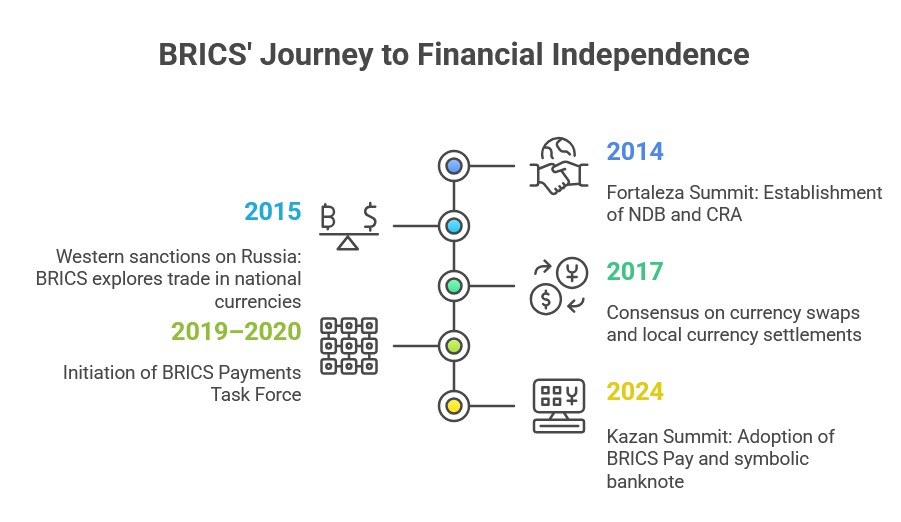
    Since 2014, BRICS nations have worked to cut dependence on the U.S. dollar, launching the New Development Bank (NDB), Contingent Reserve Arrangement (CRA), and now BRICS Pay to promote local currency trade and rival the SWIFT system.

    BRICS Pay and the Push to De-dollarize Global Finance

    About BRICS Pay Initiative:

    • Overview: BRICS Pay is a proposed cross-border digital payment and settlement platform developed by the BRICS nations (Brazil, Russia, India, China, South Africa) to facilitate trade in local currencies and reduce reliance on the U.S. dollar and the SWIFT network.
    • Origins: The idea emerged after the 2014 Fortaleza Summit, where BRICS established its own financial architecture, the New Development Bank (NDB) and the Contingent Reserve Arrangement (CRA).
    • Purpose: To enable direct financial transactions among member nations using local currencies, minimizing the role of Western-controlled financial systems and avoiding U.S.-led sanctions.
    • Development Path:
      • 2017: BRICS agreed to enhance currency cooperation via swaps, local currency settlements, and direct investments.
      • Early 2020s: The BRICS Payments Task Force (BPTF) was created to design interoperable systems.
      • 2024 Kazan Summit: Leaders highlighted strengthening of correspondent banking networks and settlements in local currencies under the BRICS Cross-Border Payments Initiative.
    • Prototype: A demo of BRICS Pay was unveiled in Moscow (October 2024), marking a concrete step toward implementation.
    • Supporting National Systems:
      • India: Unified Payments Interface (UPI)
      • China: Cross-Border Interbank Payment System (CIPS)
      • Russia: System for Transfer of Financial Messages (SPFS)
      • Brazil: Pix instant payment system
    • Strategic Importance: The initiative seeks to establish a self-reliant financial network, bypass SWIFT, and enhance monetary sovereignty among emerging economies.

    Back2Basics: Society for Worldwide Interbank Financial Telecommunication (SWIFT) System

    • Establishment: Founded in 1973 by 239 banks from 15 countries to standardize and secure cross-border financial communications.
    • Headquarters: La Hulpe, Belgium.
    • Nature: A messaging network, not a bank, it does not hold or transfer funds but enables secure interbank communication for financial transactions.
    • Coverage: Connects over 11,000 financial institutions across 200+ countries, making it the largest international payment messaging system.
    • Operation:
      • Assigns each member a Bank Identifier Code (BIC) of 8–11 characters.
      • Standardizes message formats to ensure seamless global financial communication.
      • Facilitates fund transfer instructions, trade settlements, and foreign exchange operations.
    • Governance:
      • Supervised by G10 central banks, the European Central Bank (ECB), and the National Bank of Belgium.
      • Managed by a 25-member board of directors, representing about 3,500 member institutions.
    • Strategic Role:
      • Forms the backbone of global finance, allowing efficient movement of capital.
      • Exclusion from SWIFT acts as a powerful economic sanction tool, isolating nations (e.g., Russia and Iran) from the international financial system.
    • Significance: SWIFT’s dominance reflects Western control over global finance, making it a central target for alternative networks like BRICS Pay, China’s CIPS, and Russia’s SPFS that seek a multipolar monetary order.


    [UPSC 2023] With reference to the Central Bank digital currencies, consider the following statements:

    1. It is possible to make payments in a digital currency without using US dollar or SWIFT system.

    2. A digital currency can be distributed with a condition programmed into it such as time-frame for spending it.

    Which of the statements given above is/are correct?

    Options: (a) 1 only (b) 2 only (c) Both 1 and 2* (d) Neither 1 nor 2


  • What are the challenges with the High Seas Treaty

    Introduction

    The High Seas Treaty, formally known as the Biodiversity Beyond National Jurisdiction (BBNJ) agreement, establishes a legal framework to conserve and sustainably use marine biodiversity in areas outside national control. It covers nearly two-thirds of the ocean’s surface. Adopted under the UN Convention on the Law of the Sea (UNCLOS), 1982, it aims to address threats from climate change, overfishing, and pollution through tools like Marine Protected Areas (MPAs) and Environmental Impact Assessments (EIAs). Ratified by over 60 nations in 2024, it will come into effect in January 2026. This makes it one of the most comprehensive global conservation instruments after the Paris Agreement.

    Why in the News? 

    The High Seas Treaty being ratified by 60+ nations represents a historic step in ocean governance, a domain previously beyond formal protection. For the first time, the international community has agreed on a legally binding mechanism to preserve marine life that exists outside any country’s jurisdiction. This is strikingly different from the earlier regime under UNCLOS, which lacked clear provisions for protecting biodiversity.

    What is the High Seas Treaty About?

    1. Biodiversity Beyond National Jurisdiction (BBNJ): Creates an all-inclusive framework to conserve and manage marine biodiversity beyond national boundaries.
    2. Marine Genetic Resources (MGRs): Recognised as a common heritage of humankind, ensuring equitable benefit-sharing between nations.
    3. Area-Based Management Tools (ABMTs): Establishes Marine Protected Areas (MPAs) to safeguard biodiversity and improve climate resilience and food security.
    4. Environmental Impact Assessments (EIAs): Mandates prior assessment of projects with potential cross-border or cumulative ecological impact.
    5. Capacity Building and Technology Transfer: Facilitates scientific collaboration, especially for developing nations, combining modern science and indigenous knowledge.

    Major Challenges with the High Seas Treaty

    1. Uncertainty over Core Principles
      1. Common Heritage vs. Freedom of High Seas: The “common heritage” principle promotes equitable access and benefit-sharing, while “freedom of the high seas” allows unrestricted navigation and resource use.
      2. Partial Application: The treaty applies the “common heritage” principle only partially, especially for MGRs, reflecting a compromise rather than resolution.
      3. Result: Creates ambiguity in rights and responsibilities of states in exploration, research, and benefit distribution.
    2. Ambiguity in Marine Genetic Resources (MGRs) Governance
      1. Undefined Governance Mechanism: Earlier, no clear framework existed for using or sharing MGRs.
      2. Biopiracy Concerns: Developing nations fear exploitation by developed countries, who could monopolize genetic discoveries and profits.
      3. Equity Gap: The lack of clarity risks excluding Global South nations from scientific and commercial benefits.
    3. Implementation and Enforcement Gaps
      1. Jurisdictional Complexity: The high seas lie beyond national boundaries, making monitoring and enforcement difficult.
      2. Institutional Limitations: While UNCLOS provides a broad legal foundation, there’s no dedicated global enforcement body to ensure compliance.
      3. Dependence on Voluntary Reporting: Could weaken accountability, especially in regulating corporate activities.
    4. Financial and Technological Inequities
      1. Unequal Capabilities: Developing countries lack access to marine technologies for monitoring and sustainable use.
      2. Technology Transfer Gap: The treaty mandates capacity-building, but without specific funding mechanisms, commitments may remain rhetorical.
      3. Risk: Could widen the North-South divide in ocean research and benefit sharing.
    5. Balancing Conservation and Development
      1. Sustainable Use vs. Conservation: Striking a balance between environmental protection and economic opportunities (like deep-sea mining or biotechnology) remains contentious.
      2. Unclear Prioritization: Without clear hierarchy between ecological and developmental objectives, policy conflicts may persist.

    Conclusion

    The High Seas Treaty represents a landmark effort to bring order and justice to the global commons. Yet, the true test lies in resolving philosophical ambiguities and ensuring equitable implementation. Without robust funding, technology sharing, and accountability mechanisms, it risks becoming another well-intentioned but weak global accord. For India, aligning its Blue Economy strategy with the treaty’s framework will be key to ensuring both ecological and economic dividends.

    PYQ Relevance

    [UPSC 2022] Discuss global warming and mention its effects on the global climate. Explain the control measures to bring down the level of greenhouse gases which cause global warming, in the light of the Kyoto Protocol, 1997.

    Linkage: Both Kyoto Protocol and High Seas Treaty are UN-backed frameworks aimed at addressing global commons issues, air and ocean respectively.

  • [1st November 2025] The Hindu Op-ed: The case for a board of peace and sustainable security

    PYQ Relevance

    [UPSC 2024] Terrorism has become a significant threat to global peace and security. Evaluate the effectiveness of the United Nations Security Council’s Counter Terrorism Committee (CTC) and its associated bodies in addressing and mitigating this threat at the international level.

    Linkage: The BPSS proposal aligns with the recurring UPSC theme of UN reform and institutional effectiveness. It can serve as an additional point in answers evaluating the effectiveness of the UNSC and its bodies like the CTC.

    Mentor’s Comment

    The United Nations, despite its founding vision to preserve peace, faces a persistent structural crisis, peace agreements fail, transitions stall, and conflicts reignite. In this context, former Foreign Secretary Nirupama Rao’s proposal for a “Board of Peace and Sustainable Security (BPSS)” marks a profound call for institutional reform. This article dissects the argument, structure, and implications of this proposed board through a UPSC-relevant analytical framework.

    Introduction

    The UN Security Council (UNSC), envisioned to prevent conflict and sustain global peace, continues to struggle with institutional paralysis and outdated structures. Across continents, peace efforts collapse because international systems abandon political engagement too early.
    A new institutional vision, a Board of Peace and Sustainable Security (BPSS), is proposed to infuse continuity, coordination, and political strategy into global peace efforts.

    Why in the news?

    As the UN marks its 80th anniversary, its credibility is under intense scrutiny. While conflicts proliferate, peace agreements remain fragile and transitional mechanisms fail. The UNSC’s structural limitations, lack of political continuity, and inability to sustain long-term engagement make reform urgent. The proposed Board of Peace and Sustainable Security aims to fill this vacuum by institutionalising sustained political engagement before, during, and after conflict. This is significant because it represents one of the first major reform ideas that seeks to integrate peacekeeping with political strategy and regional cooperation, without challenging UNSC authority.

    A clearly defined institutional purpose

    1. Institutional void: The UNSC lacks sustained political engagement capacity. The BPSS would institutionalize political accompaniment beyond peace agreements.
    2. Complementary role: It would not replace or challenge the UNSC or Secretary-General but reinforce implementation and coordination.
    3. Mandate: Ensures continuity in peace efforts by reinforcing national and regional ownership of peace processes and reducing relapse into conflict.
    4. Scope: Works on reinforcing national capacities, coordinating peacekeeping with regional organizations, and ensuring peace agreements translate into durable political outcomes.

    Why is reform of the UN system urgent?

    1. Loss of continuity: Peacebuilding institutions within the UN lose momentum due to ad-hoc missions. BPSS seeks to sustain political engagement beyond immediate crises.
    2. Structural inertia: Waiting for comprehensive UNSC reform delays urgent action; thus, pragmatic institutional innovation is required within existing frameworks.
    3. Authority for change: Under Article 22, the UN General Assembly already holds power to create subsidiary bodies like BPSS without requiring Charter amendments.
    4. Reform from within: Instead of replacing the UNSC, BPSS enhances coordination, ensuring peace agreements transition into stable governance systems.

    What will make the Board credible and representative

    1. Rotational membership: Around two dozen member states, elected for fixed terms, representing all regions (Africa, Asia, Europe, Latin America, Caribbean, West Asia).
    2. Avoiding elite capture: The body should represent inclusivity, not hierarchy, ensuring small and middle powers have a say.
    3. Regional linkages: Works with regional hubs (Addis Ababa, Jakarta, Brasilia, New York) to ensure peace processes reflect local ownership.
    4. Consultative participation: Civil society and regional organizations will have a structured role in deliberations, enhancing legitimacy and field coordination.

    How will the BPSS function in practice?

    1. Style of functioning: Not another bureaucratic forum, but a continuing engagement body ensuring follow-through once UN missions end.
    2. Operational continuity: Prevents premature withdrawal of peacekeeping efforts; sustains political engagement through periodic review and coordination.
    3. Integration: Works in coordination with the Secretary-General, Peacebuilding Commission, and UNSC to align peacekeeping with political strategies.
    4. Focus on youth and fragile states: Ensures peace presence remains where political institutions are nascent.
    5. Conflict prevention: Reduces relapse risk by merging early-warning with long-term political strategies and governance support.

    How will the BPSS strengthen sustainable security?

    1. Beyond short-term peacekeeping: Moves from reactive missions to proactive stability frameworks.
    2. Sustainable security concept: Integrates security, governance, and development rather than treating them in silos.
    3. Inclusive approach: Aligns local, regional, and global stakeholders, reflecting the interconnected nature of modern conflicts.
    4. Institutional learning: Retains experience from past missions to inform future interventions.
    5. Principled reform: Sustains political momentum, not episodic intervention, ensuring peace is treated as an ongoing political project.

    Conclusion

    The proposed Board of Peace and Sustainable Security reimagines peace not as an event but as a process requiring sustained political accompaniment. It seeks to anchor peacekeeping within a strategy of governance, development, and institutional resilience. This reform is not just administrative, it represents a return to the original ideals of the UN Charter, adapting them for a multipolar and conflict-prone world. Sustainable peace demands political continuity, inclusivity, and long-term commitment, principles the BPSS embodies.

  • After ASEAN Summit: Group’s importance for India, amid US-China tussle

    Introduction

    ASEAN, established in 1967, comprises 11 countries, forming one of the world’s most successful regional organizations. With over 40-50% of global trade transiting through the region, ASEAN represents both an economic hub and a strategic pivot in the Indo-Pacific. The 2025 Summit reinforced ASEAN’s centrality amid a shifting balance of power between the US and China, while India emphasized trade cooperation and connectivity.

    ASEAN’s Strategic Importance for India

    1. Geopolitical Significance: ASEAN lies at the heart of the Indo-Pacific, acting as a bridge between the Indian and Pacific Oceans.
    2. Economic Weight: ASEAN is India’s fourth-largest trading partner after the EU, US, and China.
    3. Strategic Leverage: Provides India a platform to balance China’s regional assertiveness and engage in multilateral security frameworks.
    4. Connectivity Corridor: India’s projects such as the India-Myanmar-Thailand Trilateral Highway and Kaladan Multimodal Project enhance physical and economic connectivity.
    5. Regional Integration: Strengthens India’s participation in regional supply chains, energy cooperation, and maritime trade.

    How the US-China Rivalry Shapes ASEAN’s Role

    1. Regional Polarization: ASEAN faces pressure between the US-led security framework and China’s economic dominance.
    2. Maritime Disputes: The South China Sea remains a flashpoint due to overlapping territorial claims, especially involving the Philippines, Vietnam, and China.
    3. Security Realignment: The Philippines has taken an increasingly muscular stand, rejecting China’s claims under the 2016 Hague ruling.
    4. Economic Competition: While China drives trade and infrastructure investment, the US advances Indo-Pacific partnerships emphasizing rule-based order and open seas.
    5. Strategic Autonomy: ASEAN states attempt to maintain neutrality and avoid direct alignment with either power bloc.

    India’s Engagement in the ASEAN Framework

    1. Act East Policy: Deepens trade, connectivity, and strategic cooperation in Southeast Asia.
    2. Trade Liberalization: India signed the India-ASEAN FTA in 2009, expanding goods trade and tariff concessions.
    3. Economic Challenges: India exited the RCEP (Regional Comprehensive Economic Partnership) over market access concerns but remains committed to ASEAN-based trade.
    4. High-Level Diplomacy: Prime Minister Narendra Modi reaffirmed ASEAN centrality in the Indo-Pacific vision and proposed renewed cooperation on connectivity and digital economy.
    5. Institutional Dialogue: India participates in ASEAN-led forums like EAS, ARF, and ADMM+, ensuring consistent engagement.

    Lessons from ASEAN for Other Regional Grouping

    1. Institutional Continuity: ASEAN demonstrates sustained dialogue and incremental cooperation since 1967.
    2. Economic Integration: The ASEAN Free Trade Area (AFTA) and upcoming ASEAN-Australia-New Zealand FTA reflect progressive liberalization.
    3. Replicable Model: Regional blocs like SAARC, BIMSTEC, and BBIN can emulate ASEAN’s approach to consensus-building and functional cooperation.
    4. ASEAN Centrality Principle: Encourages issue-based cooperation despite internal diversity, offering lessons for South Asian regionalism.
    5. Leadership in Transition: Malaysia and Thailand’s evolving chairmanship roles underscore ASEAN’s adaptability in managing complex geopolitics.

    Trade and Connectivity Imperative

    1. Physical Infrastructure: Projects such as Kaladan and Trilateral Highway facilitate India’s access to Southeast Asian markets.
    2. Digital and Maritime Corridors: Enhance India’s trade routes and logistical resilience against Chinese dominance.
    3. Supply Chain Diversification: Reduces dependence on China while integrating India with East Asian production networks.
    4. Economic Opportunities: ASEAN’s collective GDP of over $3 trillion presents scope for India’s pharmaceutical, IT, and engineering exports.
    5. Strategic Balancing: Economic linkages act as a counterweight to China’s Belt and Road Initiative (BRI).

    Conclusion

    ASEAN remains a cornerstone of India’s Indo-Pacific engagement, offering both strategic depth and economic opportunity. As the US-China competition intensifies, India’s sustained engagement, anchored in connectivity, trade, and institutional cooperation, can ensure regional stability, multipolar balance, and long-term strategic autonomy.

    PYQ Relevance

    [UPSC 2024] The West is fostering India as an alternative to reduce dependence on China’s supply chain and as a strategic ally to counter China’s political and economic dominance.

    Linkage: The article aligns with this PYQ as it highlights ASEAN’s centrality in India’s Indo-Pacific outreach, where Delhi’s engagement acts as a counterbalance to China’s dominance. It reinforces the West’s strategy of integrating India within regional supply chains and strategic coalitions to diversify away from Chinese dependence.

  • Various Initiatives under International Solar Alliance (ISA)

    Why in the News?

    At the 8th International Solar Alliance (ISA) Assembly, India has launched four global initiatives viz. Solar Upcycling Network for Recycling, Innovation and Stakeholder Engagement (SUNRISE), One Sun One World One Grid (OSOWOG), Global Capability Centre, and the Small Island Developing States (SIDS) Procurement Platform.

    [1] SUNRISE:

    • Overview: Launched by the International Solar Alliance (ISA) to promote a circular economy in solar energy, focusing on recycling and sustainable resource use.
    • Objective: Aims to recover nickel, cobalt, and lithium from retired solar panels, batteries, and components, reducing e-waste and enhancing material efficiency.
    • Global Collaboration: Connects governments, industries, innovators, and recyclers to formulate international standards and best practices for solar waste management.
    • Sustainability Focus: Seeks to make solar power deployment resource-efficient, low-carbon, and environmentally responsible.
    • Economic Impact: Promotes green job creation, industrial diversification, and innovation in clean-energy recycling technologies.

    [2] OSOWOG (One Sun One World One Grid):

    • Overview: A flagship ISA initiative for transnational solar power connectivity, enabling global energy interdependence through solar grid linkages.
    • Goal: Integrate regional grids across Asia, the Middle East, Africa, and Europe to ensure continuous, 24-hour renewable power supply.
    • Benefits: Promotes clean energy trade, enhances grid stability, and lowers renewable power costs through shared transmission infrastructure.
    • Implementation Strategy: Focuses on regulatory harmonisation, cross-border coordination, and interregional feasibility studies for integrated grid operations.
    • Strategic Role: Strengthens India’s leadership in global renewable energy diplomacy and sustainable development cooperation.

    [3] Global Capability Centre (GCC) and ISA Academy:

    • Vision: Conceived as a “Silicon Valley for Solar”, integrating research, innovation, digital learning, and global capacity-building.
    • Operational Model: Functions through STAR-C centres (Solar Technology Application Resource Centres) established across ISA member countries.
    • Training and Learning: The ISA Academy delivers AI-enabled courses in solar finance, engineering, policy, and project management.
    • Capacity Building: Strengthens human capital, fosters technological excellence, and promotes industrial collaboration for scalable solar growth.

    [4] SIDS Procurement Platform

    • Partnership: A joint mechanism between the ISA and World Bank designed for Small Island Developing States (SIDS).
    • Coverage: Involves 16 island nations across the Caribbean, Pacific, and Indian Ocean regions.
    • Mechanism: Facilitates bulk procurement, shared financing, and aggregated demand to lower solar technology deployment costs.
    • Resilience Building: Enhances technical and financial capacity, reducing dependency on imported fossil fuels.
    • Climate and Energy Impact: Supports climate adaptation, strengthens energy security, and promotes sustainable island economies through clean energy access.

    Back2Basics: International Solar Alliance (ISA)

    • Objective: To facilitate affordable solar technology, finance mobilization, and policy support to achieve global energy access and climate goals.
    • Founded: 2015, jointly by India and France, headquartered in Gurugram (Haryana, India).
    • Membership (2025): 98 countries, focused on promoting solar energy deployment in developing and tropical nations.
    • Strategic Focus Areas (2025):
      • Catalytic Finance Hub: Mobilising global investments in solar infrastructure.
      • Global Capability Centre: Providing technical training, digital tools, and policy frameworks.
      • Technology Roadmap: Driving innovation in floating solar, AI-based grid management, green hydrogen, and One Sun, One World, One Grid (OSOWOG) connectivity.
      • Country Engagement: Strengthening regional partnerships for implementation and capacity-building.
    [UPSC 2016] Consider the following statements:
    1. The International Solar Alliance was launched at the United Nations Climate Change Conference in 2015.
    2. The Alliance includes all the member countries of the United Nations.
    Which of the statements given above is/are correct? Options:
    (a) 1 only* (b) 2 only (c) Both 1 and 2 (d) Neither 1 nor 2