💥Join UPSC 2027,2028 Mentorship (August Batch) + XFactor Notes & Microthemes PDF

GS Paper: Executive & Judiciary

  • Removal of High Court Judges

    Why in the News?

    Lok Sabha Speaker has initiated removal proceedings against a Judge of the Allahabad High Court by admitting a motion signed by 146 members and forming a three-member inquiry committee.

    About Appointment of High Court Judges:

    • Constitutional Basis: Article 217 of the Constitution of India.
    • Appointing Authority: President of India, in consultation with the Chief Justice of India (CJI), Governor of the concerned State, and Chief Justice of the concerned High Court.
    • Collegium System: The proposal is initiated by the High Court’s Chief Justice, forwarded through the Chief Minister and Governor, and decided by the CJI along with the two senior-most judges of the Supreme Court.
    • Chief Justice Posting Policy: Chief Justices are appointed from outside the State to ensure impartiality.
    • Transfers: The CJI and senior-most judges of the Supreme Court decide transfers to maintain judicial independence.

    Removal Process:

    • Grounds: Proved misbehaviour or incapacity.
    • Procedure: Impeachment process under Articles 124(4) and 217, and Section 3(2) of the Judges (Inquiry) Act, 1968.
    • Initiation: Motion signed by at least 100 Lok Sabha MPs or 50 Rajya Sabha MPs.
    • Inquiry: 3-member committee comprising a Supreme Court judge, a Chief Justice of a High Court, and a distinguished jurist investigates the charges.
    • Voting Requirement: Two-thirds majority in both Houses of Parliament for removal.
    • In-House Mechanism: CJI can initiate internal inquiries and advise resignation in serious cases.

    Other Notable Cases:

    • Justice V. Ramaswami (1993): Faced impeachment for financial misconduct; motion failed in Lok Sabha.
    • Justice Soumitra Sen (2011): Resigned after Rajya Sabha voted for removal over fund misappropriation.
    • Justice K. Veeraswamy: Corruption case remained unresolved until his death.
    • Justice Shamit Mukherjee (2003), Justice Nirmal Yadav (2008), Justice S.N. Shukla (2017): Faced criminal charges for corruption after in-house inquiries.
    [UPSC 2007] Consider the following statements:

    1. The mode of removal of a Judge of a High Court in India is the same as that of the removal of a Judge of the Supreme Court.

    2. After retirement from office, a permanent Judge of a High Court cannot plead or act in any court or before any authority in India.

    Which of the statements given above is/are correct?

    Options: (a) 1 only * (b) 2 only (c) Both 1 and 2 (d) Neither 1 nor 2


  • Doctrine of Legal Insanity

    Why in the News?

    The Chhattisgarh High Court acquitted a double murder convict citing legal insanity under Section 84 of the IPC (Section 22 BNS), stressing the need to distinguish it from medical insanity and improve mental health investigations.

    About Legal Insanity:

    • Definition: Legal insanity refers to a mental condition where the accused cannot understand the nature of the act or distinguish right from wrong at the time of the offence.
    • Legal Basis: Codified under Section 22 of the Bharatiya Nyaya Sanhita (formerly Section 84 of the Indian Penal Code, 1860); based on the Mc’Naughten Rule (1843) from English law.
    • Presumption of Sanity: Law presumes every person is sane unless proven otherwise; burden of proof lies on the accused (Section 105, Indian Evidence Act).
    • Timing Requirement: Insanity must be present at the time of the offence—not before or after.
    • Legal vs. Medical Insanity: Legal insanity (court-recognised) is different from medical insanity (clinical diagnosis); only the former is valid for defence.
    • Terminology: Section 22 BNS uses the phrase “unsoundness of mind” instead of “insanity”.
    • Exclusions: Mental illness, abnormal behaviour, or psychiatric history alone do not qualify.
    • Test Applied: Based on cognitive incapacity—whether the person knew the nature, consequences, or wrongfulness (legal or moral) of the act.
    • Underlying Principle: Based on “Actus non facit reum nisi mens sit rea” – no crime without a guilty mind.

    Important Judicial Precedents:

    • Jai Lal v. Delhi Administration (1969): Insanity defence rejected—accused made rational statements and showed no mental disorder post-crime.
    • Shrikant Anandrao Bhosale v. State of Maharashtra (2002): Accused had paranoid schizophrenia and was found incapable of understanding the act—acquitted under Section 84.
    • Surendra Mishra v. State of Jharkhand (2011): Court held that not all mentally ill persons qualify; only proven legal insanity is valid.
    • Kamala Bhuniya v. State of West Bengal (2015): Acquittal granted—prosecution failed to prove sanity; accused’s conduct supported unsoundness of mind.
    [UPSC 2021] With reference to India, consider the following statements:

    1.When a prisoner makes out a sufficient case, parole cannot be denied to such a prisoner because it becomes a matter of his/her right. 2.State Governments have their own Prisoners Release on Parole Rules.

    Which of the statements given above is/are correct?

    Options: (a) 1 only (b) 2 only* (c) Both 1 and 2 (d) Neither 1 nor 2


  • [29th July 2025] The Hindu Op-ed: Justice on hold: India’s courts are clogged

    PYQ Relevance:

    [UPSC 2024] Explain and distinguish between Lok Adalats and Arbitration Tribunals. Whether they entertain civil as well as criminal cases ?

    Linkage: The article states that Lok Adalats, for instance, have successfully resolved over 27.5 crore cases between 2021 and March 2025, including pre-litigation and pending court cases. This question directly addresses Alternative Dispute Resolution (ADR) mechanisms, which are highlighted in the sources as a “promising way forward to ease the burden on traditional courts and deliver quicker, more affordable, and citizen-friendly justice.


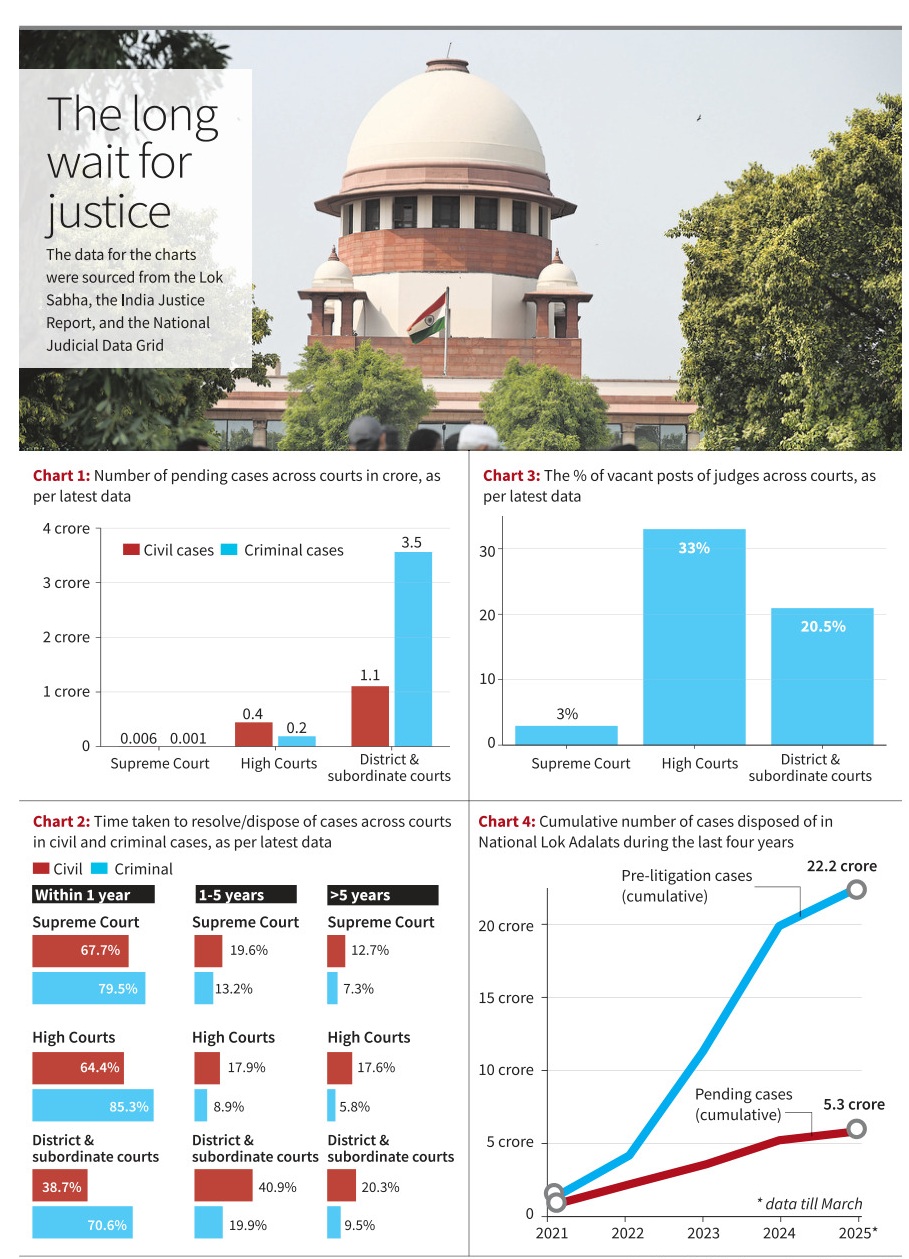
    Mentor’s Comment:   India’s judicial delays have come under sharp focus due to the enormous case backlog—over 5 crore cases pending across the Supreme Court, High Courts, and district courts. This crisis undermines the public’s trust in the legal system, as highlighted by President Droupadi Murmu’s reference to the ‘black coat syndrome’. The issue has resurfaced in light of systemic problems such as judicial vacancies, ineffective case management, and poor infrastructure, especially at the district level, where civil cases face the longest delays. The situation has sparked urgent calls for reform, improved judge strength, and the expansion of alternative dispute resolution mechanisms like Lok Adalats, which have successfully resolved over 27.5 crore cases since 2021.

    Today’s editorial analyses India’s judicial delays. This topic is important for GS Paper II (Indian Polity) in the UPSC mains exam.

    _

    Let’s learn!

    Why in the News?

    Recently, India’s problem of slow court cases has gained attention because more than 5 crore cases are still waiting to be heard in the Supreme Court, High Courts, and district courts.
    Why is timely justice vital for public trust?

    • Maintains faith in the rule of law: When justice is delivered promptly, people believe that the system works and protects them. Eg: The Jessica Lal murder case initially led to public outrage due to delays, but the eventual conviction in a fast-tracked appeal restored some public confidence.
    • Deters future crimes: Swift punishment sends a strong message that wrongdoing will not go unpunished, discouraging potential offenders. Eg: Fast-track courts for sexual assault cases post-Nirbhaya have increased deterrence and quicker resolution.
    • Reduces prolonged trauma for victims: Delayed trials prolong emotional and mental stress for victims and their families. Eg: In the 2002 Gujarat riots cases, delayed justice caused continued trauma to survivors; timely convictions like in the Best Bakery case brought some closure.
    • Prevents misuse of legal loopholes: Delays allow the accused to manipulate evidence, threaten witnesses, or use legal tricks to avoid punishment. Eg: In the Bhopal gas tragedy case, delay of over two decades led to very mild punishments, causing loss of trust in the judiciary.

    What causes structural delays in courts?

    • Judicial Vacancies: A shortage of judges leads to an overwhelming case burden on existing judges, slowing down the process. Eg: As of 2024, over 30% of High Court posts remain vacant across India, increasing pendency.
    • Procedural Inefficiencies: Outdated procedures, frequent adjournments, and lengthy documentation cause unnecessary delays. Eg: In civil suits, routine adjournments under Order XVII of CPC often delay hearings for years.
    • Inadequate Infrastructure: Lack of proper courtrooms, digital tools, and support staff hampers smooth functioning. Eg: Rural courts often lack basic IT infrastructure, affecting e-filing or virtual hearings.
    • Pending Government Cases: A large number of cases are filed by or against the government, clogging the judicial pipeline. Eg: Government is the biggest litigant, responsible for nearly 50% of pending cases.
    • Lack of Case Management Systems: Courts often don’t follow structured timelines or track progress systematically. Unlike fast-track courts, regular trial courts lack proper scheduling, leading to indefinite extensions.

    Why are civil cases slower in district courts?

    • Frequent Adjournments Requested by Parties: Parties often misuse the provision of adjournments to delay proceedings unnecessarily. Eg: In a property dispute in Uttar Pradesh, the defendant sought over 20 adjournments in 5 years, delaying the verdict significantly.
    • Insufficient Judicial Strength: A shortage of judges leads to excessive caseloads, slowing the pace of case disposal. Eg: In Madhya Pradesh, one district judge was handling over 2,000 cases, making timely resolution nearly impossible.
    • Delay in Filing and Responding to Documents: Government departments and advocates often delay submitting necessary replies or documents. Eg: In a civil suit against a municipal corporation in Maharashtra, a delay of 18 months occurred because the civic body failed to file its written statement on time.

    What role does ADR play in reducing pendency?

    • Eases Burden on Courts: ADR mechanisms like mediation, arbitration, and conciliation help resolve disputes outside the formal court system, thus reducing the number of cases pending in courts. Eg: In Delhi, the mediation centre at Tis Hazari Courts has resolved over 2 lakh cases since 2005, significantly easing judicial workload.
    • Faster and Cost-Effective Resolution: ADR offers a quicker, less expensive, and more flexible approach compared to traditional litigation, encouraging parties to settle early. Eg: In commercial disputes, arbitration under the Indian Arbitration and Conciliation Act often concludes within 12–18 months, unlike civil suits which may take years.

    How effective are Lok Adalats in clearing backlogs?

    • High Volume Disposal: Lok Adalats are effective in disposing of a large number of cases quickly, especially compoundable civil and petty criminal cases.
      Eg: In the National Lok Adalat held in November 2023, over 1 crore cases were settled in a single day, significantly reducing court backlog.
    • Reduced Litigation Time & Cost: They offer speedy and cost-free resolution, which encourages litigants to settle disputes without lengthy trials, thus clearing cases that would otherwise clog lower courts.
    • Binding and Final Awards: The decisions are legally binding, and there is no appeal, which ensures that the disposed cases do not re-enter the judicial system, helping in permanent reduction of pending cases.
    • Focus on Pre-litigation Cases: Lok Adalats also take up pre-litigation matters, preventing disputes from entering the formal court system, and thereby curbing future backlog.

    However, they are less effective for complex or non-compoundable cases (like serious criminal or constitutional matters), so their impact is limited to specific case types.

    What are the differences between ADR (Alternative Dispute Resolution) and Lok Adalat? 

    • Scope and Types: ADR (Alternative Dispute Resolution) is a broad umbrella that includes various methods like mediation, arbitration, negotiation, and conciliation. Lok Adalat is a specific type of ADR, institutionalized under the Legal Services Authorities Act, 1987.
    • Legal Status and Binding Nature: In ADR, some methods like arbitration are legally binding, while mediation/conciliation may not be. In Lok Adalat, the award is final, binding, and enforceable as a court decree with no appeal.
    • Formality and Cost: ADR mechanisms can range from formal (arbitration) to informal (mediation) and may involve fees. Lok Adalats are informal, cost-free, and designed for speedy resolution of civil and compoundable criminal cases.

    Way forward: 

    • Institutional Strengthening and Legal Awareness: Strengthen infrastructure and ensure regular training for mediators and conciliators. Promote legal literacy to make citizens aware of ADR mechanisms and Lok Adalats as effective alternatives to litigation.
    • Digital Integration and Monitoring: Introduce e-Lok Adalats, expand online dispute resolution (ODR), and use data-driven monitoring to track disposal rates and identify bottlenecks in the system for continuous improvement.
  • [24th July 2025] The Hindu Op-ed: Can Presidential Reference change a judgment?

    PYQ Relevance:

    [UPSC 2024] Explain the reasons for the growth of public interest litigation in India. As a result of it, has the Indian Supreme Court emerged as the world’s most powerful judiciary?

    Linkage: This question is about the power and role of the Supreme Court of India. It helps us understand how the Court gives advice to the President and what limits exist when it comes to reviewing or changing its past decisions.


    Mentor’s Comment: On July 22, 2025, the Supreme Court of India issued notices to the Union Government and all States on a Presidential Reference seeking clarity on whether the President and Governors can be judicially compelled to act within prescribed timelines on Bills passed by State legislatures. This comes in the wake of the Court’s April 8 judgment, which held that delays by Governors in granting assent to Bills are unconstitutional, and laid down judicially enforceable timelines for action. The Constitution Bench, led by Chief Justice B.R. Gavai, will hear the matter in detail around mid-August under Article 143(1), which allows the President to seek the Court’s advisory opinion on matters of public importance.

    Today’s editorial analyses the Presidential Reference seeking clarity on whether the President and Governors can be judicially compelled to act within prescribed timelines on Bills passed by State legislatures.. This topic is important for GS Paper II (Indian Polity) in the UPSC mains exam.

    _

    Let’s learn!

    Why in the News?

    Recently, the Supreme Court of India has asked the Union Government and all States to respond to a question raised by the President: Can the President and Governors be legally forced to take action within a fixed time on Bills passed by State Assemblies?

    What is Presidential Reference?

    Presidential Reference is a process under Article 143 of the Indian Constitution where the President of India seeks the Supreme Court’s advisory opinion on important questions of law or fact that are of public importance.

    Background:

    In 2024, President Droupadi Murmu invoked Article 143(1) to ask the Supreme Court whether binding timelines can be imposed on the President and Governors to act on Bills passed by State Legislatures — especially in light of delays in assent or return of Bills, such as those witnessed in Tamil Nadu and Punjab.

    What is the significance of Article 143(1) in constitutional interpretation in the context of Presidential Reference?

    • Presidential Power to Seek Advice: Article 143(1) empowers the President of India to seek the Supreme Court’s advisory opinion on questions of law or matters of public importance. Eg: In the Berubari Union case (1960), the President referred a question about the transfer of territory to Pakistan.
    • Advisory Role of the Supreme Court: The Supreme Court’s opinion is not binding, but carries high persuasive value in future interpretations and policy decisions. Eg: The Court’s opinion on the Ayodhya land issue (1993) was declined, as the reference was seen to violate secularism.
    • Clarifies Constitutional Dilemmas: Helps resolve grey areas in constitutional practice without formal litigation, especially in cases involving federal disputes or institutional responsibilities. Eg: The 2024 Presidential Reference seeks clarity on whether the SC can set timelines for Governors or the President in assenting to Bills.

    Why did Tamil Nadu’s plea over the Governor’s inaction raise constitutional concerns?

    • Delay Violates Constitutional Mandate: The Governor’s inaction on State Bills breaches Article 200, which requires prompt decision assent, reservation, or withholding on legislative proposals.
    • Threatens Federalism and State Autonomy: Prolonged inaction undermines the authority of the elected State government, disrupting the federal balance enshrined in the Constitution.
    • Triggers Judicial and Political Tensions: Such inaction forces judicial intervention, leading to constitutional ambiguity and disputes over the separation of powers between constitutional offices.

    How did the April 8 SC verdict reshape the Centre-State power balance?

    • Fixed a Time Limit for Governors’ Decisions: The Supreme Court ruled that Governors must act on Bills “as soon as possible”, preventing indefinite delays. Eg: In Tamil Nadu’s case, the Governor had withheld action on multiple Bills for months, leading to constitutional standoff.
    • Clarified Limits on Withholding Assent: The Court emphasized that Governors cannot sit on Bills indefinitely or reject them arbitrarily, reinforcing the legislative supremacy of elected State governments. Eg: The verdict curbed the misuse of Article 200 by Governors in opposition-ruled States.
    • Reinforced Cooperative Federalism: The judgment upheld that constitutional functionaries must act in harmony, ensuring Centre-State relations are based on trust and constitutional propriety. Eg: The verdict serves as a warning against politicized Governor roles that disrupt the federal structure.

    When can the Supreme Court refuse a Presidential Reference?

    • Lack of Public Importance: If the issue is not of sufficient public or constitutional importance, the Court may decline to give its opinion. Eg: Political or non-legal matters without broader legal impact.
    • Hypothetical or Vague Questions: The Court avoids answering abstract, premature, or unclear issues. Eg: In the Cauvery Water Disputes Tribunal case (1992), the Court refused as the matter was not ripe for consideration.
    • Risk of Judicial Overreach: If the reference could interfere with pending litigation, reopen settled judgments, or encroach on executive/legislative powers, the Court may refuse. Eg: Questions that challenge or revisit prior rulings.

    How does the non-binding nature of Article 143 opinions affect jurisprudence?

    • Encourages Deliberative Democracy: Since the opinion is not binding, it invites parliamentary debate and public discourse rather than closing the matter purely through judicial authority. Eg: After the SC’s advisory opinion in the In re Kerala Education Bill, 1957, political discussions shaped the final policy on minority education rights.
    • Enables Judicial Restraint in Political Questions: It allows the Court to share constitutional insight without overstepping into executive or legislative domains, maintaining the separation of powers. Eg: In the Ayodhya Reference case (1994), the SC declined to answer a politically loaded question, exercising restraint.
    • Promotes Flexibility in Constitutional Practice: Non-binding opinions allow the executive to consider but not be bound by the Court’s interpretation, creating space for evolving legal practices over time. Eg: The opinion in In re Cauvery Water Disputes Tribunal (1991) offered legal clarity, but the Centre retained room to manage interstate negotiations.

    Way forward: 

    • Make Advisory Opinions More Transparent and Accessible: Publish all Presidential References and advisory opinions in simple language to promote public understanding and ensure informed civic debate on constitutional matters.
    • Encourage Parliamentary Follow-Up: Parliament should deliberate on Supreme Court’s advisory views under Article 143(1) to align legislation or executive action with constitutional principles while respecting the non-binding nature of such opinions.
  • Looking inward: Reservation in Supreme Court

    Why in the News?

    Recently, for the first time ever, the Supreme Court of India has introduced a reservation policy for Scheduled Castes (SCs) and Scheduled Tribes (STs) in hiring and promoting its non-judicial staff, such as assistants and attendants.

    What is the importance of the Supreme Court’s internal reservation policy?

    • Bridges the Gap Between Principle and Practice: For decades, the Court had delivered landmark judgments on affirmative action, but hadn’t applied those standards to its own staff. Eg: Judgments like Indra Sawhney and M. Nagaraj shaped national reservation policy, but internal implementation lagged until the 2025 reform.
    • Promotes Social Inclusion Within the Judiciary: By providing 15% reservation for SCs and 7.5% for STs in administrative posts, the Court ensures better representation of marginalised communities within its own ecosystem. Eg: Of the 1,280 reserved posts, the majority are for junior assistants and attendants, opening real job opportunities for disadvantaged groups.

    Why was the Court late in applying affirmative action to its staff?

    • Lack of Leadership Will: The implementation was delayed due to the absence of decisive leadership within the Court to prioritise internal reforms. Eg: It took Chief Justice B.R. Gavai, the second Dalit CJI in the Court’s history, to initiate the reform in 2025, showing how transformational leadership can overcome systemic inertia.
    • Contradiction Between Principle and Practice:  Despite supporting reservations through judgments like Indra Sawhney and M. Nagaraj, the Court did not extend similar benefits to its own non-judicial staff until now.
    • Institutional Inertia and Exceptionalism: For nearly three decades since R.K. Sabharwal v State of Punjab (1995), the Court’s inaction on internal reservations reflected a reluctance to challenge status quo. Eg: While government departments and many High Courts had implemented SC/ST quotas, the Supreme Court remained an exception, showcasing negative exceptionalism despite advocating for equality externally.

    How have previous rulings influenced India’s reservation system?

    • R.K. Sabharwal (1995): Shifted the system from vacancy-based to post-based rosters to prevent exceeding the 50% quota cap.
    • M. Nagaraj (2006): Upheld reservation in promotions but required data on backwardness and administrative efficiency.
    • Jarnail Singh (2018): Removed the need to prove backwardness again for SCs/STs already listed.
    • Davinder Singh (2024): Allowed sub-classification within SCs/STs, affirming substantive equality over formal equality.

    Who led the push for reservation reform in the Supreme Court?

    • Chief Justice B.R. Gavai: Only the second Dalit CJI in history, he recognized the disconnect between the Court’s rulings and its internal practices and acted to correct it. Gavai also reportedly supports extending reservations to OBCs and other marginalized groups in the future.

    What challenges lie ahead in expanding the reservation to other groups?

    • Legal Ambiguity: Extension of reservations to OBCs, PwDs, and others lacks clear policy frameworks and quota specifications. Eg: The July 2025 Gazette mentions new categories but no defined implementation.
    • Institutional Inertia: Bureaucratic delays and reluctance to change slow down the adoption of new reservation measures. Eg: It took decades after R.K. Sabharwal (1995) to implement SC/ST reservations.
    • Balancing Equity and Efficiency: Concerns over merit and administrative efficiency may resist expansion of affirmative action. Eg: M. Nagaraj (2006) required data on backwardness and efficiency, which may be hard to apply internally.

    Way forward: 

    • Institutionalise Inclusive Policies: Finalise and implement a comprehensive reservation framework within the Supreme Court, ensuring clarity, transparency, and consistency with government norms for SCs, STs, OBCs, PwDs, and other eligible groups.
    • Strengthen Monitoring and Accountability: Establish a diversity oversight mechanism within the judiciary to track representation, address grievances, and ensure timely implementation of reservation provisions.

    Mains PYQ:

    [UPSC 2024] Despite comprehensive policies for equity and social justice, underprivileged sections are not yet getting the full benefits of affirmative action envisaged by the Constitution. Comment.

    Linkage: The concept of “affirmative action,” which is the foundation for reservation policies in India. The Supreme Court has been instrumental in shaping the contours of affirmative action through its landmark judgments over the years.

  • CJI assures ‘complete transparency’ in Collegium System

    Why in the News?

    Recently, CJI B.R. Gavai affirmed that the collegium system will ensure merit, transparency, and inclusive representation, and will not be swayed by external pressures.

    What is the Collegium System?

    • About: The Collegium System is the process by which judges are appointed and transferred in the Supreme Court and High Courts of India.
    • Origin: It was developed by the Supreme Court itself and is not mentioned in the Constitution.
    • Purpose: It aims to ensure judicial independence by minimizing the role of the executive in judicial appointments.
    • Basis for Appointments:
      • Supreme Court Judges: Under Article 124, the President appoints judges after consulting relevant judges from the Supreme Court and High Courts.
      • High Court Judges: Under Article 217, appointments are made by the President after consulting the Chief Justice of India, Governor of the State, and Chief Justice of the High Court concerned.
    • Structure of the Collegium:
      • Supreme Court Collegium: It consists of 5 judges — the Chief Justice of India (CJI) and the four senior-most judges of the Supreme Court.
      • High Court Collegium: It comprises the Chief Justice of the High Court and the two senior-most judges of that High Court.

    Qualifications for SC Judges:

    • Citizenship: Must be an Indian citizen.
    • Judicial Experience: At least 5 years as a High Court judge or 10 years as an advocate in one or more High Courts.
    • Alternative Route: Can also be a distinguished jurist, in the President’s opinion.

    Qualifications for HC Judges:

    • Experience: Must have held a judicial office for 10 years or practiced as an advocate for 10 years in a High Court.
    • Bar Enrollment: Must be enrolled with the Bar Council of India.

    Evolution of the Collegium System:

    • First Judges Case (1981): The Supreme Court ruled that the executive had primacy in appointments, and the CJI’s opinion was not binding.
    • Second Judges Case (1993): The Court reinterpreted “consultation” to mean “concurrence”, giving primacy to the judiciary and formally creating the Collegium System.
    • Third Judges Case (1998): On Presidential Reference, the Collegium was expanded to five members — the CJI + 4 senior-most judges.

    How does it Work?

    • Appointment of Chief Justice of India (CJI): The outgoing CJI recommends the next CJI, based on seniority. The Law Minister forwards it to the PM, who advises the President.
    • Appointment of Other SC Judges: The CJI initiates the proposal after consulting Collegium members and the senior-most judge from the concerned High Court.
    • Appointment of High Court Judges: Initiated by the High Court Chief Justice, approved by the High Court Collegium, and forwarded via the state government to the Union Law Ministry.
    [UPSC 2012] What is the provision to safeguard the autonomy of the Supreme Court of India?

    1. While appointing the Supreme Court Judges, the President of India has to consult the Chief Justice of India.

    2. The Supreme Court Judges can be removed by the Chief Justice of India only.

    3. The salaries of the Judges are charged on the Consolidated Fund of India to which the legislature does not have to vote.

    4. All appointments of officers and staff of the Supreme Court of India are made by the Government only after consulting the Chief Justice of India.

    Which of the statements given above is/are correct?

    Options: (a) 1 and 3 only * (b) 3 and 4 only (c) 4 only (d) 1, 2, 3 and 4


  • Practicing equality in constitutional courts 

    Why in the News?

    On May 13, 2025, the Supreme Court gave a key judgment revisiting earlier cases on senior lawyer designation. Though overlooked as an internal court issue, it raised concerns about inequality in the legal profession, elitism, and the fairness of classifying lawyers under Section 16 of the Advocates Act, 1961.

    What are the legal issues with the senior advocate designation?

    • Arbitrary Classification under Section 16 of the Advocates Act, 1961: Section 16 allows courts to classify lawyers into “senior advocates” and others based on vague terms like “ability” or “standing at the Bar”, which lack objective benchmarks. It has been challenged as violative of Article 14 (Right to Equality) of the Constitution because it creates unequal treatment among equals without a clear rationale.
    • Lack of Objective Selection Process in Court Rules: The Supreme Court Rules, 2013 prescribe procedures for designation but allow subjective discretion, enabling possible favouritism or bias. Eg: Rule 2 of Order IV of the Supreme Court Rules allows for pre-audience to senior advocates, reinforcing hierarchical privilege without transparency in how they are chosen.
    • Undermines Egalitarian Access to Justice: Designation often leads to a concentration of influence among a few, marginalising others and affecting diversity in courtroom representation. Eg: In Indira Jaising v. Supreme Court of India (2017), the Court upheld the validity of Section 16 but did not address how it leads to systemic exclusion, especially of women and underprivileged lawyers, conflicting with constitutional ideals of equality and non-discrimination.

    Why is the 2025 Jitender judgment seen as inadequate?

    • Did Not Address Constitutional Validity of Section 16: The 2025 judgment failed to examine the constitutional validity of Section 16 of the Advocates Act, 1961, which creates a classification between senior advocates and other advocates. The Court did not refer the matter to a larger Bench for a deeper constitutional review. The classification was upheld without addressing whether it was arbitrary or led to inequality in the legal profession.
    • Acknowledged Subjectivity but Retained Flawed Process: The Court admitted that the point-based assessment system used to designate senior advocates is “highly subjective”, yet it retained the application-based process. This allows judges’ discretion to continue dominating the selection process, opening space for favoritism and elite networks. Eg: Many competent lawyers are left out simply because they lack access to the corridors of power.
    • Missed Opportunity to Promote Inclusiveness and Reform: Instead of proposing systemic change, the Court left it to High Courts to frame rules, without tackling the core issue of representation. The process continues to exclude women, Dalits, and those from less privileged backgrounds, reinforcing elitism in the judiciary. Eg: The designation process continues to favour a “creamy layer” of elite lawyers, limiting judicial diversity.

    What are the factors fueling inequality in the legal profession?

    • Unequal Access to Quality Legal Education: Aspiring lawyers from rural or low-income backgrounds often lack access to top law schools due to language barriers, lack of coaching, or high costs. Eg: Students from remote areas rarely make it to National Law Universities, which limits their exposure and opportunities.
    • Urban Concentration of Legal Opportunities: Legal practice in metropolitan cities attracts more recognition, clients, and judicial exposure compared to small-town lawyers. Eg: Talented advocates in lower courts of Bihar or Odisha are often overlooked for high-profile cases or designations.
    • Subjectivity in Senior Advocate Designation: The selection process often favours those with elite networks or familiarity with judges, sidelining equally competent but lesser-known lawyers. Eg: Women and Dalit lawyers remain significantly underrepresented among senior advocates.

    Way forward: 

    • Transparent and Inclusive Designation Process: Develop a merit-based, transparent system for designating senior advocates with clear evaluation criteria. Include diverse representation (e.g., women, marginalized groups) in selection committees to promote judicial inclusiveness.
    • Strengthening Legal Education and Access: Expand access to quality legal education through scholarships, regional law schools, and skill-based training in vernacular languages, especially for students from rural and underprivileged backgrounds to reduce structural entry barriers.

    Mains PYQ:

    [UPSC 2014] Starting from inventing the ‘basic structure’ doctrine, the judiciary has played a highly proactive role in ensuring that India develops into a thriving democracy. In light of the statement, evaluate the role played by judicial activism in achieving the ideals of democracy.

    Linkage: This question prompts an evaluation of the judiciary’s role in achieving “ideals of democracy”. The article talks about the direct counter-narrative to this positive assertion by arguing that the classification of senior advocates, as upheld by Supreme Court judgments in Indira Jaising and Jitender, creates a “legal oligarchy” and perpetuates inequality that can damage the justice delivery system enormously.

  • India’s legal bridge is one of reciprocity, not roadblocks 

    Why in the News?

    In May 2025, the Bar Council of India (BCI) officially put into effect new rules called the “Bar Council of India Rules for Registration and Regulation of Foreign Lawyers and Foreign Law Firms in India.” This is a major step in India’s legal system, as it allows foreign lawyers to work in India in a regulated way while protecting Indian legal standards.

    What is the Bar Council of India (BCI)? 

    The BCI is a statutory body established under the Advocates Act, 1961 to regulate the legal profession and legal education in India.

    Why did the Bar Council of India (BCI) enforce the new rules?

    • To Regulate and Monitor Foreign Legal Practice in India: With growing cross-border trade and legal demands, there was a need to formally regulate how foreign lawyersoperate in India. The rules provide a clear framework for registration, scope of work, and ethical standards. Eg: Foreign law firms advising Indian clients on international mergers or arbitration cases must now register and follow BCI rules, ensuring accountability.
    • To Ensure Reciprocity and Protect Indian Legal Interests: The rules were introduced to allow foreign legal entry based on mutual terms, ensuring Indian lawyers are treated fairly abroad. It also prevents unregulated entry that could undermine local legal professionals. Eg: U.S. law firms can now operate under defined conditions, but only if similar access is given to Indian lawyers in the U.S., ensuring balanced opportunities.

    What are the key criticisms of the BCI rules by U.S. law firms?

    • Procedural Restrictions as Non-Tariff Barriers: U.S. law firms argue that the BCI rules impose excessive procedural requirements that act as a non-trade barrier, limiting their entry into India. Eg: Mandatory disclosures and registration conditions are seen as restrictive and protectionist.
    • Conflicts with U.S. Confidentiality Norms: The requirement to reveal the “nature of legal work” and “client identity” allegedly conflicts with the American Bar Association (ABA) rules on client confidentiality. Eg: U.S. lawyers are bound by rules that prevent even general disclosure of client details.
    • Lack of Reciprocity and Sudden Implementation: The fly-in, fly-out rule imposes limits (e.g., 60 days stay) without ensuring similar access for Indian lawyers in the U.S., and critics say the rules were implemented without a transition phase. Eg: No equivalent restrictions exist for U.S. law firms visiting India earlier, but now sudden compliance is required.

    Why are legal services excluded from trade agreements in India?

    • Constitutional Separation from Trade: Legal services fall under Entries 77 and 78 of the Union List (administration of justice and legal profession), not under trade and commerce entries. Hence, they are constitutionally excluded from trade negotiations. Eg: In the UK-India Free Trade Agreement negotiations, India intentionally excluded legal services, reinforcing this constitutional boundary.
    • Nature of Legal Practice as Personal Service: Indian courts have ruled that legal practice is a contract of personal service, not a commercial activity, making it unsuitable for inclusion in trade deals. Eg: In Bar of Indian Lawyers vs D.K. Gandhi (2024), the court held that legal services are distinct from trade or business, confirming their exclusion from trade frameworks.

    How do the BCI rules ensure a balance between openness and standards?

    • Structured entry for foreign lawyers and firms: The BCI rules permit foreign law firms and practitioners to operate in India through a registration-based model, ensuring regulated access rather than blanket entry. Eg: Rules 3 and 4 allow entry subject to ethical and professional conditions, preventing unregulated practice.
    • Fly-in, fly-out provisions with safeguards: The rules enable temporary legal visits under the fly-in, fly-out model, while imposing limits on duration (60 days/year) and type of legal work, ensuring such visits stay within approved bounds. Eg: Under Rule 3(1) proviso, a foreign lawyer may advise on foreign law but cannot represent clients in Indian courts.
    • Flexibility with accountability: The rules allow the BCI to assess foreign qualifications and credentials case-by-case (Rule 6), ensuring professional standards are upheld without being rigid. Eg: Rule 4(h) requires a ‘good standing’ certificate, but the BCI can make exceptions after holistic verification.

    Which laws and judgments guide India’s regulation of foreign legal practice?

    • Constitutional Framework under Union List: Legal practice in India is governed under Entries 77 and 78 of the Union List (Seventh Schedule, Constitution of India), making it a sovereign regulatory domain, distinct from trade and commerce. Eg: Legal services are not treated as tradable commodities, hence excluded from Free Trade Agreements (FTAs).
    • Bar Council of India Act and Professional Standards: The Advocates Act, 1961 and the Bar Council of India (BCI) rules provide the statutory mandate for regulating legal education, enrolment, and conduct of lawyers in India. Eg: The BCI Rules for Registration and Regulation of Foreign Lawyers and Foreign Law Firms (2023) ensure ethical compliance and reciprocity.
    • Bar Council of India vs A.K. Balaji (2018): Held that foreign firms can’t set up offices but can advise clients on fly-in, fly-out basis.
    • Lawyers Collective vs BCI (2009): Reiterated that foreign firms must follow Indian law to practice in any capacity.

    What are the implications of applied ethics?

    • Guides Real-World Decision Making: Applied ethics helps individuals and institutions make morally sound decisions in specific practical fields such as medicine, law, business, or environmental policy. Eg: In medical ethics, principles like informed consent ensure that patients are not treated without their knowledge or will.
    • Resolves Ethical Dilemmas in Professional Practice: It provides frameworks to address conflicting moral values in complex situations, balancing individual rights, social good, and professional duty. Eg: In business ethics, whistleblowing policies balance the duty to the employer with the public’s right to know about harmful practices.

    Note: Applied Ethics is a branch of ethics that deals with the practical application of moral principles to real-world issues and professional fields.

    Way forward: 

    • Strengthen Bilateral Legal Dialogue Mechanisms: India can establish a structured legal diplomacy framework with countries like the U.S. to address concerns through dialogue rather than trade disputes.
    • Introduce a Phased Liberalisation Model with Safeguards: India can consider a calibrated liberalisation of legal services with clearly defined transition periods, limited practice areas (e.g., foreign law, arbitration), and stringent professional standards to ensure reciprocity and ethical compliance while maintaining regulatory control.

    Mains PYQ:

    [UPSC 2018] India and USA are two large democracies. Examine the basic tenets on which the two political systems are based.

    Linkage:  These basic tenets influence legal and regulatory philosophies. The article underscores that India’s rules are not “roadblocks” but a “balanced approach” to liberalizing its legal ecosystem in a “structured and regulated manner. The understanding of the foundational differences in how these two democracies approach regulation, particularly in a professional service sector, is crucial for comprehending India’s justification for its “legal bridge of reciprocity.

  • Appointment and Removal of High Court Judges

    Why in the News?

    The Centre will bring a motion of removal against a Judge of the Allahabad High Court and has initiated the process of building an all-party consensus for this action.

    Qualifications of Judges of High Court:

    • Article 217(2) of the Constitution states that a person is qualified if:
      • They have held judicial office in India for at least 10 years, or
      • Have been an advocate in a High Court (or more than one in succession) for at least 10 years.
    • Tenure: As per Article 217(1), a High Court judge holds office till the age of 62 years.
    • Disputes over Age: Under Article 217(3), if a question arises regarding a judge’s age, the President, in consultation with the CJI, makes the final decision.

    Appointment Process of High Court Judges:

    • Constitutional Basis: The Article 217 of the Constitution provides that High Court judges are appointed by the President of India after consultation with the Chief Justice of India (CJI), the Governor of the state, and, in the case of judges (not Chief Justices), the Chief Justice of the High Court concerned.
    • Role of the Collegium System: The Collegium, comprising the CJI and 2 senior-most judges of the Supreme Court, plays a key role in recommending names for appointments. It ensures collaborative decision-making and maintains the independence of the judiciary.
    • Procedure:
      1. The Chief Justice of the High Court initiates the recommendation.
      2. The proposal is forwarded to the Chief Minister, who advises the Governor.
      3. The Governor sends it to the Union Law Minister, who places it before the Prime Minister, and then the President for final approval.
    • Policy for Chief Justices: To prevent local bias, Chief Justices of High Courts are generally appointed from outside the state.
    • Appointments and Transfers: The CJI and senior judges of the Supreme Court also decide on transfers of High Court judges, ensuring judicial autonomy and minimizing executive influence.

    Removal:

    • Process: Judges of the High Court (and Supreme Court) can only be removed through removal, not by executive action.
      • Requires a motion signed by at least 100 Lok Sabha MPs or 50 Rajya Sabha MPs.
      • The motion is examined by a three-member committee.
      • If the committee finds grounds, the motion is debated and must be passed by a two-thirds majority in both Houses of Parliament.
    • Legal Framework: The Judges (Inquiry) Act, 1968 outlines the detailed procedure for investigating and acting upon misconduct by judges.
    • In-House Inquiry Mechanism: For internal disciplinary matters:
      • The CJI may order a preliminary inquiry based on credible complaints.
      • A three-judge panel is constituted if allegations are serious.
      • If the committee confirms misconduct, the CJI may ask the judge to resign.
      • If the judge refuses, the judicial work is withdrawn, and removal may be considered.

    Historical Removal Efforts:

    • No judge has been impeached in India, though attempts have been made, including the failed motions against Justice V Ramaswami (1993) and Justice Soumitra Sen (2011).
    • Justice V Ramaswami (1993): Faced removal for financial misconduct, but the motion failed in the Lok Sabha.
    • Justice Soumitra Sen (2011): Resigned after removal proceedings for misappropriating funds.
    • Justice K Veeraswamy: Chief Justice of Madras HC, investigated for corruption but challenged the investigation. The case remained unresolved until his death in 2010.
    • Justice Shamit Mukherjee (2003), Justice Nirmal Yadav (2008), and Justice SN Shukla (2017): Faced criminal charges for corruption after in-house inquiries found substantial evidence against them.


    [UPSC 2007] Consider the following statements:

    1. The mode of removal of a Judge of a High Court in India is the same as that of the removal of a Judge of the Supreme Court. 2. After retirement from office, a permanent Judge of a High Court cannot plead or act in any court or before any authority in India.

    Which of the statements given above is/are correct?

    Options: (a) 1 only*  (b) 2 only (c) Both 1 and 2 (d) Neither 1 nor 2


  • Supreme Court Collegium recommends transfer of HC CJs

    Why in the News?

    The Supreme Court Collegium has recommended the transfer of 4 Chief Justices from the High Courts of Madras, Rajasthan, Tripura, and Jharkhand.

    About the Collegium System:

    • Definition: It is used in India for the appointment and transfer of judges to the Supreme Court and High Courts.
    • Non-Constitutional Origin: It is not mentioned in the Constitution or any law passed by Parliament. It developed through Supreme Court judgments to protect judicial independence.
    • Judicial Primacy: The system ensures that senior judges, not the government, have the main say in judicial appointments.
    • Evolution: It arose in response to executive interference during the 1970s, when the government tried to influence and supersede senior judges:
    • First Judges Case (1981)S.P. Gupta v. Union of India:
      • Held that the Chief Justice’s opinion was only consultative.
      • Gave the executive primary control over appointments and transfers.
    • Second Judges Case (1993)Advocates-on-Record Association v. Union of India:
      • Overruled the First Judges Case.
      • Declared that “consultation” with the CJI means “concurrence”, making the CJI’s view binding.
      • Introduced the Collegium system, involving the CJI and two senior-most judges.
      • Affirmed that judicial independence requires judicial primacy in appointments.
    • Third Judges Case (1998)Re: Presidential Reference:
      • Expanded the Collegium to include the CJI and four senior-most Supreme Court judges.
      • Emphasised institutional decision-making, not personal preferences of individual judges.

    How does the Collegium System works?

    • For Supreme Court Judges:
      • The Collegium includes the CJI and four senior-most SC judges.
      • It recommends names for appointments to the SC and appointments/transfers of High Court judges and Chief Justices.
      • The Law Ministry processes these names and sends them to the Prime Minister, who advises the President for final approval.
    • For Appointing the Chief Justice of India:
      • The sitting CJI recommends the senior-most SC judge.
      • This practice has been followed since the 1970s supersession controversy.
    • For High Court Judges:
      • Recommendations start from the Chief Justice of the High Court, who consults two senior colleagues.
      • The proposal goes to the state government, then to the Supreme Court Collegium (CJI and two senior-most SC judges), and finally to the President.
    • For Transfers of Judges:
      • Article 222 of the Constitution allows transfer of High Court judges.
      • The Collegium recommends transfers, often for administrative needs or public interest.
      • Consent is not needed, but the CJI must consult the Chief Justice of the concerned High Court and other senior judges.
      • No High Court can have an Acting Chief Justice for more than a month, so transfers and new appointments are usually done together.

    Tap to know more about the Appointment and Removal of HC Judges.

    [UPSC 2012] What is the provision to safeguard the autonomy of the Supreme Court of India?

    1. While appointing the Supreme Court Judges, the President of India has to consult the Chief Justice of India. 2. The Supreme Court Judges can be removed by the Chief Justice of India only. 3. The salaries of the Judges are charged on the Consolidated Fund of India to which the legislature does not have to vote. 4. All appointments of officers and staff of the Supreme Court of India are made by the Government only after consulting the Chief Justice of India. Which of the statements given above is/are correct?

    Options: (a) 1 and 3 only * (b) 3 and 4 only (c) 4 only (d) 1, 2, 3 and 4