💥Join UPSC 2027,2028 Mentorship (July Batch) + XFactor Notes & Microthemes PDF

GS Paper: GS2-19.Effect of policies and politics of developed and developing countries…

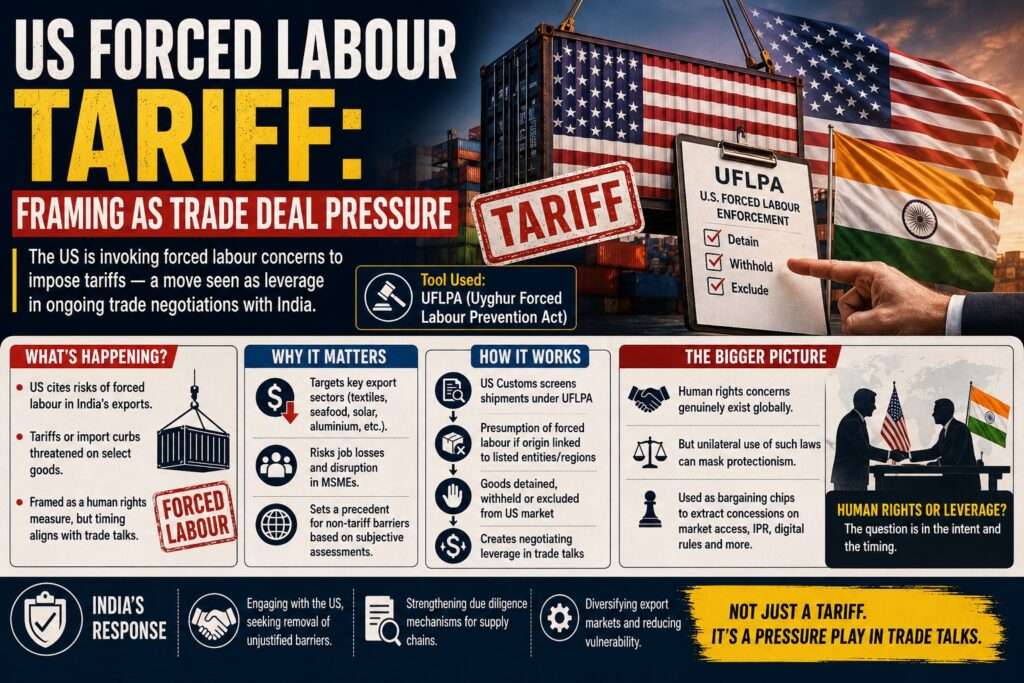
  • Editorial: US forced labour tariff framing as trade deal pressure

    PYQ Relevance
    [UPSC 2018]
    What are the key areas of reform if the WTO has to survive in the present context of ‘Trade War’, especially keeping in mind the interest of India?
    Linkage: The PYQ examines trade wars, tariffs and their implications for India’s trade interests. The US forced-labour tariffs reflect the growing use of unilateral trade measures, highlighting the challenges posed to India amid weakening multilateral trade rules.

    Mentor’s Comment

    The United States has introduced a new tariff justified on forced labour grounds, applied unevenly across trading partners, days after halting a broader trade negotiation with India. This illustrates how trade policy is increasingly being used as a geopolitical instrument rather than solely to enforce labour standards. For India, the challenge is to protect its export interests while resisting pressure to accept unfavourable trade concessions and continuing to uphold a rules-based multilateral trading system.

    What are the Trump administration’s new tariffs imposed for forced labour concern?

    1. The Trump administration has imposed new tariffs under Section 301 of the Trade Act of 1974, which is designed to address unfair foreign practices affecting US commerce.
    2. Effective from July 24, the US imposed 10 per cent or 12.5 per cent tariffs on all the 60 economies, which were subject to the investigation.
    3. India and 16 other countries are subject to the lower 10 per cent tariff, while 12.5 per cent tariffs have been imposed on the remaining 43 economies.

    Why is the tariff read as pressure rather than a labour standards measure?

    1. Uneven application: Countries that already hold a trade deal with the United States receive more favourable tariff treatment, regardless of their actual labour practices.
    2. Timing: The tariff surfaced shortly after trade talks with India stalled, suggesting it functions as leverage to revive negotiations.
    3. No independent audit trail: The tariff does not rest on a published, verifiable forced labour finding specific to Indian sectors.
    4. Selective targeting: Sectors and countries without existing US trade agreements bear a disproportionate share of the tariff’s impact.

    What is at stake for India in responding to this pressure?

    1. Negotiating posture: Accepting a hasty deal under this pressure risks locking India into terms it would not otherwise accept.
    2. Sectoral exposure: Indian export sectors named under the tariff face immediate cost pressure regardless of the tariff’s actual justification.
    3. Precedent: Conceding to a tariff based on an unverified standard invites similar leverage tactics in future negotiations.

    Conclusion

    India should not treat this tariff as a genuine labour compliance issue requiring domestic reform, but as a negotiating tactic requiring a negotiating response. Response through the WTO’s dispute mechanisms remains untested here.
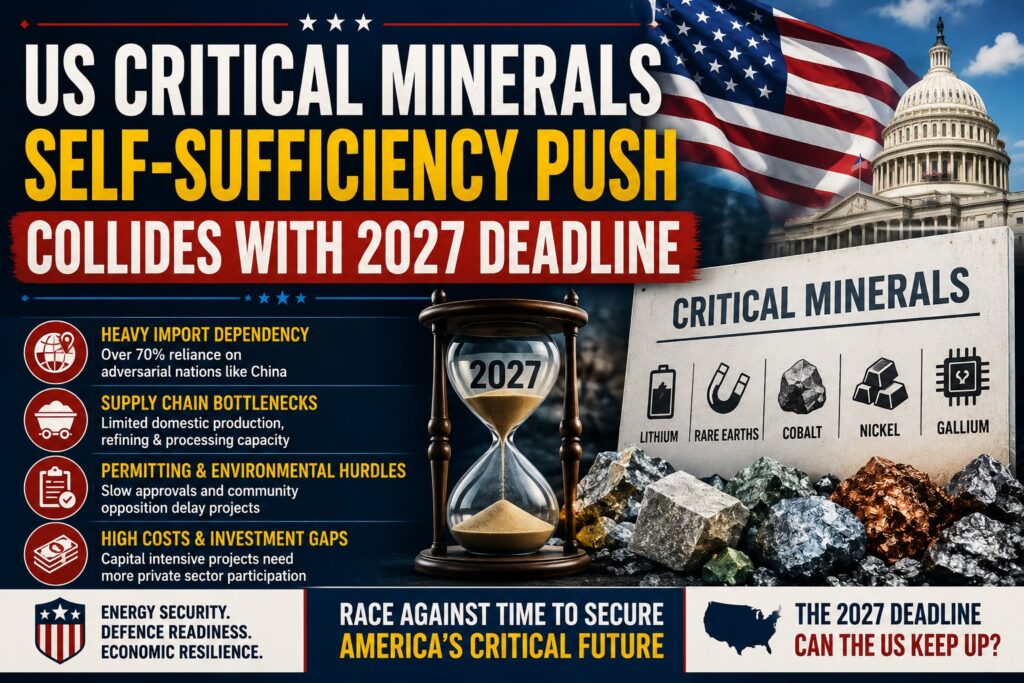
    1. US critical minerals self-sufficiency push collides with 2027 deadline

      Why in News

      The United States is facing challenges in achieving self-sufficiency in defence critical minerals before its January 2027 target. The effort is complicated by China’s dominance, which accounts for over 80% of global critical minerals refining capacity.

      Key Highlights

      • Target minerals: The US is prioritising rare earth elements, tungsten and tantalum for defence and high-technology manufacturing.
      • Project Vault: The US is building strategic reserves through Project Vault, a programme to stockpile critical minerals for defence and industrial security.

      What are Critical Minerals?

      • Critical minerals are minerals essential for economic development, clean energy and national security, but whose supply chains are vulnerable to disruption.
      • They are indispensable for semiconductors, batteries, electric vehicles, renewable energy systems, aerospace and defence equipment.

      Importance of the Target Minerals

      • Rare Earth Elements (REEs): Used in permanent magnets, fighter aircraft, missiles, radar systems, wind turbines and electric vehicles.
      • Tungsten: Known for its high melting point and hardness; used in armour-piercing ammunition, aerospace components and cutting tools.
      • Tantalum: Used in electronic capacitors, semiconductors, medical devices and defence electronics because of its excellent heat and corrosion resistance.

      Why China Dominates

      • Controls a large share of mining, refining and processing capacity.
      • Built an integrated mine-to-manufacturing supply chain over several decades.
      • Benefits from state support, advanced processing technology and economies of scale.
      • Has previously used export restrictions as a strategic tool in geopolitical disputes.

      Why It Matters

      • Critical minerals are essential for national security, defence preparedness and advanced manufacturing.
      • Supply disruptions can affect clean energy transitions, semiconductor production and military readiness.
      • Diversifying supply chains has become a strategic priority for the US, EU, Japan, India and Australia.

      India’s Position

      • India has identified 30 critical minerals as strategically important.
      • The National Critical Mineral Mission (NCMM) aims to strengthen exploration, mining, processing, recycling and overseas acquisition of critical mineral assets.
      • India is also diversifying imports through partnerships under initiatives such as the Minerals Security Partnership (MSP).

      [2026] Which of the following statements about Rare Earth Elements (REEs) and Critical Minerals is/are correct?

      1. Modern technological innovations including Artificial Intelligence, robotics and space exploration extensively utilise Rare Earth Elements (REEs).

      2. China has the highest share in mining of REEs followed by India.

      3. The Government of India launched the National Critical Mineral Mission (NCMM) in 2025 to establish a robust framework for self-reliance in the critical mineral sector.

      4. Rare Earth Elements are a set of 13 metallic elements.

      (a) 1 and 3 only (b) 3 only (c) 1, 3 and 4 (d) 1, 2 and 4