| PYQ Relevance [UPSC 2018] What are the key areas of reform if the WTO has to survive in the present context of ‘Trade War’, especially keeping in mind the interest of India? Linkage: The PYQ examines trade wars, tariffs and their implications for India’s trade interests. The US forced-labour tariffs reflect the growing use of unilateral trade measures, highlighting the challenges posed to India amid weakening multilateral trade rules. |
Mentor’s Comment
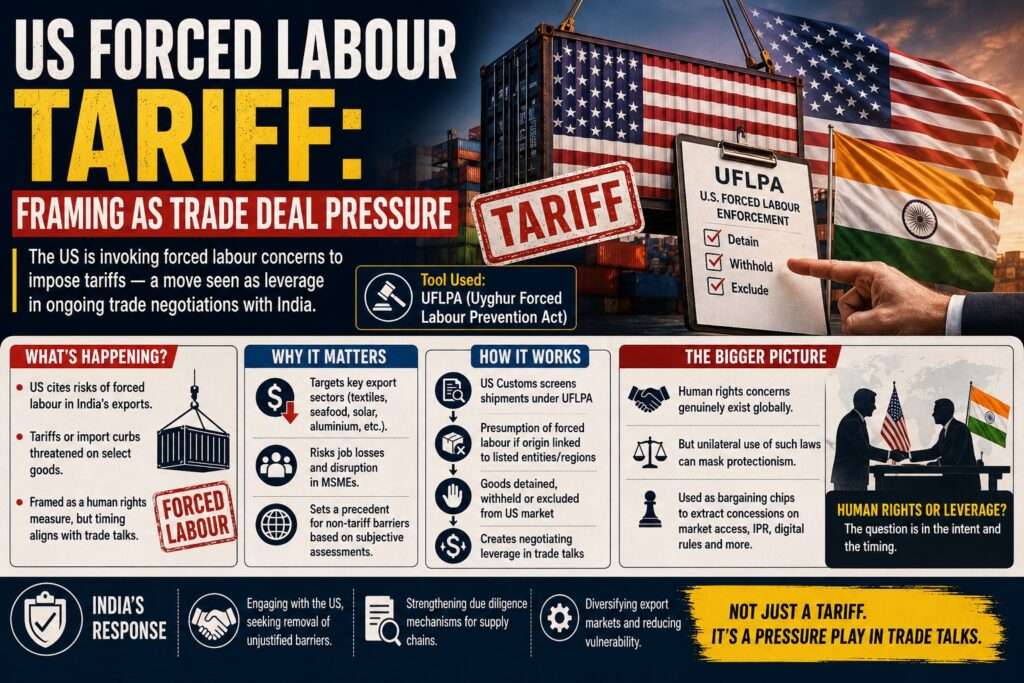
The United States has introduced a new tariff justified on forced labour grounds, applied unevenly across trading partners, days after halting a broader trade negotiation with India. This illustrates how trade policy is increasingly being used as a geopolitical instrument rather than solely to enforce labour standards. For India, the challenge is to protect its export interests while resisting pressure to accept unfavourable trade concessions and continuing to uphold a rules-based multilateral trading system.
What are the Trump administration’s new tariffs imposed for forced labour concern?
- The Trump administration has imposed new tariffs under Section 301 of the Trade Act of 1974, which is designed to address unfair foreign practices affecting US commerce.
- Effective from July 24, the US imposed 10 per cent or 12.5 per cent tariffs on all the 60 economies, which were subject to the investigation.
- India and 16 other countries are subject to the lower 10 per cent tariff, while 12.5 per cent tariffs have been imposed on the remaining 43 economies.
Why is the tariff read as pressure rather than a labour standards measure?
- Uneven application: Countries that already hold a trade deal with the United States receive more favourable tariff treatment, regardless of their actual labour practices.
- Timing: The tariff surfaced shortly after trade talks with India stalled, suggesting it functions as leverage to revive negotiations.
- No independent audit trail: The tariff does not rest on a published, verifiable forced labour finding specific to Indian sectors.
- Selective targeting: Sectors and countries without existing US trade agreements bear a disproportionate share of the tariff’s impact.
What is at stake for India in responding to this pressure?
- Negotiating posture: Accepting a hasty deal under this pressure risks locking India into terms it would not otherwise accept.
- Sectoral exposure: Indian export sectors named under the tariff face immediate cost pressure regardless of the tariff’s actual justification.
- Precedent: Conceding to a tariff based on an unverified standard invites similar leverage tactics in future negotiations.
Conclusion
India should not treat this tariff as a genuine labour compliance issue requiring domestic reform, but as a negotiating tactic requiring a negotiating response. Response through the WTO’s dispute mechanisms remains untested here.
