💥Join UPSC 2027,2028 Mentorship (July Batch) + XFactor Notes & Microthemes PDF

GS Paper: GS3-16.Achievements of Indians in Science & Technology; Indigenization of Technology and Developing New Technology.

  • With growing energy needs should India keep on expanding its nuclear energy programme? Discuss the facts and fears associated with nuclear energy.

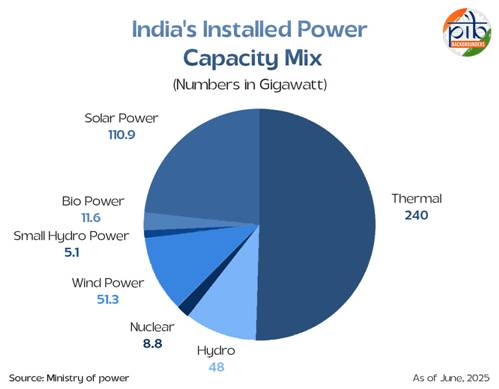
    India has installed nuclear capacity of around 8,180 MW. With the government aiming to triple this capacity to 22,480 MW by 2031-2032, the debate centers on balancing India’s soaring base-load energy demands with the strategic, financial, and environmental complexities of nuclear expansion.

    Need to Keep Expanding the Nuclear Energy Programme

    Reliable Base-Load Power: Unlike intermittent solar and wind energy, nuclear plants operate at very high capacity factors (85-90%).

    Supports Net-Zero Goals: Nuclear energy is a low-carbon source that helps reduce dependence on coal and supports India’s 2070 Net-Zero and Glasgow Panchamrit commitments.

    Advancing the Three-Stage Programme: With the PFBR at Kalpakkam attaining criticality, India can progress toward thorium-based long-term energy security.

    Low Land Requirement: Nuclear plants generate large amounts of electricity within a compact area, unlike extensive solar parks and wind farms.

    Private Investment through the SHANTI Act: Allows regulated private and foreign participation, including up to 49% equity in civilian nuclear projects.

    Commercialization of SMRs: India aims to operationalize indigenous Small Modular Reactors (SMRs) like the Bharat SMR-200 by 2033, offering lower costs and enhanced safety.

    Ensures Grid Stability: Nuclear power provides stable base-load support essential for integrating large-scale renewable energy into the national grid.

    Enhances Strategic Autonomy: Post-2008 NSG waiver, nuclear expansion strengthens India’s geopolitical standing and civil nuclear partnerships with countries like France, Russia, and the United States.

    Employment: The sector boosts advanced manufacturing and skilled employment through firms like Bharat Heavy Electricals Limited and Larsen & Toubro under the Make in India initiative.

    Fears and Challenges Associated with Nuclear Energy

    Import Dependence in Supply Chains: Despite progress in domestic manufacturing, India still relies on imports for critical high-precision nuclear components and instrumentation.

    Financial and Market Risks: High capital costs, long payback periods, tariff uncertainty, and lack of assured long-term PPAs reduce investor confidence in nuclear projects.

    Public Resistance and Safety Concerns: Projects like Kudankulam Nuclear Power Plant and Jaitapur have witnessed protests over radiation fears and displacement.

    Regulatory Uncertainty for SMRs: The absence of a dedicated regulatory framework for Small Modular Reactors (SMRs) creates uncertainty for new technology developers.

    Concerns over Supplier Liability: Changes under the SHANTI Act reducing supplier liability have raised concerns about weakening accountability and quality control standards.

    The “Act of God” Indemnity Gap: The SHANTI Act indemnifies operators for accidents caused by “grave natural disasters” marking a shift away from India’s traditional absolute liability principle.

    Fear of Nuclear Disasters: Incidents such as the Chernobyl disaster and Fukushima Daiichi nuclear disaster continue to shape public anxiety regarding reactor safety.

    Radioactive Waste Disposal: Safe long-term storage of high-level radioactive waste remains technologically and politically challenging worldwide.

    Security Vulnerabilities: Nuclear facilities face risks from cyberattacks, sabotage, drone strikes, and other asymmetric security threats. Eg- Kudankulam Plant Malware attack.

    Land Acquisition: Environmental concerns, local protests, and legal disputes continue to delay projects at sites like Jaitapur and Kovvada.

    Water Use and Thermal Pollution: Reactors require large quantities of cooling water, while discharge of heated water can harm nearby aquatic ecosystems.

    Human Capital Crisis: Declining academic interest has led many institutions, including IIT, Madras and IIT Bombay, to discontinue nuclear engineering programmes.

    Supply Chain and Execution Bottlenecks: Domestic suppliers face cash-flow shortages, skilled labour gaps, and quality compliance issues, causing delays in NPCIL’s fleet-mode construction projects.

    Way Forward

    Dedicated SMR Regulatory Framework: The Atomic Energy Regulatory Board should create a specialized framework for SMRs to accelerate safe commercialization.

    Develop Innovative Financing Mechanisms: Eg- Long-term low-interest financing, green bonds, Viability Gap Funding (VGF), and specialized insurance mechanisms.

    Strengthen Domestic Supply Chains: Should expand fleet-mode procurement and support domestic industries in producing advanced nuclear components to reduce import dependence and project costs.

    Ensure Independent Nuclear Regulation: The Atomic Energy Regulatory Board must be given greater functional and financial autonomy to ensure credible safety oversight.

    Revive Nuclear Talent Pipelines: Support nuclear engineering programmes through scholarships, research grants, and assured internships to build skilled manpower.

    Expand the Indian Nuclear Insurance Pool (INIP): Strengthening INIP through General Insurance Corporation of India can provide better coverage for accident liability.

    With the SHANTI Act and the Kalpakkam breakthrough, India has gained strong momentum for nuclear expansion. Effective implementation can help build a sustainable, self-reliant, and resilient clean energy future.
  • Discuss the work of ‘Bose-Einstein Statistics’ done by Prof. Satyendra Nath Bose and show how it revolutionized the field of Physics.

    In 1924, S.N Bose wrote a groundbreaking paper on quantum theory that solved key problems in radiation physics. Recognizing its importance, Albert Einstein translated and published it, laying the foundation of Bose-Einstein statistics and modern quantum mechanics.

    The Work of ‘Bose-Einstein Statistics’

    Indistinguishability of Particles: Bose proposed that subatomic particles like photons are completely identical and indistinguishable, meaning swapping their positions does not create a new physical state.

    New Counting Method: Instead of using classical probability, Bose developed a unique statistical method to calculate how identical particles distribute themselves across different energy levels.

    Deriving Planck’s Law: Bose successfully derived Max Planck’s blackbody radiation formula purely from quantum concepts, completely removing the traditional reliance on classical physics electromagnetism laws.

    Integer Spin Behavior: The statistics apply to particles with whole-number spins, called Bosons, which naturally tend to cluster together in the exact same quantum state.

    Extension to Matter: Albert Einstein expanded Bose’s mathematical framework from light photons to massive gas atoms, predicting a new state of matter at ultra-low temperatures.

    How It Revolutionized the Field of Physics

    The Concept of Bosons: Particles with integer spins (Eg- photons, gluons, and the Higgs Boson) were named bosons in his honor. Unlike fermions, any number of bosons can occupy the same quantum state.

    Macroscopic Quantum Phenomena: The statistics provided the mathematical basis to understand low-temperature quantum phenomena like superfluidity and superconductivity.

    Experimental Proof: The theoretical prediction of BECs was experimentally proven in 1995 by Eric Cornell and Carl Wieman, which created an entirely new field of ultra-cold atomic physics.

    Technological Applications: It serves as the underlying principle behind lasers (which rely on coherent, indistinguishable photons), semiconductors, and modern quantum computing

    S.N Bose bridged the gap between early quantum theory and modern quantum mechanics by redefining particle identity through revolutionary statistical methods, influencing pioneers like Erwin Schrödinger and Werner Heisenberg.

  • How was India benefited from the contributions of Sir M.Visvesvaraya and Dr. M. S. Swaminathan in the fields of water engineering and agricultural science respectively?

    India’s foodgrains production has surged from 50.8 million tons in 1950-51 to over 357 million tons in 2025. Sir Visvesvaraya and Dr. Swaminathan played a prominent role in this transformation.

    Contribution of Sir M. Visvesvaraya in Water Engineering

    Modernisation of Irrigation Systems – Eg- Invented the automatic weir water floodgates, first installed at KRS Dam

    Major Dams and Multipurpose Projects – Designed the Krishna Raja Sagara (KRS) Dam, which irrigated 1.2 lakh+ hectares in Mandya region

    Developed water supply and drainage systems for Hyderabad, Pune, Nagpur, Belagavi

    Promotion of Scientific Water Management – Pioneered ideas like integrated river valley development

    Advocated planned economic development through irrigation, power generation, and industrialisation. Eg- Mysore Iron & Steel Works.

    International Projects– worked on water supply and drainage systems in the British Colony of Aden (now Yemen)

    His Mysore State Flood Report in 1909 provided crucial insights on flood management

    Contributions of Dr. M. S. Swaminathan in Agricultural Science

    Chaired the National Commission on Farmers and recommended policies like the MSP formula (C2 + 50%).

    Father of the Green Revolution – Introduced high-yielding varieties of wheat and rice. Eg- “Swarna” rice variety

    Achieving Food Self-Sufficiency – foodgrain production rose from ~72 million tonnes (1965) to over 130 million tonnes (1980s), ending “ship-to-mouth” dependence.

    Promotion of Sustainable and Climate-Resilient Agriculture – Advocated genetic conservation, bio-fortification, and evergreen revolution principles

    He played an instrumental role in developing the Protection of Plant Varieties and Farmers’ Rights Act of 2001.

    Institutional Building

    ICAR modernisation – Director-General from 1972 to 1979.

    Setting up MS Swaminathan Research Foundation (MSSRF)

    Promoting biotechnology. Eg- research on cryogenetics in potato crops.

    Together, they shaped India’s progress in water management, agriculture, and national development.

    Agriculture Technology

  • The fusion energy programme in India has steadily evolved over the past few decades. Mention India’s contributions to the international fusion energy project International Thermonuclear Experimental Reactor (ITER). What will be the implications of the success of this project for the future of global energy?

    Nuclear energy contributes approximately 3.1% to India’s total electricity generation, with an installed capacity of 8,880 MW.

    Evolution of Fusion Energy Programme in India

    The Early Phase (1950s-1980s): India was one of the first countries to announce a national fusion programme at the 1955 Geneva Conference.

    Indigenous Technology (1980s-2000s):

    Establishment of the Institute for Plasma Research (IPR) in 1986.

    Built its first indigenous tokamak ADITYA in 1989.

    Followed by the SST-1 (Steady-State Superconducting Tokamak)

    Global Integration (2005-Present): India joined ITER in 2005 as a full partner. Today, ITER-India manages India’s commitments, involving major industrial players like L&T and BHEL.

    India’s Contributions to ITER

    India is responsible for 9.1% of the construction cost (approx. $2.2 billion)

    The Cryostat: high-vacuum pressure chamber (30m*30m), designed to insulate the ultra-hot plasma from the outside world.

    In-Wall Shielding: India supplied 4,500 blocks of borated and ferritic steel to protect the reactor from neutron radiation.

    Cooling Water Systems: Responsible for the complex heat rejection systems required to manage the thermal load.

    Cryolines: Development of specialized pipelines to transport liquid helium at -269°C.

    Implications of Success for Future Global Energy

    Unlimited Fuel Supply: Fusion uses Deuterium (from seawater) and Tritium (from Lithium). One liter of seawater provides energy equivalent to 300 liters of gasoline.

    Unlike solar/wind, fusion provides a constant power supply without $CO_2$ emissions, vital for the Global Net Zero goals.

    Inherent Safety: There is no risk of a “meltdown.” If the plasma is disturbed, the reaction simply ceases instantly.

    Minimal Waste: It produces no long-lived high-level radioactive waste as plant components can be recycled within 100 years.

    High Energy Density: A fusion plant requires significantly less land than a solar farm to produce the same Terawatt-hours of energy.

    Geopolitical Stability: Energy “resource wars” could end, as the fuel (Deuterium/Lithium) is distributed globally, unlike oil or gas.

    Space Exploration: Compact fusion technology could revolutionize deep-space travel by providing high-thrust, long-duration propulsion.

    Technological Spin-offs: Research for ITER has already advanced superconducting magnets (used in MRIs) and high-power microwave technologies.

    Thus, fusion technology can help in transitioning from the Age of Combustion to the Age of Fusion.