💥Join UPSC 2027,2028 Mentorship (July Batch) + XFactor Notes & Microthemes PDF

GS Paper: GS3-16.Achievements of Indians in Science & Technology; Indigenization of Technology and Developing New Technology.

  • India Approves First Dengue Vaccine (QDENGA)

    Why in News?

    India has approved its first dengue vaccine, QDENGA (TAK-003), developed by Takeda Biopharmaceuticals, after receiving market authorization from the Drug Controller General of India (DCGI).

    Key Highlights

    • First dengue vaccine approved in India.
    • Approved for individuals aged 4 to 60 years.
    • Type: Live attenuated tetravalent vaccine.
    • Protects against all four dengue virus serotypes (DENV-1, DENV-2, DENV-3, DENV-4).
    • Dosage: Two doses administered 3 months apart.
    • Can be given irrespective of previous dengue infection.
    • No pre-vaccination screening is required.

    Clinical Performance

    • Based on 19 Phase I, II and III clinical trials involving over 28,000 participants.
    • Phase III (TIDES) trial enrolled 20,000+ participants across eight dengue-endemic countries.
    • 80.2% efficacy against confirmed dengue (12 months after second dose).
    • 90.4% efficacy against dengue-related hospitalization (18 months).
    • Long-term studies showed sustained protection for up to 7 years.

    Global Status

    • Approved in 43 countries.
    • WHO recommends its use in high dengue transmission settings.
    • Received WHO prequalification.
    • Included in the national immunization programmes of Brazil and public programmes in Argentina, Colombia, and Indonesia.

    About Dengue

    • Cause: Dengue virus (Flavivirus).
    • Vector: Female Aedes aegypti mosquito (also Aedes albopictus).
    • Transmission: Mosquito-borne (not spread directly from person to person).
    • Symptoms: High fever, severe headache, muscle and joint pain, skin rash, and bleeding in severe cases.
    • Severe Form: Dengue Hemorrhagic Fever (DHF) and Dengue Shock Syndrome (DSS).

    [2023] ‘Wolbachia method’ is sometimes talked about with reference to which one of the following?

    [A] Controlling the viral diseases spread by mosquitoes.

    [B] Converting crop residues into packing material.

    [C] Producing biodegradable plastics.

    [D] Producing biochar from thermo- chemical conversion of biomass

  • Ultrafast Organic Anodes for Next-Generation Rechargeable Batteries

    Why in News?

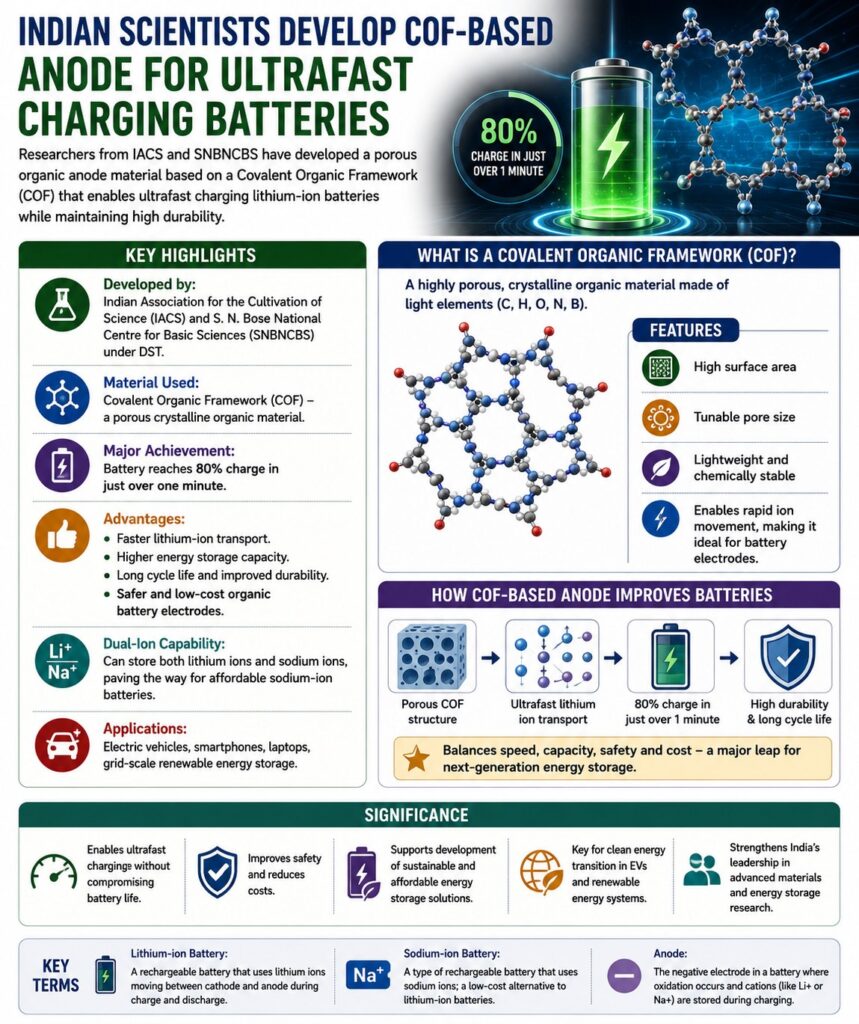
    Researchers from IACS and SNBNCBS have developed a porous organic anode material based on a Covalent Organic Framework (COF) that enables ultrafast charging lithium-ion batteries while maintaining high durability.

    Key Highlights

    • Developed by: Indian Association for the Cultivation of Science (IACS) and S. N. Bose National Centre for Basic Sciences (SNBNCBS) under DST.
    • Material Used: Covalent Organic Framework (COF) – a porous crystalline organic material.
    • Major Achievement: Battery reaches 80% charge in just over one minute.
    • Advantages:
      • Faster lithium-ion transport.
      • Higher energy storage capacity.
      • Long cycle life and improved durability.
      • Safer and low-cost organic battery electrodes.
    • Dual-Ion Capability: Can store both lithium ions and sodium ions, paving the way for affordable sodium-ion batteries.
    • Applications: Electric vehicles, smartphones, laptops, grid-scale renewable energy storage.

    What is a Covalent Organic Framework (COF)?

    • A highly porous, crystalline organic material made of light elements (C, H, O, N, B).
    • Features: High surface area. Tunable pore size. Lightweight and chemically stable. Enables rapid ion movement, making it ideal for battery electrodes.

    [2025] In the context of electric vehicle batteries, consider the following elements:
    I. Cobalt
    II. Graphite
    III. Lithium
    IV. Nickel
    How many of the above usually make up battery cathodes?

    [A] Only one

    [B] Only two

    [C] Only three

    [D] All the four

  • India’s First Hydrogen Fuel Cell Train

    Why in News?

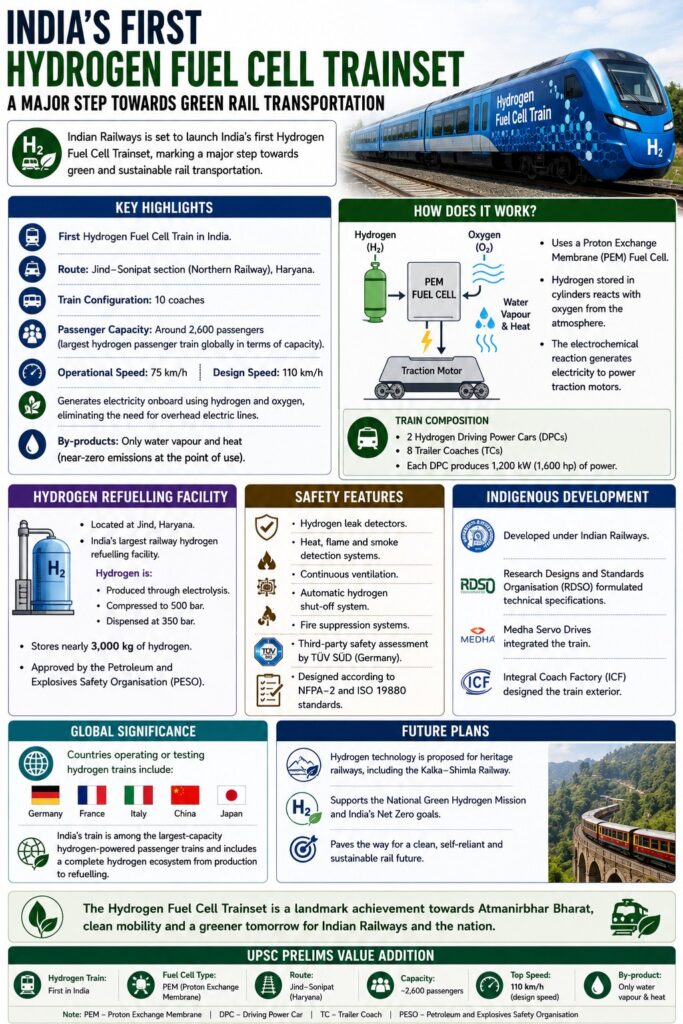
    Indian Railways is set to launch India’s first Hydrogen Fuel Cell Trainset, marking a major step towards green and sustainable rail transportation.

    Key Highlights

    • First Hydrogen Fuel Cell Train in India.
    • Route: Jind–Sonipat section (Northern Railway), Haryana.
    • Train Configuration: 10 coaches
    • Passenger Capacity: Around 2,600 passengers (largest hydrogen passenger train globally in terms of capacity).
    • Operational Speed: 75 km/h
    • Design Speed: 110 km/h
    • Generates electricity onboard using hydrogen and oxygen, eliminating the need for overhead electric lines.
    • By-products: Only water vapour and heat (near-zero emissions at the point of use).

    How Does It Work?

    • Uses a Proton Exchange Membrane (PEM) Fuel Cell.
    • Hydrogen stored in cylinders reacts with oxygen from the atmosphere.
    • The electrochemical reaction generates electricity to power traction motors.
    • The train consists of: 2 Hydrogen Driving Power Cars (DPCs) and 8 Trailer Coaches (TCs)
    • Each DPC produces 1,200 kW (1,600 hp) of power.

    Hydrogen Refuelling Facility

    • Located at Jind, Haryana.
    • India’s largest railway hydrogen refuelling facility.
    • Hydrogen is Produced through electrolysis, Compressed to 500 bar, and Dispensed at 350 bar.
    • Stores nearly 3,000 kg of hydrogen.
    • Approved by the Petroleum and Explosives Safety Organisation (PESO).

    Safety Features

    • Hydrogen leak detectors.
    • Heat, flame and smoke detection systems.
    • Continuous ventilation.
    • Automatic hydrogen shut-off system.
    • Fire suppression systems.
    • Third-party safety assessment by TÜV SÜD (Germany).
    • Designed according to NFPA-2 and ISO 19880 standards.

    Indigenous Development

    • Developed under Indian Railways.
    • Research Designs and Standards Organisation (RDSO) formulated technical specifications.
    • Medha Servo Drives integrated the train.
    • Integral Coach Factory (ICF) designed the train exterior.

    Global Significance

    • Countries operating or testing hydrogen trains include Germany, France, Italy, China, and Japan
    • India’s train is among the largest-capacity hydrogen-powered passenger trains and includes a complete hydrogen ecosystem from production to refuelling.

    Future Plans

    • Hydrogen technology is proposed for heritage railways, including the Kalka–Shimla Railway.
    • Supports the National Green Hydrogen Mission and India’s Net Zero goals

    [2026] Which of the following statements with regard to Green Hydrogen is/are correct ?
    1. It is decarbonized hydrogen obtained from natural gas reforming combined with carbon capture and storage (CCS).
    2. It is produced using electrolysis of water with electricity generated by renewable energy.
    3. National Green Hydrogen Mission of India aims for abatement of nearly 50 MMT of annual greenhouse gas emissions by 2030.
    Select the answer using the code given below :

    [A] 1 only

    [B] 2 and 3 only

    [C] 2 only

    [D] 1, 2 and 3

  • Gaganyaan: ISRO Successfully Tests Key Crew Module Systems

    Why in News?

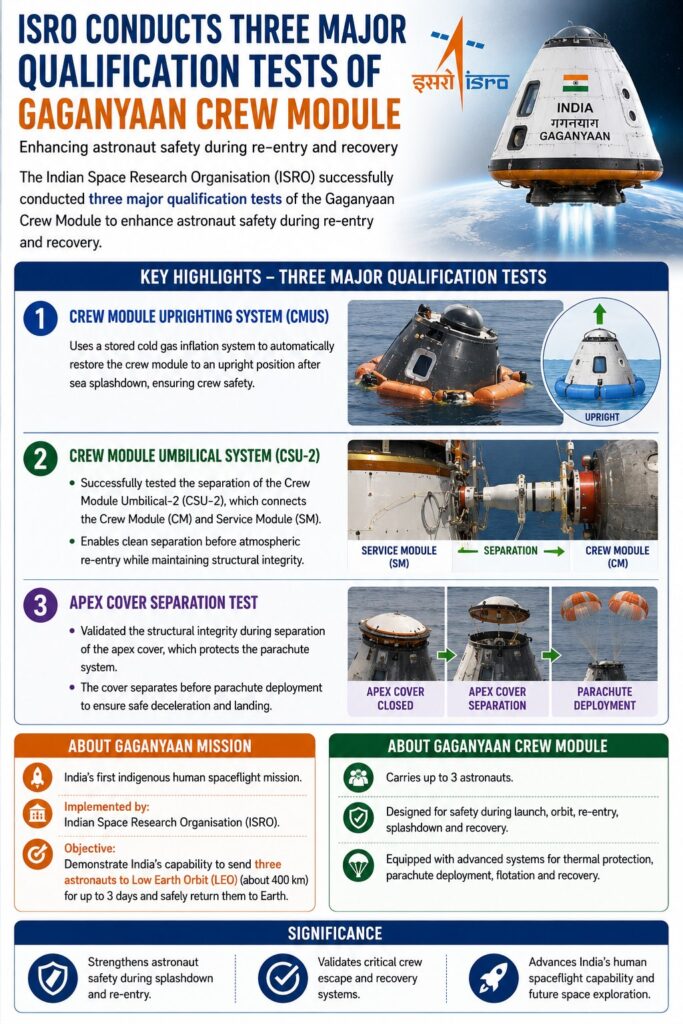
    The Indian Space Research Organisation (ISRO) successfully conducted three major qualification tests of the Gaganyaan Crew Module to enhance astronaut safety during re-entry and recovery.

    Key Highlights

    • Crew Module Uprighting System (CMUS): Uses a stored cold gas inflation system to automatically restore the crew module to an upright position after sea splashdown, ensuring crew safety.
    • Crew Module Umbilical System (CSU-2): Successfully tested the separation of the Crew Module Umbilical-2 (CSU-2), which connects the Crew Module (CM) and Service Module (SM).
      • Enables clean separation before atmospheric re-entry while maintaining structural integrity.
    • Apex Cover Separation Test: Validated the structural integrity during separation of the apex cover, which protects the parachute system.
      • The cover separates before parachute deployment to ensure safe deceleration and landing.
      • Note: Parachute systems are deployed to slow descents through the atmosphere or space.

    About Gaganyaan Mission

    • India’s first indigenous human spaceflight mission.
    • Implemented by: Indian Space Research Organisation (ISRO).
    • Objective: Demonstrate India’s capability to send three astronauts to Low Earth Orbit (LEO) (about 400 km) for up to 3 days and safely return them to Earth.

    Significance

    • Strengthens astronaut safety during splashdown and re-entry.
    • Validates critical crew escape and recovery systems.
    • Advances India’s human spaceflight capability and future space exploration.

    [2025] Consider the following space missions:
    I. Axiom-4
    II. SpaDeX
    III. Gaganyaan
    How many of the space missions given above encourage and support microgravity research?

    [A] Only one

    [B] Only two

    [C] All the three

    [D] None

  • What India’s 12 ‘operationally deployed’ nuclear warheads mean

    Why in the News?

    SIPRI’s 2026 Yearbook classified 12 of India’s 190 nuclear warheads as operationally deployed for the first time. These are positioned with active military forces mated with delivery systems and ready for use.The classification has triggered concern over a possible shift in India’s No First Use (NFU) doctrine.

    Why does SIPRI’s “deployment” classification not indicate a shift in India’s nuclear doctrine?

    1. No change in launch policy: NFU commits India to not launching a pre-emptive strike; SIPRI’s report records no revision of this commitment.
    2. No threshold lowering: The report does not indicate any lowering of the threshold for nuclear employment.
    3. No change in political control: Civilian and political oversight mechanisms governing nuclear release remain unaltered.
    4. Expert confirmation: Warheads mated with delivery platforms make assured retaliation more credible, not less restrained.
    5. Reaffirmed commitment: India’s representatives reaffirmed NFU and non-use against non-nuclear-weapon states at the UN High-Level Meeting in September 2025.
    6. Internal calls for first-use rejected: Periodic domestic proposals for a conditional or hybrid first-use posture have not prevailed.

    Why does the stockpile-deployment distinction matter for assessing India’s posture?

    Possessing a warhead and deploying it as part of an operational deterrent are not the same condition. The distinction determines whether a count of warheads signals readiness or merely holdings.

    1. De-mated baseline: For most of its nuclear history, India stored warheads separately from delivery vehicles at a central site under strict oversight.
    2. Purpose of de-mating: This was meant to maximise safety, reduce accidental-use risk, and signal restraint internationally.
    3. Definition of deployment: Deployment pairs a warhead with a delivery system and positions it with operational forces in readiness.
    4. Readiness, not intent: A deployed weapon is configured for use if authorised; it is not a signal of imminent use.
    5. Speed differential: A de-mated weapon needs time to prepare and deploy; a mated weapon can be launched faster.
    6. Scale of the shift: SIPRI’s count reflects a small but significant fraction of India’s arsenal now held in operational readiness, not a wholesale change in posture.

    How does the sea-based deterrent resolve the central vulnerability in India’s NFU doctrine?

    NFU is a retaliation-only doctrine, so it stands or falls on whether the force can survive a first strike. Sea-basing closes the specific gap that land-based deployment cannot.

    1. Survivability requirement: NFU depends on enough of the arsenal surviving a first strike to deliver a retaliatory blow; without this, NFU becomes a liability rather than a doctrine.
    2. Land-based vulnerability: Land-based missiles sit at known, mappable locations and can be targeted in a disarming first strike.
    3. Sea-based advantage: A submerged submarine cannot be found, tracked, or destroyed in time, removing this vulnerability.
    4. Arihant-class platform: India’s Arihant-class submarines have steadily strengthened second-strike survivability, with additional platforms expected to further consolidate this leg of the triad.
    5. Operational milestone: Three operational SSBNs allow India to keep at least one submarine submerged and on patrol at all times.
    6. Supporting readiness measure: Increasing reliance on canisterised Agni-series missiles, which carry fuel sealed and ready, raises operational readiness without requiring further preparation before launch.

    What broader trend does India’s deployment milestone sit within, and why does it matter?

    1. Global reversal: SIPRI’s 2026 Yearbook records states increasingly relying on nuclear weapons as instruments of national power, reversing decades of gradual disarmament progress.
    2. Scale of global arsenals: Nine nuclear-armed states held an estimated 12,187 warheads as of January 2026.
    3. China’s pace: China’s arsenal has grown to approximately 620 warheads, expanding faster than any other nuclear power and now over three times Pakistan’s estimated stockpile.
    4. Dual-direction posture: India’s modernisation is increasingly focused on long-range systems capable of reaching China, while continuing to account for Pakistan.
    5. Weakening arms control: Arms-control agreements have weakened or collapsed even as competition intensifies in hypersonic delivery, AI-enabled decision support, missile defence, and anti-submarine warfare.
    6. Unresolved risk: The maturation of India’s second-strike capability strengthens deterrence bilaterally, but does nothing to address the rising risk of miscalculation across a destabilising global order.

    Conclusion

    SIPRI’s classification of 12 Indian warheads as operationally deployed documents the maturing of India’s sea-based second-strike capability, not a retreat from No First Use. This development, however, sits inside a global environment where arms-control frameworks are weakening and major powers are re-arming. The institutions designed to manage nuclear risk must adapt to this faster-fielding environment, or the credibility gained through India’s improved deterrent will be offset by a rising structural risk of miscalculation.

    PYQ Relevance

    [UPSC 2017] Give an account of the growth and development of nuclear science and technology in India. What is the advantage of fast breeder reactor programme in India?

    Linkage: Tests India’s strategic nuclear capabilities, indigenous nuclear development and the evolution of its deterrence architecture.The article explains how India’s maturing nuclear triad and operational deployment strengthen its credible minimum deterrence and second-strike capability without altering its No First Use doctrine.

  • With growing energy needs should India keep on expanding its nuclear energy programme? Discuss the facts and fears associated with nuclear energy.

    India has installed nuclear capacity of around 8,180 MW. With the government aiming to triple this capacity to 22,480 MW by 2031-2032, the debate centers on balancing India’s soaring base-load energy demands with the strategic, financial, and environmental complexities of nuclear expansion.

    Need to Keep Expanding the Nuclear Energy Programme

    Reliable Base-Load Power: Unlike intermittent solar and wind energy, nuclear plants operate at very high capacity factors (85-90%).

    Supports Net-Zero Goals: Nuclear energy is a low-carbon source that helps reduce dependence on coal and supports India’s 2070 Net-Zero and Glasgow Panchamrit commitments.

    Advancing the Three-Stage Programme: With the PFBR at Kalpakkam attaining criticality, India can progress toward thorium-based long-term energy security.

    Low Land Requirement: Nuclear plants generate large amounts of electricity within a compact area, unlike extensive solar parks and wind farms.

    Private Investment through the SHANTI Act: Allows regulated private and foreign participation, including up to 49% equity in civilian nuclear projects.

    Commercialization of SMRs: India aims to operationalize indigenous Small Modular Reactors (SMRs) like the Bharat SMR-200 by 2033, offering lower costs and enhanced safety.

    Ensures Grid Stability: Nuclear power provides stable base-load support essential for integrating large-scale renewable energy into the national grid.

    Enhances Strategic Autonomy: Post-2008 NSG waiver, nuclear expansion strengthens India’s geopolitical standing and civil nuclear partnerships with countries like France, Russia, and the United States.

    Employment: The sector boosts advanced manufacturing and skilled employment through firms like Bharat Heavy Electricals Limited and Larsen & Toubro under the Make in India initiative.

    Fears and Challenges Associated with Nuclear Energy

    Import Dependence in Supply Chains: Despite progress in domestic manufacturing, India still relies on imports for critical high-precision nuclear components and instrumentation.

    Financial and Market Risks: High capital costs, long payback periods, tariff uncertainty, and lack of assured long-term PPAs reduce investor confidence in nuclear projects.

    Public Resistance and Safety Concerns: Projects like Kudankulam Nuclear Power Plant and Jaitapur have witnessed protests over radiation fears and displacement.

    Regulatory Uncertainty for SMRs: The absence of a dedicated regulatory framework for Small Modular Reactors (SMRs) creates uncertainty for new technology developers.

    Concerns over Supplier Liability: Changes under the SHANTI Act reducing supplier liability have raised concerns about weakening accountability and quality control standards.

    The “Act of God” Indemnity Gap: The SHANTI Act indemnifies operators for accidents caused by “grave natural disasters” marking a shift away from India’s traditional absolute liability principle.

    Fear of Nuclear Disasters: Incidents such as the Chernobyl disaster and Fukushima Daiichi nuclear disaster continue to shape public anxiety regarding reactor safety.

    Radioactive Waste Disposal: Safe long-term storage of high-level radioactive waste remains technologically and politically challenging worldwide.

    Security Vulnerabilities: Nuclear facilities face risks from cyberattacks, sabotage, drone strikes, and other asymmetric security threats. Eg- Kudankulam Plant Malware attack.

    Land Acquisition: Environmental concerns, local protests, and legal disputes continue to delay projects at sites like Jaitapur and Kovvada.

    Water Use and Thermal Pollution: Reactors require large quantities of cooling water, while discharge of heated water can harm nearby aquatic ecosystems.

    Human Capital Crisis: Declining academic interest has led many institutions, including IIT, Madras and IIT Bombay, to discontinue nuclear engineering programmes.

    Supply Chain and Execution Bottlenecks: Domestic suppliers face cash-flow shortages, skilled labour gaps, and quality compliance issues, causing delays in NPCIL’s fleet-mode construction projects.

    Way Forward

    Dedicated SMR Regulatory Framework: The Atomic Energy Regulatory Board should create a specialized framework for SMRs to accelerate safe commercialization.

    Develop Innovative Financing Mechanisms: Eg- Long-term low-interest financing, green bonds, Viability Gap Funding (VGF), and specialized insurance mechanisms.

    Strengthen Domestic Supply Chains: Should expand fleet-mode procurement and support domestic industries in producing advanced nuclear components to reduce import dependence and project costs.

    Ensure Independent Nuclear Regulation: The Atomic Energy Regulatory Board must be given greater functional and financial autonomy to ensure credible safety oversight.

    Revive Nuclear Talent Pipelines: Support nuclear engineering programmes through scholarships, research grants, and assured internships to build skilled manpower.

    Expand the Indian Nuclear Insurance Pool (INIP): Strengthening INIP through General Insurance Corporation of India can provide better coverage for accident liability.

    With the SHANTI Act and the Kalpakkam breakthrough, India has gained strong momentum for nuclear expansion. Effective implementation can help build a sustainable, self-reliant, and resilient clean energy future.

  • Discuss the work of ‘Bose-Einstein Statistics’ done by Prof. Satyendra Nath Bose and show how it revolutionized the field of Physics.

    In 1924, S.N Bose wrote a groundbreaking paper on quantum theory that solved key problems in radiation physics. Recognizing its importance, Albert Einstein translated and published it, laying the foundation of Bose-Einstein statistics and modern quantum mechanics.

    The Work of ‘Bose-Einstein Statistics’

    Indistinguishability of Particles: Bose proposed that subatomic particles like photons are completely identical and indistinguishable, meaning swapping their positions does not create a new physical state.

    New Counting Method: Instead of using classical probability, Bose developed a unique statistical method to calculate how identical particles distribute themselves across different energy levels.

    Deriving Planck’s Law: Bose successfully derived Max Planck’s blackbody radiation formula purely from quantum concepts, completely removing the traditional reliance on classical physics electromagnetism laws.

    Integer Spin Behavior: The statistics apply to particles with whole-number spins, called Bosons, which naturally tend to cluster together in the exact same quantum state.

    Extension to Matter: Albert Einstein expanded Bose’s mathematical framework from light photons to massive gas atoms, predicting a new state of matter at ultra-low temperatures.

    How It Revolutionized the Field of Physics

    The Concept of Bosons: Particles with integer spins (Eg- photons, gluons, and the Higgs Boson) were named bosons in his honor. Unlike fermions, any number of bosons can occupy the same quantum state.

    Macroscopic Quantum Phenomena: The statistics provided the mathematical basis to understand low-temperature quantum phenomena like superfluidity and superconductivity.

    Experimental Proof: The theoretical prediction of BECs was experimentally proven in 1995 by Eric Cornell and Carl Wieman, which created an entirely new field of ultra-cold atomic physics.

    Technological Applications: It serves as the underlying principle behind lasers (which rely on coherent, indistinguishable photons), semiconductors, and modern quantum computing

    S.N Bose bridged the gap between early quantum theory and modern quantum mechanics by redefining particle identity through revolutionary statistical methods, influencing pioneers like Erwin Schrödinger and Werner Heisenberg.

  • How was India benefited from the contributions of Sir M.Visvesvaraya and Dr. M. S. Swaminathan in the fields of water engineering and agricultural science respectively?

    India’s foodgrains production has surged from 50.8 million tons in 1950-51 to over 357 million tons in 2025. Sir Visvesvaraya and Dr. Swaminathan played a prominent role in this transformation.

    Contribution of Sir M. Visvesvaraya in Water Engineering

    Modernisation of Irrigation Systems – Eg- Invented the automatic weir water floodgates, first installed at KRS Dam

    Major Dams and Multipurpose Projects – Designed the Krishna Raja Sagara (KRS) Dam, which irrigated 1.2 lakh+ hectares in Mandya region

    Developed water supply and drainage systems for Hyderabad, Pune, Nagpur, Belagavi

    Promotion of Scientific Water Management – Pioneered ideas like integrated river valley development

    Advocated planned economic development through irrigation, power generation, and industrialisation. Eg- Mysore Iron & Steel Works.

    International Projects– worked on water supply and drainage systems in the British Colony of Aden (now Yemen)

    His Mysore State Flood Report in 1909 provided crucial insights on flood management

    Contributions of Dr. M. S. Swaminathan in Agricultural Science

    Chaired the National Commission on Farmers and recommended policies like the MSP formula (C2 + 50%).

    Father of the Green Revolution – Introduced high-yielding varieties of wheat and rice. Eg- “Swarna” rice variety

    Achieving Food Self-Sufficiency – foodgrain production rose from ~72 million tonnes (1965) to over 130 million tonnes (1980s), ending “ship-to-mouth” dependence.

    Promotion of Sustainable and Climate-Resilient Agriculture – Advocated genetic conservation, bio-fortification, and evergreen revolution principles

    He played an instrumental role in developing the Protection of Plant Varieties and Farmers’ Rights Act of 2001.

    Institutional Building

    ICAR modernisation – Director-General from 1972 to 1979.

    Setting up MS Swaminathan Research Foundation (MSSRF)

    Promoting biotechnology. Eg- research on cryogenetics in potato crops.

    Together, they shaped India’s progress in water management, agriculture, and national development.

    Agriculture Technology