💥Mains Ready By December. Smash Mains & Smash PYQ Admissions Open

GS Paper: GS2-13.Issues relating to development and management of Social Sector/Services relating to Health, Education, Human Resources.

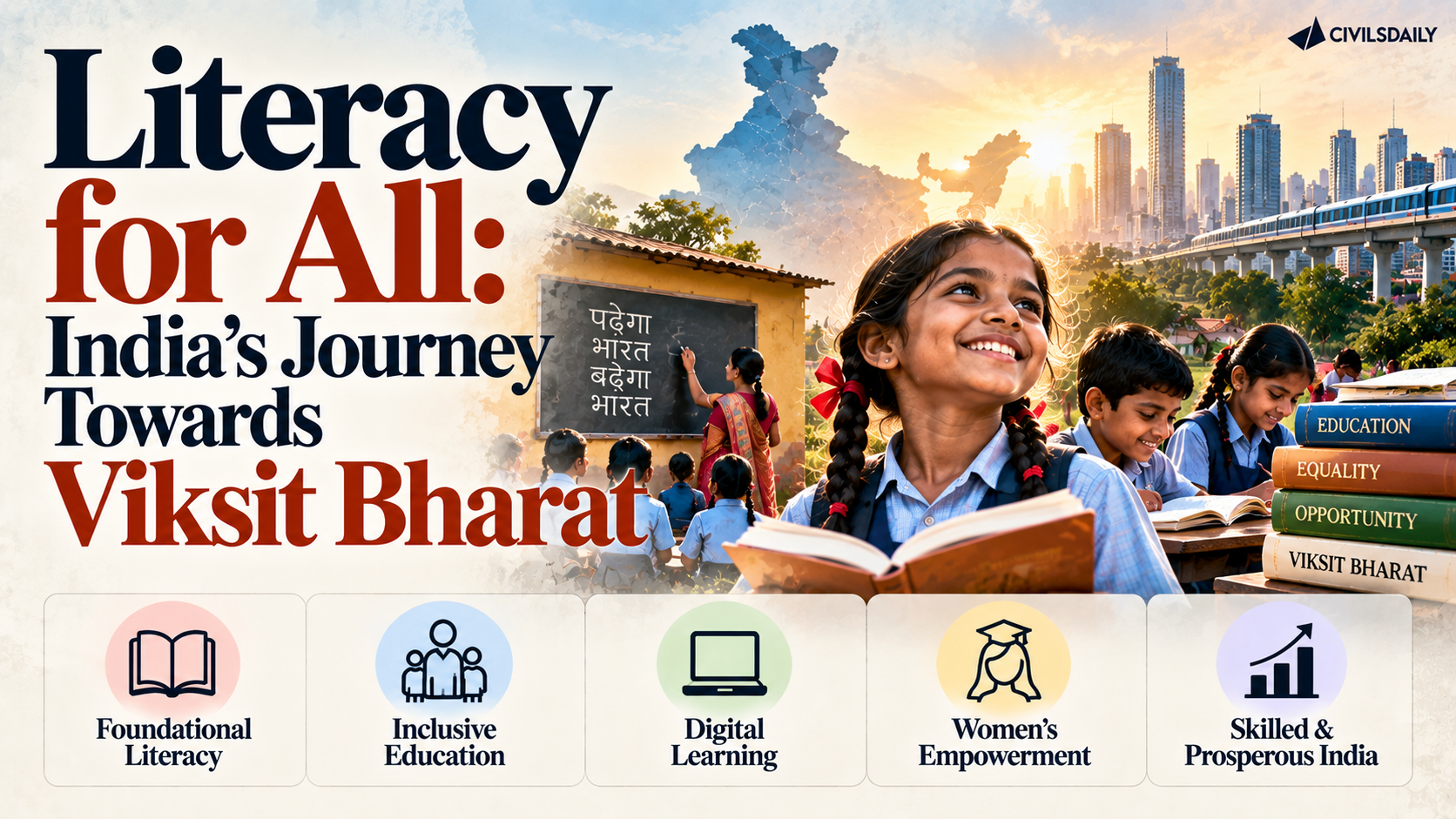
  • Literacy for All: India’s Journey Towards Viksit Bharat

    Literacy for All: India’s Journey Towards Viksit Bharat

    Why in the News?

    The PIB highlighted India’s progress towards universal literacy, including recent literacy data and government initiatives such as ULLAS and NIPUN Bharat.

    Key Highlights

    • India’s literacy rate increased from 18.32% in 1951 to 74.04% in 2011.
    • Female literacy increased from 8.86% in 1951 to 65.46% in 2011.
    • As per PLFS 2025, overall literacy rate was 81.1%.
    • Urban literacy among population aged 7+ years: 89%.
    • Rural literacy among population aged 7+ years: 77.4%.
    • The Department of School Education and Literacy considers 95% literacy in a State/UT equivalent to full literacy.
    • According to UDISE+ 2025-26, over 24.72 crore students were enrolled in schools.
    • Higher education enrolment increased from 3.42 crore in 2014-15 to 4.50 crore in 2023-24.
    • Higher education GER increased from 23.7% to 30% during the same period.

    ULLAS

    • ULLAS stands for Understanding of Lifelong Learning for All in Society.
    • Also known as New India Literacy Programme (NILP).
    • Centrally sponsored scheme aligned with NEP 2020.
    • Targets adults aged 15 years and above who missed formal schooling.
    • Covers:
      • Functional literacy
      • Numeracy
      • Critical life skills
      • Lifelong learning
    • Uses volunteerism and Janbhagidari for universal literacy.
    • ULLAS App provides learning material in 27 languages.
    • Learners eventually appear for the Foundational Literacy and Numeracy Assessment Test (FLNAT).
    • Target: 5 crore learners during 2022-27.
    • Financial outlay: ₹1,037.90 crore.
    • Around 4.03 crore registered learners and over 52.20 lakh volunteers.
    • More than 3.3 crore learners have participated in FLNAT.
    • 10 States/UTs declared themselves fully literate between 2024 and 2026.

    NIPUN Bharat

    • NIPUN: National Initiative for Proficiency in Reading with Understanding and Numeracy.
    • Launched in July 2021 under Samagra Shiksha.
    • Target: universal foundational literacy and numeracy by 2026-27.
    • Focuses on children in the Foundational Stage, ages 3-8 years.
    • Aims to ensure foundational skills by Grade 2.

    Other Education Initiatives

    • Samagra Shiksha: Promotes equitable and quality school education; subsumed SSA, RMSA and Teacher Education schemes.
    • PM SHRI: Aims to strengthen more than 14,500 exemplar schools.
    • PM e-VIDYA: Provides digital, online and on-air education; expected to benefit nearly 25 crore school-going children.
    • PM POSHAN: Provides one hot cooked meal to 11.20 crore students in Bal Vatikas and Classes I-VIII across 10.36 lakh schools.

    Prelims Quick Revision

    • 95% literacy in a State/UT is considered equivalent to full literacy.
    • India’s literacy rate: 74.04% in 2011.
    • Overall literacy as per PLFS 2025: 81.1%.
    • ULLAS: Adult literacy, 15+ years.
    • NIPUN Bharat: Foundational literacy and numeracy, ages 3-8 years.
    • ULLAS target: 5 crore learners during 2022-27.
    • NIPUN Bharat target: foundational literacy and numeracy by 2026-27.
    • SDG 4 focuses on inclusive and equitable quality education and lifelong learning.

    UPSC Prelims Trap

    • ULLAS vs NIPUN Bharat: ULLAS focuses on adult learners aged 15+, while NIPUN Bharat focuses on foundational learning among children aged 3-8 years.
    • 95% literacy is the benchmark for declaring a State/UT fully literate in the given framework, not 100%.
    • ULLAS is centrally sponsored, not a standalone Central Sector scheme.
    • NIPUN Bharat was launched in July 2021 under Samagra Shiksha.
  • Resisting invaders to swords of goddesses: NCERT revises book on medieval history for Class 9

    Why in the News

    The National Council of Educational Research and Training (NCERT) has released Part 2 of its new Class 9 social science textbook, which calls 1000 to 1700 AD a period of “Resistance and Resilience”. The book mentions “both conflict and cooperation” but focuses on resistance, not cooperation or a composite culture, which reopens the debate on how schools should teach medieval India.

    What is the new Class 9 textbook?

    1. What it is: “Understanding Society: India and Beyond” is NCERT’s new social science textbook for Class 9, part of the Secondary Stage of schooling. Part 1 came out in June, covering history, political science, geography and economics.
    2. Stated aim: The foreword by the NCERT Director says the subject should build critical inquiry, intercultural understanding and confident participation in civic life.
    3. Books replaced: The new books replace four older textbooks, including “Democratic Politics-1” and “India and the Contemporary World”, which taught the French and Russian Revolutions, Socialism in Europe and the Rise of Nazism.
    4. The takeaway: The national textbook now tells medieval history as a story of defence against outsiders, so it shapes how Class 9 students understand the whole period.

    How does the book retell 1000 to 1700 AD?

    1. Central claim: The book says the subcontinent faced repeated invasions with religious discrimination and social distress. Resistance took both military and cultural forms, and society “preserved its traditions”.
    2. Who resisted: Rajputs, the Ahom, Vijayanagara, the Marathas, Sikhs and Jats are shown resisting the Turks, the Mughals and European forces.
    3. Mewar and the Ahom: One section covers Maharana Pratap’s resistance to Akbar. Another says the Ahom kingdom of Assam stayed independent for almost six centuries, with Lachit Borphukan defeating a Mughal fleet at Saraighat.
    4. Beyond the north: The Vijayanagara section says resistance to foreign invasion “was not confined to northern India”.
    5. Swarajya: The Maratha idea is explained as “an independent, self-governing territory free from external control”.

    How does the book treat religion and culture?

    1. Sikhs and Jats: The book cites the martyrdom of the Sikh Gurus and Mughal “discriminatory practices”. It links Jat resistance to economic hardship and Aurangzeb’s religious policies.
    2. Temples: The book records temples destroyed and mosques built on their sites. Eg. Todarmal and Man Singh rebuilt Kashi Vishwanath, Aurangzeb destroyed it, and Ahilyabai Holkar reconstructed it.
    3. Bhakti: The book credits Bhakti, personal devotion to God, with sustaining worship when temple building was restricted. Eg. Chaitanya Mahaprabhu led public sankirtan (group devotional singing) in Bengal against a Qazi’s (Islamic judge’s) curbs.
    4. Sufism: Sufism is described as a comparatively liberal strand of Islam that also helped Islam spread.
    5. Swords of goddesses: A box says kings have invoked Kali, Durga and Bhavani as protectors since the seventh century. Eg. Shivaji received his sword from Tulja Bhavani, and Annamaraja of Bastar his from Danteshvari.

    How does this depart from earlier history teaching?

    1. Old consensus: For over 50 years, Indian historiography stressed cooperation and composite culture, meaning the shared art, language and belief that grew from mixing traditions.
    2. Thin Sultanate coverage: The Delhi Sultanate gets one page, mostly on local kings who resisted it. The Mughal period is longer but also centres on resistance.
    3. Kachwaha alliance: The Kachwahas of Amber and their “cooperative relationships” with the Mughals get only a brief mention.

    Challenges

    1. Partial picture: Stressing only resistance hides the alliances and shared institutions that also shaped the period. Eg. Rajputs as Mughal mansabdars (ranked nobles).
    2. Belief read as history: Goddess-given swords are traditions, and students may not separate legend from evidence.
    3. Lost world history: Dropping the French and Russian Revolutions weakens understanding of democracy and ideology.
    4. Frequent revision: Repeated rewrites unsettle teachers and students. Eg. Mughal court chapter dropped from Class 12 in 2023.

    Way Forward

    1. Source-based chapters: NCERT should add primary sources and more than one interpretation for each theme.
    2. Expert review: Drafts should go to historians and public consultation before release.
    3. Clear labels: Textbooks should mark legend, tradition and evidence separately.
    4. Teacher training: State education departments should train teachers on the new chapters.

    Conclusion

    The new book moves school history away from synthesis towards a story of resistance, and that choice is now the version most students will learn. What to watch is whether later volumes restore cooperation and world history, and how teachers handle belief and evidence in class.

    Matching Previous Year Question

    “[2026, GS2, 15 marks] Should education be treated primarily as a welfare obligation of the state or as a strategic investment for building a globally competitive, knowledge-driven nation? Critically evaluate.”

  • Indian academia’s drift from reason to ritual

    Why in the News

    At the Indian Institute of Technology (IIT) Delhi convocation in August 2026, students were reportedly told how far to bow while receiving medals from the Prime Minister and asked to stand during Vedic chants. The episode has revived a debate on whether ritual and deference are eroding academic freedom in a secular, democratic republic.

    Why do convocation rituals clash with the purpose of a university?

    1. Purpose of a university: A university seeks truth through observation, experimentation and peer review. The scientific method rests on falsifiability, meaning every claim must be open to disproof.
    2. Knowledge by challenge: Science advances by challenging the past, not revering it. Eg. Galileo, Darwin and Einstein each overturned once-sacred truths.
    3. Message of obedience: Bowing to a political figure teaches students to obey authority, not question it. A prayer at a science convocation suggests the supernatural belongs in empirical inquiry.
    4. Courtly hierarchy: The bowing protocol revives a pre-modern feudal hierarchy in which graduates submit instead of thinking independently. The Constitution’s spirit favours democratic equality over submission.
    5. The takeaway: Universities must stay spaces of scepticism, dissent and fearless inquiry, or they lose the purpose that justifies them.

    Is ritual a cultural tribute or enforced deference?

    1. Defenders’ view: Supporters call these practices “cultural flourishes”, harmless tributes to India’s ancient past that teach respect.
    2. Guru-shishya objection: The guru-shishya (teacher and disciple) model demanded unquestioning obedience. Modern teaching rests on Socratic dialectic, meaning learning through open argument and respectful dissent.
    3. Mixed message: The Prime Minister used the same address to urge students to question conventional wisdom, contradicting the ritual of reverence.
    4. Culture as shield: Wrapping practices in ancient culture deflects scrutiny. Critics get branded “westernised”, “anti-national” or “Dimagi Naxal” (intellectual extremist).
    5. Tagorean ideal: Rabindranath Tagore‘s poem “Where the Mind is Without Fear”, written under British rule, calls for courageous thought and is a tradition worth defending.

    What does the ‘Free to Think 2026’ report find?

    1. The report: Scholars at Risk (SAR), an international network that monitors education communities, published “Free to Think 2026”, covering the year to June 2026.
    2. Severely restricted: It rates academic freedom in India “severely restricted”. India’s Academic Freedom Index, where a higher score means more freedom, fell to 0.14 in 2025.
    3. Earlier score: The index stood at 0.38 in 2022, so the latest score is less than half of it.
    4. Causes cited: The report blames government interference in university governance, suppression of dissent and a pervasive climate of fear.
    5. Self-censorship: Academics and students self-censor for fear of being branded traitors, and most researchers avoid questioning government overreach.

    How has regulation narrowed university autonomy?

    1. UGC as lever: The report says the central government has expanded control over higher education through the University Grants Commission (UGC), which funds universities and sets their standards.
    2. Vice-Chancellor norms: The UGC relaxed academic qualification criteria for Vice-Chancellors, the executive heads of universities.
    3. Contract faculty: It removed the 10 per cent cap on contract faculty set by the 2018 regulations. This speeds up casualisation, meaning insecure contract jobs replace permanent posts.
    4. Interference and repression: Influence over administration, curricula and management undermines institutional autonomy. The report also cites police violence against student protests.

    Challenges

    1. Politicised research: Research agendas risk being steered by political piety rather than public need.
    2. Ideological funding: Grants risk flowing by ideological alignment, rewarding sycophants over scientific merit.
    3. Insecure faculty: Contract teachers without job security are less able to dissent or pursue long-term research.
    4. Chancellor disputes: Vice-Chancellor appointments have become contests between State governments and Governors. Eg. Kerala and Tamil Nadu.

    Way Forward

    1. Secular ceremony code: Institute governing boards should adopt convocation protocols free of religious ritual and bowing.
    2. Merit-based selection: Search committees should apply published criteria when selecting Vice-Chancellors.
    3. Contract faculty ceiling: The UGC should restore a cap on contract faculty and fill sanctioned permanent posts.
    4. Academic freedom statutes: Universities should protect faculty and student speech from disciplinary action in their statutes.

    Conclusion

    Rituals of deference at a scientific institution signal a wider loss of university autonomy in India. Whether regulators restore faculty security and merit-based leadership will show if campuses can remain places of dissent.

    Higher Education in India

    1. Scale: With over 4.6 crore students, India runs the world’s second-largest higher education system.
    2. Other regulators: The All India Council for Technical Education (AICTE) regulates technical education, and the National Council for Teacher Education (NCTE) regulates teacher training.
    3. Faculty shortage: Chronic vacancies in permanent faculty at State and central universities hamper teaching and research.

    Matching Previous Year Question

    “[2026, GS2, 15 marks] Should education be treated primarily as a welfare obligation of the state or as a strategic investment for building a globally competitive, knowledge-driven nation? Critically evaluate.”

  • Rare-disease drugs can be India’s next pharma frontier

    Why in the News

    Researchers at the Tata Institute for Genetics and Society propose that India build an industry for orphan drugs, medicines for rare diseases. India has reported 1,004 rare genetic disorders, yet patients rely on crowdfunding because such drugs are scarce and costly.

    What are orphan drugs, and why are they out of reach?

    1. What they are: Each rare disease affects very few people, so firms saw little profit in treating it. Its medicines became orphan drugs, like products no company wants to adopt.
    2. Collective scale: Around 8,000 rare diseases together affect hundreds of millions, yet drugs exist for only about 5% of them.
    3. High prices: A small market leads firms to charge around $100,000 (Rs 1 crore) a year, unaffordable without insurance or state cover.
    4. Support falls short: Government support of up to Rs 50 lakh per patient rarely covers a year, so almost 4,000 children are on a government crowdfunding platform.
    5. The takeaway: Rare diseases are rare one by one but common together, so India needs its own route to affordable orphan drugs.

    How did the US Orphan Drug Act change incentives?

    1. Orphan Drug Act, 1983: The United States gave the first approved product seven years of market exclusivity, meaning no rival could sell it. Firms also got tax incentives, grants and fee waivers.
    2. Approvals surge: Lower costs and assured profit raised US orphan drug approvals about thirtyfold.
    3. Laws elsewhere: Japan, Australia and the European Union passed similar laws.

    Why is India suited to run orphan drug trials, and on what terms?

    1. Large patient pool: India has over 1.4 billion people, and endogamy (marriage within a closed community) makes some rare diseases commoner. Its diaspora gene pool also carries unique mutations. Eg. Beta-thalassemia affects 10.5% of some groups.
    2. Organised patients: One study tracks 70 people with GNE myopathy, and Rett syndrome groups keep a registry of over 400 patients.
    3. Missing from global trials: Indian patients rarely join international trials. The government could broker foreign tie-ups, as in chip manufacturing, and invite drug development centres.
    4. Access in return: Patients will help only if they benefit, so India should set prices for India and the Global South, leaving developers free elsewhere. This is the benefit-sharing idea debated for the World Health Organization (WHO) Pandemic Agreement.

    Can India make orphan drugs, and how should the state help?

    1. Pharmacy of the world: Indian generics fill 47% of US generic prescriptions, and India has the most US-approved plants outside the US.
    2. Advanced and small-batch capacity: Indian firms supply 15% of US biosimilars (near copies of biological drugs), make chimeric antigen receptor T-cell (CAR-T) therapy, a cancer cell therapy, and will make small volumes cheaply.
    3. Rule 101 pathway: Under Rule 101, New Drugs and Clinical Trials Rules, 2019, a drug approved in one of six countries named by the Central Drugs Standard Control Organisation (CDSCO) needs no fresh Indian trial. It lacks guidance for applicants.
    4. Incentives and purchase: The state should offer Production Linked Incentive (PLI) style rewards for output, investment, exports and patient access. It should add advance market commitments, a promise to buy set volumes at set prices.
    5. De-risked supply: Purchases would flow through Centres of Excellence on Rare Diseases (designated treatment hospitals), the Central Government Health Scheme and Jan Aushadhi Kendras. The aim is to de-risk the first investment, not subsidise firms.

    Challenges

    1. Trial design: Small numbers make it hard to find a patient cohort and fix trial endpoints, the outcomes proving a drug works.
    2. Affordable small-scale supply: Making tiny volumes cheaply at high quality stays hard even after approval.
    3. Chinese competition: Chinese firms, racing US firms, already have patients and low-cost manufacturing.

    Way Forward

    1. Registries for trials: The Indian Council of Medical Research (ICMR) should turn rare disease registries into a trial recruitment network.
    2. Newborn screening: States should widen newborn screening to catch treatable rare diseases early.
    3. Clear Rule 101 guidance: CDSCO should base such approvals on bioequivalence (the copy acts like the original) and pharmacovigilance (tracking harm after launch).
    4. Cost-linked support: The Health Ministry should revise the per patient cap for the costliest therapies.

    Conclusion

    India already makes medicines cheaply for the world, but orphan drug prices and supply are still decided elsewhere. Watch for published approval guidance and a firm government purchase commitment.

    Key numbers

    1. US orphan drug approvals: 38 before the Act; 1,122 by 2022.
    2. Crowdfunding: Listed children’s annual treatment cost over Rs 9,000 crore; Rs 9 crore raised for one Kolkata toddler (mid-2025).
    3. Beta-thalassemia: 3.7% in India’s general population (2023 review).

    Matching Previous Year Question

    “[2024, GS2, 15 marks] In a crucial domain like the public healthcare system, the Indian State should play a vital role to contain the adverse impact of marketisation of the system. Suggest some measures through which the State can enhance the reach of public healthcare at the grassroots level.”
  • In IIT, student death and a reckoning

    Why in the News

    A second-year BTech student at the Indian Institute of Technology (IIT) Bombay took his life hours after he was allegedly found adopting unfair means in an examination. Following student agitation, the institute has suspended the dean who reported him. Faculty members have rallied behind their colleague. The death comes a month after the death by suicide of an MSc student at IIT-Delhi, which set off weeks of protest and questions about the responsibilities of an institution towards those in its care. The family of the IIT-Bombay student has alleged caste discrimination. The contested point is whether a campus can hold academic integrity and a duty of care at the same time.

    Why is individual resilience the wrong frame for these deaths?

    1. Endurance already demonstrated: Students who clear these competitive entrance examinations have proved a formidable capacity for endurance, so a want of resilience does not explain the outcome.
    2. Scale of the pattern: Between 2006 and 2026 there have reportedly been over 170 student deaths across various IIT campuses, which makes this a recurring institutional outcome rather than a set of individual failures.
    3. The actual question: What is at issue is the old imagination of authority in premier campuses, which have become more socially and culturally diverse than ever before.

    How has the social composition of premier campuses outrun their institutional culture?

    1. What diversity brings in: A more diverse intake carries different experiences of class, caste, language, aspiration and vulnerability into the same classroom and hostel.
    2. New forms of exclusion: Diversity without a corresponding shift in institutional culture creates fresh exclusions rather than removing old ones.
    3. Design of the institution: These campuses were built principally around teaching, testing, rigour and discipline, and that design has no place to receive what a changed student body reports.

    Why can a counsellor’s office not address the change on campus?

    1. A structural change met with an addition: A system organised around examination and discipline cannot absorb a change in who its students are through the addition of a counsellor’s office alone.
    2. What students are reporting: Many students are away from home for the first time and are describing isolation, stigma and fear, which are conditions of the campus rather than clinical complaints.
    3. Where the listening has to happen: Professors and administrators are the people placed to hear this, so the response has to sit inside the academic relationship and not only beside it.

    Where does the faculty sit between accountability and compassion?

    1. The disciplinary act and its consequence: The dean who reported an examination irregularity was suspended after student agitation, while faculty members rallied behind him, so the same act was read as duty by one side and as cause by the other.
    2. Crises they were not trained for: Faculty work inside a system of administrative protocol and are expected to anticipate crises for which they received no training.
    3. The clarity they lack: Faculty have no settled statement of what is expected of them when a student is in distress.
    4. The assurance they lack: A decision taken in a student’s best interest and in line with guidelines carries the risk of being used to scapegoat the person who took it.

    Challenges to anchoring academic excellence in student wellbeing

    1. Caste and hierarchy inside the department: Counselling and grievance machinery does not reach the hierarchy that operates between a student and the people who grade him. Eg. The deceased student’s family has alleged caste discrimination.
      The Fix: Conduct a frank institutional reckoning with caste and hierarchy as a standing exercise, separate from the grievance process.
    2. Response confined to the aftermath: Institutional change is attempted in the sound and fury that follows a death and not before one. Eg. The IIT-Delhi death produced weeks of protest before the question of institutional responsibility was asked.
      The Fix: Make meaningful student representation ordinary institutional practice, so distress reaches the administration without a tragedy to carry it.
    3. Integrity procedure without a care protocol: Reporting examination misconduct and responding to a student in distress are handled by the same staff under a single disciplinary rulebook. Eg. A report of unfair means was made and the institution had no parallel process for what followed it.
      The Fix: Write guidelines that preserve academic integrity alongside strong counselling and grievance mechanisms, so one report triggers both tracks.
    4. Purpose narrowed to high performers: An institution of excellence measures itself by what its best students achieve, which leaves failure unaccommodated. Eg. Both deaths involved students at the point of academic or disciplinary difficulty rather than at the point of selection.
      The Fix: Define the mentoring mandate to cover the student who fails, so that failure is survivable inside the institution.

    Conclusion

    Two institutions are being asked to hold accountability and compassion in the same set of rules, and they currently have a language for only one of them. The suspension of one office holder settles nothing, because the difficulty is that a disciplinary system and a duty of care are running on the same staff with no protocol connecting them. What remains unresolved is who is answerable when a procedure correctly followed ends in a death. The measure to watch is whether the IITs issue a distress response protocol that sits beside their integrity rules rather than beneath them.

    Matching Previous Year Question

    “[2014, GS2, 12.5 marks] Should the premier institutes like IITs/IIMs be allowed to retain premier status, allowed more academic independence in designing courses and also decide mode/criteria of selection of students. Discuss in light of the growing challenges.”

  • How to ensure hospitals don’t cheat patients

    Why in the News

    Maharashtra’s Food and Drug Administration (FDA) has released purchase and billing comparisons for medical items sold by hospitals, showing that a drip set costing a hospital Rs 11 carries a printed price of Rs 325. The figures follow an audit of the bills of critical patients at private hospitals across Maharashtra, facilitated by Jan Arogya Abhiyan. A Department of Pharmaceuticals committee chaired by Sudhansh Pant had recorded in 2016 that high maximum retail prices were “a tool to cheat the helpless consumer”, and had recommended capping trade margins on all medicines and implants. Statutory price regulation still reaches only 18 per cent of medicines, so the gap between what a hospital pays for an item and what it bills the patient is set by the manufacturer’s printed price rather than by a regulator.

    What is the trade margin on a medicine?

    1. Trade margin: The difference between the price at which a hospital or a chemist buys a medicine or a consumable and the maximum retail price (MRP) printed on the pack, which is what the patient pays.
    2. Who sets the ceiling: For a product outside statutory price control the manufacturer prints the MRP itself, so the margin available to the seller is decided at the point of manufacture and not by a regulator.
    3. What price control actually covers: The Drug (Prices Control) Order lets the National Pharmaceutical Pricing Authority (NPPA) fix a ceiling price for formulations in the National List of Essential Medicines. Formulations outside that list carry only a cap on the annual price increase a manufacturer may take.
    4. Why an in-patient bill is different: A hospital both dispenses the item and bills for it, so the margin a chemist would earn is captured inside the hospital bill and the patient has no comparison to make.

    How large is the gap between what a hospital pays and what a patient is billed?

    1. Consumables at the regulator’s own count: A syringe bought for under Rs 7 is marked for sale at Rs 57.
    2. Compliance with the pandemic markup limit: Not one of the 46 medicine brands examined in the audit was charged within the limit of 10 per cent markup on purchase price that was fixed during the pandemic.
    3. Spread of the overcharging: For nearly half the medicines examined, patients paid more than 150 per cent above what the hospital had paid.
    4. Named medicines: A paracetamol drip bought for about Rs 33 was billed at Rs 408. An antibiotic injection bought for about Rs 180 was billed at Rs 950.
    5. The common range: Margins most commonly ran between 200 and 400 per cent.
    6. Consumables run higher than medicines: A drip set bought for about Rs 12 is typically billed at Rs 160 and sometimes at Rs 270. An oxygen mask costing about Rs 55 can be charged up to Rs 570.

    Why has the 2016 recommendation to cap trade margins not changed billing?

    1. The committee’s finding on MRP: Fixing the MRP was recorded as “free for all and largely arbitrary in which the consumer is the net loser”, which locates the defect in the printed price itself rather than in any individual seller.
    2. The recommended cap: Trade margins on all medicines and implants, price-controlled or not, were to be capped between 35 per cent and 50 per cent depending on the product’s price.
    3. Coverage the cap would have had: The recommendation applied to items outside price control as well, which is where the largest margins sit.
    4. Ten years without action: The recommendations were not implemented and patients continue to pay unjustified margins on many medicines and consumables, which contributes to medical impoverishment.

    What three steps does the proposal put forward?

    1. Purchase price on the bill: State FDAs can direct every private hospital to print, for medicines and consumables above a set value, both the price the hospital paid and the price it is charging, which gives the patient the ground to seek a discount or to buy from another source.
    2. Statutory price regulation extended: The Centre should extend price regulation to all essential medicines and medical consumables, since the present 18 per cent coverage is applied in a manner that is often over-permissive. This requires amendments to the Drug (Prices Control) Order, with the Department of Pharmaceuticals and the NPPA carrying it.
    3. A patient right already in force: Maharashtra’s FDA ordered in 2016, and again in 2022, that hospitals cannot force admitted patients to buy medicines only from the hospital pharmacy. The National Consumer Commission has called such compulsion an unfair trade practice, the right appears in the National Patients’ Rights Charter, and every hospital must display it.

    Challenges to statutory price control of medicines

    1. Scope tied to a list: A ceiling price binds only a formulation carried on the National List of Essential Medicines, so a product that moves outside the list escapes it. Eg. The list was revised in 2015 and again in 2022, leaving a long interval in which newer formulations stayed uncontrolled.
      The Fix: Fix a statutory revision cycle for the list, so a new formulation is assessed for inclusion on a schedule rather than at discretion.
    2. Devices and consumables outside formulation control: A syringe, a drip set or a mask is not a formulation, so it falls outside a price control system built around medicines. Eg. The NPPA had to notify cardiac stents and knee implants separately in 2017 to bring each under a ceiling price.
      The Fix: Bring consumables and implants under a single trade margin ceiling that applies by value rather than by product notification.
    3. Trade margin rationalisation used selectively: The regulator has capped trade margins on small sets of products rather than across the board, so the instrument exists without reach. Eg. In 2019 the NPPA capped trade margins at 30 per cent on 42 non-scheduled anti-cancer medicines.
      The Fix: Publish the purchase-to-billing margin for each notified product from hospital procurement records, so a cap is auditable rather than self-declared.
    4. Enforcement sits with understaffed state machinery: A ceiling price is notified centrally but detected at the point of sale by state drug inspectors, whose sanctioned strength is low. Eg. The Mashelkar Committee of 2003 recorded that state drug control departments were understaffed and recommended a centralised national drug authority.
      The Fix: Publish state-wise inspector strength and the amount of overcharging recovered against notified ceiling prices every year, so weak enforcement is visible before it is litigated.

    Conclusion

    Price regulation in India has been built around what a medicine may cost, not around what a seller may add to it. The patient’s money goes into the margin, so the margin is the variable that has to be capped, and a cap on it works whether or not the product is on any list. The test now is whether the Department of Pharmaceuticals acts on a margin cap that has been before it for a decade, or leaves billing disclosure to whichever state regulator chooses to order it.

    Health financing in India

    1. Public health expenditure: Government spending on health stands at 1.9 per cent of GDP, against the National Health Policy, 2017 target of 2.5 per cent, with the Centre’s own share at 0.29 per cent of GDP.
    2. Public and private together: Combined health expenditure is 3.8 per cent of GDP, so most health spending in India is private spending.
    3. Out-of-pocket expenditure: Payments households make directly at the point of care, without insurance or public cover absorbing them, fell from 55 per cent of health spending in 2017-18 to 39.4 per cent in 2021-22.
    4. The missing middle: About 30 per cent of the population carries no health insurance of any kind, being above the eligibility line for public cover and below the reach of private cover.

    Government Initiatives for affordable medicines and care

    1. Pradhan Mantri Bhartiya Janaushadhi Pariyojana: Run by the Department of Pharmaceuticals, it sells quality generic medicines at low prices through Jan Aushadhi Kendras, aimed at patients paying for medicines themselves.
    2. AMRIT outlets: Affordable Medicines and Reliable Implants for Treatment stores inside government hospitals sell cancer and cardiovascular medicines, implants and devices at discounted prices.
    3. Ayushman Bharat Pradhan Mantri Jan Arogya Yojana: Provides hospitalisation cover to eligible households at empanelled public and private hospitals, with over 43.52 crore Ayushman cards created.
    4. Ayushman Vay Vandana: Extends a Rs 5 lakh health cover to citizens aged 70 and above irrespective of income, with over 93 lakh cards issued.

    Back2Basics: National Pharmaceutical Pricing Authority

    1. What it is: An attached office of the Department of Pharmaceuticals under the Ministry of Chemicals and Fertilizers, set up in 1997 as the price regulator for medicines.
    2. Core function: It fixes and revises the ceiling prices of scheduled formulations and monitors the prices of medicines that are not under ceiling control.
    3. Recovery power: It can demand the amount overcharged, along with interest, from a company that sells above a notified ceiling price.
    4. Policy role: It advises the Centre on pricing policy for drugs and on changes to the Drug (Prices Control) Order.

    Matching Previous Year Question

    “[2024, GS2, 15 marks] In a crucial domain like the public healthcare system, the Indian State should play a vital role to contain the adverse impact of marketisation of the system. Suggest some measures through which the State can enhance the reach of public healthcare at the grassroots level.”

  • For student well-being, rethink the campus, not just the student

    Why in the News

    Recent deaths of students at the Indian Institute of Technology (IIT) Delhi and IIT Bombay have reopened the question of what an educational institution owes students beyond teaching and evaluation. IIT Delhi has constituted an external inquiry committee. The IIT Bombay director has said a committee would examine the death and students’ concerns about representation and support services. Campus well being is treated as a clinical matter outsourced to counsellors and therapists, while the rules, hierarchies, evaluation systems and grievance procedures that shape daily campus life stay unexamined. The World Health Organization (WHO) places mental health inside social, economic and physical environments, and the 2026 interim report of India’s National Task Force on Student Mental Health and Suicide Prevention ties student well being to academic pressure, discrimination, financial hardship, institutional culture, distrust and faculty preparedness. What is contested is whether universities are willing to examine the conditions they themselves create.

    Why does a counselling first and skills first model fall short?

    1. Limits of the medical analogy: A medicine acts on a biological process while the surrounding social situation stays unchanged, so the analogy cannot carry a complete theory of well being.
    2. Distress relocated inside the student: Once professional services become the institution’s primary measure of well being, the university presents itself as a neutral background to the student’s private difficulty.
    3. Counselling cannot remove the pressure: Students negotiate academic overload, discrimination, poor hostel infrastructure, career anxiety and unresponsive administration, and counselling helps a student respond to these rather than removing them.
    4. Well being reframed as a personal skill: Time management, emotion regulation, sleep, exercise and resilience are presented as capacities students must acquire on their own.
    5. Where the skills stop working: Time management cannot solve an impossible workload, mindfulness cannot make an opaque grading system transparent, and positive thinking cannot make a compromised grievance process trustworthy.

    What institutional conditions actually shape student well-being?

    1. The ordinary machinery of the campus: Rules, hierarchies, classrooms, hostels, evaluation systems, grievance procedures and the everyday exercise of authority determine how people live on a campus.
    2. Discipline as the organising idea: Educational experience remains shaped by discipline and steep hierarchies rather than by freedom, equity, trust and empathy.
    3. Dissent read as misconduct: A student who dissents is liable to be labelled as indiscipline, political activism or disrespect.
    4. The decisions that settle the question: Whether a student can question a grade, disagree with a supervisor, express dissent, protest, or take part in decision making is what an institution’s well being claim rests on.
    5. Faculty and administrators hold the lever: Ensuring student well being is a shared responsibility of faculty and administrators, and it is routinely overlooked in practice.

    How do authoritative frameworks locate the causes of student distress?

    1. WHO framing: Mental health sits within social, economic and physical environments, and prevention must address individual, social and structural determinants together.
    2. National Task Force finding: The 2026 interim report connects student well being with academic pressure, discrimination, financial hardship, institutional culture, distrust and faculty preparedness.
    3. Convergence of the two: Both place the causes outside the individual student, which is the opposite of where campus practice places them.
    4. Existing guidance is already sufficient: Indian higher education carries enough guidelines to know that student well being cannot be separated from academic pressure and institutional culture.

    Where does the university’s model of authority contradict itself?

    1. Adults for obligation, children for voice: Students are treated as adults when fees, performance and responsibility are demanded, and as children when autonomy, voice or due process become inconvenient.
    2. Care language over paternal authority: The deeper problem appears where universities speak the language of care while retaining a paternal model of authority.
    3. Harshness defended as formation: Harshness is justified as character building, and obedience is conflated with respect.
    4. Asymmetric reciprocity: The vocabulary of the guru shishya relationship is misused once reciprocity disappears, so respect moves upward while correction and anger move downward.
    5. Forms the distress takes: Public shaming, arbitrary penalties, exclusion from opportunities, hostile communication and the use of evaluation to settle interpersonal conflict make the educational experience itself distressing.

    What would a well-being test for the classroom look like?

    1. Teaching is not outside the policy: Administrators and faculty commonly assume well being policy begins outside the classroom, as though teaching and evaluation do not bear on it.
    2. The operative test: A classroom passes where students are empowered to ask for reasons, admit uncertainty, make a mistake and disagree with a teacher.
    3. Protection after speaking: The same test requires that students can criticise or protest the administration and report unfair treatment without expecting retaliation.
    4. Scope of the claim: Universities cannot eliminate every source of suffering, students are not always right, and academic standards are not abandoned whenever conflict appears.

    What institutional redesign is proposed?

    1. Students as rights bearing adults: Students should be active participants in institutional governance rather than being confined to ornamental roles.
    2. Governance membership: Alumni and students should be part of the governance framework through board membership.
    3. Role specific training: Faculty and student affairs teams need training to recognise distress, protect confidentiality, respond without humiliating, understand bias and follow crisis protocols, and to accept that differences of opinion are students’ rights.
    4. Disciplinary process redesigned: A high stress disciplinary encounter should open with a humane conversation setting out the institutional support available, followed by further conversations rather than a single performative step.
    5. An annual well being audit: Universities must be willing to undergo an annual student well being audit, and a few principles matter more than a long list of initiatives.

    Challenges to institutional reform on student well-being

    1. Professional capacity is missing: An institutional model still needs trained counsellors at the point of crisis, and the national supply is far below requirement. Eg. India has about 0.75 psychiatrists per 100,000 people against the WHO norm of 3 per 100,000.
      The Fix: Tie a fixed counsellor to student ratio and an in house student wellness team to accreditation, so capacity is a condition of approval rather than a discretionary spend.
    2. Grievance machinery exists without trust: A redress body that students do not believe in produces silence rather than complaints, and silence is read by the institution as the absence of a problem. Eg. The University Grants Commission (Redressal of Grievances of Students) Regulations, 2023 require every higher educational institution to appoint an ombudsperson.
      The Fix: Publish anonymised annual data on grievances filed, timelines and outcomes, so disposal is visible rather than asserted.
    3. Discrimination is embedded in supervision and hostel life: Bias in supervision, allocation and everyday campus life falls on specific groups and shows up as dropout rather than as a complaint. Eg. High dropout at postgraduate and doctoral levels has been attributed to institutional bias, as argued after the Rohith Vemula case at the University of Hyderabad.
      The Fix: Give equal opportunity cells a reporting line to the governing board rather than to the administration they are meant to examine.
    4. Evaluation doubles as an instrument of authority: Discretionary grading and supervisory control over a thesis timeline give a single individual decisive power over a student’s future. Eg. Doctoral progression in most Indian universities rests on a single supervisor’s recommendation with no standing appeal route.
      The Fix: Mandate published grading rubrics and a second examiner appeal route for both coursework and doctoral progress reviews.
    5. Well being carries no measurable accountability: Nothing currently attaches an institutional consequence to a campus that produces distress, so reform stays voluntary. Eg. The Supreme Court in the Sukdeb Saha case recognised mental health as part of the right to life under Article 21.
      The Fix: Fold the annual well being audit score into National Assessment and Accreditation Council grading, so the audit carries a funding and reputational consequence.

    Conclusion

    Indian higher education has never lacked the diagnosis. What it lacks is any willingness to accept that the conditions producing student distress are its own design choices about authority, evaluation and voice. Treating counselling as the answer keeps those choices out of scrutiny at the exact point they are most visible. The marker to watch is whether the National Task Force’s final report converts its findings into audited institutional obligations rather than another set of advisory guidelines.

    Student mental health in India

    1. Scale of the system: India runs the world’s second largest higher education system, with total enrolment estimated at 4.65 crore in 2026 against 3.42 crore in 2014-15.
    2. Suicide burden: India accounts for nearly one third of global suicides, and suicide is the leading cause of death in the 15 to 29 age group.
    3. Treatment gap: The treatment gap for common mental disorders runs between 70 and 90 per cent, and under 1.5 per cent of the health budget goes to mental health.
    4. Statutory footing: The Mental Healthcare Act, 2017 replaced the 1987 law, created a right to mental healthcare and decriminalised attempted suicide.

    Government Initiatives on student and youth mental health

    1. Manodarpan: A Ministry of Education initiative carrying advisory guidelines for students, teachers and faculty, a national database of counsellors, a toll free helpline and a handbook on psychosocial support.
    2. Tele MANAS and Kiran: Tele MANAS provides a round the clock tele mental health service through State cells, and Kiran is a toll free helpline for people in psychological distress.
    3. National Suicide Prevention Strategy, 2022: The first national strategy of its kind, targeting a 10 per cent reduction in suicide mortality by 2030.
    4. District Mental Health Programme: Operating under the National Mental Health Programme, it delivers counselling, outpatient care, suicide prevention and ten bedded inpatient facilities at the district level.

    Back2Basics: National Task Force on Student Mental Health and Suicide Prevention

    1. Origin: It was constituted by the Supreme Court in 2025 to examine the causes of student suicides in higher educational institutions.
    2. Composition: It is chaired by a former judge of the Supreme Court and includes mental health professionals and academic administrators.
    3. Mandate: It is required to identify gaps in the mental health support available on campuses and recommend preventive and remedial measures.
    4. Status: It released an interim report in 2026, and its recommendations are to inform binding directions to higher educational institutions.

    Matching Previous Year Question

    “[2014, GS2, 12.5 marks] Should the premier institutes like IITs/IIMs be allowed to retain premier status, allowed more academic independence in designing courses and also decide mode/criteria of selection of students. Discuss in light of the growing challenges.”

  • A dangerous dose of deception

    Why in the News

    A joint police and drugs control raid on a farmhouse in C.K. Tandya village in South Bengaluru district has uncovered a unit repackaging low cost, substandard and expired pharmaceutical formulations into fresh vials under counterfeit labels of established companies. More than 5,600 vials of counterfeit antibiotic injections were recovered, with the total seizure valued at about Rs 4.91 crore. Police say the suspect medicines have reached more than 90 hospitals and clinics in Karnataka and other States. The unit was found because an agricultural labourer reported a heap of dumped medical waste to the local police, not because a regulator detected it. Section 17B of the Drugs and Cosmetics Act, 1940 already defines a spurious drug and Section 18 already prohibits its manufacture and sale, so the failure sits in enforcement capacity and in the price gap that creates a market for fakes.

    What does the law define as a spurious drug?

    1. The definition: Section 17B of the Drugs and Cosmetics Act, 1940 defines a spurious drug as one sold under a name belonging to another drug, one imitating another product so as to deceive, or one falsely purporting to be the product of a manufacturer it is not.
    2. The prohibition: Section 18 bars the manufacture, sale, stocking, distribution and exhibition for sale of a spurious or misbranded drug.
    3. Why relabelling is caught: The offence attaches to the label and the representation, so moving a substandard or expired formulation into a new vial carrying another firm’s label is itself the offence.
    4. Who enforces it: Drug inspectors appointed by the State drugs control departments carry out inspection, sampling and prosecution, against the central standards the Act lays down.

    How did the network operate?

    1. The premises: The unit ran from a rented farmhouse of nearly eight acres behind a compound wall on the outskirts of the village, whose owners live in Bengaluru and seldom visited it.
    2. The inputs: The operators procured low cost, substandard or expired pharmaceutical formulations from other States.
    3. The process: Those formulations were transferred into fresh vials. Counterfeit labels and packaging of established pharmaceutical companies were then applied so the product would pass as genuine inside the supply chain.
    4. The movement of goods: Villagers had seen men entering and leaving on a scooter with no number plate, and courier and e commerce delivery vehicles making regular trips to the secluded location.
    5. The evidence recovered: Police seized ledgers, invoices, mobile phones and other records that set out the supply chain, and a Special Investigation Team (SIT) was constituted to work it.

    How did the counterfeit drugs reach hospitals?

    1. The distributor: The farmhouse operators supplied Krupa Healthcare, a wholesale pharmaceutical distributor on a commercial street in Bengaluru, which then distributed the stock onward.
    2. The price incentive: Some of the medicines were offered to hospitals at discounts of up to 50 percent.
    3. The sales push: The distributor employed more than 15 medical representatives to promote the medicines and offered commissions to push the discounted stock to private hospitals and medical centres.
    4. The product range: The counterfeits were not limited to antibiotics and included critical care injections and cancer medicines.
    5. The inter State reach: A joint force carried out simultaneous searches across Karnataka, Himachal Pradesh, Haryana, Tamil Nadu, Maharashtra and Telangana, and a person police describe as a key figure in the network is currently outside the country.

    What does a counterfeit drug do to a cancer patient’s treatment?

    1. Dependence on exact dosing: Cancer treatment turns on the right drug at the right dose at the right time, so any compromise in authenticity or quality directly affects the course of treatment.
    2. Failure that is invisible: A counterfeit, substandard or expired drug may not work as intended, which delays disease control and allows the cancer to progress. The absence of response is often read as the cancer becoming resistant rather than as a drug failure.
    3. Unknown contents: A counterfeit product may carry an incorrect dose, inactive ingredients, contaminants or substances producing unexpected side effects, which is more dangerous for a patient already on multiple cancer medicines.
    4. The money already spent: Families reported paying more than a lakh and a half rupees for a single immunotherapy vial and lakhs more across the full course, with no way now of establishing whether what was administered was genuine.
    5. The decision a patient cannot make: A patient who cannot verify the authenticity of the medicine has no basis on which to decide whether to continue or discontinue treatment.

    What has the State disclosed and what has it withheld?

    1. What was published: The State government has published the list of antibiotics seized during the raid.
    2. What has not been released: The names of the oncology drugs, the hospitals and clinics that may have received the stock, and the names and batch numbers of the counterfeit medicines linked to serious illnesses remain undisclosed.
    3. The stated reason: The Karnataka Minister for Health and Family Welfare has said the full list has been communicated to the Union government and all State governments, and that nothing will be revealed while the Special Investigation Team is seized of the matter.
    4. What disclosure would enable: Hospitals need the product names and batch numbers to identify exposed patients, and a specialist in healthcare law has put the position that a hospital then carries an ethical duty to inform those patients.
    5. The cost of delay: A detailed investigation takes time, and the suspect stock can continue to reach patients while it runs.

    Why does the regulatory system not catch this earlier?

    1. An under equipped inspectorate: Drug inspectors are the first line of enforcement and are not adequately equipped for the volume and sophistication of the task.
    2. Weak deterrence: Punishment for wrongdoing is not stringent enough to deter an operation working on these margins.
    3. Price creates the market: The high cost of medicines, cancer drugs in particular, sustains a parallel market for cheaper counterfeit versions, so access and affordability are the underlying issue.
    4. Procurement outside the manufacturer’s chain: A hospital or insurer that sources a drug from outside the manufacturer’s own distribution chain loses the ability to verify origin, which is why some oncology providers refuse externally supplied drugs outright.
    5. No continuous surveillance: There is no standing system that works to prevent drug rackets and reports publicly on its own findings, so detection depends on an incident being noticed by someone.

    Challenges to drug quality regulation in India

    1. A fragmented regulator: Licensing and routine enforcement sit with separate State drugs control departments while standards are set centrally, so a firm constrained in one State can operate through another. Eg. The searches in this case ran across six States because the procurement, repackaging and distribution legs each sat in a different jurisdiction.
      The Fix: Move manufacturing licensing for all formulations to a single central licensing authority, so one regulator holds the complete record for every unit.
    2. Vacancies in the inspectorate: Sanctioned strength of drug inspectors is low against the number of manufacturing units, wholesalers and retail outlets each inspector is expected to cover. Eg. The expert committee on spurious drugs and drug regulatory issues, which reported in 2003, recommended a substantial expansion of the central and State drug regulatory workforce and its laboratory infrastructure.
      The Fix: Fix a statutory inspector to outlet ratio, fund recruitment against it, and publish the shortfall annually.
    3. No end to end traceability: There is no mandatory track and trace across the domestic supply chain, so a vial’s route from manufacturer to hospital cannot be reconstructed after the fact. Eg. Barcoding and quick response code requirements under the Drugs Rules currently apply to a list of top selling brands and to exports rather than to the entire domestic market.
      The Fix: Extend unique identifier coding with a public verification interface to every prescription formulation, and require hospitals to scan each consignment on receipt.
    4. Testing capacity is the bottleneck: A seized sample becomes a prosecution only after a government analyst’s report, so laboratory throughput limits how many samples can be drawn in the first place. Eg. Risk based inspections by the Central Drugs Standard Control Organisation (CDSCO) have repeatedly flagged units failing good manufacturing practice, with action turning on laboratory confirmation.
      The Fix: Fund accredited third party laboratories for routine screening, and reserve government analyst capacity for prosecution grade testing.
    5. The price gap sustains demand for fakes: Patented oncology therapies are priced beyond most households, so a steeply discounted vial is attractive even where its origin is doubtful. Eg. The National Pharmaceutical Pricing Authority caps prices largely for medicines in the National List of Essential Medicines, which leaves most patented cancer therapies outside price control.
      The Fix: Bring high burden oncology therapies under price control or compulsory licensing, so an affordable legitimate option exists at the point of prescription.
    6. Hospital verification has no auditable standard: Hospitals carry a legal duty to procure responsibly and verify authenticity, with no prescribed verification protocol they can be audited against. Eg. The counterfeits in this case entered through a licensed wholesale distributor rather than through an obviously unlicensed channel.
      The Fix: Prescribe a mandatory supplier qualification and batch verification protocol as a condition of hospital licensing, auditable by the State drugs controller.

    Conclusion

    Every part of the enforcement chain in this case worked after the event. The offence was already defined, the prohibition already existed, and what was absent was anyone looking before the waste was dumped. The unresolved question is disclosure, since the State holds the product names, the batch numbers and the list of affected hospitals, and is withholding them while the investigation runs. The patients with the strongest claim to that information are the ones still under treatment, and whether the list reaches them before the case concludes is where the duty to the patient is tested against the duty to the prosecution.

    Back2Basics: Central Drugs Standard Control Organisation (CDSCO)

    1. What it is: The national drug regulatory authority of India, functioning under the Directorate General of Health Services in the Ministry of Health and Family Welfare.
    2. Who heads it: It is headed by the Drugs Controller General of India (DCGI), who approves new drugs, clinical trials and licences for import.
    3. What it regulates: It approves new drugs, vaccines, blood products and medical devices, and lays down the standards that the Drugs and Cosmetics Act, 1940 is enforced against.
    4. How it is organised: It is headquartered in New Delhi and works through zonal, sub zonal and port offices along with central drug testing laboratories.

    Matching Previous Year Question

    “[2024, GS2, 15] In a crucial domain like the public healthcare system, the Indian State should play a vital role to contain the adverse impact of marketisation of the system. Suggest some measures through which the State can enhance the reach of public healthcare at the grassroots level.”

  • NEET-SS qualifying percentile will be reduced to 30: govt.

    Why in the News

    The Centre has agreed to reduce the qualifying percentile for National Eligibility cum Entrance Test Super Speciality (NEET-SS) seats from the existing 50th percentile to the 30th percentile for a proposed Special Stray Vacancy Round. It has also agreed to return 40 vacant in service seats pertaining to Tamil Nadu to the State government. The position was recorded before a Supreme Court Bench headed by Justice P.S. Narasimha, and follows the Centre’s own statement that 1,857 super speciality seats remain vacant after the second round of counselling. The contest is over how far the bar should fall. The petitioner association sought a zero cut off percentile, as had been done in the previous two years, while the Centre has stopped at 30.

    What is NEET-SS?

    1. Purpose: It is the single national entrance examination for admission to super speciality medical courses, meaning the DM and MCh programmes taken after a postgraduate degree.
    2. Qualifying percentile: Eligibility is fixed by a percentile cut off rather than a fixed mark, so the bar moves with the performance of the candidate pool in that year.
    3. Counselling structure: Admission runs through successive counselling rounds, with seats left unfilled after the regular rounds handled through stray vacancy rounds.

    What has the Centre agreed to change?

    1. The percentile cut: The qualifying percentile for NEET-SS is to fall from the 50th percentile to the 30th percentile, limited to the purpose of the proposed Special Stray Vacancy Round.
    2. The stated reason: The change is intended to ensure that available super speciality seats do not remain vacant and that available training capacity is optimally utilised.
    3. Who becomes eligible: Candidates securing the 30th percentile and above in NEET-SS become eligible to take part in the special stray vacancy round.
    4. How the position was reached: The Centre recorded that the matter had been reconsidered in consultation with the concerned stakeholders before the decision was taken.

    Why are super speciality seats going vacant?

    1. The vacancy count: 1,857 super speciality seats were lying vacant after the completion of the second round of NEET-SS counselling.
    2. Training capacity is the cost: A vacant super speciality seat is idle teaching capacity in a discipline with very few trained practitioners, which is the ground the Centre itself cites for lowering the bar.
    3. The demand for a zero cut off: The petitioner, the Tamil Nadu Medical Officers Association, sought a zero cut off percentile, pointing to the same relaxation having been granted in the past two years.

    What does the return of the Tamil Nadu in service seats settle?

    1. The reversion: 40 vacant in service seats pertaining to Tamil Nadu are to be reverted to the State government, a decision the Centre said was taken in compliance with Supreme Court orders.
    2. A bounded window: The reversion is for the limited purpose of enabling the State to conduct and complete its own stray vacancy round, over a period of one week.
    3. Upgradation permitted: The court additionally allowed Tamil Nadu to permit candidate upgradation during that one week special stray vacancy round.

    Challenges to filling seats by lowering the percentile

    1. A recurring relaxation becomes the norm: Reducing the bar every year turns an emergency measure into the standing eligibility threshold, so the percentile stops signalling anything about preparedness. Eg. A zero cut off percentile was applied in the two years before this one, and a zero cut off is what the petitioner sought again.
      The Fix: Fix the relaxation to the specific stray vacancy round by notification each year, with the regular rounds held at the standard percentile.
    2. Vacancy is concentrated, not general: Seats go unfilled in specific disciplines and specific institutions rather than across the board, so a uniform percentile cut does not target the shortage. Eg. Super speciality vacancies cluster in less preferred branches and in institutions away from metropolitan centres.
      The Fix: Publish discipline wise and institution wise vacancy data before each round so relaxation can be targeted at the branches actually going empty.
    3. In service and open quota seats move on different clocks: State in service seats and the all India pool are counselled separately, so a seat surrendered late in one stream cannot be recovered in the other. Eg. The 40 Tamil Nadu in service seats needed a court directed reversion and a separate one week State round to be usable at all.
      The Fix: Synchronise the State in service and all India counselling calendars so surrendered seats return to a common pool within the same round.
    4. Bond and service conditions deter takers: Compulsory service bonds and penalty clauses attached to super speciality seats reduce willingness to take a seat even when eligibility is not the barrier. Eg. Several States attach multi year rural or government service obligations with financial penalties to postgraduate and super speciality admissions.
      The Fix: Standardise bond duration and penalty ceilings across States so a candidate can compare obligations before choosing a seat.

    Conclusion

    The dispute is not about the merit bar as a principle but about whether the annual relaxation has become the real eligibility rule. The Centre has taken the percentile to 30 for a single stray round and returned the Tamil Nadu in service seats for a one week State round, while the petitioner’s demand for a zero cut off remains unaccepted. Whether the training capacity argument continues to justify a fresh cut each admission cycle is what the next counselling season will show.

    Back2Basics: The in service quota in medical admissions

    1. What it is: A reservation of postgraduate and super speciality seats for doctors already serving in State government health services.
    2. Purpose: It is designed to retain doctors in public service by linking higher specialisation to time served in government posts.
    3. Legal position: The Supreme Court in Tamil Nadu Medical Officers Association v. Union of India (2020) upheld the competence of States to provide in service reservation in postgraduate medical courses.
    4. Administration: In service seats are counselled by the State government, separately from the all India quota seats counselled centrally.

    Matching Previous Year Question

    “[2014, GS2, 12] Should the premier institutes like IITs/IIMs be allowed to retain premier status, allowed more academic independence in designing courses and also decide mode/criteria of selection of students. Discuss in light of the growing challenges.”

  • Our healthcare boom hides a public-system deficit

    Why in the News

    The most revealing number in India’s healthcare record is government health expenditure at 1.43 per cent of GDP in 2022 to 2023, against the 2.5 per cent target set by the National Health Policy 2017. Almost every visible measure of healthcare has expanded, with medical colleges and seats multiplied, the footprint of the All India Institute of Medical Sciences (AIIMS) network widened, and Ayushman Bharat established as one of the world’s largest publicly funded health insurance programmes. The latest report of the Parliamentary Standing Committee on Health and Family Welfare finds a system still struggling with basic capacity, affordability and regulation. The tension is that expansion has been measured in inputs the state can count, while the outcome that decides the result, whether a family is less exposed when illness strikes, is set by financing the state has not provided.

    What does government health expenditure as a share of GDP measure?

    1. What the ratio counts: It measures spending on health by the Centre, the states and local bodies, set against the size of the economy, so it rises only when health spending grows faster than output does.
    2. Why the share and not the amount: An absolute figure grows every year with prices and with the economy, so only the share shows whether health is gaining or losing ground against competing claims on public money.
    3. The benchmark it is read against: The National Health Policy 2017 fixed 2.5 per cent of GDP as the target, and the distance between that and the actual figure is what the public system’s shortfall is measured by.

    Why has expanding medical education not fixed the distribution of care?

    1. The expansion is real: The number of medical colleges has risen to 818, and undergraduate medical seats have reached 1,28,875.
    2. The problem was never the count of doctors: It was where they practise, who can afford them, and whether the system has the infrastructure to use them.
    3. Specialists are missing where they are most needed: The Committee finds specialist shortages at rural community health centres of roughly 70 to 80 per cent.
    4. Facilities without a building: There are 17,788 sub centres with no building of their own.
    5. Education as a commercial sector: Medical education has itself become a major commercial sector, with private and public private partnership models playing an important role, and once medical seats become valuable commercial assets the integrity of the regulator becomes the live question.

    What does the private sector’s share of care cost a patient?

    1. Where care actually happens: Citing the National Sample Survey Office (NSSO) 80th round of 2025, more than 60 per cent of hospitalisations and around 70 per cent of outpatient care are serviced by the private sector.
    2. The price difference: Average hospitalisation expenditure is approximately Rs 6,631 in government hospitals, against Rs 50,508 in private hospitals.
    3. How the state imposes a cost without charging one: The state does not have to bill a patient to place the cost of private treatment on them, and only has to fail to provide a realistic public alternative.

    Why does insurance leave both prices and the missing middle unaddressed?

    1. What insurance has delivered: Ayushman Bharat has helped millions of families obtain hospital care they might otherwise have been unable to afford.
    2. Insurance pays the bill without controlling the price: If treatment costs Rs 5 lakh and insurance pays that amount, the patient is protected from immediate financial ruin while the healthcare system has still consumed the same sum.
    3. Someone eventually pays: If prices continue rising, the cost falls somewhere, on the government, the insurer, the employer or the patient.
    4. The missing middle: More than 40 crore Indians remain outside comprehensive financial protection, being too well off for the scheme and too poor for private cover.
    5. Out of pocket spending stays high: Such spending has fallen substantially and still accounted for 43.4 per cent of total health expenditure in 2022 to 2023.

    What is private capital buying, and what should the test of it be?

    1. Where the capital is going: Major transactions involving Manipal Health Enterprises, CARE Hospitals, KIMS, Rainbow Children’s Hospital and several diagnostic chains illustrate the growing appetite for healthcare assets.
    2. What attracts investors: Recurring demand, consolidation opportunities and the ability to build scalable chains.
    3. Capital is not the problem: India needs enormous investment, and the open question is what that investment actually produces.
    4. The tests to apply: Whether it creates capacity in under served districts, makes treatment cheaper and strengthens primary care, or instead acquires existing businesses, consolidates markets and pursues the most profitable segments.
    5. The standard proposed: The 2026 Lancet Commission Report on a Citizen-Centred Health System for India argues for a stronger publicly financed and publicly provided health system as the foundation of universal healthcare.

    Challenges to a publicly financed health system

    1. Spending is stuck below the policy’s own target: The share of public money reaching health has not moved to the level the policy set, so every other reform runs into a financing ceiling. Eg. Only around 40 per cent of public health funds go to primary care, against the National Health Policy 2017 target of two thirds.
      The Fix: Ring fence a rising share of the health budget for primary and preventive care, with an annual reporting requirement against the two thirds target.
    2. Health is a State subject and capacity varies sharply: Delivery depends on the state, so a single national design lands on very different administrative systems. Eg. Kerala’s decentralised public health system and Tamil Nadu’s doorstep care programme for the elderly and for patients with non communicable diseases have no counterpart in many states.
      The Fix: Tie central health transfers to state level outcome indicators rather than to expenditure alone, so building capacity is what gets rewarded.
    3. Public beds sit where the patients are not: Public capacity is concentrated in cities while most of the population is rural, so proximity rather than price decides who reaches care. Eg. 73 per cent of public hospital beds are in urban areas.
      The Fix: Make rural service a condition of subsidised medical education, with the posting tied to the district that lacks that specialty.
    4. Money collected for health does not reach health: A cess raised for a stated purpose does not arrive in the fund built for it, so the shortfall persists even where the revenue exists. Eg. The Comptroller and Auditor General has reported a gap of over Rs 43,000 crore in the transfer of health cess to the Pradhan Mantri Swasthya Suraksha Nidhi.
      The Fix: Make the transfer of the health cess to that fund automatic, and report the closing balance in the annual budget documents.
    5. Regulation of a commercialised sector is weak: Where private providers deliver most of the care, the state’s only lever over price and quality is a regulatory capacity it has not built. Eg. There is no national mechanism that caps the cost of high cost private procedures.
      The Fix: Enforce the Clinical Establishments (Registration and Regulation) Act, 2010 across states, with published standard treatment guidelines and rate ranges.

    Conclusion

    The expansion is real and it is being measured against the wrong thing. Counting colleges, seats, cards and institutions records what the state has built, and records nothing about whether a household can reach care it can pay for. The unresolved tension is that the public system is being asked to carry a universal promise on a share of national income that has not risen to meet it, while the private system it defers to sets the price. What to watch is whether that financing share moves, because every other reform in this area sits downstream of it.

    Public Healthcare System in India

    1. Constitutional placement: Public health and hospitals are a State subject in the Seventh Schedule, with the Centre acting through centrally sponsored schemes and coordination rather than direct delivery.
    2. How delivery is organised: Rural care runs in three tiers, the sub centre, the primary health centre and the community health centre, with district hospitals and medical college hospitals above them.
    3. Where the disease burden now sits: Non communicable diseases account for around 66 per cent of total deaths, with cardiovascular disease and chronic respiratory disease the leading causes.
    4. Scale of the primary care network: More than 1,85,000 Ayushman Arogya Mandirs, formerly health and wellness centres, are operational.

    Government Initiatives for Public Healthcare

    1. National Health Mission: It is the umbrella programme funding rural and urban public health delivery through the states, and it created the Accredited Social Health Activist (ASHA) cadre in 2005.
    2. Pradhan Mantri Swasthya Suraksha Yojana: It addresses regional imbalance in tertiary care by setting up new AIIMS institutions and upgrading existing government medical colleges.
    3. Ayushman Bharat Digital Mission: It builds the digital health record layer, with Ayushman Bharat Health Accounts giving each person a portable health identifier.
    4. eSanjeevani: The national telemedicine service links primary health facilities to specialists on a hub and spoke model, extending specialist advice to remote and tribal areas.
    5. Pradhan Mantri Bhartiya Janaushadhi Pariyojana: Its Janaushadhi Kendras supply quality generic medicines at low prices, reducing the medicines share of household health spending.

    Back2Basics

    1. What it is: The Committee on Health and Family Welfare is one of the 24 department related standing committees of Parliament.
    2. Composition: Each such committee has 31 members, 21 from the Lok Sabha and 10 from the Rajya Sabha, all nominated rather than elected, for a tenure of one year.
    3. Origin: The system of 17 such committees was constituted with effect from 8 April 1993, and was restructured in July 2004 to the present 24.
    4. Weight of its reports: It examines the ministry’s demands for grants, bills and policy, and its recommendations are advisory rather than binding on the government.

    Matching Previous Year Question

    “[2024, GS2, 15 marks] In a crucial domain like the public healthcare system, the Indian State should play a vital role to contain the adverse impact of marketisation of the system. Suggest some measures through which the State can enhance the reach of public healthcare at the grassroots level.”