Mains Ready By December. Smash Mains & Smash PYQ Admissions Open

GS Paper: GS2-01.Indian Constitution-Historical underpinnings & evolution; Features, amendments, significant provisions, basic structure of Constitution

  • Consulting the CM Over the Appointment of The Governor

    Appointment

    Context

    • With the rise in instances of tension, and even standoffs, between State governments and Governors, there is once again a debate on the role of the Raj Bhavan and conduct of Governors, the relation of Governors with the Centre and State government, and whether Chief Ministers should have a say in the appointment of Governors in their respective States.

    Role and responsibilities of governor

    1. Executive Powers:
    • Nominal Head of the government: These powers are exercised by the council of ministers in the name of Governor. Hence Governor is only nominal head and council of ministers is the real executive.
    • Head of the state: He is the constitutional head of the state who appoints the leader of majority party as chief minister. He can seek any information from the chief minister. He appoints the advocate general, chairman and members of the respective state public commission.
    • Can recommend the emergency: He can recommend the imposition of constitutional emergency in a state to the President. During the period of President’s rule in a state, the governor enjoys extensive executive powers as an agent of the President.
    1. Legislative Powers:
    • He is part of state legislative.
    • No bill can become a law until the governor signs it.
    • He can withhold a bill and send it to the President for consideration.
    • He can dissolve the State Assembly before the expiry of its term on the advice of the Chief Minister or as directed by the President.
    • He causes the annual Budget to be presented in the Vidhan Sabha.
    1. Judicial Powers:
    • The governor appoints the district judges.
    • He is consulted in the appointment of the judges of the High Court by the President
    • He can, pardon, remit and commute the sentence of a person convicted by a state court.
    1. Financial Powers:
    • He causes the annual budget to be laid before the Vidhan Sabha;
    • No money bill can be introduced without his prior approval.
    1. Discretionary Powers:
    • Selection of CM: If no party gets an absolute majority, the Governor can use his discretion in the selection of the Chief Minister;
    • Real executive of state: During an emergency he can override the advice of the council of ministers. At such times, he acts as an agent of the President and becomes the real ruler of the state;
    • Report to president: He uses his direction in submitting a report to the President regarding the affairs of the state; and
    • Withhold the assent: He can withhold his assent to a bill and send it to the President for his approval.

     Appointment

    Sarkaria commission’s recommendation on the role of governor

    • Chief minister should be involved in appointment: The powers of the President in the matter of selection and appointment of Governors should not be diluted. However, the Governor of a State should be appointed by the President only after consultation with the Chief Minister of that State. Normally the five-year term should be adhered to and removal or transfer should be by following a similar procedure as for appointment i.e., after consultation with the Chief Minister of the concerned State.
    • Governor should convey assent or dissent in time: There should be a time-limit say a period of six months within which the Governor should take a decision whether to grant assent or to reserve a Bill for consideration of the President. If the Bill is reserved for consideration of the President, there should be a time-limit, say of three months, within which the President should take a decision whether to accord his assent or to direct the Governor to return it to the State Legislature or to seek the opinion of the Supreme Court regarding the constitutionality of the Act under article 143.

    Additional suggestions by  NCRWC

    • Committee to appoint the governor: National commission to review the Working of the constitution (NCRWC) recommendations were similar to that of Sarkaria commission. NCRWC has suggested that a committee consisting of the Prime Minister, Home Minister, Speaker of the Lok Sabha, and the Chief Minister of the state in question shall nominate the Governor.

    Know the basics: Present constitutional arrangement

    • The Governor of a State is appointed by the President for a term of five years and holds office during his pleasure.
    • Only Indian citizens above 35 years of age are eligible for appointment to this office.

     Appointment

    What is the expert’s opinion?

    • Vice-president should be involved: Total composition of the committee is of the ruling party at the Centre. It should be the Vice-President, the Speaker of the Lok Sabha, the Leader of the Opposition, and maybe the Chief Minister of the State.
    • Governor should be above the chief minister: Getting the Chief Minister involved in the process of selection is not right. The Governor cannot be made to feel that the Chief Minister was one of those responsible for his selection; the Governor has to be above the Chief Minister, be independent, be able to function in a nonpartisan manner, and not be beholden to the ruling party or to the Chief Minister.
    • Minimum qualification to be the governor: we have no criteria, no minimum qualifications laid out for a Governor. These are often retirement perks or rewards for unstinting loyalty to a particular party. Governors cannot be called before a court of law. These are things which have to be kept in mind.
    • A guide to chief minister: The Governor is supposed to be a friend, philosopher and guide, helping from the back, sorting out issues and resolving disputes, even between political parties. The Governor has to at times advise the Centre on what is happening and what needs to be done. That brings the Centre and the State together.

    Conclusion

    • Governors’ role is always in contestation when Centre and state have different government. Governor is a political appointee for political purpose. However, governor should respect the constitutional post he holds and perform his duties and responsibilities without any biases and affiliations.

    Mains Question

    Q. What actions of governors undermines his constitutional position? What are the recommendations of Sarkaria commissions regarding the governor’s office?

    Click and Get your FREE copy of Current Affairs Micro notes


  • New Category of Reservation, EWS

    Reservation

    Context

    • The Supreme Court has now upheld the validity of the 103rd constitutional amendment. For instance, economic criterion was provided for this new category of affirmative action.

    What is the verdict of supreme court?

    • SC/ST Excluded in new clause: The Scheduled Castes, Scheduled Tribes and non-creamy layer Other Backward Classes were excluded from the newly inserted clauses of Article 15(4) and 16(4).
    • The ceiling of 50 per cent reservation was breached: The cap of 50% is breached and the individual rather than the group became the basis of backwardness.

    Reservation

    Do you know?

    • Indra Sawhney Vs. Union of India -Issued 50% Cap on Caste-based reservation: In the case the Supreme Court held that reservation for beneficiaries should not exceed 50% of India’s population. It was this case that issued a cap limit on caste-based reservations.

    The Backgrounder: What are concerns over the reservation verdicts so far?

    • Judiciary is reluctant supporter of reservation: A closer look at the judicial response to reservation policies from Dorairajan (1951) to MR Balaji (1963) to Indra Sawhney (1992) to M Nagaraj (2006) shows that the Indian judiciary has not been quite supportive of such policies.
    • New conditions for new category of reservation: In many cases, it created new conditions in the implementation of such policies by introducing several exclusions/doctrines/rules etc. In fact, Parliament had to amend the Constitution through the 77th amendment to overturn Indra Sawhney judgment against reservation in promotions.
    • Reservation in promotion cancelled: The 85th constitutional amendment was passed to undo the Virpal Singh Chauhan (1995) and Ajit Singh (1999) judgments that had introduced the “catch up rule” under which general candidates, who are promoted after SC/ST candidates, will regain their seniority over earlier promoted SC/ST candidates.
    • Concerns about dilution of merit: Basically, Indian courts have been emphasising merit and have been concerned about the dilution of “merit”. In several reservation matters, the courts have been more interested in protecting the interests of general categories.
    • 90% population is eligible under EWS: As a matter of fact, the EWS reservation is for the erstwhile general candidates: The Rs 8-lakh family income provision covers over 90 per cent of our population.

    Reservation

    What is the significance of this recent Judgement?

    • New category on economic basis: The majority verdict is right in saying that though reservation on economic basis is new it has not made the Constitution unrecognizable. Justice Trivedi said the legislature best understands the needs of the people. The majority does have a point in holding that the basic structure doctrine does not bind Parliament from laying down the economic criterion. Such a basis does not impinge on the equality code of the Constitution.
    • Poverty as an injustice: Justice Maheshwari has quoted a number of judgments in which poverty was mentioned as a fundamental source backwardness. Justice Maheshwari held that poverty is not merely a stage of stagnation but a point of regression.
    • Identity of constitution will not change: India’s affirmative action programme far was catering to only historical injustices and social backwardness. The extension of this benefit to others, in the opinion of Justice Maheshwari, won’t change the identity of the Constitution.
    • Towards the justice: The court observed that the new reservation is in furtherance of the Preamble’s goal of achieving justice – social, economic and political.
    • Consistent with FR’s and DPSP’s: The other judges were also of the view that any provision that is consistent with fundamental rights and directive principles cannot be held to be in the teeth of the basic structure doctrine.
    • Constitutional amendment upheld: Constitutional amendments are rarely struck down since this can be done only on the narrow ground of the amendment being violative of the basic structure of the Constitution. Since 1973, when the basic structure doctrine was propounded, over 70 amendments had been passed but only five have so far been struck down. The NJAC was the last one in 2016.

    Reservation

    Critical analysis of judgement

    • Goes to Individual and not group reservation: Economic disadvantage is individual, unlike caste discrimination. It carries no social stigma. The Court has gone against the earlier precedents on this point, which is why Justice Bhat was not able to persuade himself to agree with this reasoning, particularly when SC/ST/OBC categories have been excluded.
    • Argument over level playing field for open category: The majority was of the view that such an exclusion was inevitable for the true operation and effect of new policy. If existing beneficiaries are not excluded, it would amount to excessive benefit and advantage. Justice Maheshwari said that in the vertical reservation provided to these groups also, others are excluded. He said that those who are themselves receiving the benefit of others’ exclusion cannot object to their exclusion in the reservation policy made for others.
    • Debate on SC/ST exclusion: Justice Bhat observed that since the bulk of the poorest people belong to SC/ST/OBC groups, their exclusion is not right. The majority was also of the view that Parliament is entitled to experiment with new policies.
    • 50% ceiling breached: The majority also cited a number of earlier judgments on the 50 per cent ceiling such as NM Thomas (1976), in which Justices Fazal Ali and V R Krishna Iyer observed that the arithmetical limit cannot be pressed too far. In Vasanth Kumar (1985), Justice Chinnappa Reddy observed that “for a court to say that reservation should not exceed 40 per cent, 50 per cent or 60 per cent would be arbitrary and the Constitution does not permit us to be arbitrary”.
    • Indira Sawhney judgement is overturned: Even Indra Sawhney had kept a small window for the government to go beyond the 50 per cent ceiling. The real question is would the Court have permitted such a breach at the all-India level if the same had been done for the existing beneficiaries of the reservation policy.
    • justice to general categories is not injustice to others: Justice Maheshwari admitted so when he observed that the 50 per cent limit was for the benefit of general candidates and it causes no injustice to the reserved categories. Justice Bhat, though, felt this may open the floodgates.

    Conclusion

    • Justice should not only be done but should also be appear to have been done. Economical weaker section reservation was an effort to pacify the dissatisfaction among general categories against reservation. However, the merit system will be compromise or not only time will tell.

    Mains Question

    Q. Does exclusion of SC/ST from EWS reservation is justifiable? How EWS reservation will impact the merit system in India? 

    Click and Get your FREE copy of Current Affairs Micro notes

  • Supreme Court, in a majority verdict, upholds the EWS Quota

    ews

    A Constitution Bench of the Supreme Court, in a 3:2 majority decision, upheld the validity of the 103rd Constitutional Amendment, which provides 10% reservation in government jobs and educational institutions to the Economically Weaker Sections (EWS) of society.

    What else?

    • The judgment excludes the “poorest of poor” among Scheduled Castes (SC), Scheduled Tribes (ST), Socially and Educationally Backward Classes (SEBC) and Other Backward Classes (OBC) from its scope.

    What was the 103rd Amendment?

    • The 103rd Amendment inserted Articles 15(6) and 16(6) in the Constitution to provide up to 10 per cent reservation to the economically weaker sections (EWS) among non-OBC and non-SC/ST sections .
    • In other words, the amendment had changed the Constitution and introduced a quota for the poor among the so-called ‘forward castes’ or ‘general category’.

    Quota available to EWS

    • The quota is available in:
    1. Admissions to higher educational institutions and
    2. Initial recruitment in central government jobs
    • The amendment also empowered state governments to provide reservation on the basis of economic backwardness.

    On what basis was the quota challenged?

    Ans. Violation of Basic Structure

    • Violation of basic structure: Essentially, the challenge was based on the argument that the 103rd amendment violated the “basic structure” of the Constitution.
    • Socially disadvantage: The primary argument in this case stemmed from the view that the special protections guaranteed to socially disadvantaged groups is part of the basic structure.
    • Sole economic criterion: The 103rd Amendment departs from this by promising special protections on the sole basis of economic status.

    Key arguments by the Judges

    [A] Majority Opinion

    Three judges, Justices Dinesh Maheshwari, Bela Trivedi, and S B Pardiwala, have upheld the validity of the 103rd amendment.

    1. Justice Dinesh Maheshwari: He has ruled that reservation based only on economic criteria does not violate the basic structure of the Constitution, and that the exclusion of classes covered in Article 15(4) and 16(4) — that is OBCs and SC/STs — in the 103rd amendment does not damage the basic structure.
    2. Justice Bela Trivedi: She has concurred with Justice Maheshwari. She ruled that treating EWS as a separate class would be a reasonable classification, and that treating unequals equally would violate the principle of equality under the Constitution.
    3. Justice Trivedi: He said that 75 years after independence, it was time to revisit the system of reservation in the larger interest of society.
    4. Justice S B Pardiwala: He concurred with Justice Maheshwari and Justice Trivedi. He observed that “Reservation is not an end, it is means, it should not be allowed to become a vested interest.

    [B] Minority (Dissenting) Opinion

    1. Justice Bhat: He has ruled that while reservation on economic criteria is per se not violative of the Constitution, excluding SC/ST/OBC from the purview of EWS is violative of basic structure. He has struck down Articles 15(6) and 16(6) for being discriminatory and violative of the equality code.
    2. CJI Lalit: He said he concurs entirely with the judgment of Justice Bhat.

    What about the 50% ceiling on quotas?

    • The judgment appears to have struck down the ceiling of 50%.
    • Justice Maheshwari said that reservations for EWS does not violate basic structure on account of 50% ceiling limit because ceiling limit is not inflexible.

    How the judiciary deviated from its earlier judgments?

    • However, the dissenting opinion says that permitting breach of 50% would result in compartmentalization, and the rule of right to equality will become right to reservations.
    • The apex court has repeatedly underlined the 50% ceiling on reservations imposed by the landmark Indra Sawhney judgment of 1992.
    • On that basis, attempts by a number of states have been struck down.
    • Several of those issues can now be reopened. Now states can rebel with their populist moves to provide reservations to some communities. Ex. Nomadic Tribes case in Maharashtra.

    What is the EWS Quota?

    • The EWS criteria for employment and admission was notified on January 31, 2019 by the Department of Personnel and Training (DoPT) based on the 103rd Amendment.
    • Under the 2019 notification, a person who was not covered under the scheme of reservation for SCs, STs, and OBCs, and whose family had a gross annual income below Rs 8 lakh, was to be identified as EWS.
    • The notification specified what constituted “income”, and excluded some persons from the EWS category if their families possessed certain specified assets.

    Broad issues with EWS quota

    • Reduction within general category: The EWS quota remains a controversy as its critics say it reduces the size of the open category, besides breaching the 50% limit on the total reservation.
    • Arbitrariness over income limit: The court has been intrigued by the income limit being fixed at ₹8 lakh per year. It is the same figure for excluding the ‘creamy layer’ from OBC reservation benefits.
    • Socio-economic backwardness: A crucial difference is that those in the general category, to whom the EWS quota is applicable, do not suffer from social or educational backwardness, unlike those classified as the OBC.
    • Metropolitan criteria: There are other questions as to whether any exercise was undertaken to derive the exceptions such as why the flat criterion does not differentiate between metropolitan and non-metropolitan areas.
    • OBC-like criteria: The question the court has raised is when the OBC category is socially and educationally backward and, therefore, has additional impediments to overcome.
    • Not based on relevant data: In line with the Supreme Court’s known position that any reservation or norms for exclusion should be based on relevant data.
    • Breaches reservation cap: There is a cap of 50% on reservation as ruled in the Indira Sawhney Case. The principle of balancing equality ordains reservation.

    Way forward

    • Preserving the merit: We cannot rule out the sorry state of economic backwardness hampering merit in our country.
    • Rational criteria: There has to be collective wisdom to define and measure the economic weakness of certain sections of society in order to shape the concept of economic justice.
    • Judicial guidance: Judicial interpretation will pave the wave forward for deciding the criterion for EWS Quota.
    • Targetted beneficiaries. The center needs to resort to more rational criteria for deciding the targeted beneficiary of this reservation system. Caste Census data can be useful in this regard.
    • Income study: The per capita income or GDP or the difference in purchasing power in the rural and urban areas, should be taken into account while a single income limit was formulated for the whole country.


    Click and get your FREE Copy of CURRENT AFFAIRS Micro Notes

  • Pahari Ethnic Community added to STs List of J&K

    The National Commission for Scheduled Tribes (NCST) has now cleared the way for the inclusion of the ‘Pahari ethnic group’ on the Scheduled Tribes list of the Union Territory of Jammu and Kashmir.

    Who are the Scheduled Tribes?

    • The term ‘Scheduled Tribes’ first appeared in the Constitution of India.
    • Article 366 (25) defined scheduled tribes as “such tribes or tribal communities or parts of or groups within such tribes or tribal communities as are deemed under Article 342 to be Scheduled Tribes for the purposes of this constitution”.
    • Article 342 prescribes procedure to be followed in the matter of specification of scheduled tribes.
    • Among the tribal groups, several have adapted to modern life but there are tribal groups who are more vulnerable.
    • The Dhebar Commission (1973) created a separate category “Primitive Tribal Groups (PTGs)” which was renamed in 2006 as “Particularly Vulnerable Tribal Groups (PVTGs)”.

    How are STs notified?

    • The first specification of Scheduled Tribes in relation to a particular State/ Union Territory is by a notified order of the President, after consultation with the State governments concerned.
    • These orders can be modified subsequently only through an Act of Parliament.

    Status of STs in India

    • The Census 2011 has revealed that there are said to be 705 ethnic groups notified as Scheduled Tribes (STs).
    • Over 10 crore Indians are notified as STs, of which 1.04 crore live in urban areas.
    • The STs constitute 8.6% of the population and 11.3% of the rural population.

    Who are the Paharis referred to in this article?

    • The proposal called for the inclusion of the “Paddari tribe”, “Koli” and “Gadda Brahman” communities to be included on the ST list of J&K.
    • The suggestion for the inclusion had come from the commission set up for socially and educationally backward classes in the UT.
    • The J&K delimitation commission has reserved six of the nine Assembly segments in the Pir Panjal Valley for STs.


    Click and get your FREE copy of Current Affairs micro notes

  • CAA is an internal matter of India: Bangladesh Minister

    Bangladesh Information Minister has said that the Citizenship Amendment Act (CAA) framed to grant Indian citizenship to minorities of Bangladesh, Pakistan and Afghanistan was an “internal matter” of India.

    What is Citizenship Amendment Act (CAA), 2019?

    • The Citizenship (Amendment) Act, 2019 (CAA) is an act that was passed in the Parliament on December 11, 2019.
    • The 2019 CAA amended the Citizenship Act of 1955 allowing Indian citizenship for religious minorities who fled from the neighboring Muslim majority countries before December 2014 due to “religious persecution or fear of religious persecution”.
    • However, the Act excludes Muslims.
    • Under CAA, migrants who entered India by December 31, 2014, and had suffered “religious persecution or fear of religious persecution” in their country of origin, were made eligible for citizenship by the new law.
    • These type of migrants will be granted fast track Indian citizenship in six years.
    • The amendment also relaxed the residence requirement for naturalization of these migrants from eleven years to five.

    Key feature: Defining illegal migrants

    • Illegal migrants cannot become Indian citizens in accordance with the present laws.
    • Under the CAA, an illegal migrant is a foreigner who: (i) enters the country without valid travel documents like a passport and visa, or (ii) enters with valid documents, but stays beyond the permitted time period.
    • Illegal migrants may be put in jail or deported under the Foreigners Act, 1946 and The Passport (Entry into India) Act, 1920.

    Exceptions

    • The Bill provides that illegal migrants who fulfil four conditions will not be treated as illegal migrants under the Act.  The conditions are:
    1. They are Hindus, Sikhs, Buddhists, Jains, Parsis or Christians;
    2. They are from Afghanistan, Bangladesh or Pakistan;
    3. They entered India on or before December 31, 2014;
    4. They are not in certain tribal areas of Assam, Meghalaya, Mizoram, or Tripura included in the Sixth Schedule to the Constitution, or areas under the “Inner Line” permit, i.e., Arunachal Pradesh, Mizoram, and Nagaland.

    Controversy with the Act

    • Country of Origin: The Act classifies migrants based on their country of origin to include only Afghanistan, Pakistan and Bangladesh.
    • Other religious minorities ignored: It is unclear why illegal migrants from only six specified religious minorities have been included in the Act.
    • Defiance of purpose: India shares a border with Myanmar, which has had a history of persecution of a religious minority, the Rohingya Muslims.
    • Date of Entry: It is also unclear why there is a differential treatment of migrants based on their date of entry into India, i.e., whether they entered India before or after December 31, 2014.

    Why discuss this?

    • The CAA became a huge cause of concern between India and Bangladesh when it was passed by the Parliament in December 2019, with Dhaka seeking a written assurance from India.
    • Dhaka, then was irked by the remarks about religious persecution of minority Hindus in Bangladesh.


    Click and get your FREE copy of Current Affairs micro notes

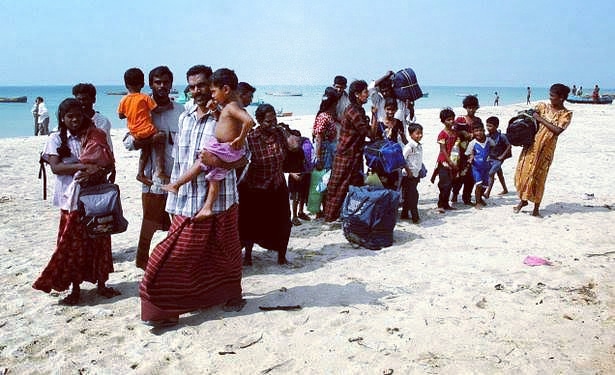
  • Case of Citizenship to Stateless Indian origin Tamils

    CitizenshipContext

    • The Supreme Court of India has now posted the 232 petitions challenging the Citizenship (Amendment) Act (CAA) to be heard on December 6, 2022. However, there is another issue linked to the subject, i.e., the unresolved status of Indian origin Tamils who repatriated from Sri Lanka.

    Present status of Sri Lankan refugees in India

    • For over four decades, Indian origin Tamils have been classified as stateless persons, based on technicalities. Nations High Commission for Refugees, “Comprehensive Solutions Strategy for Sri Lankan Refugees”, there are around 29,500 Indian origin Tamils currently living in India.

    CitizenshipHistorical background of citizenship to Indian origin Tamils

    • As Indentured plantation workers: Indian origin Tamils were brought in as indentured labourers to work in plantations. They remained mostly legally undocumented and socially isolated from the native Sri Lankan Tamil and Sinhalese communities due to the policies of the British.
    • Denied citizenship led to stateless population: After 1947, Sri Lanka witnessed rising Sinhalese nationalism, leaving no room for their political and civil participation. They were denied citizenship rights and existed as a ‘stateless’ population, numbering close to 10 lakhs by 1960.
    • Bilateral pacts granted citizenship: As an ethnolinguistic minority without voting rights, this resulted in a double disadvantage till the two national governments addressed this issue. Subsequently, under the bilateral Sirimavo-Shastri Pact (1964) and the Sirimavo-Gandhi Pact (1974), six lakh people along with their natural increase would be granted Indian citizenship upon their repatriation.
    • Civil wars forcing to seek asylum in India: The Sri Lankan civil war resulted in a spike in Sri Lankan Tamils and Indian origin Tamils together seeking asylum in India. This resulted in a Union Ministry of Home Affairs directive to stop the grant of citizenship to those who arrived in India after July 1983.
    • Focus on Refugee welfare and rehabilitation: The focus of the Indian and Tamil Nadu governments shifted to refugee welfare and rehabilitation. The legal destiny of Indian origin Tamils has been largely intertwined with that of Sri Lankan Tamil refugees, and both cohorts have been relegated to ‘refugee’ status.
    • Classified as Illegal migrants as per the CAA 2003: Indian origin Tamils who arrived after 1983 came through unauthorized channels or without proper documentation and came to be classified as ‘illegal migrants’ as per the CAA 2003. This classification has resulted in their statelessness and blocking of potential legal pathways to citizenship.

    How to overcome the problem of statelessness?

    • While constitutional courts have not had an occasion to deal with the question of statelessness, there have been two recent judgments (Madurai Bench of the Madras High Court, Justice G.R. Swaminathan), taking these issues head on.
    • Judgment on P. Ulaganathan vs Government of India (2019): The status of citizenship of Indian origin Tamils at the Kottapattu and Mandapam camps came up for consideration. The court recognized the distinction between Indian origin Tamils and Sri Lankan Tamils and held that a continuous period of statelessness of Indian origin Tamils offends their fundamental right under Article 21 of the Constitution of India. The court further held that the Union Government has implied powers to grant relaxation in conferring citizenship and prescribed that a humanitarian approach, shorn of the rigors of law, should be adopted.
    • Abirami S. vs The Union of India 2022: Statelessness is something to be avoided. The court further held that the principles of the CAA, 2019, which relaxes the conditions for citizenship for Hindus from Afghanistan, Pakistan and Bangladesh, would also apply to Sri Lankan Tamil refugees. As such, these judgments have provided categorial judicial guidance to the Union of India on how to utilize an expanded and liberal interpretation of the CAA, 2019 to overcome statelessness.
    • Supreme Court (Committee for C.R. of C.A.P. and Ors. vs State of Arunachal Pradesh 2015): An undertaking made by the Government of India with respect to grant of citizenship inheres a right in the stateless or refugee population. As such, India has made repeated undertakings, through the 1964 and 1974 pacts, which have created a legitimate expectation among the Indian origin Tamils and would entitle them to be granted citizenship.
    • Obligatory International customary law: The situation of statelessness of Indian origin Tamils is ‘de jure’, created from the failure in implementing the 1964 and 1974 pacts. De jure statelessness is recognized in international customary law. Therefore, India has an obligation to remedy the situation.

    How other nations deals with statelessness situation?

    • United States: Remedying statelessness is not a novel process in law. While dealing with a similar situation, in 1994, the United States enacted the Immigration and the Nationality Technical Corrections Act to retroactively grant citizenship to all children born to an alien father and citizen mother.
    • Brazil: Through the Constitutional Amendment No. 54 of 2007 retroactively, Brazil granted citizenship to children under jus sanguinis, which was earlier stripped by an earlier amendment, i.e., Constitutional Amendment No. 3 of 1994.

    Citizenship

    What India can do?

    • Any corrective legislative action by the Government of India to eliminate statelessness should necessarily include retroactive citizenship for Indian origin Tamils.

    Conclusion

    • India has provided the one of largest refuge to people in the world including Tibetan, Sri Lankan, Pakistani, and Bangladeshi. Despite not being a signatory to UN refugee convention. any decision of granting citizenship has to be based on national interest rather than emotional connect.

    Mains Question

    Q. What are rules for granting the citizenship to foreigner in India? What are the hurdles in Tamil Sri Lankan getting their citizenship? How can Sri Lankan Tamil get citizenship by applying the rule of intelligible differentia under article 14?

    Click and Get your FREE copy of Current Affairs Micro notes

  • SC admits plea challenging first amendment to Constitution

    The Supreme Court has agreed to examine a PIL challenging changes made to the right to freedom of speech and expression by the first amendment to the Constitution in 1951.

    Why in news?

    • The fresh petition argues that the 1st Constitutional Amendment damages the basic structure doctrine.

    What was the first amendment?

    • The Constitution (First Amendment) Act, 1951 made several changes to the Fundamental Rights provisions of the Indian constitution.
    • It provided means to:
    1. Restrict freedom of speech and expression,
    2. Validation of zamindari abolition laws, and
    3. Clarified that the right to equality does not bar the enactment of laws which provide “special consideration” for weaker sections of society
    • This Amendment set the precedent of amending the Constitution to overcome judicial judgements impeding fulfilment of the government’s perceived responsibilities.

    Why in news now?

    • In his plea, the petitioner said Section 3(1) of the 1951 Amending Act substituted original Clause (2) of Article 19.
    • This clause 19(2) deals with reasonable restrictions on the freedom of speech and expression guaranteed under Article 19(1)(a).

    (a) Objectionable insertions

    • It which contained two objectionable insertions allowing restrictions also:
    1. In the interest of public order and
    2. In relation to incitement to an offence

    (b) Crucial omissions

    • The new Clause (2) also omitted the expression “tends to overthrow the State” as appearing in the original Clause (2).
    • Section 3 (2) of the amending Act effected validation of certain laws even if they took away or abridged the right to freedom of speech and expression, the petitioner said.

    Issues created by Clause (2) of Article 19

    Ans. It protects certain arbitrary sections of IPC from constitutionality check

    • The petition contended that these two insertions protect certain IPC sections such as from the vice of unconstitutionality –
    1. Sections 124A: Sedition
    2. Section 153A: Promoting enmity between different groups on grounds of religion, race, place of birth, residence, language, etc. prejudicial to maintenance of harmony
    3. Section 295A: Deliberate and malicious acts, intended to outrage religious feelings of any class by insulting its religion or religious beliefs and
    4. Section 505: Statements conducing to public mischief
    • The questionable expressions inserted unduly abridge the fundamental right under Article 19 (1)(a) { freedom of speech and expression}.

    How it sought to trivialize national security?

    • The amendment also neglects national security by dropping the expression ‘tends to overthrow the State’.
    • The omission of this expression raises grave concern in the context of the dangers posed to the concept of secular democratic republic by radicalism, terrorism and religious fundamentalism.
    • This could either be radicalism or right-wing extremism.

    How did the petition invoke basic structure doctrine here?

    • The petition argued that undue abridgement does not advance or sub serve any constitutional objectives.
    • They appear more to damages inter alia democracy and republicanism and supremacy of the Constitution.


    Click and Get your FREE copy of Current Affairs Micro notes

  • Gujarat announces panel to study Uniform Civil Code (UCC)

    The Gujarat government has moved a proposal to constitute a committee to evaluate all aspects of implementing the Uniform Civil Code (UCC).

    What is a Uniform Civil Code (UCC)?

    • A UCC is one that would provide for one personal civil law for the entire country.
    • This would be applicable to all religious communities in their personal matters such as marriage, divorce, inheritance, adoption etc.

    Basis for UCC

    • Article 44, one of the Directive Principles of the Constitution lays down that the state shall endeavour to secure a UCC for the citizens throughout the territory of India.
    • These, as defined in Article 37, are not justiciable (not enforceable by any court) but the principles laid down therein are fundamental in governance.

    Personal Laws And Uniform Civil Code: Timeline

    # British period
    During the British Raj, Personal laws were first framed mainly for Hindu and Muslims citizens.

    # Start of 20th Century
    In the beginning of the twentieth century, the demand for a uniform civil code was first put forward by the women activists. The objective behind this demand was the women’s rights, equality and secularism.

    # 1940 – The Idea of Uniform Civil Code is born
    The idea of Uniform Civil Code was tabled by the National Planning Commission (NPC) appointed by the Congress. There was a subcommittee who was to examine women’s status and recommends reforms of personal law for gender equality.

    # 1947 – Question of UCC as a Fundamental Right
    UCC was sought to be enshrined in the Constitution of India as a fundamental right by Minoo Masani, Hansa Mehta, Amrit Kaur and Dr. B.R Ambedkar.

    # 1948 – Constitution Assembly debated UCC
    Article 44 of the Indian Constitution i.e. Directive Principles of State Policy sets implementation of uniform civil laws which is the duty of the state under Part IV.

    # 1950 – Reformist Bill passed
    Reformist bills were passed which gave the Hindu women the right to divorce and inherit property. Bigamy and child marriages are outlawed. Such reforms were resisted by Dr. Rajendra Prasad.

    # 1951 – Dr. Ambedkar Resigns
    Dr. Ambedkar resigned from the cabinet in 1951 when his draft of the Hindu Code Bill was stalled by the Parliament.

    # 1985 – Shah Bano Case
    In this case, a divorced Muslim woman was brought within the ambit of Section 125 of Code of Criminal Procedure, 1973 by the Supreme Court in which it was declared by the Apex court that she was entitled for maintenance even after the completion ofiddatperiod.

    # 1995- Sarla Mudgal v. Union of India
    In this case, Justice Kuldip Singh reiterated the need for the Parliament to frame a Uniform Civil Code, which would help the cause of national integration by removing contradictions based on ideologies. Therefore, the responsibility entrusted on the State under Article 44 of the Constitution whereby a Uniform Civil Code must be secured has been urged by the Supreme Court repeatedly as a matter of urgency.

    # 2000 – Supreme Court advocates UCC
    The case of Lily Thomas v. Union of India (2000),where the Supreme Court said it could not direct the centre to introduce a UCC.

    # 2015 – The Debate lives through
    The apex court refused to direct the government to take a decision on having a UCC.

    # 2016 – Triple Talaq Debate
    When PM asked the Law Commission to examine the issue.

    # 2017 – Ruling of the Triple Talaq case
    Triple Talaq (Talaq -e- biddat) was declared unconstitutional on August 22, 2017.

    UCC vs. Right to Freedom of Religion

    1. Article 25 lays down an individual’s fundamental right to religion
    2. Article 26(b) upholds the right of each religious denomination or any section thereof to “manage its own affairs in matters of religion”
    3. Article 29 defines the right to conserve distinctive culture

    Reasonable restrictions on the Freedom of Religion

    • An individual’s freedom of religion under Article 25 is subject to “public order, health, morality” and other provisions relating to FRs, but a group’s freedom under Article 26 has not been subjected to other FRs.
    • In the Constituent Assembly, there was division on the issue of putting UCC in the fundamental rights chapter. The matter was settled by a vote.
    • By a 5:4 majority, the fundamental rights sub-committee headed by Sardar Patel held that the provision was outside the scope of FRs and therefore the UCC was made less important.

    Minority Opinion in the Constituent Assembly

    • Some members sought to immunize Muslim Personal Law from state regulation.
    • Mohammed Ismail, who thrice tried unsuccessfully to get Muslim Personal Law exempted from Article 44, said a secular state should not interfere with the personal law of people.
    • B Pocker Saheb said he had received representations against a common civil code from various organizations, including Hindu organizations.
    • Hussain Imam questioned whether there could ever be uniformity of personal laws in a diverse country like India.
    • B R Ambedkar said “no government can use its provisions in a way that would force the Muslims to revolt”.
    • Alladi Krishnaswami, who was in favour of a UCC, conceded that it would be unwise to enact UCC ignoring strong opposition from any community.
    • Gender justice was never discussed in these debates.

    Enacting and Enforcing UCC

    • Fundamental rights are enforceable in a court of law.
    • While Article 44 uses the words “state shall endeavour”, other Articles in the ‘Directive Principles’ chapter use words such as “in particular strive”; “shall in particular direct its policy”; “shall be obligation of the state” etc.
    • Article 43 mentions “state shall endeavour by suitable legislation” while the phrase “by suitable legislation” is absent in Article 44.
    • All this implies that the duty of the state is greater in other directive principles than in Article 44.

    What are more important — fundamental rights or directive principles?

    • There is no doubt that fundamental rights are more important.
    • The Supreme Court held in Minerva Mills (1980): Indian Constitution is founded on the bed-rock of the balance between Parts III (Fundamental Rights) and IV (Directive Principles).
    • To give absolute primacy to one over the other is to disturb the harmony of the Constitution.
    • Article 31C inserted by the 42nd Amendment in 1976, however, lays down that if a law is made to implement any directive principle, it cannot be challenged on the ground of being violative of the FRs under Articles 14 and 19.

    What about Personal Laws?

    • Citizens belonging to different religions and denominations follow different property and matrimonial laws which are an affront to the nation’s unity.
    • If the framers of the Constitution had intended to have a UCC, they would have given exclusive jurisdiction to Parliament in respect of personal laws, by including this subject in the Union List.
    • “Personal Laws” are mentioned in the Concurrent List.

    Various customary laws

    • All Hindus of the country are not governed by one law, nor are all Muslims or all Christians.
    • Muslims of Kashmir were governed by a customary law, which in many ways was at variance with Muslim Personal Law in the rest of the country and was, in fact, closer to Hindu law.
    • Even on registration of marriage among Muslims, laws differ from place to place.
    • In the Northeast, there are more than 200 tribes with their own varied customary laws.
    • The Constitution itself protects local customs in Nagaland. Similar protections are enjoyed by Meghalaya and Mizoram.
    • Even reformed Hindu law, in spite of codification, protects customary practices.

     Why need UCC?

    • UCC would provide equal status to all citizens
    • It would promote gender parity in Indian society.
    • UCC would accommodate the aspirations of the young population who imbibe liberal ideology.
    • Its implementation would thus support the national integration.

    Hurdles to UCC implementation

    • There are practical difficulties due to religious and cultural diversity in India.
    • The UCC is often perceived by the minorities as an encroachment of religious freedom.
    • It is often regarded as interference of the state in personal matters of the minorities.
    • Experts often argue that the time is not ripe for Indian society to embrace such UCC.

    These questions need to be addressed which are being completely ignored in the present din around UCC.

    1. Firstly, how can uniformity in personal laws are brought without disturbing the distinct essence of each and every component of the society.
    2. Secondly, what makes us believe that practices of one community are backward and unjust?
    3. Thirdly, has other uniformities been able to eradicate inequalities which diminish the status of our society as a whole?

    Way forward

    • It should be the duty of the religious intelligentia to educate the community about its rights and obligations based on modern liberal interpretations.
    • A good environment for the UCC must be prepared by the government by explaining the contents and significance of Article 44 taking all into confidence.
    • Social reforms are not overnight but gradual phenomenon. They are often vulnerable to media evils such as fake news and disinformation.
    • Social harmony and cultural fabric of our nation must be the priority.

    Conclusion

    • The purpose behind UCC is to strengthen the object of “Secular Democratic Republic” as enshrined in the Preamble of the Constitution.
    • This provision is provided to effect the integration of India by bringing communities on a common platform on matters which are at present governed by diverse personal laws.
    • Hence UCC should be enforced taking into confidence all the sections of Indian society.


    Click and Get your FREE copy of Current Affairs Micro notes

  • What is the Doctrine of Pleasure?

    The Kerala Governor has sought dismissal of a minister from the Cabinet, declaring that he has withdrawn the pleasure of having him in the Council of Ministers.

    Doctrine of Pleasure: The concept behind

    • The pleasure doctrine is a concept derived from English common law.
    • It says is that a civil servant of the Crown holds office during the pleasure of the Crown.
    • This means his services can be terminated at any time by the Crown, without assigning any reason.

    How is it practised in India?

    • In India, Article 310 of the Constitution says every person in the defence or civil service of the Union holds office during the pleasure of the President.
    • Similarly, every member of the civil service in the States holds office during the pleasure of the Governor.
    • However, Article 311 imposes restrictions on the removal of a civil servant.

    How arbitrary is this doctrine?

    • It provides for civil servants being given a reasonable opportunity for a hearing on the charges against them.
    • There is also a provision to dispense with the inquiry if it is not practicable to hold one, or if it is not expedient to do so in the interest of national security.
    • In practical terms, the pleasure of the President referred to here is that of the Union government, and the Governor’s pleasure is that of the State government.

    Is the governor entitled to exercise his/her displeasure?

    • Under Article 164, the Chief Minister is appointed by the Governor; and the other Ministers are appointed by the Governor on the CM’s advice.
    • It adds that Ministers hold office during the pleasure of the Governor.
    • In a constitutional scheme in which they are appointed solely on the CM’s advice, the ‘pleasure’ referred to is also taken to mean the right of the CM to dismiss a Minister, and not that of the Governor.

    Why in news now?

    Ans. Issue over appointment of Vice-Chancellor

    • The latest controversy has arisen after the Governor sought the resignation of several vice-chancellors following a Supreme Court judgment.
    • The V-C’s appointment of a technical university was contrary to the regulations of the University Grants Commission (UGC).
    • The appointment Committee had identified only one candidate and recommended the name to the Chancellor for appointment.
    • However, under UGC regulations, a panel of three to five names should be recommended so that the Chancellor has a number of options to choose from.

    How is Governor involved in this?

    • The Governor, in his capacity as Chancellor of universities, responded by directing the V-Cs of nine universities to resign the very next day.
    • He contended that the infirmities pointed out by the Supreme Court in one case also vitiated their appointments.


    Click and Get your FREE copy of Current Affairs Micro notes
  • Is Medical Education in Hindi Practicable?

    Context

    • The unveiling of the Hindi editions of the first professional MBBS books by Union Home Minister Amit Shah in Bhopal has stirred anti-Hindi agitations, with the Opposition, especially in the South, contending that the move is nothing more than a poll gimmick.

    Why medical education should be in local language (Hindi)?

    • Example of Non-English countries: Supporters of the move are quoting examples from China, Japan, Ukraine, Russia, and Norway – countries where official languages are the sole medium of instruction in all the technical and non-technical courses.
    • Education in mother tongue is effective: If they can do so, why can’t we, they argue, especially as it is an established fact that imparting education in a student’s mother tongue is effective for learning.

    Why English is best medium of English education?

    • Teaching in local plus English language: Fifty-two medical colleges, out of the total 170 colleges on mainland China, whose graduates can attempt the USMLE (the entrance exam to practice in the US), teach in both Chinese and English. There has been a steep rise in the number of parents interested in enrolling their children – at just three years old – in ESL (English as a Second Language) courses.
    • Less resources in Hindi: It is unwise to compare the status of Hindi to Chinese or German, given India’s diversity. Moreover, Hindi, or any other vernacular language, for that matter, offers far fewer resources to support the job-seeking young populace. Learning English, therefore, comes with a promise of roti, kapda, makaan (food, clothes, shelter.)
    • Higher demand for English Medium: A few years ago, when newspapers reported on the closing down of government schools in Tamil Nadu, one of the major reasons cited was parents’ preoccupation with English-medium schools – leading them to deny free cash and food and admit their kids to low-end, mediocre English schools, instead.
    • English is a great leveller: When it comes to higher education, English is a great leveller, allowing dialogue to continue with the rest of the world. Medicine, as evidence-based as it is, is constantly evolving with the introduction of novel research. Treating cases sometimes requires consulting multiple books, research papers, and journal articles, for which a sound system of translation needs to be established before we can even begin thinking about phasing out English.
    • Issue of Translation: The people involved in the translation process spoke of two things, First, instead of “translation”, the books have been transliterated. The medical terminology remains the same; sentences have only been translated for easier reading. That too, in the most mainstream dialect of Hindi. Second, these books are to be used as “bridge books”, and not as replacements for the English ones, designed to address the initial hiccups students are bound to face.
    • No clarity on roadmap: The initial announcement also fails to account for the necessary infrastructure. There has been no clarity on whether or how these translations will be incorporated as reading materials, and how they will evolve or change with time. Whether standard books like Harrison and Robbins would also be translated is anyone’s guess. Translating these tomes only once would not suffice as newer editions every three to five years incorporate significant changes.
    • Training of teachers and conferences: Professors and other teaching staff would also need to be trained. Most of all, what about medical conferences, the staple of a medical student? Would they be organised in Hindi moving forward?
    • Our medical industry is yet to develop: While basing our argument only on language, we often forget that Chinese healthcare is self-sufficient when it comes to research and protocols, or that Germany has primary resources available in their own language. Our focus right now should be to develop primary resources. Our medical industry is at way too nascent a stage to be speaking of language.

    Conclusion

    • Offering extra evening classes as done by AIIMS, Delhi could have been a better substitute given that the strength of students who struggle with English makes up about one to two per cent of the entire batch. Besides, no strict distinction exists between Hindi and non-Hindi-speaking states as most institutions have a portion of seats that are filled up by a pan-India entrance exam. Our focus should be on quality of education instead of medium of instruction.

    Mains Question

    Q. Medical education in English is more viable than local language. Explain. Why Government of India Supports the Medical education in Hindi?

    UPSC 2023 countdown has begun! Get your personal guidance plan now! (Click here)