Mains Ready By December. Smash Mains & Smash PYQ Admissions Open

GS Paper: GS2-01.Indian Constitution-Historical underpinnings & evolution; Features, amendments, significant provisions, basic structure of Constitution

  • Parliamentary Standing Committees

    Parliamentary CommitteesContext

    • In the recent monsoon session of Parliament (July-August) the Competition (Amendment) Bill, 2022 and the Electricity (Amendment) Bill, 2022 sent to the Parliamentary Committees for detailed examination and a report thereon.

    Background

    • Parliament had only limited legislative time this session and could pass only five pieces of legislation
    • Oppositions stand: opposition alleging that the Government has been trying to steamroll various pieces of legislation in the last few sessions.
    • Governments stand: Government worries that so much time is lost in disruptions in Parliament that the legislative process, as it is, becomes unduly delayed and therefore, referring the bills to the Standing Committees.

    Parliamentary CommitteesParliamentary Committees

    • Need of parliamentary committees: The functions of the Parliament are varied, complex and voluminous. Moreover, it has neither the adequate time nor necessary expertise to make a detailed scrutiny of all legislative measures.
    • Function: To assist parliament to discharge of its duties.
    • Mandate: To examine various legislations referred to it, the budget proposals of different Ministries, and also to do policy thinking on the vision, mission and future direction of the Ministries concerned.
    • Composition: Members of the Parliament of both the LokSabha and the RajyaSabha in the ratio 2:1,
    • Authority: constituted by the Speaker of the LokSabha and the Chairman of the RajyaSabha, jointly.
    • Classification: Broadly, two kinds–Standing Committees and Ad Hoc Standing Committees are permanent (constituted every year or periodically) and work on a continuous basis, while Ad Hoc Committees are temporary and cease to exist on completion of the task assigned to them.
    • Parliament has 24 Department Related Parliamentary Standing Committees (DRSC).

    Relevance of parliamentary committees

    • Withdrawal of farm law bills shows that if bills are not discussed thoroughly, these laws are just bizarre pieces of legislation from point of view consumers and stakeholders.
    • Parliamentary committee’s discussions are held closed door. Members can express their opinion freely.
    • Members of DRSC always try reach to consensus despite political differences. Such practices are essential for healthy democracy.
    • To strengthen the relevance of parliamentarians the parliamentary committees are crucial tools.

    Parliamentary CommitteesHow to improve Efficacy of committees?

    • Compulsory process: The Speaker of the Lok Sabha and the Chairman of the Rajya Sabha have powers to refer Bills to a DRSC of Parliament. Making the process of reference of Bills to these committees compulsory/an automatic process will be useful. An exemption could be made with the specific approval of the Speaker/ Chairman after detailed reasons for the same.
    • No whip: All discussions in the Parliamentary Standing Committee should be frank and free. No whip of the party would apply to them during the discussion.
    • Time bound: fixed timeline to come up with the recommendation and present its report which can be decided by the Speaker/Chairman. In case the committee if fails to give its recommendation within the approved/extended time, the Bill may be put up before the House concerned directly.
    • Inviting filed Expertise: To ensure quality work in the committees, experts in the field may be invited who could bring with them the necessary domain knowledge and also help introduce the latest developments and trends in that field from Some subject matter experts/young researchers could be associated with the committee for a short period would be fruitful.
    • Authority: The Speaker/Chairman should have the right to fix a time limit, sometimes even stringent, if the government of the day asks for it and the demand is found to be reasonable by the Speaker/Chairman.
    • Organized work in the gap: Between two sessions, there is generally enough time to organise committee meetings for discussions on Bills in the parliamentary committees. It is important for the Ministry of Parliamentary Affairs in collaboration with the committee chairmen to get these parliamentary works organized during the intersessional period, in advance.
    • Other than Budget Proposals: The committees should not limit themselves to discussing just the budget proposals and endorsing them with a few qualifications here or amendments there. They should also come up with suggestions for the Ministry to take up new initiatives and people friendly measures.

    Conclusion

    • Discussion is not a stumbling block but an indispensable preliminary of any wise actions.
    • Discussion is soul of democracy.
    • Parliamentary committees are truly democratic institutions in India due to its consensus and bonhomie while functioning.
    • Government of the day should take step to strengthen DRSC and refer more bills to committees. 

    Other related information

    Parliamentary sessions

    • The president from time to time summons each House of Parliament to meet.
    • The maximum gap between two sessions of Parliament cannot be more than six months.
    • In other words, the Parliament should meet at least twice a year.
    • There are usually three sessions in a year: 1. The Budget Session (February to May); 2. The Monsoon Session (July to September); and 3. The Winter Session (November to December).

    Competition Commission of India (CCI)

    • CCI is the chief national competition regulatorin India.
    • The commission was established on 14 October 2003. It became fully functional in May 2009
    • It is a statutory body within the Ministry of Corporate Affairs
    • Responsibility: To enforce the Competition Act, 2002 to promote competition and to prevent activities that effects negatively on competition in India.
    • The CCI looks into cases and investigates them if the same has a negative impact on competition.
    • CCI also approves combination under the act so that two merging entities do not overtake the market.

    Mains Question Q.

    Evaluate the significance of parliamentary standing committee in parliamentary democracy. Suggest the steps to strengthen the parliamentary committees.


    UPSC 2023 countdown has begun! Get your personal guidance plan now! (Click here)


  • Hindi not a competitor of regional languages: Home Minister

    Union Home Minister has appealed to guardians to speak to children in their mother tongue to enable them to learn Hindi without much effort, on the Hindi Divas.

    What did HM say on Hindi?

    • He said it was time that inferiority complex around Indian languages, instilled by the British, was overthrown from people’s conscience with the help of regional languages and Hindi.
    • He also said that Hindi was not a competitor but a “friend” of all the other regional languages in the country and they were mutually dependent on each other for their growth.
    • He said there was a concerted disinformation campaign to pit Hindi against other languages such as Marathi and Tamil, and underlined the need to strengthen local languages with Hindi.

    Debate over Hindi

    • Between September 12 and 14, 1949, that the Constituent Assembly debated the status of India’s languages.
    • Among the issues that were discussed were the use of the term ‘national language’ instead of ‘official’ language.
    • Hindi author Seth Govind Das, who represented the Central Provinces and Berar, argued for ‘one language and one script’ and suggested that Hindi should replace English at the earliest.

    What is the status of Hindi?

    • Finally, the Constituent Assembly adopted what was known as “Munshi-Ayyangar Formula.”
    • According to this, Hindi in the Devnagari script would be the official language of the Union.

    Official, not national

    • English would continue to be used for all official purposes for the next 15 years, to enable a smooth transition for non-Hindi speaking states.
    • The deadline was 26 January 1965.
    • Under Article 343 of the Constitution, the official language of the Union shall be Hindi in Devanagari script.
    • The international form of Indian numerals will be used for official purposes.

    Why has language become a sensitive issue?

    • Self-identification: A strong identification with one’s regional language and an underlying fear of homogenisation is at the heart of the national language question in India. An individual conceptualises and communicates his thoughts in a language, enabling him to be an active part of society.
    • Language defines primary group: People identify with one another based on language, thus giving them a primary group. A nation is the largest primary group that once can address.
    • Learning abilities at stake: The dangers of imposing a language are manifold. It can affect the learning ability of non-native speakers thereby affecting their self-confidence.
    • Threats to endangered languages: It can also endanger other languages and dialects and reduce diversity.
    • Threats to diversity: National integration cannot come at the cost of people’s linguistic identities. Language is integral to culture and therefore privileging Hindi over all other languages spoken in India takes away from its diversity.
    • Promises made by Constituent Assembly: Then PM Pt. Nehru had promised that Hindi would only serve as a linking language and it would not be imposed on non-Hindi speaking states as long as they were against it.

    Benefits of having a national language

    • Wide range of speakers: Hindi is still the most widely spoken language in the country with an estimated 258 million people declaring that Hindi is their native language and millions more comfortable with Hindi.
    • Language as a unifying language: A complete usage of Hindi language whilst respecting the various native languages would also ensure better coordination and cooperation among all the states and act as a strong unifying factor and eliminate all regional differences.
    • Reputation at international fora: When countries like Germany, Japan, France, Italy etc. use their respective language as a medium of communication even during International forums not only has the reputation of those countries have greatly enhanced but also those languages have gained a huge reputation worldwide.

    Issues with Hindi

    • Inherent opposition to Hindi: The Constituent Assembly was bitterly divided on the question, with members from States that did not speak Hindi initially opposing the declaration of Hindi as a national language.
    • Fear of imposition: Opponents were against English being done away with, fearing that it may lead to Hindi domination in regions that did not speak the language.
    • Symbol of identity politics: The approach towards linguistic policy seems to be driven more by the politics of identity than values of aspiration or accommodation.
    • Favour for majoritarianism: The primary argument in favour of Hindi has been reduced to assertions of slim majoritarianism.
    • Few speakers, still dominant: Even then, there are concerns about the claim based on mere numerical strength, as only 25 per cent of Indians seem to recognise Hindi as their mother tongue (Census 2011).
    • Demographic barriers: Today nearly 35% of people are migrating daily for work. In such a situation, we have to conceptualise a new form of language identity for our states.
    • Economic barriers: Any idea of one link language, whether Hindi or English, will be economically disastrous for India. It will slow down migration and reduce the ease of capital flow.
    • Multiple dialects: Only five states in India have Hindi as their’ native language’. However, in those states, too, the dialects of Hindi are associated with locals and their communities.

    Why Hindi cannot be the national language?

    • Multiple dialects: Hindi has largely been influenced by Persian — and then English, among other languages. Also, when the languages were enumerated, Hindi subsumed Bhojpuri, which is spoken by a little over five crore people.
    • Inefficacy of Sanskrit: There were demands to make Sanskrit the official language, while some argued in favour of ‘Hindustani’.
    • Issue over Script: There were differences of opinion over the script too. When opinion veered towards accepting Hindi, proponents of the language wanted the ‘Devanagari’ script to be adopted both for words and numerals.

    Why this issue needs a rational consideration?

    • Linguistic chauvinism: Various policies on language have been framed both by the central and state governments that have been termed as forms of linguistic chauvinism.  Ex. Obsession for Marathi in Mumbai
    • Secular fabric under threat: The states’ fear of the central government’s ideology of monopolising faith, education, and language will adversely affect the Indian political system, which is based on pluralism and accommodation.
    • Monolingualism can prove disastrous: If there is a mechanical and monolithic idea of unity followed by any entity, such an entity generally generates great hostility beyond its immediate borders.  In neighbouring Bangladesh – then East Pakistan – the language movement against the imposition of Urdu on Bengali speakers was a key driver of Pakistan splitting into two nations.

    Way forward

    • Language as a skill: Language should be looked at as an important skill to operate in a world which is more connected today than at any other point in time.
    • Language not a cultural burden: A united nation has to have space for diversity. India is united in its diversity. Diversity is a great philosophical idea and should never be seen as a cultural burden.
    • Linguistic heritage needs priority: This is not to contend that our linguistic heritage should be neglected or trivialised. Our metropolises must be recognized as multilingual entities.


    UPSC 2023 countdown has begun! Get your personal guidance plan now! (Click here)

  • Centre adds 4 new tribes to Scheduled Tribes (ST) List

    The Union Cabinet under the chairmanship of PM has approved the addition of four tribes to the list of Scheduled Tribes (ST), including those from Himachal Pradesh, Tamil Nadu and Chhattisgarh.

    Which tribes are we talking about?

    1. Hatti tribe in the Trans-Giri area of Sirmour district in Himachal Pradesh
    2. Narikoravan and Kurivikkaran hill tribes of Tamil Nadu and
    3. Binjhia tribe in Chhattisgarh, which was listed as ST in Jharkhand and Odisha but not in Chhattisgarh

    Other tribes in news

    • The Cabinet also approved ‘Betta-Kuruba’ as a synonym for the Kadu Kuruba tribe In Karnataka.

    Who are the Scheduled Tribes?

    • The term ‘Scheduled Tribes’ first appeared in the Constitution of India.
    • Article 366 (25) defined scheduled tribes as “such tribes or tribal communities or parts of or groups within such tribes or tribal communities as are deemed under Article 342 to be Scheduled Tribes for the purposes of this constitution”.
    • Article 342 prescribes procedure to be followed in the matter of specification of scheduled tribes.
      • Article 342(1) empowers the President of India to specify, by public notification, the tribes or tribal communities deemed to be Scheduled Tribes in each state and union territory.
    • Among the tribal groups, several have adapted to modern life but there are tribal groups who are more vulnerable.
    • The Dhebar Commission (1973) created a separate category “Primitive Tribal Groups (PTGs)” which was renamed in 2006 as “Particularly Vulnerable Tribal Groups (PVTGs)”.

    How are STs notified?

    • The first specification of Scheduled Tribes in relation to a particular State/ Union Territory is by a notified order of the President, after consultation with the State governments concerned.
    • These orders can be modified subsequently only through an Act of Parliament.

    Status of STs in India

    • The Census 2011 has revealed that there are said to be 705 ethnic groups notified as Scheduled Tribes (STs).
    • Over 10 crore Indians are notified as STs, of which 1.04 crore live in urban areas.
    • The STs constitute 8.6% of the population and 11.3% of the rural population.

    What is the reason for special provisions for the Scheduled Tribes in the constitution of India? Are these provisions successful in ameliorating their conditions? (250 Words)


    UPSC 2023 countdown has begun! Get your personal guidance plan now! (Click here)

  • Citizenship Amendment Act (CAA), 2019

    A three-judge Bench of the Supreme Court led by Chief Justice of India (CJI) U U Lalit will hear the challenge to the contentious Citizenship (Amendment) Act.

    What is Citizenship Amendment Act (CAA), 2019?

    • The act is sought to amend the Citizenship Act, 1955 to make Hindu, Sikh, Buddhist, Jain, Parsi, and Christian illegal migrants from Afghanistan, Bangladesh, and Pakistan, eligible for citizenship of India.
    • In other words, it intends to make it easier for non-Muslim immigrants from India’s three Muslim-majority neighbours to become citizens of India.
    • Under The Citizenship Act, 1955, one of the requirements for citizenship by naturalization is that the applicant must have resided in India during the last 12 months, as well as for 11 of the previous 14 years.
    • The amendment relaxes the second requirement from 11 years to 6 years as a specific condition for applicants belonging to these six religions, and the aforementioned three countries.
    • It exempts the members of the six communities from any criminal case under the Foreigners Act, 1946 and the Passport Act, 1920 if they entered India before December 31, 2014.

    Key feature: Defining illegal migrants

    • Illegal migrants cannot become Indian citizens in accordance with the present laws.
    • Under the CAA, an illegal migrant is a foreigner who: (i) enters the country without valid travel documents like a passport and visa, or (ii) enters with valid documents, but stays beyond the permitted time period.
    • Illegal migrants may be put in jail or deported under the Foreigners Act, 1946 and The Passport (Entry into India) Act, 1920.

    Exceptions

    • The Bill provides that illegal migrants who fulfil four conditions will not be treated as illegal migrants under the Act.  The conditions are:
    1. they are Hindus, Sikhs, Buddhists, Jains, Parsis or Christians;
    2. they are from Afghanistan, Bangladesh or Pakistan;
    3. they entered India on or before December 31, 2014;
    4. they are not in certain tribal areas of Assam, Meghalaya, Mizoram, or Tripura included in the Sixth Schedule to the Constitution, or areas under the “Inner Line” permit, i.e., Arunachal Pradesh, Mizoram, and Nagaland.

    Controversy with the Act

    • Country of Origin: The Act classifies migrants based on their country of origin to include only Afghanistan, Pakistan and Bangladesh.
    • Other religious minorities ignored: It is unclear why illegal migrants from only six specified religious minorities have been included in the Act.
    • Defiance of purpose: India shares a border with Myanmar, which has had a history of persecution of a religious minority, the Rohingya Muslims.
    • Date of Entry: It is also unclear why there is a differential treatment of migrants based on their date of entry into India, i.e., whether they entered India before or after December 31, 2014.
    • Against the spirit of Secularism: Further, granting citizenship on the grounds of religion is seen to be against the secular nature of the Constitution which has been recognised as part of the basic structure that cannot be altered by Parliament.

    Basis of challenging in Supreme Court

    • The challenge rests primarily on the grounds that the law violates Article 14 of the Constitution that guarantees that no person shall be denied the right to equality before law or the equal protection of law in the territory of India.

    The Supreme Court has developed a two-pronged test to examine a law on the grounds of Article 14.

    1. First, any differentiation between groups of persons must be founded on “intelligible differentia”
    2. Second, that differentia must have a rational nexus to the object sought to be achieved by the Act
    • Simply put, for a law to satisfy the conditions under Article 14, it has to first create a “reasonable class” of subjects that it seeks to govern under the law.
    • Even if the classification is reasonable, any person who falls in that category has to be treated alike.

    What happens next?

    • The listing of the CAA challenge indicates that the hearing will be fast-tracked.
    • The court will have to ensure that all pleadings, written submissions are filed and served to the opposite party before it is listed for final hearing.
    • Some petitioners could also seek a referral to a larger Constitution Bench.
    • However, the challenge is to a statute and does not directly involve interpretation of the Constitution.
    • These issues are also likely to be debated before the court allots time for the final hearing.

    Way forward

    • India is a constitutional democracy with a basic structure that assures a secure and spacious home for all Indians.
    • Being partitioned on religious grounds, India has to undertake a balancing act for protecting the religious minorities in its neighbourhood.
    • These minorities are under constant threat of persecution and vandalism.
    • India needs to balance its civilization duties to protect those who are prosecuted in the neighbourhood.


    UPSC 2023 countdown has begun! Get your personal guidance plan now! (Click here)
  • Rajpath, Central Vista lawns renamed ‘Kartavya Path’

    Rajpath and Central Vista Lawns in the national capital will now be known as “Kartavya Path”, the New Delhi Municipal Council (NDMC) announces.

    Updating to Kartavya Path

    • The entire stretch and the area from the Netaji statue under the Grand Canopy to the Rashtrapati Bhavan will be known as Kartavya Path.
    • Kartavya Path, which will be opened to the public at the end of the official function, will exhibit landscapes, lawns with walkways, added green spaces, refurbished canals, amenity blocks, improved signages and vending kiosks.
    • New pedestrian underpasses, improved parking spaces, new exhibition panels, and upgraded night lighting are some other features that will enhance the public experience.
    • It also includes a number of sustainability features like solid waste management, storm-water management, recycling of used water, rainwater harvesting, water conservation and energy-efficient lighting systems, among others.

    Kingsway to Rajpath

    • Called Kingsway during British rule, the three-km stretch was built as a ceremonial boulevard by Edwin Lutyens and Herbert Baker, the architects of New Delhi, more than a hundred years ago.
    • The capital of the Raj moved to New Delhi from Calcutta in 1911, and construction continued for several years thereafter.
    • Lutyens conceptualised the modern imperial city centred on a “ceremonial axis”, which was named Kingsway in honour of the then Emperor of India, George V.
    • He visited Delhi during the Durbar of 1911, where he formally proclaimed the decision to move the capital.
    • The nomenclature followed that of the Kingsway in London, an arterial road built in 1905, which was named in honour of King Edward VII, the father of George V.
    • Following Independence, the road was given its Hindi name, Rajpath, on which the Republic Day parades took place over the decades that followed.

    Why sudden renaming?

    • During his address from the Red Fort on August 15, Modi had stressed on the abolition of symbols of colonialism.
    • The new name and look of Rajpath, as well as the installation of the 28-foot statue of Netaji under the Grand Canopy under which a statue of George V once stood, are meant to represent that spirit of the proud new India.

    Significance of all recent event

    • The construction of the Central Vista Redevelopment Project began in February 2021, with the new Parliament building and redevelopment of the Central Vista Avenue in the first phase.
    • The aim is to build an iconic avenue that truly befits the New India, the government has said about the Rs 608 crore Central Vista Avenue project.
    • It symbolizes a shift from erstwhile Rajpath being an icon of power to Kartavya Path being an example of public ownership and empowerment.


    UPSC 2023 countdown has begun! Get your personal guidance plan now! (Click here)

  • EWS Quota

    A five-judge Constitution Bench led by CJI U.U. Lalit are hearing petitions challenging the 10% quota for the economically weaker sections (EWS) and an Andhra Pradesh law that grants reservation to Muslims.

    What is the news?

    • The five-judge Bench, led by CJI, is considering the validity of the 103rd Constitutional Amendment.
    • The said amendment provides the 10% reservation to economically weaker sections (EWS) of society in government jobs and educational institutions.
    • Economic reservation was introduced by amending Articles 15 and 16 and adding clauses empowering the State governments to provide reservation on the basis of economic backwardness.

    EWS Quota: A backgrounder

    • The 10% reservation was introduced through the 103rd Constitution Amendment and enforced in January 2019.
    • It added Clause (6) to Article 15 to empower the Government to introduce special provisions for the EWS among citizens except those in the classes that already enjoy reservation.
    • It allows reservation in educational institutions, both public and private, whether aided or unaided, excluding those run by minority institutions, up to a maximum of 10%.
    • It also added Clause (6) to Article 16 to facilitate reservation in employment.
    • The new clauses make it clear that the EWS reservation will be in addition to the existing reservation.

    Significance of the quota

    • The Constitution initially allowed special provisions only for the socially and educationally backward classes.
    • The Government introduced the concept of EWS for a new class of affirmative action program for those not covered by or eligible for the community-based quotas.

    What are the court’s questions about the criteria?

    • Reduction within general category: The EWS quota remains a controversy as its critics say it reduces the size of the open category, besides breaching the 50% limit on the total reservation.
    • Arbitrariness over income limit: The court has been intrigued by the income limit being fixed at ₹8 lakh per year. It is the same figure for excluding the ‘creamy layer’ from OBC reservation benefits.
    • Socio-economic backwardness: A crucial difference is that those in the general category, to whom the EWS quota is applicable, do not suffer from social or educational backwardness, unlike those classified as the OBC.
    • Metropolitan criteria: There are other questions as to whether any exercise was undertaken to derive the exceptions such as why the flat criterion does not differentiate between metropolitan and non-metropolitan areas.
    • OBC like criteria: The question the court has raised is that when the OBC category is socially and educationally backward and, therefore, has additional impediments to overcome.
    • Not based on relevant data: In line with the Supreme Court’s known position that any reservation or norms for exclusion should be based on relevant data.
    • Breaches reservation cap: There is a cap of 50% on reservation as ruled in the Indira Sawhney Case. The principle of balancing equality ordains reservation.

    What is the current status of the EWS quota?

    • The reservation for the EWS is being implemented by the Union Government for the second year now.
    • Recruitment test results show that the category has a lower cut-off mark than the OBC, a point that has upset the traditional beneficiaries of reservation based on caste.
    • The explanation is that only a small number of people are currently applying under the EWS category — one has to get an income certificate from the revenue authorities — and therefore the cut-off is low.
    • However, when the number picks up over time, the cut-off marks are expected to rise.

    Practical issues with EWS Quota

    The EWS quota will come in for judicial scrutiny soon. But it’s not only a matter for the judiciary, India’s Parliament should revisit the law too.

    • Hasty legislation: This law was passed in haste. It was passed in both the houses within 48 hours, and got presidential approval the next day.
    • Minority appeasement: It is widely argued that the law was passed to appease a certain section of upper-caste society and to suppress the demands for minority reservations.
    • Morality put to question: Imagine! A constitutional amendment has been made with few hours of deliberation and without consultation of the targeted group. This is certainly against constitutional morality and propriety.
    • Substantial backing is missing: This amendment is based on a wrong or unverified premise. This is at best a wild guess or a supposition because the government has not produced any data to back this point.
    • Under-reservation of Backward Classes: The assertion is based on the fact that we have different data to prove the under-representation of SC, ST, OBCs. That implies that ‘upper’ castes are over-represented (with 100 minus reservation).
    • Rationale of 10%: There is one more problem in this regard. The SC and ST quota is based on their total population. But the rationale for the 10 per cent quota was never discussed.
    • Principle of Equality: Economic backwardness is quite a fluid identity. It has nothing to do with historic wrongdoings and liabilities caused to the Backward Classes.

    Way forward

    • Preserving the merit: We cannot rule out the sorry state of economic backwardness hampering merit in our country.
    • Rational critera: There has to be collective wisdom to define and measure the economic weakness of certain sections of the society in order to shape the concept of economic justice.
    • Judicial guidance: Judicial interpretation will pave the wave forward for deciding the criterion for EWS Quota.
    • Targetted beneficiaries. The centre needs to resort to more rational criteria for deciding the targeted beneficiary of this reservation system. Caste Census data can be useful in this regard.
    • Income study: The per capita income or GDP or the difference in purchasing power in the rural and urban areas, should be taken into account while a single income limit was formulated for the whole country.

    Conclusion

    • Reservation is a constitutional scheme to ensure the participation of backward classes shoulder to shoulder with all citizens in the nation-building process.
    • The EWS quota with above discussed ambiguities is the subversion of the constitutional scheme for reservation.


    UPSC 2023 countdown has begun! Get your personal guidance plan now! (Click here

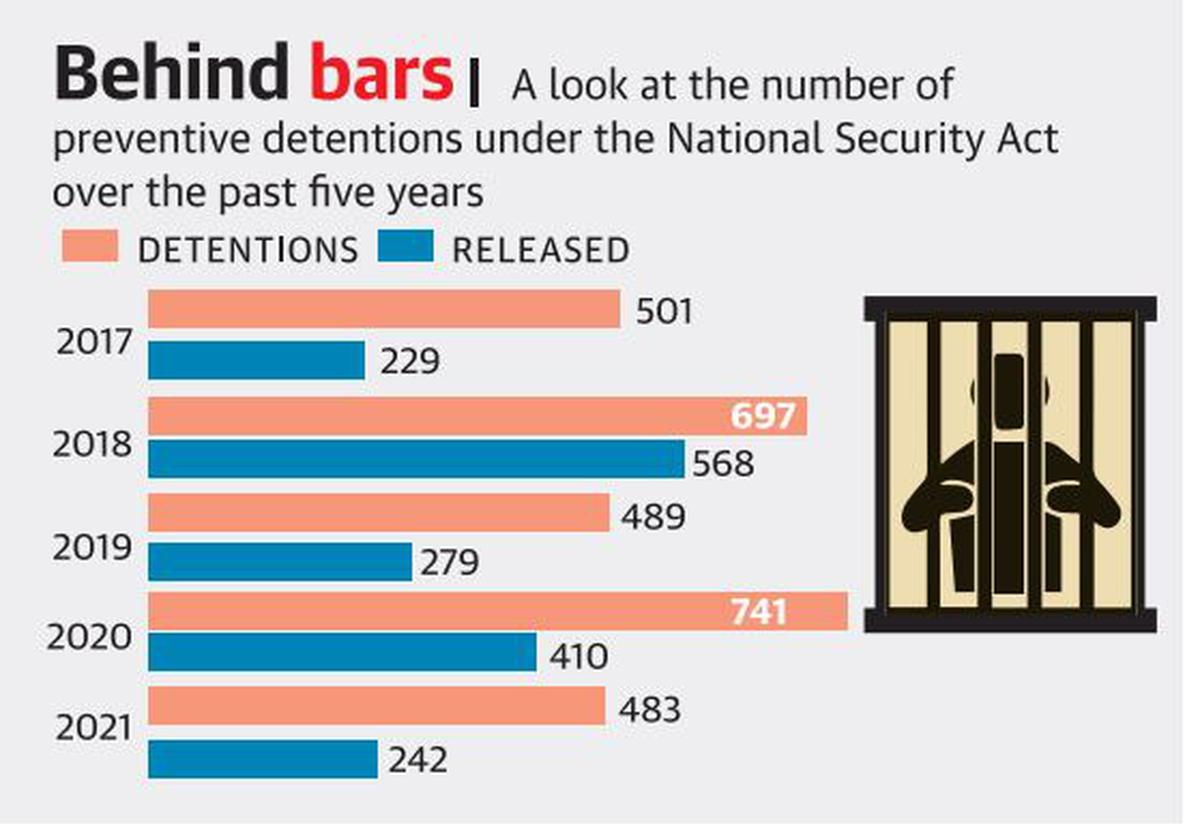
  • Preventive Detention

    Preventive detentions in 2021 up by 23.7% compared to year before - The  Hindu

    Preventive detentions in 2021 saw a rise by over 23.7% compared with the year before, with over 1.1 lakh people being placed under preventive detention, according to statistics released by the National Crime Records Bureau (NCRB).

    What does NCRB report say on Preventive Detention?

    • Over 24,500 people placed under preventive detention were either in custody or still detained as of 2021-end — the highest since 2017 when the NCRB started recording this data.
    • Over 483 were detentions under the National Security Act, of which almost half (241) were either in custody or still detained as of 2021-end.
    • In 2017, the NCRB’s Crime in India report found that 67,084 persons had been detained as a preventive measure that year.
    • Of these, 48,815 were released between one and six months of their detention and 18,269 were either in custody or still in preventive detention as of the end of the year.

    Various provisions invoked for Preventive Detention

    • Among other laws under which the NCRB has recorded data on preventive detentions are the:
    1. Goonda Act (State and Central) (29,306),
    2. Prevention of Illicit Traffic in Narcotic Drugs and Psychotropic Substances Act, 1988 (1,331), and
    3. A category classified as “Other Detention Acts”, under which most of the detentions were registered (79,514).
    • Since 2017, the highest number of persons to be placed under preventive detention has consistently been under the “Other Detention Acts” category.

    Concerns over the report

    • The number of persons placed under detention has been increasing since 2017 — to over 98,700 in 2018 and over 1.06 lakh in 2019 — before dipping to 89,405 in 2020 (due to lockdowns).
    • The number of persons placed under preventive detention has seen an increase in 2021.

    What is Preventive Detention?

    • Preventive detention means detaining a person so that to prevent that person from commenting on any possible crime.
    • In other words, preventive detention is an action taken by the administration on the grounds of the suspicion that some wrong actions may be done by the person concerned which will be prejudicial to the state.

    Preventive Detention in India

    A police officer can arrest an individual without orders from a Magistrate and without any warrant if he gets any information that such an individual can commit any offense.

    • Preventive Detention Law, 1950: According to this law any person could be arrested and detained if his freedom would endanger the security of the country, foreign relations, public interests, or otherwise necessary for the country.
    • Unlawful Activities Prevention Act (UAPA) 1968: Within the ambit of UAPA law the Indian State could declare any organization illegal and could imprison anyone for interrogation if the said organization or person critiqued/questioned Indian sovereignty territorially.

    What is the difference between Preventive Detention and an Arrest?

    • An ‘arrest’ is done when a person is charged with a crime.
    • In the case of preventive detention, a person is detained as he/she is simply restricted from doing something that might deteriorate the law-and-order situation.
    • Article 22 of the Indian Constitution provides protection against arrest and detention in certain cases.

    Rights of an Arrested Person in India

    A/c to Article 22(1) and 22(2) of the Indian constitution:

    • A person cannot be arrested and detained without being informed why he is being arrested.
    • A person who is arrested cannot be denied to be defended by a legal practitioner of his choice. This means that the arrested person has right to hire a legal practitioner to defend himself/ herself.
    • Every person who has been arrested would be produced before the nearest magistrate within 24 hours.
    • The custody of the detained person cannot be beyond the said period by the authority of magistrate.

    Exceptions for Preventive Detention

    Article 22(3) says that the above safeguards are not available to the following:

    • If the person is at the time being an enemy alien
    • If the person is arrested under certain law made for the purpose of “Preventive Detention”

    Constitutional provision

    • It is extraordinary that the framers of the Indian Constitution, who suffered most because of the Preventive Detention Laws, did not hesitate to give Constitutional sanctity.
    • B.R. Ambedkar was of the opinion that the freedom of the individual should not supersede the interests of the state.
    • He had also stated that the independence of the country was in a state of inflancy and in order to save it, preventive detention was essential.

    Issues with preventive detention

    • Arbitrariness: The police determinations of whether a person poses a threat are not tested at a trial by leading evidence or examined by legally trained persons.
    • Rights violation: Quiet often, there is no trial (upto 3 months), no periodic review, and no legal assistance for the detained person.
    • Abuse: It does not provide any procedural protections such as to reduce detainees’ vulnerability to torture and discriminatory treatment, and to prevent officials’ misusing preventive detention for subversive activities.
    • Tool for suppression: In the absence of proper safeguards, preventive detention has been misused, particularly against the Dalits and the minorities.

    What has the apex court recently rule?

    • Preventive detention is a necessary evil only to prevent public disorder, ruled the Supreme Court in 2021.
    • The State should not arbitrarily resort to “preventive detention” to deal with all sundry “law and order” problems, which could be dealt with by the ordinary laws of the country.
    • Whenever an order under a preventive detention law is challenged, one of the questions the court must ask in deciding its legality is: was the ordinary law of the land sufficient to deal with the situation?
    • If the answer is in the affirmative, the detention order will be illegal.

    Upholding the Article 21

    • Preventive detention must fall within the four corners of Article 21 (due process of law) read with Article 22 (safeguards against arbitrary arrest and detention) and the statute in question, Justice Nariman ruled.
    • The Liberty of a citizen is a most important right won by our forefathers after long, historical, and arduous struggles.

    Way forward

    • Having such kind of acts has a restraining influence on the anti-social and subversive elements.
    • India is a large country and many separatist tendencies against the national security and integrity existed and existing and a strict law is required to counter the subversive activities.
    • The number of persons detained in these acts is not a very large and due attention is made before preventive detention.
    • The state should have very effective powers to deal with the acts in which the citizens involve in hostile activities, espionage, coercion, terrorism, etc.


    UPSC 2023 countdown has begun! Get your personal guidance plan now! (Click here)

  • Constitution Bench to hear Delhi statehood plea

    A Constitution Bench led by Justice D.Y. Chandrachud will hear the legal battle between the Centre and the Government of Delhi for control over officials in the national capital.

    What is a Constitution Bench?

    • The constitution bench is the name given to the benches of the Supreme Court of India.
    • The Chief Justice of India has the power to constitute a Constitution Bench and refer cases to it.

    Constitution benches are set up when the following circumstances exist:

    1. Interpretation of the Constitution: Article 145(3) provides for the constitution of at least five judges of the court which sit to decide any case “involving a substantial question of law as to the interpretation” of the Constitution of India.
    2. President of India seeking SC’s opinion: When the President has sought the Supreme Court’s opinion on a question of fact or law under Article 143 of the Constitution. Article 143 of the Constitution provides for Advisory jurisdiction to the SC. As per the provision, the President has the power to address questions to the apex Court, which he deems important for public welfare.
    3. Conflicting Judgments: When two or more three-judge benches of the Supreme Court have delivered conflicting judgments on the same point of law, necessitating a definite understanding and interpretation of the law by a larger bench.
    • The Constitution benches are set up on ad hoc basis as and when the above-mentioned conditions exist.
    • Constitution benches have decided many of India’s best-known and most important Supreme Court cases, such as:
    1. K. Gopalan v. State of Madras (Preventive detention)
    2. Kesavananda Bharati v. State of Kerala (Basic structure doctrine) and
    3. Ashoka Kumar Thakur v. Union of India (OBC reservations) etc.

    Why in news now?

    • A 2018 Constitution bench decision interpreting Article 239AA had not dealt with an aspect having a bearing on the dispute over services, CJI agreed.
    • The proceedings have their genesis in the Delhi HC judgment of August 4, 2017, whereby it held that for the purposes of administration, the L-G was not bound by the aid and advice of the Council of Ministers in every matter.
    • On appeal, the SC on February 15, 2017, referred the matter to decide on the interpretation of Article 239AA.

    What is the 2018 Judgment all about?

    • By a majority decision in July, 2018, the Constitution bench upheld the respective powers of the state Assembly and the Parliament.
    • It said that while the CoM must communicate all decisions to the L-G, this does not mean that the L-G’s concurrence is required.
    • In case of a difference of opinion, the L-G can refer it to the President for a decision.
    • The L-G has no independent decision-making power but has to either act on the ‘aid and advice’ of the CoM or is bound to implement the decision of the President on a reference being made.
    • The bench, which limited itself to the interpretation of Article 239AA, left individual issues to be decided by regular benches.

    When power tussle began?

    • Subsequently in 2019, a two-judge bench of the SC dealt with some individual issues arising from the power tussle between the Centre and the NCT government.
    • It ruled that the Anti-Corruption Branch of the Delhi government cannot investigate corruption cases against central government officials.
    • The power to appoint commissions under the Commission of Inquiry Act, 1952, would be vested with the Centre and not the Delhi government, the judgment said.

    Issue over control of administrative services

    • The judges, however, differed on who should have control over administrative services.
    • This was challenged again in the SC where the Centre contended that the two judges could not take a decision on the question.
    • The 2018 Constitution bench judgment had not interpreted the expression “insofar as any such matter as applicable to Union Territories” appearing in Article 239AA.
    • The Centre has urged SC CJI Ramana to refer the matter to a five-judge Constitution bench so that the question of law can be settled before the dispute over who has control over services can be looked into.

    Article 239AA of the Indian Constitution

    • Article 239AA granted Special Status to Delhi among Union Territories (UTs) in the year 1991 through the 69th Constitutional Amendment.
    • It provided a Legislative Assembly and a Council of Ministers responsible to such Assembly with appropriate powers.
    • That’s when Delhi was named as the National Capital Region (NCT) of Delhi.
    • As per this article – Public Order, Police & Land in NCT of Delhi fall within the domain and control of Central Government which shall have the power to make laws on these matters.
    • For remaining matters of State List or Concurrent List, in so far as any such matter is applicable to UTs, the Legislative Assembly shall have the power to make laws for NCT of Delhi.


    UPSC 2023 countdown has begun! Get your personal guidance plan now! (Click here)

  • The Portuguese Civil Code of 1867 is a colonial burden on Goa

    Context

    The Portuguese Civil Code of 1867, the so-called “common civil code” of Goa, is in the news again. A 28-member parliamentary standing committee recently visited the state to study it in the context of the demand for a uniform civil code.

    Background

    • Long before the arrival of the British imperialists in India, the Portuguese had occupied certain territories in the coastal regions with its capital in Cochin, later shifted to Goa.
    • They did not interfere with the local customs relating to family relations and framed, in the mid-19th century, three separate codes of religion-based customary laws of Goa, Daman and Diu.
    • The three codes were formally enforced as the law by royal decrees issued by the King of Portugal.
    • The Portuguese Civil Code of 1867 was extended to Goa, Daman and Diu by a royal decree of November 18, 1869, declaring that the code would apply to the natives subject to the local usages and customs “so far as they are not inconsistent with morality or public order”.
    •  In 1910, the Portuguese parliament enacted two civil marriage and divorce decrees and, in 1946, a canonical marriage decree for Catholics.
    • All of these too were extended to Goa, Daman and Diu.
    • The family law applied by the Portuguese, both at home and in the occupied Indian territories, was thus not a uniform code but a loose conglomeration of civil and religious laws.

    After Indian independence

    • Fourteen years after the advent of Independence, Goa and its affiliated territories were liberated and turned into a Union Territory (UT) under central rule.
    •  The Goa, Daman and Diu Administration Act of 1962 declared that all laws in force in these territories before their liberation would continue to be in force “until amended or repealed by a competent legislature or other competent authority” (Section 5).
    • None of the pre-liberation family laws was, however, amended or repealed.
    • Nor was any central law on family rights, including the four Hindu law Acts of 1955-56, extended to any of the three territories.
    • In 1987, the Goa, Daman and Diu Reorganisation Act made Goa a full-fledged state with its own legislative assembly and left Daman and Diu as a UT.
    • Twenty-five years later, the Goa state legislature enacted the Succession, Special Notaries and Inventory Proceedings Act, amending certain provisions, mainly procedural, of the 155-year old civil code.
    • In 2019, the UT of Daman and Diu was merged with another such territory – Dadra and Nagar Haveli (also ruled in the past by Portugal) — to form a single UT under central rule.
    • As laid down in Section 17 of the unifying Act, this development did not in any way change the family law system prevailing in either of these places since their liberation from foreign rule.

    Need for uniform civil code

    • The law ministry has told the concerned standing committee of Parliament that the Portuguese civil code and its later amendments as in force in Goa may — if required — be duly reviewed.
    • Uniform civil code: What has been said now by the law ministry about Goa is in the context of implementing the constitutional directive of Article 44 for a uniform civil code for the citizens throughout the territory of India.
    • However, while the 21st Law Commission had already given its opinion against the feasibility and need of such a code at this juncture
    • In recent months, the ministry has told Parliament about its reference on this issue to the Law Commission.
    • There is no justification for retaining over a century-old archaic law, 75 years after the independence of India.
    • Hindu law Acts of 1955-56 governing four religious communities in the rest of the country needs to be extended to the same communities in Goa, Daman and Diu.

    Conclusion

    The ministry has now reportedly told the parliamentary committee that enacting a uniform civil code would be possible only when a “sizeable majority” of the people seeks such a change.

    UPSC 2023 countdown has begun! Get your personal guidance plan now! (Click here)

  • India @75 –Relooking our democracy

    Context

    • As we celebrate the nation @75 , we must also reflect on the mixed nature of our democracy

    Definition of democracy

    • “Government of the people, by the people and for the people” were the words used by Abraham Lincoln in the year 1863 while talking about democracy.

    Purpose of democracy

    • Cornerstones of democracy include freedom of assembly, association, property rights, freedom of religion and speech, inclusiveness and equality, citizenship, consent of the governed, voting rights, freedom from unwarranted governmental deprivation of the right to life and liberty, and minority rights.

    Background

    • India is a parliamentary democratic secular republic in which the president of India is the head of state & first citizen of India and the prime minister of India is the head of government.
    • It is based on the federal structure of government, although the word is not used in the Constitution itself.

    How it has performed

    (1) Political front

    • India is the world’s the largest democracy proved success in accommodation of group and regional demands in a complex, quasi-federal, polity.
    • During the first general election in the 1951 India had 54 political parties and now it has grown up to 464 in the 2014 general election as an evident of deepening of the democratic process.
    • In the first General election 1951, 173 million citizens were given right to vote.
    • In the 16th general election in 2014, the size of the electorate had increased to 814 million.

    (2) Social front

    • The democratic process has brought about a shift of political power from the middle and higher castes and classes of urban society to backward classes who are now the politically most influential ones in the country.
    • They have won reservations for themselves in legislatures and government services as were accorded to the Scheduled Castes and Scheduled Tribes after independence through Constitutional provisions.

    (3) Economic Front

    • These include strategic affairs and security, politico-legal democratic governance as well as society and economy.
    • India has been able to emerge as a regional power in Asia and super power in south Asia backed by its economic, military and nuclear capabilities.

    Contradictions in democracy

    • Performance of Bureaucracy: Dishonest officials to protect themselves from the consequences of their wrong-doings have largely exploited constitutional protection for the Services under Article 311.
    • Administration of Justice: Judicial system has not been able to meet even the modest expectations of the society. Its delays and costs are frustrating, its processes slow and uncertain. People are pushed to seek recourse to Extra-legal methods for relief. Trial system both on the civil and criminal side has utterly broken down.
    • Areas of Concern: There is a fundamental breach of the constitutional faith on the part of the Governments and their method of governance lies in the neglect of the people who are the ultimate source of all political authority.
    • Regionalism: Issues of national integrity and security have not received adequate and thoughtful attention. Mechanisms for the assessment of early warning symptoms of social unrest are absent.
    • Corruption: The increasing instability of elected governments is attributable to opportunistic politics and unprincipled defections.

    Some positive suggestions to government

    • Feedback: The Government should hear criticism rather than rejecting it outrightly. Suggestions on eroding democratic values need a thoughtful, and respectful response.
    • Freedom of press: The press and the judiciary which are considered the pillars of India’s Democracy, require to be independent of any executive interference.
    • Opposition: strong democracy requires strong opposition. Without an alternative choice, the very objective of election to provide a check on arbitrary power gets defeated.

    Way forward

    • The institutionalization of constitutional democracy has helped the people of India realize the importance of democracy and inculcate democratic sensibilities among them.
    • At the same time, it is important that all the government organs work in harmony to uphold the trust people of the country have held in them and ensure the objectives of true democracy.

    Mains question

    Q.We are celebrating Azadi ka amrit mahotsav India @75, trace the journey of democracy critically by providing some suggestions for robust democracy.

    UPSC 2023 countdown has begun! Get your personal guidance plan now! (Click here)