💥Join UPSC 2027,2028 Mentorship (July Batch) + XFactor Notes & Microthemes PDF

GS Paper: Indian Economy

  • Cryptos and a CBDC are not the same thing

    Context

    Cryptocurrency will be discouraged via taxation and capital gains provisions. This was the message from the Finance Minister during the Budget discussion in Parliament.

    Growing worry about the cryptocurrencies

    • The Governor of the Reserve Bank of India, in February, highlighted two things.
    • First, “private cryptocurrencies are a big threat to our financial and macroeconomic stability”.
    • Second, “these cryptocurrencies have no underlying (asset).
    • Clearly, statements from the RBI indicate a growing worry since the proliferation of cryptos threatens the RBI’s place in the economy’s financial system.
    • This threat emerges from the decentralised character of cryptos based on blockchain technology which central banks cannot regulate and which enables enterprising private entities to float cryptos which can function as assets and money.
    • The total valuation of cryptos recently was upward of $2 trillion — more than the value of gold held globally.
    • Challenges in banning it: Cryptos which operate via the net can be banned only if all nations come together.
    • Even then, tax havens may allow cryptos to function, defying the global agreement.

    Crypto as currency

    • A currency is a token used in market transactions. 
    • Historically, commodities (such as copper coins) have been used as tokens since they themselves are valuable.
    • But paper currency is useless till the government declares it to be a fiat currency.
    • Paper currency derives its value from state backing.
    • Cryptos are a string of numbers in a computer programme. And, there is no state backing. 
    • Their acceptability to the well-off enables them to act as money.
    • So, cryptos acquire value and can be transacted via the net.
    • This enables them to function as money.
    • Solving the problem of double spending:  Fiat currency has the property that once spent, it cannot be spent again except through forgery, because it is no more with the spender.
    • But, software on a computer can be used repeatedly.
    • Blockchain and encryption have solved the problem by devising protocols such as ‘proof of work’ and ‘proof of stake’. 

    Why CBDC is not a solution

    • A Central Bank Digital Currency (CBDC) will not solve the RBI’s problem since it can only be a fiat currency and not a crypto.
    • Blockchain enables decentralisation.But, central banks would not want that.
    • Further, central bank would want a fiat currency to be exclusively issued and controlled by them.
    • But, theoretically everyone can ‘mine’ and create crypto.
    • So, for the CBDC to be in central control, solving the ‘double spending’ problem and being a crypto (not just a digital version of currency) seems impossible.
    • Validating transaction: A centralised CBDC will require the RBI to validate each transaction — something it does not do presently.
    • Once a currency note is issued, the RBI does not keep track of its use in transactions.
    • Keeping track will be horrendously complex which could make a crypto such as the CBDC unusable unless new secure protocols are designed.

    Conclusion

    CBDCs at present cannot be a substitute for cryptos that will soon begin to be used as money. This will impact the functioning of central banks and commercial banks.

    UPSC 2022 countdown has begun! Get your personal guidance plan now! (Click here)

  • What are Oil Bonds?

    Over the last one year, as retail prices of petrol, diesel and other petroleum products have surged, the government has attracted criticism.

    Finance Minister has sought to counter such criticism by claiming that the current government cannot bring down taxes (and, as a consequence, prices) because it has to pay for the oil bonds issued by the previous regime.

    What are oil bonds?

    • An oil bond is an IOU (I owe you), or a promissory note issued by the government to the OMCs, in lieu of cash that the government would have given them so that these companies don’t charge the public the full price of fuel.
    • An oil bond says the government will pay the oil marketing company the sum of, say, Rs 1,000 crore in 10 years.
    • And to compensate the OMC for not having this money straightaway, the government will pay it, say, 8% (or Rs 80 crore) each year until the bond matures.
    • Thus, by issuing such oil bonds, the government of the day is able to protect/ subsidise the consumers without either ruining the profitability of the OMC or running a huge budget deficit itself.

    Why were they issued?

    • When fuel prices were too high for domestic consumers, governments in the past often asked oil marketing companies (OMCs) to avoid charging consumers the full price.
    • But if oil companies don’t get paid, they would become unprofitable.
    • To address this, the government said it would pay the difference.
    • But again, if the government paid that amount in cash, it would have been pointless, because then the government would have had to tax the same people to collect the money to pay the OMCs.
    • This is where oil bonds come in.

    How much of fuel prices is tax?

    • There are two components to the domestic retail price — the price of crude oil itself, and the taxes levied on this basic price.
    • Together they make up the retail price.
    • The taxes vary from one product to another. For instance, as of now, taxes account for 50% of the total retail price for a litre of petrol, and 44% for a litre of diesel.

    How much of the UPA-era oil bonds has the NDA government paid back?

    • There are two components of oil bonds that need to be paid off: the annual interest payment, and the final payment at the end of the bond’s tenure.
    • By issuing such bonds, a government can defer the full payment by 5 or 10 or 20 years, and in the interim just pay the interest costs.
    • Table 1 shows that between 2015 and 2021, the NDA government has fully paid off four sets of oil bonds — a total of Rs 13,500 crore.
    • Each year, the BJP government had also had to pay the interest rate on all bonds that have not matured. Chart 1 shows the amount paid towards interest payment each year.
    • Between 2014 and 2022, the government has had to spend a total of Rs 93,686 crore towards interest as well as the principal.

    Still, isn’t it a bad idea to issue such bonds?

    • Former PM Manmohan Singh was correct in noting that issuing bonds just pushed the liability to a future generation.
    • But to a great extent, most of the government’s borrowing is in the form of bonds.
    • This is why each year the fiscal deficit (which is essentially the level of government’s borrowing from the market) is so keenly tracked.
    • Further, in a relatively country like India, all governments are forced to resort to the use of bonds of some kind.
    • Take the current NDA government itself, which has issued bonds worth Rs 2.79 lakh crore (twice the amount of oil bonds) to recapitalise public sector banks.
    • These bonds will be paid by governments till 2036.


    UPSC 2022 countdown has begun! Get your personal guidance plan now! (Click here)

  • Places in news: Nadabet- the Wagah of Gujarat

    As part of the Seema Darshan project, Union Home Minister inaugurated an Indo-Pakistan border viewing point in Nadabet in Gujarat, around 188 km from Ahmedabad.

    Where is Nadabet?

    • Located in the Rann of Kutch region, Nadabet is also known as the ‘Wagah of Gujarat’.
    • It is connected by a narrow bitumen road cutting across mudflats that get inundated during high-tide.
    • The biggest attraction of the Seema Darshan Project is the access provided to civilians to view the fenced international border with Pakistan at ‘Zero Point’.
    • This is guarded round the clock by the Border Security Force (BSF) in Banaskantha district of Gujarat.
    • Pakistan is around 150 metres from the border pillar 960 at Nadabet.
    • Though the BSF conducts a parade similar to the one held at Attari-Wagah border in Punjab every evening during sunset, there won’t be anyone present across the border on the Pakistani side.

    What is the Seema Darshan Project?

    • The Seema Darshan project is a joint initiative of the tourism department of the Gujarat state government and the BSF Gujarat Frontier.
    • The focus is to develop border-tourism in the region which has a sparse population and even sparser vegetation.
    • The project aims to boost tourism as well as restrict migration from the villages across the border to the Indian side.

    Role of Nadabet in 1971 Indo-Pak War

    • Nadabet played a key role in the 1971 Indo-Pakistan War.
    • It was in this region that the BSF not only stalled the enemy trying to invade from the west, but also captured 15 enemy posts.
    • During the war, the BSF had captured 1,038 square km of Pakistan territory in Nagarparkar and Diplo areas.
    • The area was returned to Pakistan after the Shimla Agreement was signed.


    UPSC 2022 countdown has begun! Get your personal guidance plan now! (Click here)

  • Challenges in RBI’s inflation management

    Context

    The first bi-monthly meeting of the Reserve Bank of India’s Monetary Policy Committee (MPC) for the current financial year reaffirmed its focus on inflation management.

    Towards the normalisation of monetary policy

    • The MPC voted to keep the policy rate unchanged at 4 per cent and retained its accommodative stance.
    • However, the wording was changed to “remain accommodative while focusing on withdrawal of accommodation to ensure that inflation remains within the target going forward, while supporting growth.”
    • This statement sets the stage for a shift to a neutral stance in the next meeting and policy rate hikes in subsequent meetings.
    • RBI has announced the withdrawal of some of the steps taken during the pandemic to support the economy.
    • These will foster the normalisation of monetary policy.

    Inflation challenge

    • The central bank has acknowledged that the disruptions caused by the Russia-Ukraine crisis have upended their growth and inflation outlook.
    • It has steeply revised its inflation projection from 4.5 per cent earlier to 5.7 per cent now for the current financial year.
    • The projection is based on an average global crude oil price of $100 per barrel.
    • The Food and Agriculture Organisation’s (FAO’s) Food Price Index, a gauge of global food prices, posted a record growth of 12.6 per cent from February.

    Formalisation of Liquidity Adjustment Framework (LAF)

    • The RBI has been managing liquidity infused into the system during the pandemic through the Variable Rate Reverse Repo Auctions (VRRR) to withdraw liquidity and Variable Rate Repo auctions to inject liquidity.
    • RBI has now formalised the Liquidity Adjustment Framework (LAF).
    • The LAF is a framework to absorb and inject liquidity into the banking system.
    • The LAF is now a symmetric corridor with a width of 50 basis points.
    • The policy repo rate is at the centre of the corridor, with the MSF 25 basis points above the policy rate and the SDF 25 basis points below the policy rate.

    What is a Standing Deposit Facility

    • The RBI has introduced the Standing Deposit Facility (SDF) as the lower bound of the LAF corridor to absorb liquidity.
    • The idea of the SDF was first mooted by the Urjit Patel Committee report on the monetary policy framework.
    • The RBI Act was amended through the Finance Act of 2018 to allow RBI to use this instrument.
    • The SDF will be a facility available to banks to park their funds.
    • The SDF will serve as the standing liquidity absorption facility at the lower end of the LAF corridor.
    • At the upper end of the corridor is the Marginal Standing Facility (MSF) to inject liquidity.
    • Through the SDF, the RBI can absorb liquidity without placing government securities as collateral, hence it will give greater flexibility to the central bank.
    • The change also marks a shift away from reverse repo being the effective policy rate.

    Key takeaways

    • While on the face of it, there are no rate hikes, the shift from the reverse repo rate to the SDF signals a tightening of monetary policy.
    • There is a 40 basis points increase in the floor rate.
    •  In the medium run, the call money rate would move towards the new LAF corridor, thus bringing orderly conditions in the money market.
    • As RBI begins to normalise liquidity in a calibrated manner, its ability to manage bond yields will likely be limited.
    • Yields on bonds are likely to inch up and remain above the 7 per cent mark.
    • Going forward, the trade-off between managing inflation and the borrowing programme of the government will become challenging.

    Conclusion

    For now the RBI has rightly decided to place top priority on inflation management. This will help in maintaining the credibility of the inflation targeting framework.

    UPSC 2022 countdown has begun! Get your personal guidance plan now! (Click here)

  • RBI proposes ATM cash withdrawals using UPI

    The RBI’s Monetary Policy Committee (MPC) has proposed to make cardless cash withdrawal facility available at all ATMs, irrespective of banks, through the Unified Payment Interface (UPI).

    What is UPI?

    • UPI is an instant real-time payment system developed by National Payments Corporation of India (NPCI) facilitating inter-bank transactions.
    • The interface is regulated by the Reserve Bank of India and works by instantly transferring funds between two bank accounts on a mobile platform.

    How will cash withdrawals via UPI work?

    • While the RBI did not disclose specific details on how the process will work, a person having knowledge about the matter said ATMs soon will show an option to withdraw cash using UPI.
    • Upon selecting that option, a user would have to add the amount they wish to withdraw following which a QR code would be generated on the ATM machine.
    • The user would then have to scan that code on their UPI app and enter their pin following which the ATM will dispense cash.

    Why such move?

    • Allowing cash withdrawals through UPI would increase the security of such transactions.
    • The absence of the need for physical cards for such transactions would help prevent frauds such as card skimming and card cloning, among others.

    What are the current ways of cardless cash withdrawals at ATMs?

    • At the moment, a few banks such as ICICI Bank, Kotak Mahindra Bank, HDFC Bank and SBI, allow their users to withdraw cash from their ATMs without a card.
    • This was a feature introduced in the wake of the Covid-19 pandemic.
    • However, it is a long-drawn process.
    • Users have to install apps of their respective banks and first select the option of cardless cash withdrawal on the app, followed by adding beneficiary details and the withdrawal amount.
    • After confirming the mobile number of a user, the bank will send an OTP and a nine-digit order ID to the beneficiary’s phone.
    • Post that, the beneficiary would have to visit an ATM and key-in the OTP, order ID, amount for transaction and mobile number to get the cash.

    Could this impact debit card usage?

    • Debit cards are currently the most popular way of cash withdrawals at ATMs.
    • As of now, there are more than 900 million debit cards in the country, and experts have cautioned that allowing cash withdrawals through UPI could negatively impact debit card usage.
    • There could be a potential first-order impact on debit cards as this step would reduce the need to carry debit cards.

    What’s next in the UPI pipeline?

    • It is projected that in the next 3-5 years, UPI would be processing a billion transactions a day, and to enable that, a number of initiatives have been introduced.
    • Chief among these is UPI’s AutoPay feature, which has already seen increased adoption owing to RBI’s disruptive guidelines on recurring mandates.
    • According to industry experts, the AutoPay feature will be crucial to increasing daily transactions on the platform.
    • The RBI has also announced UPI123 on feature phones without an Internet connection, which is expected to open up the payments system to more than 40 crore individuals who use such devices.
    • This will expand digital financial inclusion and add to the number of transactions made on the platform.


    UPSC 2022 countdown has begun! Get your personal guidance plan now! (Click here)

  • RBI shift on monetary policy

    Context

    The Monetary Policy Committee (MPC) of the Reserve Bank of India (RBI) on Friday gave a surprise, with a formal start to policy normalisation. This was contrary to the predominant market expectations of a hold.

    RBI on the path of policy normalisation

    • Focus on target of 4% +/- 2%: While the MPC voted unanimously to remain accommodative, in a change of language, the focus would now be on “withdrawal of accommodation to ensure that (CPI) inflation remains within the target (of 4 per cent +/- 2 per cent) going forward”.
    •  Remember, the RBI had become a (flexible) inflation-targeting central bank since FY17, whose primary objective is price stability, that is, inflation management.
    • The Liquidity Adjustment Facility (LAF) corridor was narrowed back to the conventional 0.25 percentage points from the earlier extraordinary pandemic widening in late March 2020.
    • The cap of the erstwhile corridor was the repo rate and the floor was the reverse repo.
    • Now, while the repo rate was held at 4.0 per cent and the latter at 3.35 per cent, the floor of the corridor was increased by 0.4 percentage points from 3.35 per cent.
    • There was also a change in the monetary policy orientation, of which the stance is one component.
    • The priority for monetary policy now is inflation, growth and financial stability, in that order.

    Reasons for unexpected tightening of policy

    • Inflation concerns: Despite uncertainty over growth impulses and demand concentrated at the upper-income level households, inflation has increasingly emerged as a big concern.
    •  Given that inflation is likely to average 6.1 per cent in Q4 of FY22, this increases the risk of inflation remaining above the 6 per cent upper target for three consecutive quarters, necessitating an explanation to the government by the MPC.
    • One comforting aspect of this scenario is that household inflation expectations remain anchored, with the median of three months to one year ahead expectations (as of March ’22) rising by only 0.1 percentage points from the earlier January readings.
    • Stabilisation of demand: On demand conditions, the RBI scaled-down the FY23 real GDP growth projection to 7.2 per cent (from 7.8 per cent), indicating that a combination of continuing supply dislocations, slowing global economy and trade, high prices and financial markets volatility are likely to take a toll.
    • One possible reconciliation with modest GDP growth is continuing weakness in services, which is also borne out by channel checks.
    • Certainly, continuing high inflation is likely to lead to some demand destruction, which will act as an automatic stabiliser.
    • A relatively loose fiscal policy is likely to offset some of this reduced demand, particularly with continuing subsidies to lower-income households.
    • Financial stability: This has multiple dimensions – interest and foreign exchange rates, market volatility, banking sector asset stress, and so on.
    • An important objective for the RBI is the management of money supply and system liquidity.
    • In a rising rate cycle, with a large borrowing programme of the Centre and state governments, interest rates on sovereign bonds are likely to increase without a measure of support from the RBI through Open Market Operations (OMOs).
    • This will entail injecting more liquidity into an already large surplus, which might add to inflationary pressures.
    • The introduction of the overnight Standing Deposit Facility (SDF) was a significant measure in this context.
    • Unlike the reverse repo facility, the RBI will not need to give banks government bonds as collateral against the funds they deposit.
    • This is thus a more flexible instrument should a shortage of government bonds in RBI holdings actually transpire under some eventuality, say the need to absorb large capital inflows post a bond index inclusion.

    What are the implications?

    • Interest rates will begin to increase but, for bank borrowers, this is likely to be a very gradual process.
    • For corporates and other wholesale borrowers, who also borrow from bond markets, this increase is likely to be faster as the surplus system liquidity is gradually drained.
    • How this is likely to affect demand for credit is uncertain, given the capex push of the government, some revival of private sector investment and likely continuing demand for housing.

    Conclusion

    This cycle of policy tightening will present a particularly difficult mix of economic and financial trade-offs, but RBI has demonstrated the ability to innovatively use the multiple instruments at its disposal to ensure an orderly transition.

    UPSC 2022 countdown has begun! Get your personal guidance plan now! (Click here)


    Back2Basics: Liquidity Adjustment Facility corridor

    • Liquidity adjustment facility (LAF) is a monetary policy tool which allows banks to borrow money through repurchase agreements or repos.
    • LAF is used to aid banks in adjusting the day to day mismatches in liquidity (frictional liquidity deficit/surplus).
    • The liquidity adjustment facility corridor is the excess of repo rate over reverse repo.
  • What is Standing Deposit Facility (SDF)?

    The Reserve Bank of India (RBI) introduced the Standing Deposit Facility (SDF), an additional tool for absorbing liquidity, at an interest rate of 3.75 per cent.

    What is SDF?

    • In 2018, the amended Section 17 of the RBI Act empowered the Reserve Bank to introduce the SDF – an additional tool for absorbing liquidity without any collateral.
    • By removing the binding collateral constraint on the RBI, the SDF strengthens the operating framework of monetary policy.
    • The SDF is also a financial stability tool in addition to its role in liquidity management.
    • The SDF will replace the fixed-rate reverse repo (FRRR) as the floor of the liquidity adjustment facility corridor.
    • Both the standing facilities — the MSF (marginal standing facility) and the SDF will be available on all days of the week, throughout the year.

    How it will operate?

    • The main purpose of SDF is to reduce the excess liquidity of Rs 8.5 lakh crore in the system, and control inflation.
    • The SDF rate will be 25 bps below the policy rate (Repo rate), and it will be applicable to overnight deposits at this stage.
    • It would, however, retain the flexibility to absorb liquidity of longer tenors as and when the need arises, with appropriate pricing.
    • The RBI’s plan is to restore the size of the liquidity surplus in the system to a level consistent with the prevailing stance of monetary policy.

    Also read:

    What is Reverse Repo Normalization?

    UPSC 2022 countdown has begun! Get your personal guidance plan now! (Click here)


  • The HDFC Ltd.-HDFC Bank Merger

    Mortgage lender HDFC Ltd. and India’s largest private sector bank HDFC Bank on Monday announced a mega-merger.

    Impact of the move

    • Under the terms of the deal, which is one of the biggest in the Indian financial sector, HDFC Bank will be 100% owned by public shareholders.
    • Existing shareholders of HDFC Ltd. will own 41% stake in HDFC Bank.
    • Post-merger HDFC Ltd. will no longer be a separate mortgage lender, it will get folded into the bank.

    What are the terms of the merger?

    • The merger has to go through a series of regulatory approvals.
    • It has to get approval from the shareholders of both companies.
    • At this moment what has been announced by the two entities is that its an all-share deal, so there’s no cash transaction involved.
    • The terms of the share swap are such that shareholders of HDFC Ltd. will receive 42 shares of HDFC Bank for every 25 shares they hold in HDFC Ltd.

    What happens to existing customers and employees?

    • As far as customers are concerned, HDFC Ltd.’s customers will become the bank’s customers as well.
    • As for employees, HDFC Bank is planning to absorb and retain all the employees.
    • Neither of the entities are very heavy on employee numbers and have been fairly conservative in their employee sizes.

    What is the rationale behind this merger?

    • HDFC have largely had a fairly conservative lending culture, both reasonably customer-friendly, customer-centric, culturally, there wouldn’t be a big challenge.
    • The evolution of the regulatory framework for the NBFC (non-banking financial company) industry has been gradually moving closer, to harmonise with the banking sector’s regulatory framework.
    • Earlier, NBFCs had a fairly different and a far more loose sort of framework for lending and deposits.
    • This led to issues in the industry with some NBFCs struggling and going under or being taken over by others.
    • As Basel III norms for capital adequacy are in place, the NPA (non-performing asset) book is very closely monitored.

    What is in it for HDFC Ltd. and HDFC Bank?

    • Post-merger, the mortgage lender, HDFC Ltd., gets access to HDFC Bank’s CASA (current and savings accounts) deposits, which are lower cost funds.
    • For the mortgage lending business, the capital cost will come down. As the capital cost comes down, automatically it will have the ability to lend at a finer rate.
    • For HDFC Bank, every home loan customer can be tapped to become a bank customer.

    Impacts of the deal

    • It’s possible that we might see more NBFCs seeking to merge with banks.
    • There is already talk of the number of banks coming down.
    • So in some ways, this merger may be a precursor to what is going to happen in the state-run banking space, where the government has said it is going to reduce the number of public sector banks.

    Back2Basics: Basel Accords

    • They refer to the banking supervision Accords (recommendations on banking regulations)—Basel I, Basel II and Basel III—issued by the Basel Committee on Banking Supervision (BCBS).
    • They are called the Basel Accords as the BCBS maintains its secretariat at the Bank for International Settlements in Basel, Switzerland and the committee normally meets there.
    • These are a set of recommendations for regulations in the banking industry.
    • India has accepted Basel accords for the banking system.

    Let’s revise them:

    [1] Basel I

    • In 1988, BCBS introduced capital measurement system called Basel capital accord, also called as Basel 1.
    • It focused almost entirely on credit risk. It defined capital and structure of risk weights for banks.
    • The minimum capital requirement was fixed at 8% of risk-weighted assets (RWA).
    • RWA means assets with different risk profiles.
    • For example, an asset backed by collateral would carry lesser risks as compared to personal loans, which have no collateral. India adopted Basel 1 guidelines in 1999.

    [2] Basel II

    • In June ’04, Basel II guidelines were published by BCBS, which were considered to be the refined and reformed versions of Basel I accord.
    • The guidelines were based on three parameters, which the committee calls it as pillars:
    • Capital Adequacy Requirements: Banks should maintain a minimum capital adequacy requirement of 8% of risk assets.
    • Supervisory Review: According to this, banks were needed to develop and use better risk management techniques in monitoring and managing all the three types of risks that a bank faces, viz. credit, market and operational risks.
    • Market Discipline: This need increased disclosure requirements. Banks need to mandatorily disclose their CAR, risk exposure, etc to the central bank. Basel II norms in India and overseas are yet to be fully implemented.

    [3] Basel III

    • In 2010, Basel III guidelines were released. These guidelines were introduced in response to the financial crisis of 2008.
    • A need was felt to further strengthen the system as banks in the developed economies were under-capitalized, over-leveraged and had a greater reliance on short-term funding.
    • Also the quantity and quality of capital under Basel II were deemed insufficient to contain any further risk.
    • Basel III norms aim at making most banking activities such as their trading book activities more capital-intensive.
    • The guidelines aim to promote a more resilient banking system by focusing on four vital banking parameters viz. capital, leverage, funding and liquidity.


    UPSC 2022 countdown has begun! Get your personal guidance plan now! (Click here)

  • Asian Development Outlook Report

    The Asian Development Bank (ADB) forecasts has provided some useful insights about India’s GDP growth.

    About Asian Development Bank (ADB)

    • The ADB is a regional development bank established on 19 December 1966 which is headquartered in Philippines.
    • ADB is committed to achieving a prosperous, inclusive, resilient, and sustainable Asia and the Pacific, while sustaining its efforts to eradicate extreme poverty.
    • The bank admits the members of the United Nations Economic and Social Commission for Asia and the Pacific (UNESCAP).
    • The ADB was modelled closely on the World Bank, and has a similar weighted voting system where votes are distributed in proportion with members’ capital subscriptions.
    • The president has a term of office lasting five years, and may be re-elected.
    • Traditionally, and because Japan is one of the largest shareholders of the bank, the president has always been Japanese.
    • ADB is an official United Nations Observer.

    Highlights of the ADB Outlook Report 2020

    • India’s GDP growth will moderate to 7.5% in 2022-23, from an estimated 8.9% in 2021-22.
    • It has factored in the Russia-Ukraine conflict’s implications for India, which would be largely indirect through higher oil prices
    • The severity of the COVID-19 pandemic would subside with a rise in vaccination rates.
    • Higher public capital spending is expected to improve the efficiency of India’s logistics infrastructure, crowd-in private investment, generate jobs in construction and sustain growth.


    UPSC 2022 countdown has begun! Get your personal guidance plan now! (Click here)

  • India to export Wheat

    Russia and Ukraine account for about 25% of the world’s wheat exports. However, Russia’s invasion of Ukraine and the subsequent Western sanctions against Moscow have curtailed wheat supplies drastically.

    India eyeing the global wheat basket

    • As a result of War, many countries which were sourcing wheat mainly from these two nations are now in a dire need of alternatives.
    • India, the largest wheat producer after China, is reported to be eyeing the void.
    • The government plans to allow increased exports to cash in on the higher price of wheat in the international market.
    • With harvesting season (March to May) coinciding with the supply crunch, a bumper crop is also expected again this year.

    Global wheat scenario

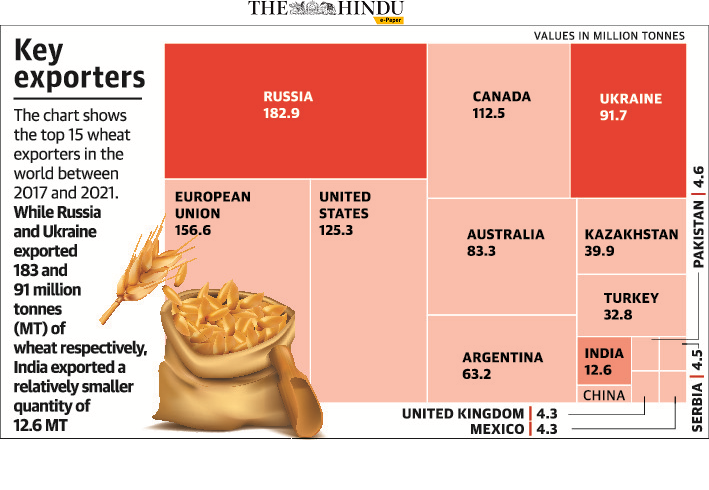
    • While Russia and Ukraine exported 183 million tonnes (MT) and 91 MT of wheat, respectively, between 2017 and 2021, India exported just a fraction of its output, or just 12.6 MT, in the period.
    • Five other countries accounted for the bulk of wheat exports in this period, including the European Union (157 MT), the U.S. (125 MT), Canada (112 MT) and Australia (83 MT).
    • India, which had the second-highest wheat supply (including production, existing stocks and imports) in this period at 613 million tonnes, exported only 2% of this, with about 80% used for domestic consumption, and the rest stored.

    Impact of the war

    • Many countries in Africa, West Asia and Southeast Asia rely heavily on Russian and Ukrainian wheat.
    • Egypt, the biggest importer of wheat, sources 93% of its needs from the East European neighbors. Indonesia, the second-largest importer, has a 30% dependence on these two nations.
    • African nations such as Sudan (60% reliance), Tanzania (64%), Libya (53%), Tunisia (52%), and West Asian countries including Lebanon (77% dependency), Yemen (50%) and the UAE (42%) are also highly dependent on supplies from the two neighbors now at war.

    India’s focus markets

    • India is now focussing on exporting wheat to many nations such as Egypt, Turkey, Nigeria, Algeria, West Asia, Indonesia, Vietnam, Sri Lanka, Bangladesh, Thailand, the Philippines, Morocco and Tanzania.
    • To give impetus to the export promotion of wheat as well as to bring focus on the challenges and bottlenecks faced in production and export, APEDA has created a task group.

    Legal hurdles over Wheat Exports

    • If India decides to export wheat from its stocks, some developed nations may raise objections at the World Trade Organisation.
    • Already, in March, India was accused of exporting rice from its stocks.
    • India had replied that its rice exports were not from stocks set aside under the public stockholding programs.

    India’s consideration

    • The Supreme Court in the Right to Food case, observed that the peace clause adopted in WTO’s Bali Ministerial in 2014 does not prevent India from exporting foodgrains.
    • With the buffer stocks at hand, India should increase its wheat exports in order to stabilise global prices to the extent that it can.
    • It is also important because the countries that were dependent on Russia and Ukraine for their wheat are looking for an alternative source.

    Way ahead

    • There is a need to prioritise local prices and ensure adequate supplies for domestic consumption before deciding on the quantum of exports.
    • Ensuring the stability of prices in India and availability of grain for internal consumption should be of utmost priority to the Indian government
    • The government should plan this move in such a way that it does not impact local consumption.
    • A bumper crop of wheat is expected, so the government can procure enough for its distribution and buffer needs.
    • Further, as of now, there are no export restrictions, so farmers can also get the advantage of higher prices by selling the surplus to private traders for exports.


    Try this PYQ from CSP 2019:

    Q. Among the agricultural commodities imported by India, which one of the following accounts for the highest imports in terms of value in the last five years?

    (a) Spices

    (b) Fresh fruits

    (c) Pulses

    (d) Vegetable oils


    [wpdiscuz-feedback id=”ff150g1lak” question=”Please leave a feedback on this” opened=”1″]Answer is subjective to the year. But still you can give it a try.[/wpdiscuz-feedback]


    UPSC 2022 countdown has begun! Get your personal guidance plan now! (Click here)