💥Join UPSC 2027,2028 Mentorship (August Batch) + XFactor Notes & Microthemes PDF

GS Paper: GS1

  • Why a flat map fails to accurately depict Earth

    Why a flat map fails to accurately depict Earth

    Why in the News

    • The UN General Assembly has adopted a resolution encouraging a shift from the Mercator projection towards the Equal Earth projection.
    • 164 countries, including India, supported the resolution.
    • The United States voted against, while six countries abstained.
    • The resolution is non-binding.
    • The debate centres on how world maps represent the relative size of different regions, particularly Africa.

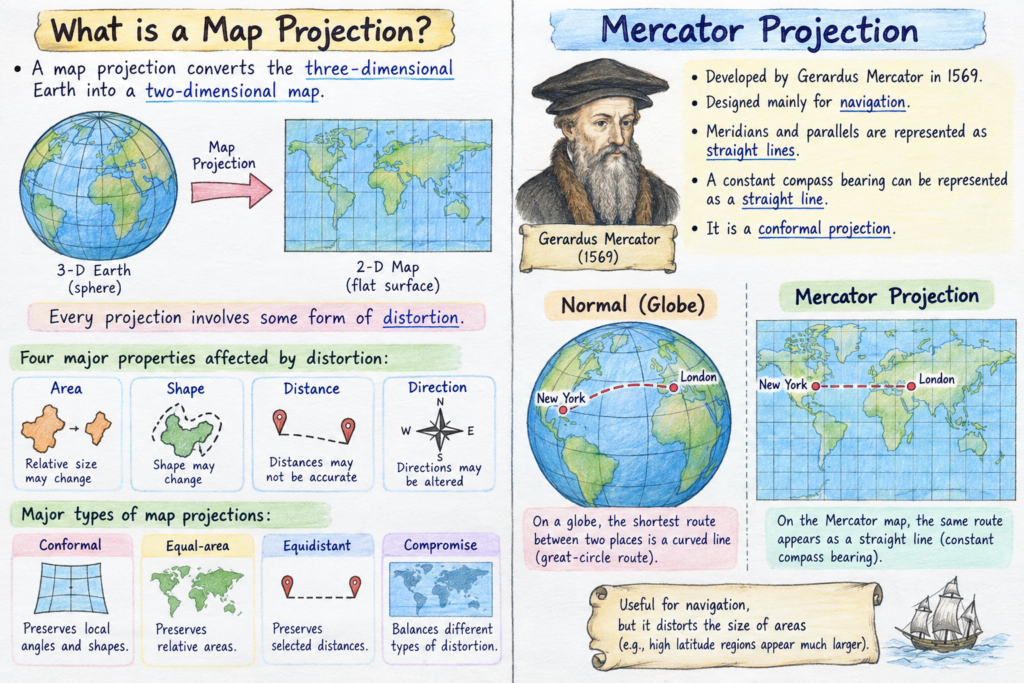
    What is a Map Projection?

    • A map projection converts the three-dimensional Earth into a two-dimensional map.
    • Every projection involves some form of distortion.
    • Four major properties are: Area, Shape, Distance, Direction
    • Major types include:
      • Conformal: Preserves local angles and shapes.
      • Equal-area: Preserves relative areas.
      • Equidistant: Preserves selected distances.
      • Compromise: Balances different types of distortion.

    Mercator Projection

    • Developed by Gerardus Mercator in 1569.
    • Designed mainly for navigation.
    • Meridians and parallels are represented as straight lines.
    • A constant compass bearing can be represented as a straight line.
    • It is a conformal projection.

    Major Limitation

    • Areas become increasingly exaggerated towards the poles.
    • Greenland and Antarctica therefore appear much larger than their actual relative size.
    • This can visually distort perceptions of the geographical size of regions.

    Equal Earth Projection

    • Developed in 2018.
    • It is an equal-area projection.
    • Preserves the relative area of landmasses.
    • Particularly useful for:
      • Population distribution
      • Climate data
      • Land-use mapping
      • Resource distribution
    • It sacrifices some accuracy in shape and distance.

    Which Projection for Which Purpose?

    • Navigation → Mercator or other conformal projections.
    • Statistical/thematic maps → Equal-area projections such as Equal Earth.
    • General world maps → Robinson or Winkel Tripel.
    • Polar regions → Azimuthal projections.

    Challenges

    • UN resolutions are not legally binding.
    • Digital mapping systems continue to rely heavily on Mercator-derived projections.
    • Changing a projection does not eliminate distortion; it only changes which property is prioritised.
    • Therefore, maps should clearly mention the projection and its principal purpose.

    Way Forward

    • Use projection according to purpose, rather than adopting one universal map.
    • Provide equal-area options in government statistical and mapping platforms.
    • Clearly mention the projection used on published maps.
    • Improve geographical literacy by teaching the limitations of different projections.

    Prelims Pointers

    • Compromise projections → Balance multiple distortions.
    • Mercator → Conformal projection.
    • Mercator → Developed in 1569.
    • Mercator’s major use → Navigation.
    • Equal Earth → Equal-area projection.
    • Equal-area projection → Preserves relative areas.
    • Geostationary ≠ Geosynchronous is a separate orbital concept, not a map projection.
    • No flat map → Can simultaneously preserve area, shape, distance and direction perfectly.
  • Concerns over the Census questions

    Why in the News

    The Central government has notified the questions to be asked of every individual during the population enumeration phase of the 2027 Census. In a departure from past Censuses, the schedule seeks personal details that cannot be used to generate any useful statistics: the names of the parents of every individual, nationality as declared, the permanent residential address, the place of COVID-19 vaccination, the number of bank accounts held, and mobile, Aadhaar, voter identity and passport numbers. The same details are the ones required to prepare or update a population register. The contest is over whether a questionnaire built partly out of identifiers still serves the statistical purpose the Census exists for.

    What is a population census?

    1. The United Nations definition: A census is the total process of planning, collecting, processing, analysing, disseminating and evaluating demographic, economic and social data at the smallest geographic level, at a specified time, covering all persons in a country or in a well delimited part of it.
    2. Its output is statistics, not records: The exercise generates statistics for the use of the government in particular and society in general, so the information an individual gives is used only to compile the relevant statistics.
    3. Confidentiality is a founding principle: Principle 6 of the United Nations Fundamental Principles of Official Statistics requires individual data collected by statistical agencies to be strictly confidential and used exclusively for statistical purposes. India has adopted these principles.

    What is new in the 2027 questionnaire?

    1. Household relationships: Respondents must give the details of the parents of every individual, and of the spouses of the married persons in the household.
    2. Status and residence: Nationality as declared and the permanent residential address are to be recorded.
    3. A pandemic era question: The place of COVID-19 vaccination is to be recorded.
    4. Financial detail: The total number of bank accounts held by each person is to be recorded.
    5. Identifiers: Mobile number, Aadhaar number and voter identity card number are to be recorded if available, along with the passport number of Indian passport holders and whether the person holds a driving licence.
    6. The length of the schedule: The questionnaire runs to 40 questions, many of them requiring descriptive answers.

    Why have names never entered Census databases?

    1. A name identifies, it does not measure: An individual’s name has no relevance to the exercise beyond identifying the person during enumeration. Names have been placeholders and have not been present in Census databases.
    2. India has never computerised them: There have been no attempts in the Indian Censuses to computerise names at all.
    3. Other countries record names for a declared later use: Some countries include the name and open past Census data for genealogical study. Eg. Past data from the United States Census can be accessed 72 years after the exercise, and India has no comparable rule or policy.

    Which households cannot answer these questions?

    1. Institutional households: Wardens of hostels, old age homes and jails must supply the names of every resident along with the names of their parents.
    2. Students are counted where they are not present: Large numbers of children study away from home in hostels and as paying guests. February falls towards the end of the academic year, so they may not be at home and would not be eligible for enumeration at their normal households.
    3. Ordinary households have gaps too: A respondent may not know the details of grandparents living with them.
    4. Visitors and staff are also covered: Visitors and domestic servants living in a household for the entire duration of the enumeration period are to be enumerated there, and the respondent may be unable to obtain their details.

    What can the identifier questions actually produce?

    1. ‘If available’ is undefined: It is unclear whether availability refers to the household member concerned or to the respondent. Read as the respondent, the numbers will not reach the Census, since respondents are frequently housewives or elderly parents who do not hold these details for every member.
    2. The numbers do not tabulate: These are not data items usable for any tabulation, beyond determining whether such a number exists.
    3. The field cost is prohibitive: More than 30 lakh enumerators would have to sit with households to record these numbers correctly, and they may lack the time and patience to obtain the relevant records.
    4. The respondent carries no duty of care: The respondent is not a Census functionary, so an individual whose identifiers are disclosed by a household respondent has no protection against their misuse.

    What would the bank account question have to be to work?

    1. The tabulation it supports is narrow: The total number of bank accounts held by each person yields a distribution of persons by number of accounts, and little else.
    2. The same distribution exists elsewhere: For account holders, the number can be obtained by tabulating accounts against each Permanent Account Number (PAN), which is required to open a bank account.
    3. A simpler question meets the policy need: If the object is only to identify persons without any bank account, asking whether the person holds one is enough.
    4. The field reality: A schoolteacher appointed as an enumerator will struggle to get a correct count of accounts from upper class respondents, who may not answer even the simpler questions.

    Why was the nationality question dropped after 1961?

    1. Declaration does not establish status: Nationality as declared may serve no useful purpose, since a person residing illegally may declare Indian nationality.
    2. India tried it and abandoned it: The question was asked in the 1951 and 1961 Censuses and was discarded from 1971 onwards.
    3. A comparable decision abroad: The United States decided, after considerable debate, not to include the citizenship question in its 2020 Census.

    Is the Census being used to build the National Population Register?

    1. The proposal has a history: Proposals to update the National Population Register (NPR) during the 2021 Census exercise drew objections from several States.
    2. States control the field staff: The Census is conducted by enumerators appointed by the State government under Section 4(2) of the Census Act, 1948, so a State may refuse the use of its staff for work that is not part of the Census. The Citizenship Act says nothing about a State government’s role in preparing the NPR.
    3. The new questions fit the register, not the statistics: Details of parents, permanent address and nationality are useful for preparing or updating the NPR, which is to form the basis for preparing the National Register of Citizens. They add no statistics of their own.
    4. Extraction would breach confidentiality: Collecting the information through the Census questionnaire and later extracting it for another organisation within the government may violate the principle of confidentiality.
    5. The objection is to the route, not the register: Preparing a population register or a citizen register is unobjectionable and its uses are well recognised. The collection for it should run through a transparent process with a legal basis, without jeopardising the Census.

    What does the length of the schedule do to data quality?

    1. Respondent fatigue: The time a long descriptive schedule takes per household invites disinterest, and the respondent answers similar questions again for every individual in the household.
    2. Casual replies follow: A disinterested respondent supplies answers that are recorded as data, so fatigue enters the dataset rather than showing up as non-response.
    3. Enumerator workload: Recording names and addresses has significantly increased the enumerator’s workload.
    4. The output degrades: Loading the Census with questions that generate no statistics may seriously affect the quality of Census data.

    Challenges to the 2027 Census

    1. The decadal series carries a gap: The last completed Census was in 2011, so sampling frames, welfare targeting and constituency data have run for over a decade on an ageing base. Eg. Household surveys draw their samples from Census frames, which have not been refreshed since 2011.
      The Fix: Fix a statutory calendar for enumeration and for data release, so the exercise cannot be deferred by administrative decision.
    2. The general data protection regime does not cover this risk: Census records rely on the secrecy provisions of the Census Act. The general law carries wide exemptions for government processing. Eg. The Digital Personal Data Protection Act, 2023 permits the Union government to exempt instrumentalities of the State from its obligations.
      The Fix: Notify an express purpose limitation for Census records that bars their transfer into any non statistical database.
    3. Digital self enumeration excludes the least connected: The 2027 Census offers self enumeration through a digital application, which the households most likely to be missed are least able to use. Eg. Internet access and smartphone ownership remain lowest among the poorest rural households.
      The Fix: Keep full enumerator coverage as the default and treat self enumeration as an additional channel rather than a substitute.
    4. Caste enumeration adds a classification burden: The 2027 Census will record caste, and caste names vary across regions, languages and spellings, which makes field coding unreliable. Eg. The 1931 Census, the last to enumerate caste comprehensively, recorded several thousand caste and sub caste entries.
      The Fix: Publish a pre coded State wise caste list with a residual open field, so enumerators record rather than classify.

    Conclusion

    The questionnaire stands notified, and enumeration will run on it unless the government revises the schedule before the field work begins. The unresolved point is not whether the state may build a population register, which nobody disputes. It is whether the Census, whose cooperation from a household rests on the assurance that answers become numbers and nothing else, is the right instrument to build one with. Every question that cannot be tabulated tests that assurance, and a household that begins to doubt it answers the rest of the schedule differently.

    Back2Basics: National Population Register

    1. What it is: A register of the usual residents of the country, prepared at the local, sub district, district, State and national level.
    2. Legal basis: It is prepared under the Citizenship Act, 1955 and the Citizenship (Registration of Citizens and Issue of National Identity Cards) Rules, 2003.
    3. Who is a usual resident: A person who has resided in a local area for six months or more, or who intends to reside there for the next six months or more, irrespective of citizenship.
    4. Its status now: The register was first prepared in 2010 alongside the house listing phase of Census 2011 and was updated in 2015.

    Matching Previous Year Question

    “No direct PYQ traced in the provided files”

  • Safety in Delhi needs a regulatory reset

    Why in the News

    A building collapse in Satya Niketan has reopened the question of who is answerable for building safety in Delhi. Comparable failures have occurred at Saidulajab, Hauz Rani, Tughlakabad Extension, Palam and Vivek Vihar. Delhi already runs an online single window system for building proposals, built on Automated Development Control Regulations (Auto DCR) software, and that system reached none of these structures. The contest is between a regulator that examines the plans submitted to it and a city where the dangerous construction is precisely the construction that submits no plan.

    How does Delhi’s single window building approval system work?

    1. Online filing and document verification: Building proposals are submitted online. The Auto DCR software and the Building Plan Approval Management System verify the mandatory documents.
    2. Fee and site visit: The system issues a scrutiny fee challan for online payment. It then sends an SMS to the building inspector and the architect carrying the details of the site visit.
    3. Automated reading of the drawing: Auto DCR creates entities such as plots, building layouts and roads from the submitted drawings, using layers, geometrical mapping and reports.
    4. Rule checking and status: AutoCAD and allied software analyse the plans against the development control regulations and the building bye-laws, and the compliance status is available online before the plans are examined for approval.

    Which laws does illegal construction breach?

    1. Planning and municipal law: Illegal construction violates the Master Plan for Delhi, the Unified Building Byelaws, the Delhi Development Act and the Delhi Municipal Corporation Act, 1957.
    2. Fire law: It also violates the Delhi Fire Service Act, 2007, which is the source of the fire safety clearance a building is required to hold.
    3. The city absorbs the cost: Unapproved construction adds load to transport, services and civic amenities that were planned for a lower density.
    4. The failures are recurrent: Frequent fire incidents and structural failures in illegal constructions have endangered lives.

    Why is Delhi’s exposure larger than the collapses suggest?

    1. Seismic exposure: Delhi falls in Seismic Zone IV, where earthquakes may be severe, so unengineered construction carries a citywide risk rather than a single owner’s risk.
    2. Two cities with one problem: Planned development coexists with informal growth in slums and unauthorised colonies. Both are plagued by building violations along with a lack of oversight and enforcement.
    3. Safety is not conditional on tenure: The city cannot afford unsafe buildings irrespective of the type of development, the land ownership or the land use.

    Why has repeated official attention changed so little?

    1. The findings already exist: Courts, the commissions headed by G T Nanavati and by Baleshwar Prasad, and the high level committee headed by Tejendra Khanna have all underlined building safety, with very little impact.
    2. Monitoring is the weak link: Haphazard development and weak monitoring systems produce inefficiencies, delays and a loss of accountability.
    3. Non-compliance carries no standing consequence: Every building without a structural and fire safety certificate should be sealed and should display a safety related warning, and no such automatic consequence operates today.

    Why does approving plans not produce safe buildings?

    1. The department sees only what is filed: Building departments mainly deal with the plans they receive, so massive illegal and risky constructions are left out of the process altogether.
    2. The digital reform did not widen the net: The single window system improved the handling of submitted proposals. It brought no unauthorised construction into any approval or inspection stream, which is why the reform has not been successful.
    3. The software trails the city it regulates: The system needs updating to handle redevelopment, green buildings, transit oriented development and approvals under mixed land use.

    What would demunicipalising building regulation mean?

    1. Separating the regulator from the political apparatus: The proposal is to make the regulatory function for buildings independent of the municipal and political structure that currently houses it.
    2. One structure performs two conflicting roles: The same municipal apparatus both sanctions construction and polices it, so enforcement competes with local political interest.
    3. Bringing in the settlements now left out: Radical reform is required so that structures in informal settlements, urban villages and resettlement colonies receive regulatory attention.

    What can technology detect that inspection does not?

    1. Remote detection of new construction: Geospatial artificial intelligence, using high resolution satellite imagery and LiDAR (laser based remote sensing that measures distances to build a three dimensional model of a surface), can monitor and detect unauthorised construction.
    2. Continuous tracking in place of periodic visits: Spatial data driven Real-Time Morphological Tracking can change how building and layout plans are approved, and improve compliance with the building bye-laws, the Fire Services Act and land use stipulations.
    3. Less discretion, less rent: Automated detection reduces the human interface in approval and enforcement, and reduces the corruption that discretion creates.

    Challenges to an independent building regulator for Delhi

    1. Authority over building control is already split: Sanction and enforcement are divided among the Municipal Corporation of Delhi, the New Delhi Municipal Council, the Delhi Development Authority and the Delhi Cantonment Board, so a new regulator adds a layer unless it absorbs theirs. Eg. The Delhi Development Authority prepares the Master Plan, and the municipal bodies sanction individual building plans under it.
      The Fix: Vest building safety certification in one statutory authority for the whole National Capital Territory, with the municipal bodies acting as its field arms.
    2. Unauthorised construction carries statutory protection: Punitive action against unauthorised colonies has repeatedly been suspended by law, so a regulator inherits a built stock it cannot act against. Eg. Successive National Capital Territory of Delhi Laws (Special Provisions) Acts have protected specified categories of unauthorised construction from demolition and sealing.
      The Fix: Convert that protection into a time bound retrofitting and certification requirement, so regularisation buys structural safety rather than immunity alone.
    3. Detection is not structural assessment: Satellite imagery and LiDAR identify a new or altered footprint, and they cannot read load bearing capacity, foundation integrity or the quality of materials. Eg. A failure triggered by excavation under an existing building leaves no external signature beforehand.
      The Fix: Pair remote detection with a mandatory structural audit by empanelled engineers for every building above a defined height or age.
    4. Certification capacity does not exist at that scale: Sealing every building without a structural and fire safety certificate presumes a supply of qualified structural engineers and fire auditors the city does not have. Eg. Fire safety clearance is required only above a prescribed building height, and even that stock is audited irregularly.
      The Fix: Licence and empanel private structural auditors under statutory personal liability, with random state verification of the certificates they issue.

    Conclusion

    Building regulation in Delhi is organised around a transaction, the filing of a plan, and the buildings that kill people are the ones that never generate that transaction. Better software and further audit requirements leave that structure untouched. The reform with any prospect of changing outcomes starts from the built stock rather than from the file, detects change on the ground, and carries the authority to act on what it finds without asking an elected municipal body first. Whether the proposal for a regulator of that kind moves past commentary is the thing to watch.

    Urban Governance in India

    1. Cities carry the economy: Cities house about 37 per cent of the population and generate close to 70 per cent of India’s Gross Domestic Product (GDP).
    2. The urban share keeps rising: Urban India is projected to reach about 60 crore people, or 40 per cent of the population, by 2036.
    3. Authority is fragmented by design: Municipal functions are split across urban local bodies, development authorities and parastatal agencies, so no single body answers for a city.
    4. Cities raise almost nothing of their own: Urban local bodies raise under 0.6 per cent of GDP as own revenue, of which property tax accounts for about 0.15 per cent.

    Constitutional Framework Governing Urban Governance

    1. Part IXA, Articles 243P to 243ZG: Inserted by the Constitution (Seventy-fourth Amendment) Act, 1992, it gives municipalities constitutional status and fixes their composition, duration and elections.
    2. Twelfth Schedule: Lists 18 functions a State may devolve to municipalities, including urban planning, regulation of land use and construction of buildings, and fire services.
    3. Article 243W: Empowers State legislatures to confer powers and responsibilities on municipalities as institutions of self government and for the Twelfth Schedule functions.
    4. Article 243Y: Requires the State Finance Commission to review municipal finances and recommend the sharing of State taxes with municipalities.

    Laws and Rules Governing Urban Development

    1. National Building Code of India, 2016: A model code issued by the Bureau of Indian Standards setting requirements for structural safety, fire and life safety and building services. States give it force through their own bye-laws.
    2. Model Building Bye-Laws, 2016: A template issued by the Ministry of Housing and Urban Affairs for State and municipal bye-laws, covering sanction procedure, setbacks, parking and fire safety.
    3. Real Estate (Regulation and Development) Act, 2016: Requires registration of projects and agents with a State regulatory authority, and fixes promoter liability for structural defects for five years from possession.
    4. Disaster Management Act, 2005: Provides the statutory basis for disaster management plans and for safety and retrofitting norms in hazard prone areas.

    Challenges in Urban Governance

    1. Devolution under the Seventy-fourth Amendment is incomplete: Many States have not transferred the listed functions or empowered mayors, so the body closest to a building is not the body that controls it. Eg. Urban planning and land use regulation sit with State owned development authorities in most large cities.
      The Fix: Complete activity mapping for the Twelfth Schedule functions and provide for directly elected mayors with a fixed tenure.
    2. Municipal finances cannot fund enforcement: Weak own revenue leaves cities without the technical staff to inspect, audit or prosecute. Eg. Successive Finance Commissions have tied municipal grants to property tax reform and audited municipal accounts.
      The Fix: Shift property tax to capital value with periodic revision, and make audited accounts a condition for central mission funds.
    3. Most urban land is not planned at all: Only about 30 per cent of urban land is properly planned, so the majority of growth happens outside any development control regime. Eg. Census towns cross the urban thresholds without having any urban local body.
      The Fix: Extend statutory planning coverage to census towns and peri urban areas before they are built out.
    4. Urban disaster risk is outrunning municipal capacity: Flooding, fire and heat concentrate on the least regulated built stock and on the poorest occupants. Eg. The Disaster Management (Amendment) Act, 2025 provides for Urban Disaster Management Authorities in large cities.
      The Fix: Make the city disaster authority the owner of building safety audits, with the power to seal non compliant structures.

    Matching Previous Year Question

    “[2023, GS2, 10.0 marks] “The states in India seem reluctant to empower urban local bodies both functionally as well as financially.” Comment.”

  • Fading alphabet to fresh paint: Dogri scripts a comeback on Jammu signboards

    Why in the News

    New public signboards in Jammu carry area names in Namey Dogra Akhar, the script of the Dogri language, alongside the usual Devanagari for Hindi and Roman for English. Dogri has long been written in Devanagari, with its own script falling into disuse. Civic authorities are putting the boards up at prominent locations and institutions as an attempt to revive that script. Dogri itself carries the full set of formal protections available to an Indian language, at the Union level and in the Union Territory. The tension is that the decision that secured the language, adopting Devanagari to popularise its literature, is the same decision that displaced its script.

    What is Namey Dogra Akhar?

    1. A modified Takri: Namey Dogra Akhar is a modified version of Takri, the original script in which Dogri was written. The name translates as new Dogri script.
    2. It was created to solve a transcription problem: Takri had no vowel signs, so official orders and documents could not be reliably transcribed in it.
    3. The vowels were borrowed from Devanagari: Writers were directed to take vowel signs from Devanagari, which produced the new script. It then entered administrative work alongside Persian, which was already in use.

    Where does Dogri stand as a language?

    1. Family and group: Dogri is an Indo-Aryan language, part of the Indo-European family that also includes Hindi, Bengali and Punjabi. It belongs to the Western Pahari group, a cluster of related languages found mainly in the western Himalayas.
    2. Speakers and spread: It was the primary language of nearly 2.6 million people at the 2011 Census. It is spoken mainly by the Dogras of Jammu and Kashmir’s Jammu division, with smaller groups in Punjab, Himachal Pradesh and Pakistan-occupied Kashmir.
    3. Formal recognition: Dogri was recognised as one of the 22 scheduled languages under the Eighth Schedule in 2003. It was declared one of the official languages of the Union Territory of Jammu and Kashmir in 2020.

    How did the script lose its place in administration?

    1. The first Dogra ruler left it undeveloped: Maharaja Gulab Singh, the first Dogra ruler of Jammu and Kashmir, directed his energies at expanding the empire up to Tibet. He found little time to promote or develop Takri.
    2. His successor built the new script into government: Maharaja Ranbir Singh, who ascended the throne in 1856, was a scholar of Sanskrit and Persian and a reformer who had the civil and criminal laws compiled into the Ranbir Penal Code. The modified script emerged in administrative work during his rule.
    3. Urdu replaced Persian and squeezed the script out: Maharaja Pratap Singh, who succeeded in 1885, replaced Persian with Urdu as the official language to simplify administrative work, since Urdu was already widely used among the local population.
    4. Local use outlasted official use: The Dogri script continued to be used by many local people for several years after it lost its administrative standing.
    5. Three script demands were balanced against each other: Maharaja Hari Singh, who became ruler in 1926, faced British pressure for English in official work and a demand for Hindi in the Dogra heartland. He promoted Devanagari and Roman alongside the Perso-Arabic script used for Urdu.

    Why did reviving the language not revive the script?

    1. A literary body switched scripts to widen readership: The Dogri Sanstha, a literary organisation, adopted the Devanagari script in 1944 to popularise Dogri literature.
    2. The switch bought recognition at the script’s expense: It helped Dogri gain Sahitya Akademi recognition in 1969. It also contributed to the eventual decline of Namey Dogra Akhar.
    3. Academic institutionalisation ran entirely in Devanagari: The University of Jammu set up a Dogri Research Cell in 1971, later upgraded into a full department. The language became a formal subject in affiliated degree colleges in 1987, taught in Devanagari.
    4. The agitations were about the language, not the script: A Dogri Action Committee led by a Dogri poet held demonstrations in 1990 to get the language introduced in schools. An umbrella group, the Dogri Sangharsh Morcha, launched an agitation two years later for inclusion among the scheduled languages, and Dogri entered primary schooling as a third language in 2002.

    What is the current revival attempt?

    1. It began outside government: Civil society members started displaying boards written in Namey Dogra Akhar at religious places and cremation grounds a few years ago. A former principal of the Government Medical College, Jammu led that effort.
    2. It then moved to the municipal body: The same effort approached the Jammu Municipal Corporation to install public signboards, which is how the boards reached prominent locations and institutions.
    3. Teaching is the announced next step: Classes in the Dogri script are to be started, on the stated position that a language cannot survive without its own script.

    Challenges to reviving the Dogri script

    1. Signage does not by itself create readers: A script on a board stays decorative until a population can decode it, and Dogri continues to be taught in Devanagari. Eg. Manipur returned Meitei Mayek to everyday use only after making the script compulsory in schools from 2006.
      The Fix: Introduce the script as a taught component of the existing Dogri syllabus in schools and colleges rather than as an optional cultural add on.
    2. Digital support is thin: A script without fonts, keyboard layouts and rendering support cannot be used in the places where writing now happens. Eg. The Dogra script received its own Unicode block in 2018, and usable fonts and input methods remain scarce.
      The Fix: Commission open licensed fonts and an input method, and require them in Union Territory government publishing so the script has a working digital base.
    3. The written corpus is not accessible: Older material in Takri and its modified successor survives largely in temple and private collections rather than in catalogued, digitised archives. Eg. The National Mission for Manuscripts, set up in 2003, catalogues such holdings, and regional collections in scripts with few readers move slowest through it.
      The Fix: Fund a script specific digitisation and transliteration project, so learners have material to read once they can read it.
    4. Official status has not required the script: Recognition for the language and official language status in the Union Territory brought protection to Dogri without obliging anything to be written in its own script. Eg. Government business in the Union Territory runs in Devanagari, Roman and Perso-Arabic.
      The Fix: Mandate the script on official signage, letterheads and certificates, so demand for literacy follows an actual use.

    Conclusion

    The boards make the script visible before they make it legible, and that gap is where comparable revivals have stalled. Recognition for Dogri arrived through a script that was not its own, which is why formal status has never carried the script along with the language. The marker to watch is whether the promised classes and a place in the school syllabus follow the signboards, since a script survives by being written rather than by being displayed.

    Back2Basics: Eighth Schedule of the Constitution

    1. What it lists: The Eighth Schedule names the languages the Union is obliged to develop and enrich. It currently carries 22 languages, against 14 at the Constitution’s commencement.
    2. Where it is used in the Constitution: Article 344(1) provides for an Official Language Commission whose members are drawn from these languages. Article 351 directs the Union to draw on them in developing Hindi.
    3. How a language is added: Inclusion requires a constitutional amendment. Dogri, Bodo, Maithili and Santhali were the most recent additions, made by the 92nd Constitutional Amendment Act.

    [2018, GS1, 10 marks] Safeguarding the Indian art heritage is the need of the moment. Discuss.

  • Civil Service candidates await Centre’s word on foundation course amid case in top court

    Why in the News

    The Centre has asked the Supreme Court for permission to let the Department of Personnel and Training (DoPT) allocate services to the 2025 Civil Services Examination recommendees without implementing the Rohith Nathan judgment. That judgment, delivered on 11 March, found that the DoPT was excluding certain Other Backward Classes (OBC) candidates from reservation by treating them as creamy layer on the basis of their parents’ salary income alone. The Court directed corrective measures within six months. The examination results had been declared on 6 March, days before the ruling, which places one entire recruitment cycle across the line the judgment drew. The 958 candidates recommended in that cycle now have no service allocation and no foundation course date.

    What is the creamy layer income test?

    1. Where it comes from: The DoPT Office Memorandum of 8 September 1993 operationalised the Supreme Court’s direction in Indra Sawhney (1992) to exclude the socially advanced sections within a backward class.
    2. How it is structured: The Memorandum sets out a Schedule of six categories. The first five exclude a candidate by the status of the parent regardless of income, covering constitutional posts, service grades, armed forces ranks, professions and trade, and property ownership.
    3. The sixth category is residual: It applies an income and wealth test to everyone the first five do not catch, using gross annual family income above the ceiling for three consecutive years.
    4. What the income test leaves out: Salary income and agricultural income are excluded from that calculation. Only income from property, business, capital gains and similar sources is counted, and the ceiling has stood at Rs 8 lakh since 2017.

    What did the Rohith Nathan judgment find, and what did it direct?

    1. The finding: A Division Bench held that the DoPT was treating equals unequally, since the single variable separating two otherwise identical candidates was the parent’s employer.
    2. How the discrimination worked: A child of a government clerk was tested without salary income and passed. A child of a public sector or private employee on the same pay was tested with salary income counted and failed.
    3. What the Court held on the test itself: The income and wealth component is a residual filter, not the primary basis for exclusion. It must apply the same way to all until the government establishes equivalence between public sector posts and government grades.
    4. The direction: The Centre was to create supernumerary posts for the petitioners within six months, with services allotted according to the candidates’ ranks in their respective examination years.

    Why is the service allocation stalled?

    1. The Centre has asked to be excused from the ruling for this cycle: Its application seeks permission for the DoPT to allocate services without implementing the judgment.
    2. The cycle straddles the ruling: Results were declared on 6 March and the judgment came on 11 March, so allocation for this batch would be the first application of whichever reading the Court settles on.
    3. Nothing moves until the hearing: The Supreme Court is set to hear the Centre on 17 September, and the allocation question is what that hearing turns on.

    What are the 958 recommendees facing?

    1. The course has not begun: The foundation course was expected to begin in August and has not started.
    2. The schedule lapsed without a replacement: A tentative start date of 24 August was circulated, and nothing has been communicated since the matter came before the Court.
    3. No communication has reached the candidates: Recommended candidates report receiving nothing from the DoPT or from the academy about when the course will start.
    4. Neither official channel has been updated: No updates on the next steps have appeared on the DoPT website or on the website of the training academy.

    Challenges to the creamy layer determination

    1. The equivalence of posts was never established: The 1993 Schedule made the rank test for public sector and private employees conditional on an equivalence with government grades that has not been drawn up in three decades. Eg. Reservation policy is the Ministry of Social Justice and Empowerment’s subject under the Allocation of Business Rules, and the DoPT can only issue instructions once that Ministry frames the policy.
      The Fix: Notify a post-equivalence table so the rank-based categories apply uniformly whoever the employer is, which removes the need for the income test in these cases altogether.
    2. The income ceiling moves by discretion rather than by indexation: With no formula, the threshold stays static through years of inflation and then jumps, so the excluded population changes for reasons unrelated to backwardness. Eg. The ceiling went from Rs 1 lakh to Rs 8 lakh in five irregular steps over 24 years.
      The Fix: Tie the ceiling to a published price or wage index with automatic annual revision.
    3. Verification rests on self-declaration: Certificates are issued on a declaration checked by local revenue staff, so a defect surfaces only when the appointment is scrutinised. Eg. Recruitment bodies cancel candidatures years after selection over defective certificates.
      The Fix: Validate income declarations against tax and land records at the point the certificate is issued rather than at the point of appointment.
    4. No data exists on who actually captures the benefit: Without caste-wise data on selections and appointments, the claim that a small number of families corner reserved posts cannot be tested either way. Eg. The Rohini Commission on sub-categorisation of Other Backward Classes worked without a comprehensive survey of selections.
      The Fix: Publish caste-wise selection and appointment data against reserved posts as a standing annual return.
    5. Central and State lists diverge: A community recognised as backward by a State is often absent from the Central list, and the same test is administered differently across the two. Eg. Candidates holding State OBC certificates have been denied central reservation.
      The Fix: Publish a mapped concordance between the Central list and each State list, so a candidate can see which list governs a given post.

    Conclusion

    The dispute is no longer about whether the exclusion was wrong, since that has been decided. It is about who absorbs the cost of correcting it, and both available answers create a fresh set of claimants. A recruitment cycle cannot be held open indefinitely, and a batch allotted on a reading the Court has already rejected moves the litigation one year forward rather than ending it. The hearing later this month is where that choice is made, and the marker is whether the Court permits an interim allotment or holds the executive to the timetable it set.

    Back2Basics

    1. What it is: The Lal Bahadur Shastri National Academy of Administration is the central training institution for the Indian Administrative Service.
    2. Where it is: It is located at Mussoorie in Uttarakhand.
    3. What the foundation course is: The Academy runs the common Foundation Course taken by fresh recruits to the All India Services and the Central Civil Services before they move to their own service academies.
    4. Who administers it: It functions under the Department of Personnel and Training, and was formed in 1959 by merging the earlier IAS Training School at Delhi and the IAS Staff College at Shimla.

    Matching Previous Year Question

    “[2024, GS1, 15 marks] Despite comprehensive policies for equity and social justice, underprivileged sections are not yet getting the full benefits of affirmative action envisaged by the Constitution. Comment.”

  • Glacial collapse unlikely to halt China’s mega dam plan

    Why in the News

    China is going ahead with construction of a mega dam on the lower reaches of the Yarlung Zangbo, the Brahmaputra, in a seismically active part of Tibet near the border with India. Fresh concerns raised by the glacial collapse along the Nepal-China border have not changed that plan. A month before those flash floods and mudslides, China released its 15th Five-Year Plan for renewable energy, which called for advancing construction of major projects including the Yarlung Zangbo Lower Reaches Hydropower Project. India’s concern is how much water the project will store and how its diversion tunnel will alter downstream flows. Almost nothing about either has been made public, and the one channel through which India receives hydrological data from China has worked irregularly.

    What is the Yarlung Zangbo Lower Reaches Hydropower Project?

    1. What it is: It is a hydropower complex of five power stations on the lower reaches of the Yarlung Zangbo in Tibet, referred to in China as the mega dam project.
    2. How the water is used: Water is taken out of the river at the top of the Great Bend, where the river’s course falls steeply and turns towards India, and carried through a tunnel of about 40 km before rejoining the river below.
    3. The scale committed: A total investment of 1.2 trillion Yuan, around ₹14 lakh crore, was announced for the construction of the five power stations at the groundbreaking in July 2025.
    4. Who builds and runs it: A new State-run entity, the China Yajiang Group, was set up to run the entire project.

    Why has the glacial collapse not changed Beijing’s calculation?

    1. The project sits in a standing plan: The renewable energy Five-Year Plan named the project for advancement before the collapse occurred, so the collapse arrived against a target already fixed.
    2. Political weight is attached to it: China’s Vice Premier visited Nyingchi in Tibet in April and described it as a landmark mega project of the new era. The Premier had called it the project of the century at the groundbreaking.
    3. The safety response is procedural, not a pause: The stated answer to risk is strict enforcement of construction standards and of ecological and environmental protection requirements, with construction progress kept subordinate to quality and safety.
    4. Information has been withheld since the start: There has been little public information about the project since the groundbreaking, and the Vice Premier’s visit is what disclosed the new operating company.

    What exactly is India concerned about?

    1. Storage volume is unknown: How much water will be held in the reservoir is not published, and storage determines how far the timing of downstream flows can be controlled.
    2. The tunnel’s effect on flow is unknown: Diverting the river at the top of the bend and returning it below means the natural channel around the bend carries only what the tunnel does not.
    3. Wider ecological impact is unassessed: No assessment of downstream ecological effects has been released.
    4. The absence of information is itself the obstacle: The lack of published detail prevents India from assessing the impact at all, rather than merely disagreeing with China’s assessment of it.

    Why is the run-of-the-river description contested?

    1. The label implies no storage: A run-of-the-river scheme passes flow through without holding it back, so it carries limited power to change the timing of water reaching a downstream State.
    2. A reservoir is part of the design: The project involves the construction of a reservoir, which a Shanghai-based energy analyst places at the town of Mainling, upstream of Nyingchi, on the basis of reported relocations.
    3. The generating configuration is built around drop: The descending force of the diverted water powers five 12-GW powerhouses, which concentrates head rather than passing the river through unchanged.

    What does China’s earlier dam on the same river show?

    1. The precedent: China has already opened one major dam on the middle reaches of the Yarlung Zangbo at Zangmu, on which construction began in 2010, and a final acceptance meeting was held in June.
    2. The output claimed: Zangmu has generated 22.2 billion kilowatt-hours, described as equivalent to saving approximately 7.4 million tonnes of standard coal and cutting carbon dioxide emissions by around 22.2 million tonnes.
    3. The regional case made for it: State media said the dam had provided a solution to nearly 26 per cent of electricity demand in the Xizang Autonomous Region, and detailed an elaborate fishway designed to move fish between upstream and downstream sections. The project’s design engineer said the fishway would likely be used for future projects.
    4. The new project is of a different order: Chinese analysts project 60 GW of installed capacity and 300 billion kilowatt-hours a year, over three times the Three Gorges, against which Zangmu is small.

    How well does the India-China channel on rivers work?

    1. The forum exists and is about to meet: India and China will hold a meeting of the Expert-Level Mechanism on Trans-border Rivers later this month.
    2. Transmission has been intermittent: The sharing of hydrological data has not been regular and has on occasion been suspended during difficult periods in relations.
    3. China’s stated position denies downstream harm: China’s Foreign Ministry has said it maintains a highly responsible attitude toward transboundary river development, that construction is beneficial for disaster prevention and mitigation throughout the entire river basin, and that it will not have adverse effects on downstream areas.
    4. Cooperation is described in reporting terms: The Ministry cites hydrological reporting, flood control and disaster reduction cooperation with downstream countries, rather than any joint assessment or consent mechanism.

    Challenges to the Yarlung Zangbo Lower Reaches Hydropower Project

    1. Seismic exposure at the Eastern Himalayan syntaxis: The Great Bend sits where the Indian and Eurasian plates converge most sharply, which is among the most earthquake-prone locations in Asia. Eg. The 1950 Assam-Tibet earthquake, of magnitude 8.6, struck this same zone and triggered landslides that blocked and then burst Himalayan river channels.
      The Fix: Publish the seismic design basis and the dam-break inundation modelling for the reach below the project, so downstream authorities can plan against a stated failure scenario.
    2. Sediment trapping changes the floodplain downstream: The Brahmaputra carries one of the world’s heaviest sediment loads, and any storage structure holds back part of it. Eg. Majuli, the river island in Assam, has lost a large part of its area to bank erosion as the balance between deposition and scouring has shifted.
      The Fix: Fix a sediment flushing schedule and share the release calendar with the downstream riparian in advance of each flushing operation.
    3. There is no treaty, only renewable memoranda: India and China share no water-sharing treaty, and data supply rests on memoranda of understanding that expire and must be renewed. Eg. Flood-season hydrological data for the Brahmaputra was not supplied in 2017, the year of the Doklam standoff.
      The Fix: Convert the memoranda into a standing basin instrument with automatic data transmission that does not lapse with the state of political relations.
    4. India’s own detection capacity is thin at the entry point: An anomalous release is useful information only if it is detected before it reaches populated reaches. Eg. Sudden rises and sudden discolouration in the Siang in Arunachal Pradesh have been attributed to upstream activity without independent measurement to confirm the cause.
      The Fix: Build a telemetered gauging network on the Siang and the Lohit reporting in near real time to the Central Water Commission.
    5. The gorge is an ecological zone of its own: The Great Bend gorge holds an unusual altitudinal range of habitat compressed into a short distance, and diversion removes water from that reach. Eg. The Yarlung Tsangpo canyon is among the deepest in the world and carries forest types from subtropical to alpine within a few kilometres.
      The Fix: Require publication of an environmental flow regime for the bypassed reach, stating the minimum discharge to be maintained through the year.

    Conclusion

    The dispute is not yet about water, it is about disclosure. India cannot contest a projection it has not been given. A downstream State that learns a reservoir’s capacity only after commissioning has lost the one point at which design can still be influenced. The meeting of the Expert-Level Mechanism this month is the marker to watch, and the test of it is narrow: whether operating rules are put on the table, or whether the meeting produces another reaffirmation of responsible conduct.

    Back2Basics: Expert-Level Mechanism on Trans-border Rivers

    1. It is the standing India-China official channel on shared rivers, established in 2006 following an agreement between the two governments.
    2. Its declared business is the provision of hydrological information by China during the flood season, and cooperation on emergency management of trans-border rivers.
    3. It covers the Brahmaputra and the Sutlej, the two rivers on which separate memoranda of understanding govern data supply.
    4. It is a consultative forum with no adjudicatory power, and it does not allocate water between the two countries.

    Matching Previous Year Question

    “Identify the river of the Indian sub-continent on the basis of the following information: 1. Antecedent drainage system. 2. Flows through three countries. 3. Originates in the Tibetan Plateau; important for irrigation. 4. Does not form distributaries. Select the answer from the following: (a) Brahmaputra (b) Indus (c) Sutlej (d) Teesta”

  • Census advanced in four poll-bound States, formally deferred in Manipur

    Why in the News

    The Union government has advanced the population enumeration phase of Census 2027 in the poll-bound States of Uttar Pradesh, Punjab, Uttarakhand and Goa, scheduling it from November 16, 2026 to January 4, 2027, ahead of the nationwide enumeration planned for February 2027. The same notification formally deferred the Census exercise in Manipur till further declaration. The reference date for the four States is fixed at 00.00 hours on January 5, 2027, against March 1 for the rest of the country and October 1, 2026 for Ladakh and the snow-bound areas of Uttarakhand, Jammu and Kashmir and Himachal Pradesh. The second phase carries 40 questions and includes an open-ended field for recording caste details. The tension is that a single count needs a single moment of reference, and the schedule now bends to the electoral calendar in four States and to a citizenship register demand in one.

    What does the revised schedule change?

    1. The legal basis: The notification was issued by the Registrar General and Census Commissioner of India under the Census Act, 1948.
    2. The order of operations in the four States: Residents have the option of self-enumeration through a dedicated portal between November 16 and November 30, ahead of the door-to-door survey, which begins on December 1.
    3. The revisional round: Population enumeration in the four States is followed by a revisional round from January 5 to January 9, 2027, immediately after the reference moment.
    4. The stated reason for the advance: The exercise is being completed in these four States before assembly elections due early next year.

    What does the second phase ask?

    1. The scale of the schedule: The second phase carries 40 questions, of which at least 13 are new compared with the 2011 Census.
    2. Caste is recorded without a fixed list: The schedule includes an open-ended field for caste details. Respondents may also decline to disclose their caste or state that they do not belong to any caste.
    3. The new identity and household questions: Spouse’s name, nationality, father’s particulars and mother’s particulars are being asked for the first time.
    4. The new asset, document and service questions: Digital literacy, permanent residential address, place of Covid-19 vaccination, number of bank accounts, passport number, availability of a driving licence and a mobile phone, and Aadhaar and voter ID numbers where available.

    Why has Manipur been left out?

    1. The deferral is open ended: The notification defers the Census exercise in the State indefinitely, with no revised date attached.
    2. The demand behind it: A large section of civil society groups from the Meitei and Naga communities has demanded that a National Register of Citizens (NRC) be compiled first, before the Census is undertaken in the ethnic violence-hit State.
    3. The communities involved: Manipur has three major communities, the Meitei, the tribal Naga and the Kuki-Zo, and the demand as reported comes from groups within two of them.
    4. What deferral costs: A State counted at a different time cannot be compared with the rest of the country on the same reference date, which is the property that makes Census data usable for allocation.

    What is the Opposition’s objection?

    1. The planning objection: The Congress has said the fresh notification shows shoddy planning, since the population enumeration due in February 2027 has been advanced in four States where elections were already known to be due.
    2. The timing objection: It has framed the sudden revision as driven by political calculation rather than statistical need, given how long the schedule had been settled.
    3. The caste question objection: It has argued that the caste question is deliberately very poorly designed and will render the whole caste census exercise meaningless.
    4. The procedural complaint: The Leaders of the Opposition in the Lok Sabha and the Rajya Sabha wrote to the Prime Minister on August 20, 2026 on the caste question, and no mid-course correction followed.

    Challenges to Census 2027

    1. An open-ended caste field cannot be aggregated: Self-reported caste names arrive in many spellings, synonyms and sub-group labels, and no total can be produced from them without a coding frame prepared in advance. Eg. The Socio Economic and Caste Census of 2011 threw up roughly 46 lakh distinct caste entries, and its caste data was never released.
      The Fix: Publish a draft State-wise caste list for public objection before enumeration, and code every response against that list at the point of collection.
    2. A delayed count ages every entitlement built on it: Welfare coverage fixed as a share of population continues to use the last enumerated population until a new one exists. Eg. Coverage under the National Food Security Act, 2013 remains anchored to the 2011 Census, so population added since then sits outside the ration entitlement.
      The Fix: Provide in the enumeration notification for automatic revision of population-linked entitlement ceilings once provisional totals are published.
    3. Self-enumeration presumes the capability being measured: A portal-first round shifts the first pass onto respondents who need a device, connectivity and the confidence to file. Eg. Digital literacy is itself one of the questions being asked in this schedule, which indicates it cannot be assumed across households.
      The Fix: Treat the portal response as one input into the door-to-door visit rather than as a substitute for it, and verify every self-filed record in the field round.
    4. The count competes with the election machinery for the same staff: Enumerators in India are largely school teachers and local officials, who are also the staff deployed on electoral roll work and poll duty. Eg. The advanced enumeration in the four States runs in the months immediately preceding their assembly elections.
      The Fix: Ring-fence the enumeration workforce from election duty for the enumeration and revisional rounds, and record the deployment so overlaps are visible.

    Conclusion

    The count is now running on two clocks, one set by the electoral calendar and one by the need for a common moment of reference. Comparability survives only if enumeration in each region closes cleanly before the next begins, and an advanced schedule in four States narrows that margin. The revisional round that follows the advanced enumeration is the last point at which its errors can be corrected. Manipur’s deferral carries no end date, so the country’s first count in over a decade will be incomplete until the demand that produced the deferral is settled.

    Back2Basics: Census Act, 1948

    1. It provides the legal basis for taking the Census in India and empowers the Centre to notify the schedule, the questions and the reference date.
    2. The exercise is conducted by the Registrar General and Census Commissioner of India, which functions under the Ministry of Home Affairs.
    3. Individual returns are confidential, are not open to inspection and are not admissible as evidence in any court; only aggregated data is published.
    4. Answering the Census questions is a legal obligation on the respondent, and giving false information or refusing to answer is a punishable offence.

    Matching Previous Year Question

    “Consider the following statements : 1. Between Census 1951 and Census 2001, the density of the population of India has increased more than three times. 2. Between Census 1951 and Census 2001, the annual growth rate (exponential) of the population of India has doubled. Which of the statements given abova is/are correct ? (a) 1 only (b) 2 only (c) Both 1 and 2 (d) Neither 1 nor 2”

  • Restoration work on temple in Goa island unearths relics from 14th to 16th century

    Restoration work on temple in Goa island unearths relics from 14th to 16th century

    Why in the News

    Restoration work at the old site of the Saptakoteshwar temple on Divar island in Goa has uncovered relics dated between the fourteenth and the sixteenth centuries.

    What was recovered, and where?

    1. A guardian motif: A Kirtimukh motif is among the finds, and its presence marks a formal temple entrance rather than an open air shrine.
    2. A structural element: A carved capital of a temple pillar was also recovered, which is the load bearing head of a column and part of a built temple rather than a portable object.
    3. The find spot: Both were recovered along the old pathway running between Koti Tirth and Madhavachi Talli.
    4. The dating: The relics and remains have been dated to between the fourteenth and the sixteenth centuries.

    Why do the finds change the reading of the site?

    1. Distribution carries the argument: The elements sit along a pathway, so it is their placement rather than the value of any single object that supports the inference.
    2. A complex rather than a shrine: Architectural members of this kind, found together, indicate a temple complex rather than one isolated structure.
    3. A sacred corridor: The alignment links the site’s water body with its associated structures into a processional route.
    4. The extent is revised: The understood extent of the island’s pre Portuguese temple landscape is now larger than the surviving remains indicated.

    Why does Saptakoteshwar matter in Goa’s religious history?

    1. A principal Shaiva site: Saptakoteshwar is counted among Goa’s principal Shaiva sites and its deity is a form of Shiva.
    2. Kadamba patronage: The Kadamba rulers of Goa held Saptakoteshwar as their tutelary deity, and the name appears on their coinage.
    3. Displacement in the Portuguese period: The Divar temple was destroyed in the sixteenth century, and the deity was moved off the island to Narve in Bicholim, which lay outside Portuguese control at the time.
    4. A later rebuilding: The temple at Narve was rebuilt in 1668 by Chhatrapati Shivaji Maharaj, and worship has continued at that site since.

    Challenges to protecting incidental archaeological finds

    1. Restoration is not excavation: Material surfacing during repair work is lifted without the layer by layer record that dates it and relates it to what lies around it. Eg. The Divar elements were recovered along a pathway during restoration rather than from a documented trench.
      The Fix: Require a licensed archaeologist to supervise any ground disturbance at a historic temple site, with layer wise recording completed before material is moved.
    2. Most sites carry no legal protection: Statutory protection attaches only to monuments notified under the Ancient Monuments and Archaeological Sites and Remains Act, 1958 or a State equivalent, and everything else depends on local custody. Eg. The Archaeological Survey of India protects roughly 3,700 monuments, a small fraction of the country’s stock of historic sites.
      The Fix: Notify a newly evidenced site under the State protection list as soon as dated material is recovered, rather than waiting for an excavation to conclude.
    3. A living temple changes faster than it is recorded: A site in continuous worship is repaired and rebuilt by its own community, which removes earlier fabric in the process. Eg. Cement plaster and modern tiling at working shrines routinely cover older stone members.
      The Fix: Complete measured drawings and photographic documentation of a living temple before any restoration grant is released.
    4. Conservation capacity is thin: Trained conservators, epigraphists and conservation architects are few relative to the number of sites needing attention. Eg. State archaeology departments in the smaller States operate with a handful of technical posts.
      The Fix: Fund State conservation units jointly with university archaeology departments so field documentation has standing capacity behind it.

    Conclusion

    The value of these finds lies less in the objects than in the boundary they redraw around a site long assumed to end at its surviving shrine. Whether that reading holds depends on a systematic survey along the corridor rather than on further chance recovery during repair work. The step to watch is whether the pathway and its surroundings are brought under a protected category before restoration continues over them.

    Back2Basics: Kirtimukh

    1. What it is: Kirtimukh is a fierce swallowing face carved as an architectural motif, the name meaning face of glory.
    2. Where it is placed: It is set above temple doorways, over deity niches and at the apex of arches, as a guardian of the threshold.
    3. Its origin story: Puranic accounts describe a devouring being created by Shiva that consumes its own body at his command and is then placed at the entrance to be honoured first.
    4. Its reach: The motif runs across Hindu and Buddhist architecture in India and into Southeast Asia, so its presence signals a formal temple structure.

    [2018, GS1, 10 marks] Safeguarding the Indian art heritage is the need of the moment. Discuss.”

  • WMO warns of ‘very’ strong El Nino, to last until February 2027

    WMO warns of ‘very’ strong El Nino, to last until February 2027

    Why in the News

    The World Meteorological Organization (WMO) has warned of an impending very strong El Nino that is expected to strengthen and last until February 2027. Its Secretary General stated that El Nino is firmly established and has the potential to deliver a massive blow to communities and economies across the world.

    How does El Nino work?

    1. The mechanism: El Nino is a periodic warming of sea surface temperatures in the equatorial and eastern Pacific Ocean, caused by a weakening of the trade winds.
    2. Why it travels: The warming moves the region where heat and moisture rise into the atmosphere, which alters temperature and rainfall patterns far from the Pacific.
    3. Its rhythm: The phenomenon recurs every two to seven years and a single event lasts up to about twelve months.
    4. What it produces: It is known to trigger heatwaves, wet spells and extreme temperatures.

    How strong is this event, and how is that graded?

    1. The index used: Intensity is determined by the sea surface temperature averaged over three months in the Nino 3.4 region along the equatorial Pacific Ocean.
    2. The readings so far: The index surpassed 1.5 degrees Celsius above normal during May to July and crossed 2 degrees Celsius above normal in July.
    3. The persistence forecast: The likelihood of El Nino continuing through February 2027 is put at close to 100 percent, the first time the agency has forecast an event at that degree of certainty.
    4. A possible record: Exceptionally warm Pacific temperatures make this potentially the strongest El Nino since monitoring began.

    What does it mean for India this season?

    1. The monsoon largely escaped: The India Meteorological Department (IMD) confirmed that rainfall in the later half of August came under the influence of the developing El Nino. With three fourths of the season over, the monsoon has largely escaped it.
    2. A countervailing signal: A positive phase of the Indian Ocean Dipole is expected to develop during September to November, with a seasonal mean value of 0.9 degrees Celsius.
    3. Why the offset matters: A positive Dipole strengthens rainfall over the Indian region and can therefore work against El Nino’s drying influence.
    4. The offset is not assured: The Dipole swung briefly towards the positive phase in late August and then returned to neutral.

    What is the WMO doing about it?

    1. A mobilisation without precedent in the agency: The Secretary General described this as the largest mobilisation with National Meteorological and Hydrological Services in the WMO’s fifty year history.
    2. Why those agencies: National meteorological services are the bodies that convert a global seasonal outlook into forecasts and warnings people can act on.
    3. Impacts are already visible: Droughts and floods are already causing disruption, and the agency expects these to intensify as the event strengthens.
    4. The recent record: Europe recorded one of its hottest summers in recent decades this year, and August brought record temperatures in many parts of the globe.

    Challenges to acting on an El Nino warning

    1. A seasonal outlook is not a local forecast: El Nino shifts the odds of dry conditions across a season and cannot say what a particular district receives in a particular week. Eg. The 2023 monsoon closed about 6 percent below normal for India as a whole, and several subdivisions still recorded surplus rain.
      The Fix: Issue impact based forecasts at district level that translate the seasonal outlook into expected effects on sowing dates, reservoir filling and power demand.
    2. The Indian Ocean modifies the Pacific signal: El Nino’s effect on the Indian monsoon depends on the state of the Indian Ocean, so an El Nino year is not automatically a drought year. Eg. The 1997 event was among the strongest recorded and the Indian monsoon that year was normal.
      The Fix: Publish the El Nino and Dipole outlooks as one combined regional signal rather than as two separate advisories a user has to reconcile.
    3. Warnings stop short of the last mile: Early warning coverage remains uneven for small farmers and fishing communities who cannot act on a technical bulletin. Eg. The United Nations Early Warnings for All initiative exists because a large share of the world’s population is still not covered by any early warning system.
      The Fix: Route advisories through State agriculture extension and fisheries departments in local languages, tied to one specific recommended action.
    4. Reservoirs are operated on inflows, not on forecasts: Storage decisions respond to water already received, so a deficit is managed only after it has appeared. Eg. Southern region reservoirs stood far below their ten year average through the summer of 2024, after the previous year’s deficient monsoon.
      The Fix: Write seasonal forecasts into reservoir rule curves so storage is conserved in advance of a forecast dry season.
    5. The consequences outlast the monsoon: El Nino affects the rabi season and global crops, so the exposure continues well after the Indian monsoon withdraws. Eg. India restricted rice exports during the 2023 El Nino year on domestic supply concerns.
      The Fix: Set buffer stock and import cover decisions against the forecast horizon rather than against the harvest just completed.

    Conclusion

    The forecast has settled the question of whether the event arrives and left open only what is done before it peaks. India’s monsoon has escaped this season, so the exposure shifts to the rabi crop, to reservoir storage and to the summer that follows. The marker to watch is whether the Indian Ocean Dipole holds its positive phase long enough to blunt the Pacific signal over the region.

    Back2Basics: Indian Ocean Dipole

    1. What it is: The Indian Ocean Dipole is the difference in sea surface temperature between the western and the eastern parts of the tropical Indian Ocean.
    2. Positive phase: The western Indian Ocean is warmer than the eastern part near Indonesia, which favours stronger rainfall over the Indian subcontinent and East Africa.
    3. Negative phase: The eastern part is warmer, which suppresses rainfall over India and shifts it towards Indonesia and Australia.
    4. How it is tracked: It is measured as the Dipole Mode Index, the temperature gradient between the two poles of the ocean.

    [2017] With reference to ‘Indian Ocean Dipole (IOD)’ sometimes mentioned in the news while forecasting Indian monsoon, which of the following statements is/are correct?

    1. IOD phenomenon is characterized by a difference in sea surface temperature between tropical Western Indian Ocean and tropical Eastern Pacific Ocean.

    2. An IOD phenomenon can influence an El Nino’s impact on the monsoon.

    Select the correct answer using the code given below:

    (a) 1 only

    (b) 2 only

    (c) Both 1 and 2

    (d) Neither 1 nor 2

  • ‘OBC lists were not used for Census as they featured classes, not castes’

    Why in the News

    The Union government has settled the 2027 Census on an open column method of recording caste, under which every caste outside the Presidential Scheduled Caste and Scheduled Tribe lists is written down as the household states it. The Central and State lists of Other Backward Classes (OBCs) were considered as the alternative and rejected, on the recorded ground that the list of OBCs is a list of classes and not a list of castes. The Union Cabinet had approved the inclusion of caste in the Census forms a year after the Opposition campaigned for a caste census, and the need to enumerate the OBC population was that campaign’s main argument. The method now chosen produces no OBC count of its own, which is the point the Leader of the Opposition in the Lok Sabha and the Congress president are contesting. This is the first Census to enumerate caste beyond the Scheduled lists since 1931.

    What is the open column method of caste enumeration?

    1. The household’s own answer is recorded: The enumerator writes the caste name as it is stated, without matching it against a list drawn up in advance.
    2. The Scheduled categories stay list based: Scheduled Caste and Scheduled Tribe communities continue to be enumerated against the corresponding Presidential lists, as has always been done.
    3. Classification is a separate, later step: The raw names collected are grouped into categories after enumeration is complete, rather than at the doorstep.

    Why were the Central and State OBC lists rejected?

    1. Several entries name something other than a caste: The lists carry entries describing occupational groups, settler groups, and a specific class of labourers.
    2. The examples cited are concrete: Officials pointed to “local borns” in the Andaman and Nicobar Islands and tea garden workers in Assam.
    3. Such entries are a minority of the lists: They sit among nearly 3,000 communities classified as OBC across the Central and State lists.
    4. The same community changes category across States: Several communities carried on OBC lists are classified as Scheduled Caste or Scheduled Tribe depending on the State.
    5. The State survey route was assessed on the same test: The problem surfaced when the government examined whether the methodology of State conducted caste surveys, such as those in Bihar and Telangana, could be replicated nationally.

    What is the objection to the open column?

    1. It yields no enumerated list of communities: OBC groups and Opposition leaders want the communities named, listed and counted specifically rather than written in freehand.
    2. The 2011 precedent is the stated worry: The Socio Economic and Caste Census of 2011 threw up over 46 lakh caste names, which critics expect an open column to reproduce.
    3. The government has used that same result before: It cited the 46 lakh names as its reason for not releasing the caste data from that exercise.
    4. The utility of the method is what is questioned: The objection is not that the count will not happen, but that its output will not be usable for policy.

    Does the government’s own record support the reason it gave?

    1. A statutory body concluded the opposite: A 2015 National Commission for Backward Classes document held that a caste can be, and quite often is, a social class in India.
    2. That document treated caste as the workable starting unit: It recorded that caste represents an existing, identifiable social group, and that an exercise can begin there and then extend to other groups, sections and classes.
    3. The choice was made at the top of the system: Officials involved in the methodology recorded that each option carried its own advantages and drawbacks, and that the open column was finalised only after the alternatives were considered at the highest levels.

    Challenges to caste enumeration through an open column

    1. Spelling and synonym variants inflate the count: One community is recorded under several names across districts, dialects and languages, and each variant enters the data as a separate entity. Eg. Bihar’s 2023 caste survey recorded 215 distinct castes because its enumerators worked from a fixed list rather than a blank field.
      The Fix: Publish a standardised State wise caste directory before enumeration and map every write-in entry to it during data processing.
    2. The classification authority is not named in advance: Grouping raw names into Backward Class and other categories is a decision taken after the count by a body the enumeration design does not identify. Eg. An expert group was constituted in 2015 to classify the caste data collected in the 2011 exercise, and that data was never released.
      The Fix: Notify the classifying authority, its composition and its publication timetable before the first form is filled.
    3. Self reported caste responds to incentive: A household may report the name that improves its standing or its eligibility rather than the one it ordinarily uses. Eg. Karnataka’s 2015 socio economic and educational survey drew objections from dominant communities over its recorded counts and stayed unpublished for years.
      The Fix: Verify a sample of write-in entries against household level administrative records before the totals are finalised.
    4. The quality of the answer rests on the enumerator: A caste question asked without a fixed probe sequence produces a sub-caste from one household and a broader cluster name from its neighbour. Eg. Census enumeration is carried out by roughly 30 lakh school teachers and government staff deployed for a few weeks.
      The Fix: Script the caste question with a mandatory probe sequence and test every enumerator on it before deployment.

    Conclusion

    The method of collection is now settled. What is not settled is who converts several lakh written answers into a list of communities, and by what rule. That step, and not the column on the form, is what decides whether the exercise produces a usable Backward Class number at all. It sits outside the methodology the government has announced, and it has no published owner.

    Back2Basics

    1. The Census is conducted under the Census Act, 1948 and the rules framed under it, which make participation compulsory and the individual returns confidential.
    2. It is carried out by the Office of the Registrar General and Census Commissioner of India, which functions under the Ministry of Home Affairs.
    3. It is decennial, and the last completed round was in 2011, the 2021 round having been deferred.
    4. The 2027 round runs in two phases, houselisting followed by population enumeration, with a reference date of 1 March 2027 and 1 October 2026 for snow bound areas.

    [2023, GS1, 15 marks] Why is caste identity in India both fluid and static?