💥Join UPSC 2027,2028 Mentorship (July Batch) + XFactor Notes & Microthemes PDF

GS Paper: GS1

  • Person in news: Revolutionary Ashfaqullah Khan

    The Uttar Pradesh cabinet has approved a proposal for a zoological garden spread across 121 acres in Gorakhpur, to be named after the freedom fighter and revolutionary Ashfaqullah Khan.

    Ashfaqullah Khan

    • Khan was a freedom fighter who, along with Ram Prasad Bismil, was sentenced to death for the Kakori train robbery, commonly referred to as the Kakori conspiracy of 1925.
    • He was born on October 22, 1900, in Shahjahanpur, Uttar Pradesh.
    • He grew up at a time when Mahatma Gandhi had launched the non-cooperation movement and urged Indians not to pay taxes to the government or co-operate with the British.

    Moved by NCM withdrawal

    • Within about 1.5 years of the movement’s launch, in February 1922, the Chauri Chaura incident took place in Gorakhpur — a large number of non-cooperation protestors clashed with the police and set the police station on fire, killing roughly 22 policemen.
    • Opposed to violence, Gandhi called off the movement.
    • The youth of the country were greatly disappointed and disillusioned with this. Khan was one among these youths.
    • Subsequently, he joined the revolutionaries and became acquainted with Bismil.

    Ashfaqullah Khan and the Hindustan Socialist Republican Association

    • In the mid-1920s, Khan and Bismil went on to found the Hindustan Socialist Republican Association (HSRA), with the aim of winning freedom for the country through an armed revolution.
    • HSRA published its manifesto titled “The Revolutionary” in 1925.
    • It held that the immediate object of the revolutionary party in the domain of politics is to establish a federal Republic of United State of India by an organized and armed revolution.
    • The final constitution of this Republic shall be framed and declared at a time when the representatives of India shall have the power to carry out their decision.
    • But the basic principles of this Republic will be universal suffrage and abolition of all system which make the exploitation of man by man possible, e.g. the railways, the mines and other industries such as the manufacture of steel and ships all these shall be nationalised.

    The Kakori Conspiracy

    • In August 1925, an armed robbery took place on board the Kakori Express, going from Shahjahanpur to Lucknow, carrying money that had been collected at various railway stations and was to be deposited in Lucknow.
    • In this planned robbery, carried out to fund the activities of the HSRA, Bismil, Khan and over 10 other revolutionaries stopped the train and fled with the cash they found in it.
    • Within a month of the robbery, many members of the HSRA were arrested.
    • In September 1926, Bismil was arrested however Khan was on the run and was later arrested.
    • The trial for the case went on for about 1.5 years. It ended in April 1927, with Bismil, Khan, Rajendra Lahiri and Roshan Singh sentenced to death, and the others given life sentences.
  • Epiphany festival

    The Epiphany festival was celebrated in parts of India, such as Goa and Kerala. In Goa, the celebration is known by its Portuguese name ‘Festa dos Reis’, and in parts of Kerala by its Syriac name ‘Denha’.

    Epiphany or Three Kings’ Day

    • Epiphany is among the three oldest and major festival days in Christianity, the two others being Christmas and Easter.
    • It is celebrated on January 6 by a number of Christian sects, including Roman Catholics, and on January 19 by some Eastern Orthodox churches.
    • In the West, the duration between December 25 and January 6 is known as the Twelve Days of Christmas.
    • Epiphany is a feast day, or a day of commemoration, which in Christianity marks the visit of the Magi (meaning the Three Wise Men or Three Kings) to the Infant Jesus (Christ from his nativity until age 12).
    • According to Christian belief, the Magi — Balthasar, Melchior, and Gaspar (or Casper), the kings of Arabia, Persia, and India, respectively — followed a miraculous guiding star to Bethlehem to paid homage to the Infant Jesus.
    • The day also commemorates the baptism of Jesus in the Jordan River.

    Celebrations in India

    • In Goa, the Magi or Three Kings are called ‘Reis Magos’ in Portuguese.
    • The Reis Magos fort, and church, in Bardez, and the Three Kings Chapel in Cansaulim, get their name from the belief.
    • Communities in Bardez, Chandor, Cansaulim, Arossim, and Cuelim are known to celebrate Epiphany.
    • In Kerala, at the St. Mary’s Orthodox Syrian Cathedral in Piravom, ‘Denha’ is an important annual celebration, in which a big congregation takes part.
  • Blaze down under

    Context

    In Australia, forest fires, among the worst in the country’s history, have been raging since September and show no signs of abating.

     Unabated fire in Australia

    • The fire, worst in Australia’s history, has been raging since September and shows no signs of abating.
    • At least 24 people lost their lives, 500 million animal have perished, and more than 12bn acres of land has turned to cinders.
    • New South Wales, the country’s worst-affected state, declared an emergency last week in its southeastern region.

    Climate change and the fire

    • Australians have vented their anger at Prime Minister for playing down the blaze’s association with climate change.
    • Bushfires are actually a part of Australia’s ecosystem. Many plants depend on them to cycle nutrients and clear vegetation.
    • Eucalyptus trees in Australia depend on fire to release their seeds.
    • The prolonged blaze this year has coincided with Australia’s harshest summer.
    • Parts of the country recorded their highest recorded temperature in December.
    • Much of Australia is facing a drought that is a result of three consecutive summers with very little precipitation.
    • This, according to climate scientists, is unprecedented.
    • Australian Bureau of Meteorology’s 2018 State of the Climate report had given a hint of the change.
    • It said “Australia’s climate has warmed by just over 1 degree Celsius since 1910, leading to an increase in the frequency of extreme heat events.’’
    • This has led to more rainfall in northern Australia but created drought-like conditions in the more densely populated southeast.

    Damage caused to the flora and fauna of Australia

    • Australia is home to nearly 250 animal species.
    • Some of them like the koalas and kangaroos are not found elsewhere.
    • The region also has the highest rate of native animals going extinct over the past 200 years.
    • Experts, for example, reckon that more than a quarter of the koala habitat has been consumed by the blaze.
    • The fires have also caused a drop in the bird, rodent and insect populations.

    Conclusion

    • These creatures perished are the building blocks of the ecosystem and the fall in their population is bound to have long-term impacts. In Australia’s bushfires lies a warning about the complex ways in which climate variables interact.
  • Places in news: Nankana Sahib

    Recently tension mounted in Pakistan after few goons vandalized the Nankana Sahib Gurdwara.

    Nankana Sahib

    • Nankana Sahib is a city of 80,000 in Pakistan’s Punjab province, where Gurdwara Janam Asthan (also called Nankana Sahib Gurdwara) is located.
    • The shrine is built over the site where Guru Nanak, the founder of Sikhism, was believed to be born in 1469.
    • It was constructed by Maharaja Ranjit Singh, after he visited Nankana Sahib in 1818-19 while returning from the Battle of Multan.
    • It is 75 kms to the west of Lahore, and is the capital of Nankana Sahib district.
    • The city was previously known as Talwandi, and was founded by Rai Bhoi, a wealthy landlord.
    • Rai Bhoi’s grandson, Rai Bular Bhatti, renamed the town ‘Nankana Sahib’ in honour of the Guru. ‘Sahib’ is an Arabic-origin epithet of respect.

    Historical significance

    • During British rule, the Gurdwara Janam Asthan was the site of a violent episode when in 1921, over 130 Akali Sikhs were killed after they were attacked by the Mahant of the shrine.
    • The incident is regarded as one of the key milestones in the Gurdwara Reform Movement, which led to the passing of the Sikh Gurdwara Act in 1925 that ended the Mahant control of Gurdwaras.
    • In 2014, Pakistan had a memorial for the massacre built.
  • [op-ed snap]Secularism’s Brexit moment


    Context

    In India, the debate on the issue of secularism needs to be based on a more principled and practical basis.

    Change in public discourse

    • Popular skepticism of secularism has been growing these days.
    • Secularism is being increasingly discounted not only by the hardliners but also by the moderate middle.
    • It is no longer taboo to raise questions that were formerly the preserve of the fringe.
    • Today, democracy is taken for granted by all the Indians. No one raises questions over its utility.
    • Secularism need to be elevated to the same level as is the democracy today, where no one raises the question on its utility.

    What are the issues with the defenders of secularism?

    • Rather than make case for secularism, its champions indulge in name-calling and citing the example from the past to tarnish and shut down critics.
    • They also cite the Constitution in their support-without realising that it is this very document’s secular thrust that has became suspect.
    • They also assume the obvious correctness of their cosmopolitan worldview.

    What changes need to be made?

    • They must make a case for secularism anew-principled and practical.
    • On principled basis-individual equality, freedom of conscience and personal habits.
    • On a practical basis-no country can flourish by degrading their minority.
    • They must stress the India’s plurality and “live and let live” culture, syncretic traditions and long history of respect and accommodation of differences.
    • They also need to show some humility.
    • They also have to show openness to fair-minded criticism.

    Conclusion

    These suggestions are urgently needed to be followed by those arguing in the defence of secularism otherwise there is a very real possibility of a large section of a society losing faith in secularism. In this anxious hours India needs to engage in open and self-critical debate-rather than polarising polemic.


  • Smog Tower

    Recently New Delhi got its first smog tower (a prototype air purifier). In November, the Supreme Court had directed the Centre and the Delhi government to prepare a plan to install ‘smog towers’ across the capital to deal with air pollution.

    What is a ‘Smog Tower’?

    • Smog towers are structures designed to work as large-scale air purifiers.
    • They are usually fitted with multiple layers of air filters, which clean the air of pollutants as it passes through them.
    • The smog tower installed at Lajpat Nagar is capable of treating 6,00,000 cubic metres of air per day and can collect more than 75 per cent of particulate matters (PM) 2.5 and 10.
    • After the cleaning, the tower releases clean air.
    • The project is collaboration between the IIT Bombay, IIT-Delhi and the University of Minnesota, the latter having helped design a similar tower of over 100 metres in China’s Xi’an city.
    • The Central Pollution Control Board (CPCB) will also be involved with the project.

    How it works?

    • The 20-metre (65 feet) high tower will trap particulate matter of all sizes suspended in the air.
    • Large-scale air filters shall draw in the air through fans installed at the top before passing it through the filters and releasing it near the ground.
    • The filters installed in the tower will use carbon nanofibres as a major component and will be fitted along its peripheries. The tower will focus on reducing particulate matter load.

    Other examples in the world

    • China, which has been battling air pollution for years, has two smog towers — in its capital Beijing and in the northern city of Xi’an.
    • The Xi’an tower is dubbed the world’s largest, and has reportedly brought down PM 2.5 by 19% in an area of around 6 sq km in its vicinity.
    • The 100-metre (328 feet) high tower has produced 10 million cubic metres of clean air every day since its launch.
    • On severely polluted days the tower is able to bring down smog close to moderate levels.
  • Carbon Stock in Indian forests

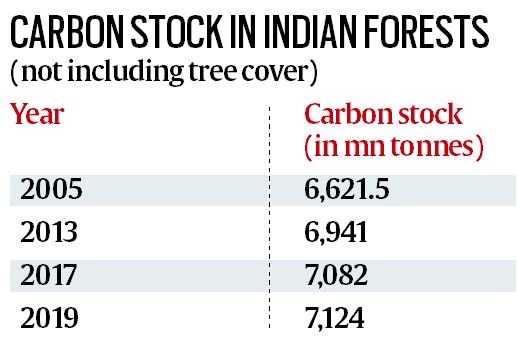
    • The State of Forest Report (SFR) 2019 has shown an increase in the carbon stock trapped in Indian forests in the last two years.
    • However it shows why it is going to be an uphill task for India in meeting one of its international obligations on climate change.

    India’s carbon commitment

    • India, as part of its contribution to the global fight against climate change, has committed itself to creating an “additional carbon sink of 2.5 to 3 billion tonnes of carbon dioxide equivalent” by 2030.
    • That is one of the three targets India has set for itself in its climate action plan, called Nationally Determined Contributions, or NDCs, that every country has to submit under the 2015 Paris Agreement.
    • The other two relate to an improvement in emissions intensity and an increase in renewable energy deployment.
    • India has said it would reduce its emissions intensity (emissions per unit of GDP) by 33% to 35% by 2030 compared to 2005.
    • It has also promised to ensure that at least 40% of its cumulative electricity generation in 2030 would be done through renewable energy.

    What is the relationship between forests and carbon?

    • Forests, by absorbing carbon dioxide from the atmosphere for the process of photosynthesis, act as a natural sink of carbon.
    • Together with oceans, forests absorb nearly half of global annual carbon dioxide emissions.
    • In fact, the carbon currently stored in the forests exceeds all the carbon emitted in the atmosphere since the start of the industrial age.
    • An increase in the forest area is thus one of the most effective ways of reducing the emissions that accumulate in the atmosphere every year.

    How do the latest forest data translate into carbon equivalent?

    • The latest forest survey shows that the carbon stock in India’s forests (not including tree cover outside of forest areas) have increased from 7.08 billion tonnes in 2017.
    • This translates into 26.14 billion tonnes of carbon dioxide equivalent as of now.
    • It is estimated that India’s tree cover outside of forests would contribute another couple of billion of tonnes of carbon dioxide equivalent.

    How challenging does this make it for India in meeting its target?

    • An assessment by the Forest Survey of India (FSI) last year had projected that, by 2030, the carbon stock in forests as well as tree cover was likely to reach 31.87 billion tonnes of CO2 equivalent.
    • An additional 2.5 to 3 billion tonnes of sink, as India has promised to do, would mean taking the size of the sink close to 35 billion tonnes of CO2 equivalent.
    • Considering the rate of growth of the carbon sink in the last few years, that is quite a stiff target India has set for itself.
    • In the last two years, the carbon sink has grown by just about 0.6%%. Even compared to 2005, the size of carbon sink has increased by barely 7.5%.
    • To meet its NDC target, even with most optimistic estimates of carbon stock trapped in trees outside of forest areas, the sink has to grow by at least 15% to 20% over the next ten-year period.

    Way Forward

    • There are two key decisions to be made in this regard — selection of the baseline year, and addition of the contribution of the agriculture sector to carbon sink.
    • When India announced its NDC in 2015, it did not mention the baseline year.
    • India’s emissions intensity target uses a 2005 baseline, so there is an argument that the forest target should also have the same baseline.
    • But there is a strong demand for a 2015 baseline as well, so that it results in some concrete progress in adding new forest cover.
    • The NDC specifically mentions that and “additional” 2.5 to 3 billion tonnes of carbon sink would be created through additional forest and tree cover by 2030 MoEFCC insist that tree cover outside forest areas must include agriculture as well.
    • India would also have to specify whether it wants to count the carbon sink in the agriculture sector in its target.
  • Savitribai Phule’s impact on women’s education in India

    Yesterday, January 3rd was birth anniversary of one of India’s first modern feminists and a social reformer Savitribai Phule. She is especially remembered for being India’s first female teacher who worked for the upliftment of women and untouchables in the field of education and literacy.

    Who was Savitribai Phule?

    • Phule was born in Naigaon, Maharashtra in 1831 and married activist and social-reformer Jyotirao Phule when she was nine years old.
    • After marriage, with her husband’s support, Phule learned to read and write and both of them eventually went on to found India’s first school for girls called Bhide Wada in Pune in 1948.
    • Before this, she started a school with Jyotirao’s cousin Saganbai in Maharwada in 1847.
    • Since at that time the idea of teaching girls was considered to be a radical one, people would often throw dung and stones at her as she made her way to the school.
    • Significantly, it was not easy for the Phule’s to advocate for the education of women and the untouchables since in Maharashtra a nationalist discourse was playing out between 1881-1920 led by Bal Gangadhar Tilak.
    • These nationalists including Tilak opposed the setting up of schools for girls and non-Brahmins citing loss of nationality.

    Her work

    • Essentially, both Jyotirao and Savitribai recognised that education was one of the central planks through which women and the depressed classes could become empowered and hope to stand on an equal footing with the rest of the society.
    • The Phules started the Literacy Mission in India between 1854-55.
    • They started the Satyashodhak Samaj (Society for Truth-Seeking), through which they wanted to initiate the practice of Satyashodhak marriage, in which no dowry was taken.
    • Because of the role played in the field of women’s education, she is also considered to be one of the “crusaders of gender justice”.
    • Her books of poems “Kavya Phule” and “Bavan Kashi Subodh Ratnakar” were published in 1934 and 1982.
  • In news: Partition of Bengal

    West Bengal Governor drew widespread condemnation over his tweet referring to a table, apparently used by Lord Curzon to sign papers pertaining to the Partition of Bengal in 1905, as “iconic”.

    Who was Lord Curzon?

    • Curzon, India’s Viceroy between 1899 and 1905, was one of the most controversial and consequential holders of that post.
    • The partition of the undivided Bengal Presidency in 1905 was one of his most criticised moves, which triggered widespread opposition not only in Bengal but across India, and gave impetus to the freedom movement.
    • Curzon was deeply racist, and convinced of Britain’s “civilizing mission” in India.
    • In 1901, he described Indians as having “extraordinary inferiority in character, honesty and capacity”.
    • He was deeply intolerant of Indian political aspirations.

    The Partition of Bengal

    • In July 1905, Curzon announced the partition of the undivided Bengal Presidency.
    • The Presidency was the most populous province in India, with around 8 crore people, and comprised the present-day states of West Bengal, Bihar, parts of Chhattisgarh, Odisha, and Assam, as well as today’s Bangladesh.
    • A new province of East Bengal and Assam was announced, with a population of 3.1 crore, and a Muslim-Hindu ratio of 3:2. Bengal, the western province, was overwhelmingly Hindu.
    • While the move was ostensibly aimed at making the administration of the large region easier, Curzon’s real intentions were far less benign.

    Aftermath of the partition

    • The partition provoked great resentment and hostility in Bengal.
    • It was clear to the Bengal Congress and patriotic Indians in both Bengal and elsewhere that Curzon’s motive was to crush the increasingly loud political voices of the literate class in the province, and to provoke religious strife and opposition against them.
    • But the protests against the partition did not remain confined to this class alone.
    • A campaign to boycott British goods, especially textiles, and promote swadeshi began.
    • There were marches and demonstrations with the protesters singing Bande Mataram to underline their patriotism and challenge the colonialists.
    • Samitis emerged throughout Bengal, with several thousand volunteers.
    • Rabindranath Tagore led the marches at many places, and composed many patriotic songs, most famously ‘Amar Sonar Bangla’ (My Golden Bengal), which is now the national anthem of Bangladesh.
    • The message of patriotism and Bengali nationalism was showcased in Jatras, or popular theatre.

    Scrapping of the partition

    • Curzon left for Britain in 1905, but the agitation continued for many years.
    • Partition was finally reversed in 1911 by Lord Hardinge in the face of unrelenting opposition.
  • NCRB Report on Farmers Suicide

    In 2017, 10,655 people involved in agriculture committed suicide in India, according to data released January 2, 2020 by the National Crime Record Bureau (NCRB).

    NCRB had released the 2017 crime data last October 2019, but held back information on suicides.

    Highlights of the report

    • NCRB highlighted that the toll was the lowest since 2013.
    • Among those who took their lives, 5,955 were farmers / cultivators and 4,700 agricultural labourers — both lower than in 2016.
    • They comprised 8.2 per cent of all suicide cases in the country in 2017.
    • In 2016, 6270 farmers killed themselves, down from 8,007 in 2015, while 5,109 farm hands committed suicide, up from 4,595.
    • The number of women farmers committing suicide, however, jumped to 480 in 2017 from 275 in ’16.

    Farm suicides over half a decade

    Years No. of farm sector suicides No. of farmers
    2017 10,655 5,955
    2016 11,379 6270
    2015 12,602 8007
    2014 12,360 5650

    Statewise data

    • In 2017, the most number of farm suicides were reportedly in Maharashtra (34.7 per cent), followed by Karnataka (20.3 per cent), Madhya Pradesh (9 per cent), Telangana (8 per cent) and Andhra Pradesh (7.7 per cent).
    • The trend was quite similar to previous year: In 2016, Maharashtra accounted for 32.2 per cent, Karnataka 18.3 per cent, MP 11.6 per cent, Andhra 7.1 per cent and Chhattisgarh 6 per cent.
    • In 2015 too Maharashtra tops in farmers suicides followed by Karnataka, Madhya Pradesh in 2016.
    • West Bengal, Odisha, Nagaland, Manipur, Mizoram, Uttarakhand, Chandigarh, Dadra and Nagar Haveli, Daman and Diu, Delhi, Lakshadweep and Puducherry reported zero suicides by farmers or agricultural labourers.

    Causes of Farmers Suicide

    • Major causes of farm suicides were reportedly bankruptcy / indebtedness, problems in the families, crop failure, illness and alcohol / substance abuse.

    Assist this newscard with:

    [Burning Issue] Annual Crime in India Report-2017