đŸ’„Join UPSC 2027,2028 Mentorship (July Batch) + XFactor Notes & Microthemes PDF

GS Paper: GS1

  • Global Social Mobility Report 2020


    The Global Social Mobility Report was recently released at the ongoing World Economic Forum at Davos, Switzerland.

    Global Social Mobility Report

    • The World Economic Forum organizes the well-known annual gathering of the world’s most influential business and political decision-makers at Davos.
    • It has come out with its first-ever Global Social Mobility Report, which has ranked India a lowly 72 out of the 82 countries profiled.
    • According to the report, the Nordic economies such as Denmark and Finland top the social mobility rankings while countries like India, Pakistan, Bangladesh and South Africa languish at the bottom (see Table 1).

    Table 1: WEF’s Global Social Mobility Rankings

    Country Rank (out of 82)
    Denmark 1
    Germany 11
    United Kingdom 21
    United States 27
    Russia 39
    China 45
    Saudi Arabia 52
    Brazil 60
    India 76
    Pakistan 79


    What is the context for this report?

    • Notwithstanding fast global growth, inequalities have been growing across the world.
    • The rise of inequality has not only created massive social unrest but also adversely affected the global consensus on the kind of economic policies that countries follow.
    • A good example of this is the rise of trade protectionism across the world over the past few years.
    • Be it US or the UK several countries have started looking inwards in the hope that greater trade protectionism will help allay the fears and apprehensions of domestic workers.

    What is Social Mobility?

    • Typically, inequalities are measured in income terms. And this measure has been found inadequate.
    • As the report states, “many situations exist where, despite high levels of absolute income mobility, relative social mobility remains low.
    • For example, in economies such as China and India, economic growth can lift entire populations upward in terms of absolute income, but an individual’s status in society relative to others remains the same”.
    • The report states: “The notion of relative social mobility is more closely related to the social and economic status of an individual relative to their parents. I
    • n a country with a society with perfect relative mobility, a child born in a low-income family would have as much chance to earn a high income as a child born to parents who earn a high income”.

    Thus, the concept of social mobility is much broader than just looking at income inequality. It encompasses several concerns such as:

    • Intragenerational mobility: The ability for an individual to move between socio-economic classes within their own lifetime.
    • Intergenerational mobility: The ability for a family group to move up or down the socio-economic ladder across the span of one or more generations.
    • Absolute income mobility: The ability for an individual to earn, in real terms, as much as or more than their parents at the same age.
    • Absolute educational mobility: The ability for an individual to attain higher education levels than their parents.
    • Relative income mobility: How much of an individual’s income is determined by their parents’ income.
    • Relative educational mobility: How much of an individual’s educational attainment is determined by their parents’ educational attainment.

    Why does social mobility matter?

    • How far an individual can move up in the society determines a lot whether one is closer to the income “floor” (or poor) or “ceiling” (or rich).
    • Social mobility levels, then, can help us understand both the speed – that is, how long it takes for individuals at the bottom of the scale to catch up with those at the top – and the intensity – that is, how many steps it takes for an individual to move up the ladder in a given period – of social mobility.
    • Research also shows that countries with high levels of relative social mobility—such as Finland, Norway or Denmark— exhibit lower levels of income inequality.
    • Conversely, countries with low relative social mobility—such as India, South Africa or Brazil—also exhibit high levels of economic inequality.
    • That’s why it matters for countries like India to increase social mobility.


    As shown in Table 2, it would take a whopping 7 generations for someone born in a low-income family in India to approach mean income level; in Denmark, it would only take 2 generations.


    Table 2: Income Mobility across Generations

    Country Number of generations required by a poor family member to achieve mean income level
    Denmark 2
    United States/ United Kingdom 5
    Germany/ France 6
    India/China 7
    Brazil/South Africa 9


    So, how is social mobility calculated?

    The WEF’s Global Social Mobility Index assesses the 82 economies on “10 pillars” spread across the following five key dimensions of social mobility:

    1. Health;
    2. Education (access, quality and equity, lifelong learning);
    3. Technology;
    4. Work (opportunities, wages, conditions);
    5. Protection and Institutions (social protection and inclusive institutions).

    How did India perform on each of the 10 pillars of social mobility?

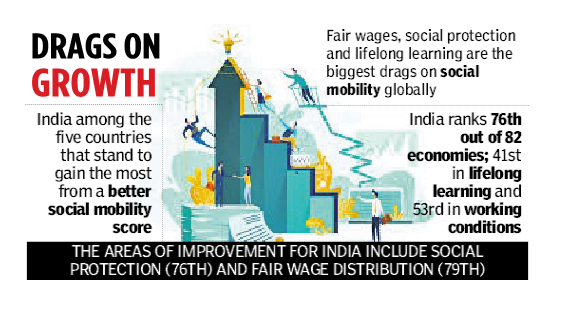
    India’s overall ranking is a poor 76 out of the 82 countries considered. Thus it should not come as any surprise that India ranks lowly in individual parameters as well.

    Table 3 below provides the detailed breakup.

    Table 3: Where India ranks on the 10 Pillars of Social Mobility

    Parameter Rank (out of 82 countries)
    Health 73
    Access to Education 66
    Quality and Equity in Education 77
    Lifelong learning 41
    Access to Technology 73
    Work Opportunities 75
    Fair Wage Distribution 79
    Working Conditions 53
    Social Protection 76
    Inclusive Institutions 67


    Back2Basics

    World Economic Forum (WEF)

    • The WEF based in Cologny-Geneva, Switzerland, is an NGO founded in 1971.
    • The WEF’s mission is cited as “committed to improving the state of the world by engaging business, political, academic, and other leaders of society to shape global, regional, and industry agendas”.
    • It is a membership-based organization, and membership is made up of the world’s largest corporations.
    • The WEF hosts an annual meeting at the end of January in Davos, a mountain resort in GraubĂŒnden, in the eastern Alps region of Switzerland.

    Various reports published by WEF:

    [Tikdam: Most (Not all) reports titled with ‘Global’ are released by WEF.]

    1. Global Competitiveness Report
    2. Global Information Technology Report
    3. Global Gender Gap Report
    4. Global Travel and Tourism Report
    5. Global Enabling Trade Report etc.
  • Thawing of Permafrost


    A recent study makes a disturbing connection between the loss of Arctic sea ice and thawing (melting) of permafrost in the region, with global implications.

    What is Permafrost?

    • ‘Permafrost’ or permanently frozen ground is land that has been frozen at or below 0 degrees Celsius for two or more consecutive years.
    • A staggering 17 per cent of Earth’s entire exposed land surface is comprised of permafrost.
    • Composed of rock, sediments, dead plant and animal matter, soil, and varying degrees of ice, permafrost is mainly found near the poles, covering parts of Greenland, Alaska, Northern Canada, Siberia and Scandinavia.
    • The Arctic region is a vast ocean, covered by thick ice on the surface (called sea ice), surrounded by land masses that are also covered with snow and ice.

    Permafrost thawing

    • When permafrost thaws, water from the melted ice makes its way to the caves along with ground sediments, and deposits on the rocks.
    • In other words, when permafrost thaws, the rocks grow and when permafrost is stable and frozen, they do not grow.

    Why thawing?

    • The link between the Siberian permafrost and Arctic sea ice can be explained by two factors:
    • One is heat transport from the open Arctic Ocean into Siberia, making the Siberian climate warmer.
    • The second is moisture transport from open seawater into Siberia, leading to thicker snow cover that insulates the ground from cold winter air, contributing to its warming.
    • This is drastically different from the situation just a couple of decades ago when the sea ice acted as a protective layer, maintaining cold temperatures in the region and shielding the permafrost from the moisture from the ocean.
    • If sea ice (in the summer) is gone, permafrost start thawing.

    Impact on Climate Change

    • Due to relentlessly rising temperatures in the region, since the late-twentieth century, the Arctic sea ice and surrounding land ice are melting at accelerating rates.
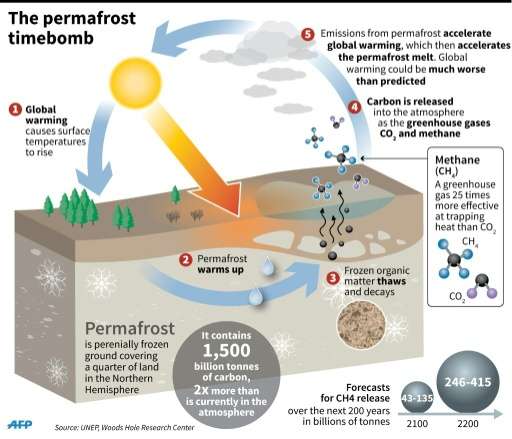
    • When permafrost thaws due to rising temperatures, the microbes in the soil decompose the dead organic matter (plants and animals) to produce methane (CH4) and carbon dioxide (CO2), both potent greenhouse gases.
    • CH4 is at least 80 times more powerful than CO2 on a decadal timescale and around 25 times more powerful on a century timescale.
    • The greenhouse gases produced from thawing permafrost will further increase temperatures which will, in turn, lead to more permafrost thawing, forming an unstoppable and irreversible self-reinforcing feedback loop.
    • Experts believe this process may have already begun. Giant craters and ponds of water (called ‘thermokarst lakes’) formed due to thawing have been recorded in the Arctic region. Some are so big that they can be seen from space.

    Why a matter of concern?

    • An estimated 1,700 billion tonnes — twice the amount currently present in the atmosphere — of carbon is locked in all of the world’s permafrost.
    • Even if half of that were to be released to the atmosphere, it would be game over for the climate.
    • Scientific estimates suggest that the Arctic Ocean could be largely sea ice-free in the summer months by as early as 2030, based on observational trends, or as late as 2050, based on climate model projections.
  • Explained: What new monsoon dates mean


    The India Meteorological Department (IMD) had decided to revise the normal onset and withdrawal dates for the monsoon in some parts of the country from this year.

    Onset of Monsoon

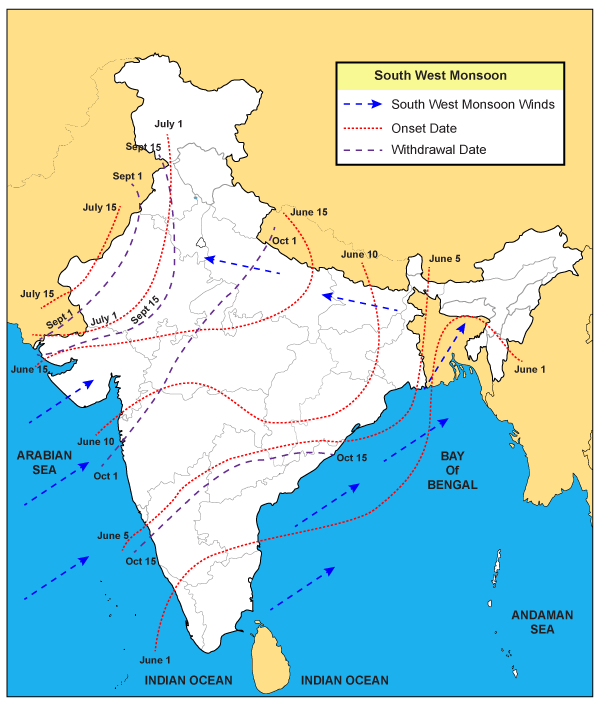
    • The four-month southwest monsoon season, which brings as much as 70 per cent of the country’s annual rainfall, officially begins on June 1, with the onset over Kerala, and ends on September 30.
    • It takes about a month and half after onset on the Kerala coast to cover the entire country; and about a month, beginning from the northwestern parts of the country on Sept. 1 to withdraw completely.
    • Although the June 1 date for the onset of the monsoon on the Kerala coast is unlikely to be changed, the dates for onset in many other parts of the country are expected to be revised.
    • Mumbai, for example, expects to start getting rain from June 10 the revision is likely to push this date back by a few days.
    • Effectively, the monsoon is now expected to have later arrival and withdrawal dates in most parts of the country.

    Why was this revision needed?

    • The main reason for the revision in the normal dates is the changes in precipitation patterns that have been taking place over the last many years.
    • In the last 13 years, for example, only once has the onset over the Kerala coast happened on June 1.
    • While two or three days of earlier or later onset falls within the yearly variability in several years the onset happened five to seven days late.
    • Similarly, the commencement of withdrawal has happened in the first week of September only twice during this period, and last year, the withdrawal started as late as October 9 — and was completed in around just a week.

    Recent peculiarity with the exam

    • One of the significant changes being noticed is that rainfall is getting increasingly concentrated within a narrow band of days within the monsoon season.
    • So, there are extremely wet days followed by prolonged periods of dry days.
    • IMD data show that over several previous years, nearly 95 per cent of monsoon precipitation in 22 major cities of the country had happened over a period of just three to 27 days.
    • Delhi, for example, had received almost 95 per cent of its monsoon rainfall over just 99 hours. And half of Mumbai’s monsoon rain had fallen over just 134 hours, or five and a half days, on average.

    Regional variations

    • Patterns of regional variations in rainfall are also changing
    • Areas that have traditionally received plenty of rainfall are often remaining dry, while places that are not expected to get a lot of monsoon rain have sometimes been getting flooded.
    • Climate change could be one of the factors driving these changes, but there could be other reasons as well.

    What will be the impact of IMD’s move?

    For Farmers

    • The revisions are meant to reflect the changes in precipitation patterns in recent years.
    • New dates will likely nudge farmers in some parts of the country to make slight adjustments in the time of sowing their crops.
    • It would definitely have an impact on our agriculture practices — when to start sowing, when to harvest.
    • So, even if there is a delay in the arrival of monsoon by three to four days over a region, it would not matter much if there is a fairly good rainfall distribution thereafter.
    • The change in dates would affect water management practices as well.

    For Industries

    • The planning that goes to beat the heat — several cities execute heat action plans — just ahead of the monsoon would have to factor in the need to be prepared for longer periods of heat.
    • Rajeevan said many other activities including industrial operations, the power sector, or those using cooling systems, would also need to change their behaviour.
    • The power grid can, for example, have more realistic planning for peak periods of electricity consumption in certain months.

    Way Forward

    • The changed dates are expected to be announced in April, when the IMD makes its first forecast for the monsoon.
    • Agro-meteorologists, however, agree that more than the onset, it is the information about the spatio-temporal distribution of rainfall that will be more helpful for farmers.
    • Ultimately, the change in normal dates of the onset and withdrawal of the monsoon would help people understand when to expect rains, and to plan their activities accordingly.
  • [pib] Indian Digital Heritage (IDH) Initiative


    The Union Ministry of Culture and Tourism launched a month-long special exhibition titled Indian Heritage in Digital Space. This special exhibition showcases the adaptation and infusion of technologies being developed under the Indian Digital Heritage (IDH) initiative.

    Indian Digital Heritage (IDH)

    • This initiative is undertaken by the Department of Science and Technology (DST) in the cultural heritage domain of the country.
    • The exhibition demonstrates the outcome of two flagship projects viz., A digital mini-spectacle to showcase the glory of Hampi and Augmented Reality based interactions with physical models of monuments.
    • The goals of these projects are to create digital installations using 3D laser scan data, AR, holographic projections and 3D fabrication,to provide interactive and immersive experiences showcasing the glory of Hampi and five Indian monuments namely Kashi Vishwanath Temple, Varanasi; TajMahal, Agra; Sun Temple, Konark; Ramachandra Temple, Hampi ; and RaniKiVav, Patan .
    • These projections are driven by cutting-edge technologies such as 3D fabrication, Artificial Intelligence, Augmented, Virtual and Mixed Reality, Holographic Projections and Projection Mapping etc.

    ViRaasat

    A special installation named ‘ViRaasat’, consisting of a scaled-down 3D printed replica shall provide a mixed reality experience to visitors for selected monuments, using laser-scanning, 3D modelling and rendering, 3D printing, computer vision and spatial AR.

  • Classical languages in India

    Recently in a Marathi literary festival, a resolution was passed demanding its declaration as a ‘Classical’ language.

    ‘Classical’ languages in India

    Currently, six languages enjoy the ‘Classical’ status: Tamil (declared in 2004), Sanskrit (2005), Kannada (2008), Telugu (2008), Malayalam (2013), and Odia (2014).

    How are they classified?

    According to information provided by the Ministry of Culture in the Rajya Sabha in February 2014, the guidelines for declaring a language as ‘Classical’ are:

    • High antiquity of its early texts/recorded history over a period of 1500-2000 years;
    • A body of ancient literature/texts, which is considered a valuable heritage by generations of speakers;
    • The literary tradition be original and not borrowed from another speech community;
    • The classical language and literature being distinct from modern, there may also be a discontinuity between the classical language and its later forms or its offshoots.”

    How are the Classical languages promoted?

    The HRD Ministry noted the benefits it provides once a language is notified as a Classical language:

    • Two major annual international awards for scholars of eminence in classical Indian languages
    • A Centre of Excellence for studies in Classical Languages is set up
    • The University Grants Commission is requested to create, to start with at least in the Central Universities, a certain number of Professional Chairs for the Classical Languages so declared.
  • Six degrees of Endangerment of a Language

    Recently, The NY Times reported that the “near-extinct” Nepalese language Seke has just 700 speakers around the world. As per the Endangered Languages Project (ELP), there are roughly 201 endangered languages in India and about 70 in Nepal.

    The last year, 2019, was the International Year of Indigenous Languages, mandated by the UN.

    Nepal’s Seke language

    • According to the Endangered Language Alliance (ELA), Seke is one of the over 100 indigenous languages of Nepal.
    • The dialects from these villages differ substantially and are believed to have varying degrees of mutual intelligibility.
    • In recent years, Seke has been retreating in the face of Nepali, which is Nepal’s official language and is considered to be crucial for getting educational and employment opportunities outside villages.

    Degrees of endangerment

    UNESCO has six degrees of endangerment. These are:

    1. Safe, which are the languages spoken by all generations and their intergenerational transmission is uninterrupted;
    2. Vulnerable languages, which are spoken by most children but may be restricted to certain domains;
    3. Definitely endangered languages, which are no longer being learnt by children as their mother tongue.
    4. Severely endangered are languages spoken by grandparents and older generations, and while the parent generation may understand it, they may not speak it with the children or among themselves.
    5. Critically endangered languages are those of which the youngest speakers are the grandparents or older family members who may speak the language partially or infrequently and lastly,
    6. Extinct languages, of which no speakers are left.
  • Eruption of Taal Volcano


    In the Philippines, a volcano called Taal on the island of Luzon; 50 km from Manila has recently erupted.

    Taal Volcano

    • Taal is classified as a “complex” volcano. Taal has 47 craters and four maars (a broad shallow crater).
    • It is situated at the boundaries of two tectonic plates — the Philippines Sea Plate and the Eurasian plate — it is particularly susceptible to earthquakes and volcanism.
    • A complex volcano, also called a compound volcano, is defined as one that consists of a complex of two or more vents, or a volcano that has an associated volcanic dome, either in its crater or on its flanks.
    • Examples include Vesuvius, besides Taal.
    • The Taal volcano does not rise from the ground as a distinct, singular dome but consists of multiple stratovolcanoes (volcanoes susceptible to explosive eruptions), conical hills and craters of all shapes and sizes.

    Threats posed

    • Taal’s closeness to Manila puts lives at stake. Manila is a few tens of kilometres away with a population of over 10 million.
    • The volcano is currently at alert level 4, which means that a “hazardous eruption” could be imminent within a few hours to a few days.
    • Hazardous eruptions are characterised by intense unrest, continuing seismic swarms and low-frequency earthquakes.

    Earlier records of eruption

    • Taal has erupted more than 30 times in the last few centuries. Its last eruption was on October 3, 1977.
    • An eruption in 1965 was considered particularly catastrophic, marked by the falling of rock fragments and ashfall.
    • Before that, there was a “very violent” eruption in 1911 from the main crater. The 1911 eruption lasted for three days, while one in 1754 lasted for seven months.
    • Because it is a complex volcano with various features, the kinds of eruption too have been varied. An eruption can send lava flowing through the ground, or cause a threat through ash in the air.
  • Fastest growing cities in India

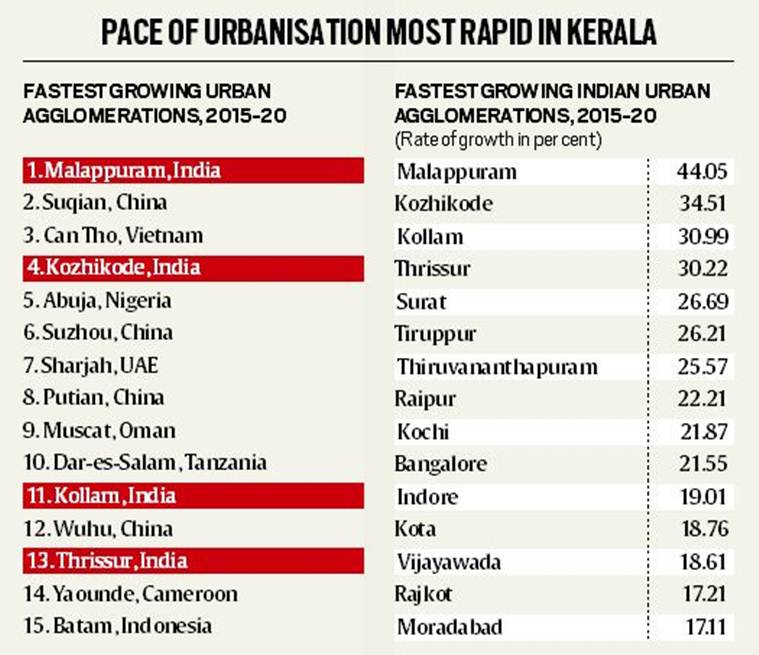
     The Economist has put Malappuram at the top of the “Top ten fastest-growing cities” in the world.

    Anomalies in the data

    • The total fertility rate (TFR, the number of children a woman is likely to have in the childbearing age of 15-49) in Kerala is 1.8 as per NITI Aayog data from 2016 — below the replacement rate of 2.1.
    • Another Kerala city, Thrissur, is No. 13, and the capital Thiruvananthapuram is No. 33 on the UN list.
    • Tiruppur in Tamil Nadu — which has an even lower TFR of 1.6 — is No. 30.
    • Surat in Gujarat (TFR of 2.2) is No. 27. There is no representation on the list from high population growth states like Bihar and UP.

    What does “fastest growing” refer to? How is a “city” defined?

    • The list based on data from the UN Population Division refers to “urban agglomerations” (UA), which are extended areas built around an existing town along with its outgrowths — typically villages or other residential areas or universities, ports, etc., on the outskirts of the town.
    • The Census defines a UA as “a continuous urban spread consisting of a town and its adjoining urban outgrowths or two or more physically contiguous towns together”.
    • The NCT of Delhi is a UA that includes the Municipal Corporation of Delhi (MCD) and New Delhi Municipal Council (NDMC) areas, as well as 107 “Census towns” — erstwhile surrounding villages where more than 75% of the population is now engaged in non-agricultural pursuits.

    A pace of urbanization

    • The Economist has listed the rate at which the populations of the UAs are expected to increase between 2015 and 2020.
    • Since data on India and many other countries were not available for 2015 (the last Census in India was in 2011), the UN report used projections of UAs’ populations — estimates based on past population growth data.
    • The rate of growth between 2015 and 2020 thus calculated provides a measure of the pace of urbanisation.

    How does urban population grow?

    • Urban populations can grow when the birth rate exceeds the death rate when workers migrate to the city in search of jobs; when more areas get included within the boundaries of the city; or when existing rural areas are reclassified as urban.
    • The low fertility rate in Kerala means the increase in the population of Malappuram and other cities is not because women are having more children; rather it is because more villages are being transformed into towns, and city borders are expanding.
    • According to the Census definition, an urban area is either a census town (CT) or a statutory town (ST). An ST is any place with a municipal corporation, municipal council, or cantonment board.
    • A CT can be a village with “urban characteristics” — a population more than 5,000, population density more than 400 people per sq km, and with more than 75% of the population not engaged in agriculture for their livelihood.
    • When a village becomes a CT, its population is included in the urban population of the district.

    Could migration have caused the increase?

    • Migration can either increase or decrease the population of a town.
    • Kerala sees both emigration — migration from the state to other places — and immigration — the migration of workers to the state.
    • Also the remittances that emigrants send allow the residents of villages to move away from agriculture, which changes the status of a village to census town.

    Why these cities are growing so fast?

    • These cities are seeing rapid urbanisation, and the main reason is the inclusion of new areas in the UA’s limits.
    • In 2001, there were two municipal corporations within the UA of Malappuram. In 2011, the number of municipal corporations had doubled to four, and an additional 37 CTs were included within Malappuram.
    • The population of the UA (excluding the residents of the outgrowths) increased almost 10 times in the same period — from 1,70,409 to 16,99,060 — obviously because of the inclusion of existing urban areas in the town.
    • Similarly, Kollam UA grew from one municipal corporation in 2001 to 23 CTs, one municipal corporation, and one municipal council in 2011.
    • Its population increased by 130%, even though the population of the original ST of Kollam actually decreased by 4%.

    Why is this not seen elsewhere in India?

    • In Kerala, urbanisation is driven by a move away from agriculture, which leads to a change in a village’s Census classification status.
    • This is evident from the large number of CTs that were included in the UAs of the state since the last Census. On the other hand, except Delhi, the more populous cities in the North had fewer CTs in 2011.
    • While the pace of urbanisation has been slower in the North, some unnaturally high increases in the population can be expected after the 2021 Census — because in some cases, villages on the peripheries were brought within the administrative boundaries of the cities.

    Is it good for the economy?

    • Urbanisation leads to the growth of cities, which are sites of infrastructure like universities, hospitals, and public transport facilities.
    • There are more opportunities for the youth, which is why they attract young people and entrepreneurs.
    • In India, people moving to cities leave behind (to some extent) caste and class divisions that dominate life in the villages, and can hope to climb up the social ladder.
    • However, unplanned urbanisation can be “exclusionary”, making it difficult for migrants to live there given the high cost.
    • Unregulated housing, lack of reliable public transport, and longer commutes within these towns puts a strain on the meagre resources of migrants.
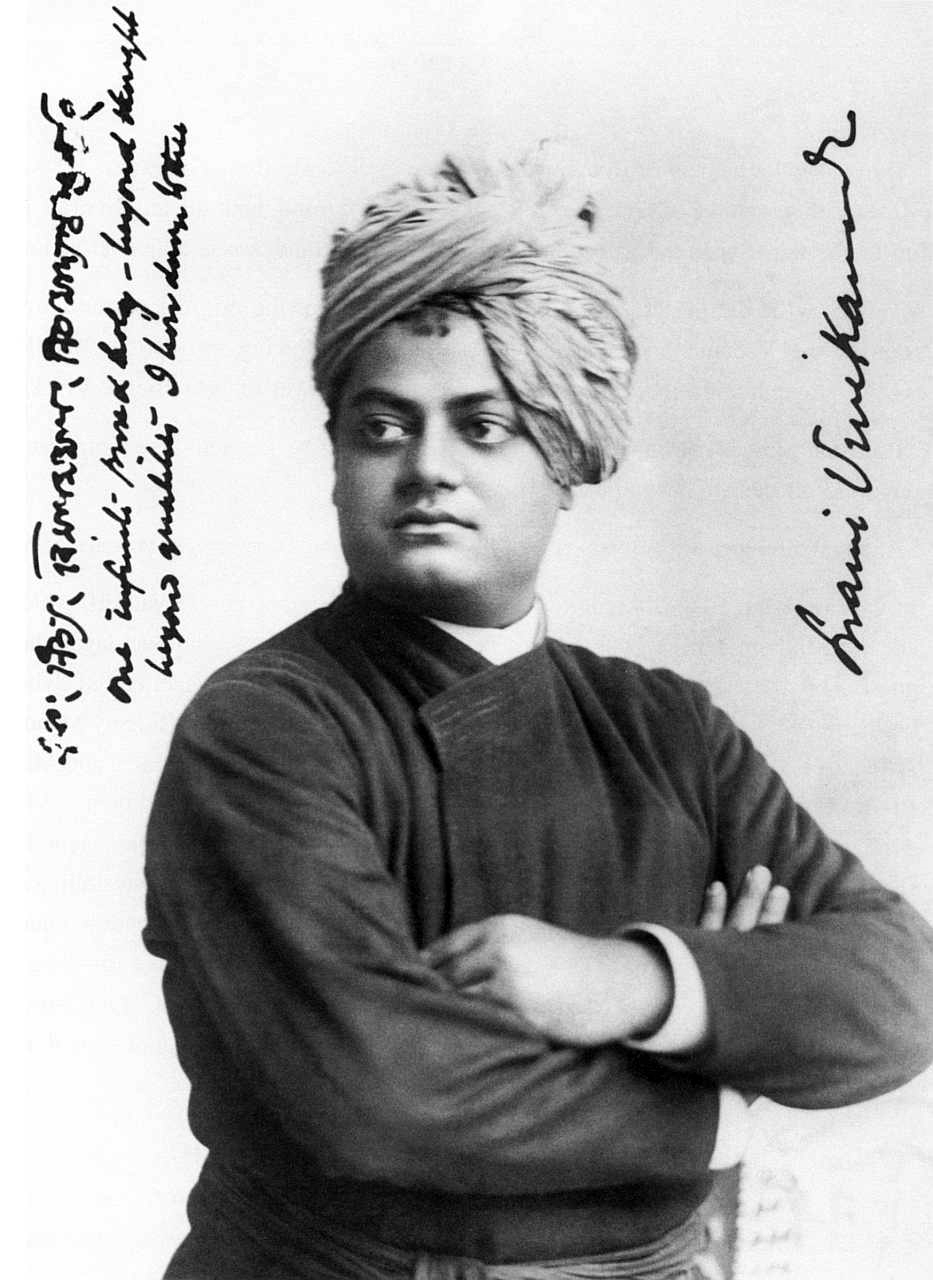
  • Person in news: Swami Vivekananda

    January 12 is the birth anniversary of Swami Vivekananda, the famous spiritual leader and intellectual from the late 19th century. In his honour, the government of India in 1984 declared his birthday as National Youth Day.

    Swami Vivekananda early life

    • Vivekananda was born in Kolkata on January 12, 1863, as Narendra Nath Datta.
    • From an early age, he nurtured an interest in Western philosophy, history, and theology, and went on to meet the religious leader Ramakrishna Paramhansa, who later became his Guru.
    • He remained devoted to Ramakrishna until the latter’s death in 1886.
    • In 1893, he took the name ‘Vivekananda’ after Maharaja Ajit Singh of the Khetri State requested him to do so, changing from ‘Sachidananda’ that he used before.
    • After Ramakrishna’s death, Vivekananda toured across India, and set after educating the masses about ways to improve their economic condition as well as imparting spiritual knowledge.

    The Chicago address

    • Vivekananda is especially remembered around the world for his speech at the Parliament of the World’s Religions in Chicago in 1893.
    • The speech covered topics including universal acceptance, tolerance and religion, and got him a standing ovation.
    • He began delivering lectures at various places in the US and UK, and became popular as the ‘messenger of Indian wisdom to the Western world’.

    Return to India

    • After coming back to India, he formed the Ramakrishna Mission in 1897 “to set in motion a machinery which will bring noblest ideas to the doorstep of even the poorest and the meanest.”
    • In 1899, he established the Belur Math, which became his permanent abode.

    His legacy

    • Through his speeches and lectures, Vivekananda worked to disseminate his religious thought.
    • He preached ‘neo-Vedanta’, an interpretation of Hinduism through a Western lens, and believed in combining spirituality with material progress.
    • ‘Raja Yoga’, ‘Jnana Yoga’, ‘Karma Yoga’ are some of the books he wrote.
    • An important religious reformer in India, Swami Vivekananda is known to have introduced the Hindu philosophies of Yoga and Vedanta to the West.
    • Subhas Chandra Bose had called Vivekananda the “maker of modern India.”
  • Person in news: Manilal Doctor

    An associate of Mahatma Gandhi, Manilal Doctor is known for his efforts towards helping abolish the indentured labour system that Indian immigrants in many parts of the British Empire were subjected to. He fought for the rights of Indian-origin people in Mauritius and Fiji.

    The indentured labour system

    • In 1833, the British Parliament banned slavery, and the practice became illegal throughout the Empire. However, to maintain the supply of labour in their territories, colonial authorities effectively replaced slavery with the indentured labour system.
    • The ‘indenture’ (meaning contract) system required Indians to sign a legal agreement stating their consent to move abroad for a minimum of five years to work mainly on sugar estates.
    • Many were lured to distant lands, such as the Caribbean, South Africa, RĂ©union, Mauritius, Malaysia, and Fiji, where they ended up living in miserable conditions.
    • In the mid 19th century, over 35 lakh Indians were transported to British, French, and Dutch colonies around the world. The system was officially banned in 1917.

    Manilal Doctor

    • Born in 1881 in Vadodara, Doctor studied law in Bombay before travelling to Britain in 1905 for further studies.
    • He became a member of the Indian Home Rule Society in London, and wrote in the monthly ‘Indian Sociologist’.
    • In 1906, Doctor met Gandhi, who at the time was in London to meet imperial authorities on behalf of South Africa’s Indian origin people.
    • During the meeting, Gandhi asked Doctor to move to Mauritius to assist the Indian community there in their struggle for equal rights. Doctor arrived in Mauritius the following year.

    In Mauritius (1907-1911)

    • Doctor organised the Indian community in the island colony, which consisted of indentured and non-indentured workers, and advocated for the abolition of discriminatory laws.
    • He practised law at the Supreme Court in St Louis, and provided free legal service to bonded workers in need.
    • Doctor visited plantations across the island and met indentured labourers, making them aware of their rights and encouraged them to agitate.
    • He founded ‘The Hindustani’ newspaper in Mauritius, which had the motto “Liberty of Individuals! Fraternity of Men!!! Equality of Race!!!”
    • Doctor also helped establish the Arya Samaj in Mauritius. He returned to India in 1911.

    Next, Fiji (1912-1920)

    • In 1912, Gandhi deputed Doctor to the Fiji Colony with the same objective. Like in Mauritius, Doctor emerged as the leader of the Indian community in Fiji in the coming years.
    • In Fiji, Doctor started ‘The Indian Settler’ newspaper, and helped set up the Indian Imperial Association. Here too, he helped establish the Arya Samaj.
    • In 1920, Doctor organised a major strike, which rattled colonial authorities.
    • The imperial administration had Doctor deported to New Zealand, where he remained under surveillance and was barred from practising.
    • In 1922, Doctor was able to move to Gaya in Bihar, where he could practise law. He later practised for many years in Aden, also then a British colony, and died in Bombay in 1956.