đŸ’„Join UPSC 2027,2028 Mentorship (July Batch) + XFactor Notes & Microthemes PDF

GS Paper: GS2

  • Reforming H-1B Visa Program: Vivek Ramaswamy’s Pledge

    h-1b visa

    Central Idea

    • Indian-American Republican presidential contender Vivek Ramaswamy vows to overhaul the H-1B visa program.
    • The H-1B visa, highly sought-after among Indian IT professionals, permits US companies to employ foreign workers for specialized roles requiring theoretical or technical expertise.

    Why discuss this?

    • The H-1B visa are highly sought-after category used by Indian professionals in the US as many use them as a precursor for permanent residency.
    • However, the waiting periods for the employment-based green card for Indians can stretch into decades.
    • The US embassy in India has already processed over 9 lakh non-immigrant visa currently and is expected to pass the one million mark soon.

    Understanding H-1B Visa Program

    • The H-1B visa program is crafted to facilitate the entry of skilled foreign workers into the United States, enabling them to work for American companies.
    • It is particularly sought after by Indian IT professionals as it permits U.S. companies to employ foreign workers in specialized roles demanding theoretical or technical expertise.
    • Despite its popularity, the H-1B visa program faces criticisms for extended waiting periods and the use of a lottery system for selection.

    Ramaswamy’s Perspective

    • Personal Experience: Ramaswamy acknowledged his own immigrant experience and contended that the H-1B system is detrimental to all parties involved.
    • Merit-Based Reform: He advocated for replacing the lottery system with a meritocratic admission process, describing the current system as a form of indentured servitude that primarily benefits sponsoring companies.
    • Eliminating Chain Migration: He also emphasized the need to eliminate chain-based migration, arguing that family members who join immigrants are not merit-based contributors to the country.

    Historical Context and Comparisons

    • Resonance with Trump: Ramaswamy’s stance on H-1B visas draws parallels with Donald Trump’s 2016 campaign.
    • Hard stance: Despite hiring foreign workers under H-1B visas for his businesses, Trump initially adopted a hardline stance on these workers before later softening his rhetoric.
  • Transformations and Trends in the Indian Parliament over 75 Years

    Central Idea

    • India’s parliamentary journey spanning 75 years reflects a dynamic and evolving landscape of political representation, legislative processes, and societal changes.
    • From shifting demographics to parliamentary practices and electoral dynamics, this retrospective analysis sheds light on the fascinating facets of India’s parliamentary evolution.

    Key Trends in Indian Parliament

    Youth Representation
    • Despite a growing youth population, the number of MPs aged 35 and below in the Lok Sabha is at a record low.
    • In the First Lok Sabha, there were 82 such MPs, but in the 17th Lok Sabha, there are only 21.
    • This decline contrasts with India’s youthful demographic, where around 66% of the population is under 35.
    Women’s Turnout and Representation
    • Women’s voter turnout has consistently risen since 1962, even surpassing male turnout in 2019.
    • Number of women candidates has increased, from 45 in 1957 to 726 in 2019.
    • However, women’s representation in the Lok Sabha remains low, with just 14.36% of the total seats occupied by women in 2019.
    • Women’s reservation Bill, aimed at increasing women’s representation to 33%, has faced hurdles in passing.
    Missing Deputy Speaker
    • 17th Lok Sabha is set to become the first in independent India without a Deputy Speaker, breaking from tradition.
    Declining Parliamentary Sittings
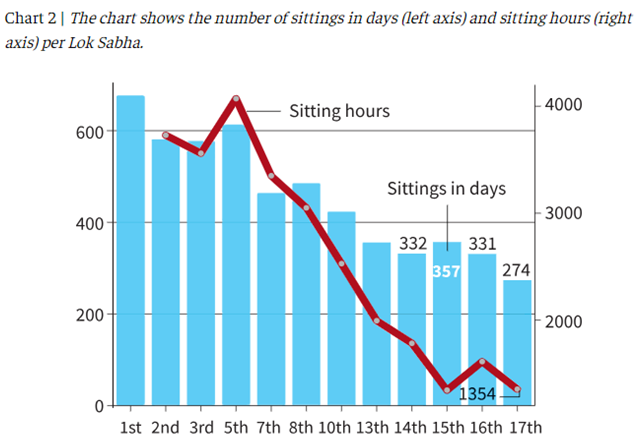
    • Between 1952 and 1974, the Lok Sabha consistently held over 100 sittings annually, but this trend has declined.
    • Pandemic in 2020 led to a significant decrease in sittings.
    • Average sitting time per day has also decreased over the years.
    Bills Passed and Ordinances Issued
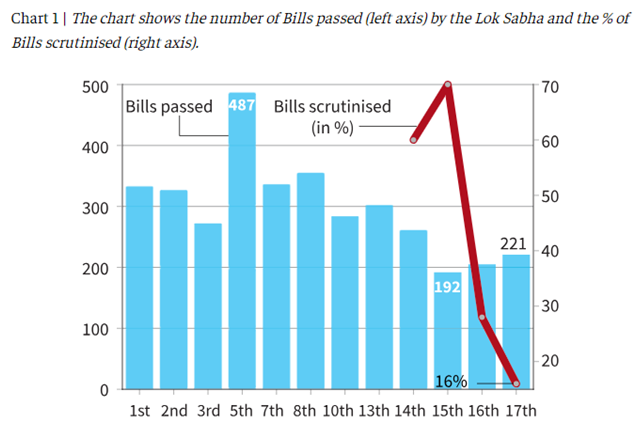
    • Both Houses of Parliament are passing fewer bills compared to earlier decades.
    • Highest number of bills passed occurred during the Emergency in 1976, while the lowest was in 2004.
    • An increase in ordinances issued by the Union government has coincided with fewer parliamentary sittings.
    Voter Enrollment and Parties in the Fray
    • Number of voters has increased six-fold from 1951 to 2019, resulting in a higher number of polling stations.
    • Nos. of parties participating in Lok Sabha polls has multiplied over the years, with 673 parties in 2019 compared to 53 in 1951.
    • Number of contestants has also grown significantly.
    Vote Share and Majority Trends
    • Out of 17 Lok Sabha elections held so far, 10 have resulted in clear majorities, while 7 have been fractured mandates.
    • Recent trends show that the winning party typically receives a higher vote share than the runner-up since 2004.
    Changing Focus on Questions
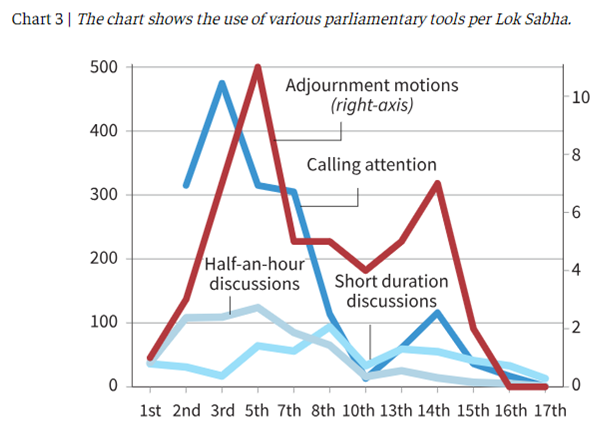
    • Time allocated for questions in the Lok Sabha has decreased over the years.
    • First Lok Sabha dedicated 15% of its time to questions, whereas the 14th Lok Sabha allocated only 11.42%.
    • Data for the 15th, 16th, and 17th Lok Sabhas is not available for comparison.

    Conclusion

    • As India’s Parliament embarks on its journey of 75 years, these trends provide a fascinating glimpse into the evolving dynamics of the nation’s highest legislative body.
  • The Khalistan shadow on India-Canada ties, over the years

    Central idea

    • Relations between India and Canada have reached a new low, with allegations of Canadian leniency towards Khalistani supporters and accusations of India’s involvement in a recent killing. This isn’t a recent issue but a longstanding tension that dates back to the mid-20th century. The modern-day discord between Prime Minister Narendra Modi and Canadian Prime Minister Justin Trudeau over Khalistani extremism has exacerbated these historical strains.

    Historical Roots of Khalistan Movement in Canada

    • Establishment of Khalistan Office: Surjan Singh Gill established the ‘Khalistan government in exile’ office in Vancouver in 1982, issuing Khalistani passports and currency.
    • Militancy’s Impact: The militancy in Punjab in the early 1980s had repercussions in Canada, leading to the emergence of organizations like the International Sikh Youth Federation (ISYF), the Babbar Khalsa, and the World Sikh Organisation.
    • Air India Kanishka Bombing: The Babbar Khalsa orchestrated the bombing of Air India Kanishka in 1985, resulting in 331 civilian deaths.

    Recent Developments

    • Strained Relations: Relations between India and Canada have deteriorated due to Canada’s alleged leniency toward Khalistani supporters. Canadian Prime Minister Justin Trudeau accused India of involvement in the killing of Hardeep Singh Nijjar, designated as a terrorist by India, in Surrey in June.
    • Tensions Over Khalistan: Tensions related to Khalistan extremism have been ongoing for years, with Trudeau’s appointment of Sikh ministers in 2015 sparking controversy and accusations of his proximity to Khalistan sympathizers.
    • Incidents Fueling Tensions: Various incidents, such as the refusal of meetings by Punjab Chief Minister Capt Amarinder Singh and Trudeau’s cool reception during his India visit, have exacerbated the India-Canada rift.
    • Report on Sikh Extremism: Canada released a report in 2018 mentioning ‘Sikh extremism’ and Khalistan as threats, but later revised the report, removing these references, which caused further strain.
    • Alliance with NDP: In March 2022, Trudeau’s Liberal Party formed an alliance with the New Democratic Party (NDP), led by Jagmeet Singh, who openly endorsed the Khalistan Referendum on Canadian soil.
    • G20 Summit Concerns: During the recent G20 summit in New Delhi, PM Modi expressed strong concerns about continuing anti-India activities of extremist elements in Canada.

    Sikh Community’s Influence

    • Political Influence: Canada’s Sikh community, constituting approximately 2 percent of the population, has gained significant political influence. This is evident through the election of Sikh Members of Parliament and their active involvement in Canadian politics.
    • Representation in Canadian Parliament: Sikh Canadians have been elected to important political positions, including Members of Parliament. In 2019, there were 18 Sikh MPs in the Canadian parliament, surpassing the number of Sikh MPs in India.
    • Cultural Impact: Sikh festivals, notably Vaisakhi, are widely celebrated in Canada and have become integral to the country’s multicultural tapestry.
    • Social Activism: Sikh organizations in Canada are known for their social and humanitarian initiatives, including providing free meals (langar) to those in need. This commitment to community welfare is a notable aspect of their influence.
    • Business and Economic Contributions: Sikh Canadians have made significant contributions to Canada’s business and economic landscape, with many Sikh-owned businesses playing key roles in the country’s economy.

    Changing Political Landscape

    • Varied Responses: Canada’s stance on the Khalistan movement has shifted over the years, with some governments engaging with Khalistanis while others sought reconciliation with India.
    • Strong Relations under Stephen Harper: During Stephen Harper’s tenure as Canadian PM, Canada and India enjoyed strong relations, marked by high-level visits and agreements.
    • Efforts at Reconciliation: Both the Modi and Harper governments initially made efforts toward reconciliation, including removing individuals from blacklists and engaging with radicals.

    Consequences and Perspectives

    • Impact on Bilateral Relations: The tensions related to Khalistan have strained India-Canada bilateral relations, affecting diplomatic interactions and cooperation in various areas such as trade, counter-terrorism, and education.
    • Security Concerns: Both countries have expressed concerns about the presence and activities of Khalistani extremists on their respective soils, which have led to heightened security measures and intelligence sharing.
    • Asylum Claims: The increase in asylum claims by Indian nationals in Canada, particularly from Punjab, is seen as a consequence of the Khalistan-related tensions. This has created a complex immigration challenge for Canadian authorities.
    • Shift in Focus: The article suggests that Canada’s focus on Khalistan has sometimes overshadowed other important aspects of the bilateral relationship, potentially hampering broader cooperation.
    • Changing Perceptions: The research paper mentioned in the article indicates that interest in the Khalistan movement in Canada is waning, especially among younger generations. This shift in perceptions could impact the future of the movement.

    Way Forward

    • Diplomatic Engagement: The way forward in resolving the tensions related to Khalistan may involve sustained diplomatic engagement and dialogue between India and Canada to address each other’s concerns and find common ground.
    • Counter-Terrorism Cooperation: Both countries can enhance their cooperation on counter-terrorism measures, intelligence sharing, and law enforcement efforts to counter any extremist activities effectively.
    • Community Outreach: Canadian authorities can engage with the Sikh community to better understand their concerns and perspectives while ensuring that Canada’s commitment to multiculturalism and diversity is respected.
    • Balanced Foreign Policy: Canada can aim for a balanced foreign policy that addresses the aspirations of its Sikh community while maintaining strong diplomatic relations with India, a significant global partner.
    • Promotion of Dialogue: Encouraging dialogue and understanding among different communities and advocacy groups within Canada can contribute to peaceful coexistence and reduce tensions related to Khalistan.
    • Addressing Root Causes: Exploring the root causes of extremism and radicalization within the Sikh community and working together to address them can be a proactive step toward preventing future tensions.

    Conclusion

    • The enduring strain in India-Canada relations over Khalistan remains a complex issue rooted in historical events and contemporary political dynamics. Resolving these tensions will require nuanced diplomacy and a deeper understanding of the evolving nature of the Khalistan movement within Canada.

    Also read:

    Khalistani Movement in Canada

  • Reforms and Concerns: The CEC and Other EC Bill, 2023

    cec bill

    Central Idea

    • After being passed in the Rajya Sabha on August 10, the Chief Election Commissioner and Other Election Commissioners (Appointment, Conditions of Service and Term of Office) Bill, 2023, has now moved to the Lok Sabha for approval.

    CEC and Other EC Bill, 2023

    • Objective: To amend constitutional provisions that currently equate Election Commissioners with Supreme Court judges, as well as addressing recent judicial rulings.

    Key Provisions of the Bill

    • Salary and Service Conditions: The Bill proposes to align the salary, allowances, and service conditions of the Chief Election Commissioner (CEC) and the two Election Commissioners with those of a Cabinet Secretary.
    • Repealing the 1991 Act: The Bill’s passage would lead to the repeal of the Election Commission Act of 1991, where Election Commissioners enjoyed parity with Supreme Court judges in terms of remuneration.
    • Potential Impact: While the stipulated salaries for Supreme Court judges and Cabinet Secretaries are similar, Supreme Court judges receive additional post-retirement benefits, raising concerns about the increased bureaucracy’s potential impact on the authority and independence of Election Commissioners.

    Challenges to Independence

    • Shifting Authority: The Election Commission’s primary role involves overseeing, directing, and controlling elections, as defined in Article 324 of the Constitution. Concerns arise that this control may shift if Election Commissioners, now equivalent in rank to Cabinet Secretaries, attempt to discipline Union Ministers for electoral violations.
    • Current Status: Presently, when commissioners summon government officials, their orders are perceived as carrying the authority of a Supreme Court Judge, a status that may change if they are seen as equals to Cabinet Secretaries.

    Preserving Independence and Equivalence to SC Judges

    • Constitutional Safeguards: Article 324 (5) of the Constitution specifies that a CEC can only be removed in a manner similar to that of a Supreme Court judge, safeguarding the independence and equivalence of Election Commissioners to Supreme Court judges.
    • Previous SC Ruling: The Bill also seeks to constitute a committee comprising the Prime Minister, Leader of the Opposition in the Lok Sabha, and a Cabinet Minister nominated by the PM to select Election Commission members. Notably, this committee excludes the CJI, in contrast to a top court ruling from March 2023.

    Background: The SC Ruling

    • Committee Formation: In March 2023, a five-judge Supreme Court bench unanimously ruled that a committee consisting of the Prime Minister, Leader of the Opposition in Lok Sabha, and the Chief Justice of India (CJI) should select the Chief Election Commissioner (CEC) and Election Commissioners (ECs).
    • Founding Principles: The ruling emphasized that India’s founding fathers did not intend for the executive to exclusively dictate appointments to the Election Commission, striving for a more balanced selection process.
    • PIL Origins: The case originated from a PIL filed in 2015, challenging the constitutionality of the President appointing ECI members based on the PM’s advice.

    Impact on the 1991 Act

    • Bill’s Amendment: The Bill aims to repeal the 1991 Act, which previously ensured that the CEC and ECs received salaries equivalent to Supreme Court judges.
    • Revised Equality: Section 10 of the Bill specifies that the salary, allowances, and service conditions of the CEC and ECs will match those of the Cabinet Secretary, marking a departure from the 1991 Act’s provisions.

    Various Concerns Raised

    • Autonomy of the Election Commission: Concerns exist due to the selection panel’s composition, which includes a Cabinet Minister nominated by the Prime Minister instead of the CJI.
    • Unanimous Decisions: Suggestions for unanimous committee decisions aim to address one-sided decision-making concerns.
    • Constitutional Validity: Critics argue the Bill violates democratic principles.
    • Conflicting SC Judgment: The Bill diverges from the Supreme Court’s ruling on the importance of an independent committee in selecting Election Commissioners.
    • Past Electoral Integrity: Some believe Indian elections have been generally fair despite government involvement in Election Commissioner appointments.
    • Consistency in Decision-Making: Concerns have been raised about the Commission’s decision consistency regarding Model Code of Conduct violations.
    • Timing of Election Announcements: Questions surround election announcement timing in relation to government programs, raising concerns about political influence.

    Conclusion

    • Balancing Reforms: The Bill reflects efforts to reform election administration but raises concerns about preserving the Election Commission’s independence and its equivalence to Supreme Court judges.
    • Evolution of Selection Process: The ongoing debate highlights the evolving process of selecting Election Commissioners, aiming to ensure fair and transparent appointments while safeguarding the institution’s autonomy.
  • What is the Vishwakarma scheme, launched for those engaged in traditional crafts and skills

    What’s the news?

    • On September 17, Prime Minister Narendra Modi launched the PM Vishwakarma scheme in New Delhi on the occasion of Vishwakarma Jayanti.

    Central idea

    • Recently launched, the PM Vishwakarma scheme, introduced during his Independence Day speech a month earlier, aims to support traditional craftsmen and economically marginalized communities, especially the OBC, while also serving as a strategic move ahead of the 2024 Lok Sabha elections.

    About Vishwakarma

    • Vishwakarma, a revered figure in Hindu mythology, is regarded as the divine architect of the gods, a master craftsman, and a divine carpenter.
    • He is celebrated as the patron deity of workers, artisans, and artists, responsible for crafting the gods’ weapons, cities, and chariots.
    • The scheme takes its name from this emblematic figure, symbolizing the recognition and empowerment of skilled laborers.

    What is the Vishwakarma scheme?

    • The Vishwakarma scheme is a new government initiative fully funded by the central government and has a budgetary allocation of Rs 13,000 crore.
    • The scheme is designed to address the challenges faced by professionals engaged in traditional crafts and skills, often passed down through generations within their families.
    • This includes artisans such as carpenters, goldsmiths, masons, laundry workers, barbers, and others engaged in traditional crafts and skills.
    • The scheme has ambitious coverage goals, aiming to support five lakh families in the first year and eventually reaching 30 lakh families over five years.
    • It also seeks to integrate Vishwakarmas into both domestic and global value chains.

    Eligibility Criteria

    • Workers engaged in traditional crafts and skills are eligible.
    • Emphasis is placed on individuals facing specific challenges, such as:
      • Lack of access to modern tools and equipment.
      • Absence of professional training for their work.
      • Geographical distance from markets relevant to their craft.
      • Limited availability of capital for investment in their trade.
    • The scheme particularly targets marginalized and socially backward communities, including the Other Backward Classes (OBC) groups.
    • Eligible individuals may include those who have acquired their skills through family traditions or apprenticeships. Top of Form

    Benefits offered by the Vishwakarma Scheme

    • Free Registration: Vishwakarma workers can register for free through Common Services Centers using the biometric-based PM Vishwakarma portal.
    • Recognition: Workers will receive recognition through the PM Vishwakarma certificate and ID card.
    • Skill Upgradation: The scheme offers both basic and advanced training to improve the skills of artisans.
    • Toolkit Incentive: Artists will receive a toolkit incentive of â‚č15,000
    • Collateral-Free Credit: Workers can avail of collateral-free credit support up to â‚č1 lakh (first tranche) and â‚č2 lakh (second tranche) at a concessional interest rate of 5%.
    • Digital Transactions Incentive: The scheme provides incentives for digital transactions and offers marketing support.
    • Toolkit Booklet: To keep artisans informed about new technologies in their field, a toolkit booklet has been released in 12 Indian languages, accompanied by video elements.
    • Additional benefits: Other benefits include a stipend of Rs 500 for skill training and Rs 1,500 to purchase modern tools.

    Common challenges faced by professionals engaged in traditional crafts and skills

    • Lack of Access to Modern Tools and Equipment: Many professionals in traditional crafts may not have access to modern tools and equipment, limiting the efficiency and quality of their work.
    • Limited Professional Training: Traditional artisans often learn their skills through family traditions or apprenticeships, which may not provide formal professional training, potentially resulting in outdated techniques.
    • Limited Capital for Investment: Traditional craftsmen may face difficulties in securing capital for purchasing materials, tools, or expanding their businesses, which can constrain their growth.
    • Inadequate Recognition and Marketing: Traditional artisans may struggle with marketing and promoting their products effectively, leading to challenges in reaching a broader customer base.
    • Competition from Mass Production: The rise of mass-produced goods can threaten traditional artisans who produce handcrafted items, impacting their livelihoods.
    • Skills Preservation and Succession: Ensuring the preservation of traditional skills and passing them on to the next generation can be a challenge, as younger generations may not always be interested in pursuing these crafts.
    • Financial Insecurity: Irregular income patterns common in traditional crafts can lead to financial instability, especially due to seasonal demand or market fluctuations.

    Significance of the Vishwakarma Scheme

    • Empowering Traditional Artisans: The Vishwakarma Scheme is significant as it aims to empower and uplift traditional artisans and craftsmen engaged in various trades. It recognizes their importance in India’s cultural and economic fabric.
    • Social and Economic Inclusion: The scheme targets marginalized communities, especially the OBC groups, and provides them with opportunities for skill development and financial support, thereby promoting social and economic inclusion.
    • Preserving Cultural Heritage: By supporting traditional crafts and skills, the scheme contributes to the preservation of India’s rich cultural heritage. It ensures that age-old craftsmanship is not lost to modernization.
    • Recognition and Certification: The scheme provides recognition to artisans through the PM Vishwakarma certificate and ID card, boosting their status and recognition in society.
    • Financial Security: By offering collateral-free credit support and financial incentives, the scheme provides financial security to artisans, helping them invest in their crafts and improve their livelihoods.
    • Digital Integration: Encouraging digital transactions and offering incentives for digital business practices promotes financial literacy and inclusion among traditional artisans.
    • Integration with Global Value Chains: By aiming to integrate Vishwakarmas with domestic and global value chains, the scheme opens up opportunities for artisans to access broader markets and participate in the global economy.

    Conclusion

    • The PM Vishwakarma scheme represents a significant step toward empowering traditional craftsmen by providing them with the tools, training, and financial support they need to thrive in an ever-changing world. As this scheme unfolds, it holds the potential to transform the lives of countless skilled workers and contribute to the nation’s growth and development.
  • Challenge of Non-Communicable Disease in India

    What’s the news?

    • India, with its emerging leadership in global issues, faces the challenge of rising NCDs, including diabetes and heart diseases. The healthcare industry calls for collaboration to address this crisis, highlighting India’s progress in healthcare, its role as a Medical Value Travel hub, and its potential in AI-driven healthcare innovations.

    Central idea

    • In recent years, India has emerged as a prominent voice on the global stage, leading the way in critical areas such as climate change, electrification, manufacturing, and space exploration. India’s achievements include successfully landing a mission near the moon’s south pole and a successful G-20 presidency. However, as India aims to become a global leader, it must confront a looming health crisis of NCDs.

    What are Non-Communicable Diseases (NCDs)?

    • NCDs are also known as chronic diseases, which are not caused by infectious agents and are not transmissible from person to person.
    • NCDs are long-lasting and progress slowly, typically taking years to manifest symptoms.
    • Examples of NCDs include cardiovascular diseases, cancer, chronic respiratory diseases, and diabetes.
    • These diseases are often caused by modifiable risk factors such as an unhealthy diet, a lack of physical activity, tobacco and alcohol use, and environmental factors.
    • NCDs are a major cause of morbidity and mortality worldwide, accounting for around 70% of all deaths.

    India’s NCD challenge

    • Diabetes and Hypertension Prevalence: India is facing a high prevalence of NCDs, particularly diabetes and hypertension, which affect millions of people.
    • Youth Health Issues: The burden of NCDs is increasingly affecting India’s youth, leading to heart attacks, cancer, respiratory problems, depression, and more.
    • Economic Consequences: If unchecked, India’s NCD burden could lead to an economic cost of nearly $4 trillion by 2030. This poses a significant roadblock to India’s development and is compared to an age tax on the country’s demographic dividend.

    India’s healthcare progress

    • Improved Health Metrics: India has witnessed notable improvements in key health metrics.
    • Infant Mortality: India has witnessed a remarkable improvement in infant mortality rates, which have decreased by four times from previous levels.
    • Maternal Mortality: Maternal mortality rates have shown remarkable progress as well, decreasing by seven times from earlier rates.
    • Average Life Expectancy: The average life expectancy of an Indian has increased by nearly 30%, rising from 55 years to over 70 years, reflecting the overall improvement in healthcare and quality of life in the country.
    • World-Class Healthcare Infrastructure: India is described as having world-class healthcare infrastructure. Investments have been made in modern hospitals, clinics, and medical facilities to provide high-quality healthcare services.
    • Clinical Excellence: India is noted for its pool of highly skilled clinical talent. These healthcare professionals are capable of delivering best-in-class clinical outcomes and providing healthcare services at a scale and cost that are favorable compared to the global average.

    India as a Medical Value Travel (MVT) hub

    • Global MVT Hub: India has emerged as a prominent global destination for MVT, attracting patients from around the world, particularly in specialized medical fields such as oncology, orthopedics, and robotic surgery.
    • Advanced Medical Technology: India has invested in state-of-the-art medical technology and facilities, including the introduction of proton beam therapy for cancer treatment, positioning itself as a regional leader in cancer care.
    • Highly Skilled Healthcare Professionals: India has a highly skilled and trained workforce of healthcare professionals known for their expertise in complex procedures, including joint replacements, spinal surgeries, and robotic-assisted surgeries.
    • Minimally Invasive Techniques: Many medical procedures in India are conducted using minimally invasive techniques, attracting patients seeking precise and less invasive treatments.
    • Cost-Effective Care: India offers cost-effective healthcare services, making it an attractive destination for patients seeking high-quality medical care at competitive prices.
    • Growth Potential: India’s MVT sector has significant growth potential, capable of creating employment opportunities and contributing to foreign exchange earnings.

    India’s potential for harnessing Artificial Intelligence (AI) to transform the healthcare sector

    • AI in Healthcare Transformation: AI is rapidly reshaping healthcare worldwide, and India is poised to play a leading role in this transformation. India has a wealth of talented data scientists, engineers, and healthcare professionals capable of driving innovation in AI-driven healthcare solutions.
    • Diagnostic Advancements: AI can significantly impact diagnostics by enhancing accuracy and efficiency in medical diagnoses. AI-powered tools can lead to faster treatment decisions and improved patient outcomes. Moreover, AI can aid in predicting disease outbreaks, analyzing healthcare data, optimizing treatment plans, expediting healthcare procedures, and revolutionizing drug discovery.
    • India’s Progress in AI: India has already made strides in the application of AI in healthcare. However, to maintain and strengthen its leadership position, India must continue to invest in research and development, encourage collaborations between academia and industry, and create an ecosystem that fosters innovation.
    • Economic Potential: The AI expenditure in the country is expected to reach $11.78 billion by 2025 and could contribute $1 trillion to India’s economy by 2035.

    Way forward

    • AI-Driven Healthcare Transformation: India should fully embrace the transformative potential of AI in healthcare. This involves integrating AI-powered solutions for diagnostics, treatment optimization, and healthcare procedures.
    • Investment in R&D: India should continue and increase investment in research and development to drive healthcare innovation. Funding and supporting research initiatives will be crucial for advancements in healthcare technology.
    • Collaboration Between Academia and Industry: Strengthening partnerships between academic institutions and the healthcare industry is essential. These collaborations can expedite the application of research findings to practical healthcare solutions.
    • Nurturing an Innovation Ecosystem: India should create an ecosystem conducive to healthcare innovation. This includes supporting healthcare startups, offering incentives for innovation, and facilitating the growth of healthcare technology companies.
    • Economic Potential of AI: Recognizing the economic potential of AI in healthcare, India should actively invest in AI-driven healthcare solutions. The expected growth in AI expenditure presents an opportunity to contribute significantly to the country’s economy.
    • Community Health Focus: Prioritizing community health is essential. Initiatives aimed at improving public health, creating awareness about preventive measures, and addressing healthcare disparities should be emphasized.
    • Public-Private Collaboration: Collaboration between the public and private sectors is critical. Joint efforts can lead to infrastructure development, the promotion of medical tourism, and the establishment of international healthcare accreditation bodies.
    • Leadership in NCD Prevention: India should take a leading role in addressing non-communicable diseases (NCDs). Comprehensive strategies, including prevention, early detection, and effective management, should be at the forefront of healthcare efforts.

    Conclusion

    • India stands at a critical juncture in its healthcare journey. By reimagining its healthcare model, India can position itself as a global leader in medical value travel, a powerhouse in AI-driven healthcare solutions, and a trailblazer in combating NCDs. With concerted efforts and a commitment to excellence, India can forge a healthier and more prosperous future for generations to come, truly realizing its destiny as a global leader.

    Also read:

    India’s Rising Burden of Diabetes: Urgent Actions Needed

  • Crafting a new chapter in parliamentary conduct

    What’s the news?

    • Disruptive behavior within India’s Parliament is on the rise, leading to concerns about declining decorum and public perception, as well as its impact on governance.

    Central idea

    • India’s Parliament faces a decorum crisis with growing disruptive behavior during special sessions, raising concerns of impending chaos. Lawmakers from various parties resort to disruption instead of constructive debate. It’s high time to address this issue and seek inspiration from the British parliamentary model, which once inspired our nation’s leaders.

    Initial Pride in the Parliamentary System

    • Britain’s Westminster model: In the early years following India’s independence, Indian politicians took great pride in the parliamentary system they had adopted. This system was modeled after Britain’s Westminster model.
    • Longing for Denied Benefits: India’s nationalists were determined to experience the democracy they had long been denied under British colonial rule. They believed that the British parliamentary system was the best model, and its adoption was a significant step toward achieving democratic governance.
    • Attlee’s Proposal: When Clement Attlee, a future British Prime Minister, visited India as part of a constitutional commission, he suggested the merits of a presidential system over a parliamentary one. However, this proposal was met with shock and horror by his Indian interlocutors, who strongly favored the parliamentary system.
    • Admiration for British Parliamentary Traditions: Many of India’s first-generation parliamentarians had received their education in England and held a deep admiration for British parliamentary traditions. They found authenticity in emulating these traditions.
    • Continuation of British Practices: India’s parliamentary practices continued to mirror British traditions. For example, Indian MPs still thump their desks in approbation, a practice similar to desk-thumping in the British Parliament. When voting on bills, the affirmative call is typically aye rather than yes, although hanh is gaining popularity on some Treasury benches.
    • A Compliment from a British Prime Minister: In an instance where an Anglophile Communist MP, Professor Hirendranath Mukherjee, proudly recounted how a visiting British Prime Minister, Anthony Eden, had remarked that the Indian Parliament was in every respect like the British one, This comment was regarded as a compliment, even by a Communist, and it emphasized the authenticity with which India had adopted British parliamentary traditions.

    Departure from British parliamentary traditions and increasing leniency towards disruption

    • Change Over Decades: Over the course of seven and a half decades since India gained independence, significant changes have occurred in the functioning of its parliamentary system.
    • Emergence of Boisterous Behavior: India’s natural inclination towards boisterousness and assertiveness has reemerged in its legislative proceedings. This shift marks a departure from the decorum and traditions of the British parliamentary system.
    • Disruptions in State Assemblies: Some state assemblies have already experienced chaotic scenes, including instances where furniture was overturned, microphones were ripped out, and legislators threw slippers. Fisticuffs and torn garments have also been observed during scuffles among politicians in these assemblies.
    • Code of Conduct Violations: In the national legislature, the code of conduct, which is imparted to all newly-elected MPs, is frequently breached. This includes violations such as speaking out of turn, shouting slogans, waving placards, and marching into the well of the house.
    • Pepper Spray Incident: The situation reached an extreme point when a protesting MP released pepper spray within the parliamentary chamber. This act resulted in the hospitalization of some MPs and caused discomfort for the then-Speaker.
    • Impunity for Rule-Breaking: Lawmakers have exhibited a remarkable level of impunity in flouting the rules they are elected to uphold. Despite instances of MPs charging up to the presiding officer’s desk, wrenching his microphone, and tearing up his papers, they have often been quietly reinstated to their positions after a few months, accompanied by muted apologies.

    Concerns and consequences of disruptive behavior in India’s Parliament

    • Obstruction of Meaningful Debate: Disruptive behavior obstructs meaningful debate on important issues, preventing critical legislation from being discussed and passed.
    • Weakening of Governance: Prolonged disruptions impede the government’s ability to implement policies and address the needs of the population, leading to weakened governance.
    • Erosion of Parliamentary Decorum: Disruptive behavior has led to a noticeable erosion of parliamentary decorum and traditional standards of conduct.
    • Negative Public Perception: Disruptions have contributed to a negative public perception of the Parliament, potentially leading to disillusionment with the democratic process.
    • Decline in Accountability: Leniency towards disruptive behavior has undermined the accountability of elected representatives.
    • Loss of Legislative Productivity: Frequent disruptions have resulted in a loss of valuable legislative time and productivity.
    • Threat to Democracy: The disruptive behavior poses a threat to India’s democratic system by hindering the functioning of democratic institutions and diminishing their credibility.

    British parliamentary techniques that the Indian parliament must learn and implement

    • Opposition Day:
    • In the British parliamentary system, Opposition Day allows the opposition parties to select specific policy areas or issues they want to bring to the floor of the House for debate.
    • This practice provides the opposition with a designated platform to express their views, criticize government policies, and propose alternatives.
    • It promotes constructive debate on matters of political significance and ensures that the government must address issues raised by the opposition.
    • Prime Minister’s Question Time (PMQs):
    • PMQs is a significant and widely watched parliamentary event in the United Kingdom.
    • During PMQs, MPs have the opportunity to question the Prime Minister about various issues.
    • This practice enhances transparency, accountability, and scrutiny of the government’s actions and decisions.
    • It is known for spirited exchanges and serves as a key aspect of the British parliamentary system’s tradition of executive accountability.

    What else?

    • Speaker’s Role: The Speaker should reconsider the frequent rejection of adjournment motions and the practice of grouping proposed amendments to bills for voice votes without discussion.

    Conclusion

    • India’s Parliament stands at a crossroads, with its credibility and functionality at stake due to persistent disruptions. By adopting some of the practices of the British parliamentary system and ensuring a more inclusive and accountable parliamentary culture, India can reinvigorate its democratic institutions and preserve the sanctity of its democracy. It is imperative for the government and the opposition to come together on these fundamental matters to salvage the integrity of the Parliament and the nation’s democracy.
  • Supreme Court’s Integration with the National Judicial Data Grid

    National Judicial Data Grid

    Central Idea

    • On September 14th, the Supreme Court of India took a monumental stride by incorporating its case data into the National Judicial Data Grid (NJDG).

    What is the National Judicial Data Grid (NJDG)?

    • Comprehensive Repository: NJDG stands as a comprehensive online repository, housing orders, judgments, and case particulars from a vast network of 18,735 District and subordinate Courts and High Courts.
    • Real-time Access: This platform is an integral component of the eCourts Project, providing real-time updates and in-depth data down to the Taluka level.

    Administration of NJDG

    • E-Courts Initiative: NJDG was conceived as part of Phase II of the e-Courts project, a Centrally Sponsored Scheme designed to modernize the Indian judiciary.
    • Collaborative Effort: The National Informatics Centre (NIC) collaborated closely with the in-house software development team of the Computer Cell at the Supreme Court to bring NJDG to fruition.
    • User-Friendly Interface: NJDG boasts an interactive interface and an analytics dashboard, ensuring accessibility for legal professionals and the general public.

    The Power of Data

    • Monitoring and Management: NJDG serves as a potent tool for monitoring and managing case backlogs, ultimately alleviating the burden of pending cases.
    • Supreme Court’s Example: Analyzing data from the Supreme Court in 2023, it reveals a total pendency of 64,854 registered cases, with 5,412 new cases received and 5,033 cases disposed of in the last month. This underscores that the backlog primarily consists of legacy cases, managed at a rate comparable to the annual influx of new cases.
    • Identifying Bottlenecks: NJDG aids in identifying specific bottlenecks in the judicial process. For instance, a surge in land dispute cases in a particular state prompts policymakers to consider strengthening relevant laws.
    • Insights from the Chief Justice: Chief Justice Chandrachud noted that year-wise pendency data indicates the Supreme Court has less than a hundred cases pending from before 2000, allowing the Chief Justice to prioritize the resolution of the oldest cases.
    • Specialized Insights: NJDG also facilitates the generation of insights into specific areas of law. For instance, it links Land Records data from 26 States with NJDG to track land dispute cases effectively.
  • Why Dominant Caste are Demanding Reservation in India?

    maratha quota

    Central Idea

    • A Maratha activist has been on a 17-day hunger strike demanding reservation for the Maratha community in jobs and education.
    • The demand for a Maratha quota is expected to gain momentum as Lok Sabha and Assembly elections approach.

    Historical Context of Maratha Reservation Demand

    • Maratha Background: The Marathas, historically identified as a “warrior” caste, comprise mainly peasant and landowning groups, constituting nearly one-third of Maharashtra’s population. They have been a politically dominant community in the state.
    • Demand for Reservation: The demand for Maratha reservation dates back to the early 1980s when Mathadi Labour Union leader Annasaheb Patil led the first protest rally in Mumbai.

    Recent Developments

    • OBC Status: The Marathas seek to be identified as Kunbis (Farmers), which would entitle them to benefits under the quota for Other Backward Classes (OBCs). This demand arose after the Supreme Court, in May 2021, struck down the quota for Marathas under the state’s Socially and Educationally Backward Class (SEBC) Act, 2018.
    • Bombay High Court Decision: In June 2019, the Bombay High Court upheld the Maratha quota under the SEBC Act but reduced it to 12% in education and 13% in government jobs, in compliance with the 50% reservation limit set by the court.
    • Supreme Court Ruling: In May 2021, the Supreme Court declared the Maharashtra law providing reservation to Marathas unconstitutional, citing it breached the 50% reservation cap set in the Indra Sawhney (Mandal) judgment of 1992.
    • Impact on EWS Quota: Following the SC’s decision on the 10% quota for Economically Weaker Sections (EWS), the Maharashtra government stated that poor Marathas could not benefit from the EWS quota until the Maratha reservation issue was resolved.
    • Government Response: In response to protests and clashes, the government issued a Government Resolution (GR) promising Kunbi caste certificates to certain Maratha community members and referred to an older GR from 2004 pledging reservation for eligible Maratha-Kunbis and Kunbi-Marathas.

    OBC Opposition to Maratha Demand

    • OBC Organizations: OBC organizations have opposed the Maratha demand for OBC reservations due to quota shrink. They argue that Marathas, as a dominant community, should not share the OBC quota, which is already limited in Maharashtra compared to the national quota.
    • Reservation Distribution: Currently, reservations in the state are divided among various categories, including Scheduled Castes, Scheduled Tribes, OBCs, Special Backward Classes, and others.

    Political Impact

    • Polarization: The Maratha reservation issue has led to a sharp Maratha-OBC polarization in politics. Traditionally, Marathas leaned towards the Congress and NCP, while the BJP and Shiv Sena garnered OBC support.
    • Changing Dynamics: Recent political developments, including splits within parties and alliances, have complicated the political landscape, making the issue even more complex.

    Conclusion

    • The Maratha reservation issue remains a highly contentious and politically charged topic in Maharashtra, with implications for both social and political dynamics in the state.
  • Relevance of Constitution Benches in the Supreme Court

    Constitution Bench

    Central Idea

    • CJI D.Y. Chandrachud, took a moment to address a lawyer’s misconceptions regarding the purpose of Constitution Benches in the Supreme Court.

    What is a Constitution Bench?

    • The constitution bench is the name given to the benches of the Supreme Court of India.
    • The Chief Justice of India has the power to constitute a Constitution Bench and refer cases to it.

    Constitution benches are set up when the following circumstances exist:

    1. Interpretation of the Constitution: Article 145(3) provides for the constitution of at least five judges of the court which sit to decide any case “involving a substantial question of law as to the interpretation” of the Constitution of India.
    2. President of India seeking SC’s opinion: When the President has sought the Supreme Court’s opinion on a question of fact or law under Article 143 of the Constitution. Article 143 of the Constitution provides for Advisory jurisdiction to the SC. As per the provision, the President has the power to address questions to the apex Court, which he deems important for public welfare.
    3. Conflicting Judgments: When two or more three-judge benches of the Supreme Court have delivered conflicting judgments on the same point of law, necessitating a definite understanding and interpretation of the law by a larger bench.
    • The Constitution benches are set up on ad hoc basis as and when the above-mentioned conditions exist.
    • Constitution benches have decided many of India’s best-known and most important Supreme Court cases, such as:
    1. K. Gopalan v. State of Madras, 1950 (Preventive detention)
    2. Ashoka Kumar Thakur v. Union of India, 1972 (OBC reservations) etc.
    3. Kesavananda Bharati v. State of Kerala, 1973 (Basic structure doctrine) and

    Critique and Response

    • A Lawyer’s Concern: A litigant had expressed concerns in a letter to the top court’s Secretary General, suggesting that the court was investing excessive time in Constitution Bench cases, neglecting public interest petitions that directly impact common individuals.
    • Court’s Defense: CJI challenged this notion, emphasizing that not all Constitution Bench cases revolve around the interpretation of the Constitution.
    • Examples Matter: He provided an example of a recent Constitution Bench case concerning whether a person holding a light motor vehicle license can operate a commercial vehicle. This directly affects the livelihood of countless drivers across the nation.

    CJI Dispelling Misconceptions

    • Not Just “Fancy” Matters: CJI clarified that the Supreme Court doesn’t convene Constitution Benches solely for matters detached from the everyday concerns of ordinary citizens.
    • Voice of the Nation: He highlighted instances like the Article 370 abrogation challenge, where the court engaged with the “voice of the nation.” Stakeholders from the Valley actively participated in extensive hearings.

    Arguments against such hearings

    • People’s Perspective: The Advocate clarified that his objection wasn’t against the court hearing Constitution Bench matters but rather the court’s engagement in public policy issues without adequate public input.
    • Court’s Response: CJI countered this argument, citing the Article 370 case as an example where groups of individual interveners from the Valley actively presented their perspectives to the court.

    Conclusion

    • Balancing Act: CJI’s remarks underscore the delicate balance between addressing constitutional matters and matters of public interest, highlighting that both have their place in the Supreme Court’s agenda.
    • Inclusive Justice: The exchange between the Chief Justice and the lawyer reflects the importance of ensuring that the court’s decisions consider the perspectives and concerns of the broader public, especially in cases with significant societal impact.