💥Join UPSC 2027,2028 Mentorship (July Batch) + XFactor Notes & Microthemes PDF

GS Paper: GS3

  • Repurposing Old Thermal Plants for Nuclear Power

    Why in the News?

    India has shortlisted three old thermal power plant sites for conversion into nuclear power projects as part of its plan to expand civil nuclear capacity and repurpose ageing coal infrastructure.

    Key Highlights

    • Three old thermal power sites shortlisted:
      • Two suitable for 700 MWe reactors
      • One suitable for 220 MWe reactors
    • Exercise conducted by a sub-committee of the Central Electricity Authority (CEA) with:
      • Atomic Energy Regulatory Board
      • Nuclear Power Corporation of India

    Objective

    • Repurpose ageing coal-based thermal plants for cleaner nuclear energy generation.
    • Support India’s target of expanding nuclear power capacity from:
      • 8.8 GWe to 100 GWe by 2047.

    Why Old Thermal Sites?

    Advantages include:

    • Existing land and water availability
    • Existing transmission and infrastructure
    • Reduction in emissions from old coal plants
    • Support for clean energy transition

    SHANTI Act, 2025

    • Opened parts of the nuclear sector to private participation.
    • Allowed private role in operations and fuel management.

    Site Selection Criteria

    • Water availability
    • Land availability
    • Seismic safety
    • Population density
    • Meteorological conditions
      • Sites in Seismic Zone V or near active faults were excluded.

    What is Exclusion Zone?

    • Mandatory safety zone around nuclear reactors where habitation and economic activity are restricted.
    • Current Norms: Around 1 km radius for nuclear plants.
    • Proposed Changes
      • 700 MWe reactors: reduce from 1 km to 700 m
      • 220 MWe reactors: reduce to 500 m
    • Proposal has received in-principle approval from:
      • AERB
      • Department of Atomic Energy (DAE)

    Small Modular Reactors (SMRs)

    • Officials noted that repurposed thermal sites may be more suitable for:
      • Small Modular Reactors (SMRs)
      • Smaller nuclear projects
    [2013] Which one among the following industries is the maximum consumer of water in India? 
    (a) Engineering
    (b) Paper and pulp
    (c) Textiles
    (d) Thermal power
  • India’s First Satellite-Tagged Ganges soft-shell turtle Released in Kaziranga National Park and Tiger Reserve

    Why in the News?

    India’s first satellite-tagged Ganges soft-shell turtle was released in Kaziranga National Park, Assam, coinciding with Endangered Species Day.

    Key Highlights

    • The turtle was released in the 1,302 sq. km Kaziranga National Park and Tiger Reserve.
    • The project aims to study:
      • Seasonal movement patterns
      • Home range
      • Nesting and breeding habitats
    • Conducted by the Wildlife Institute of India in collaboration with:
      • Kaziranga National Park authorities
      • Assam Forest Department
    • Funded by the National Geographic Society.

    About the Ganges Soft-shell Turtle

    • Scientific name: Nilssonia gangetica
    • Freshwater turtle species found in:
      • Large rivers
      • Lakes
      • Reservoirs
    • Identified by arrowhead-shaped markings on the head.

    Conservation Status

    • IUCN Red List: Endangered
    • Protected under:
      • Schedule I of the Wild Life (Protection) Act, 1972

    Ecological Importance

    • Major river predator and scavenger.
    • Helps maintain river health by feeding on dead and decaying animal matter.

    Assam and Turtle Conservation

    • Assam is a priority region for freshwater turtle conservation.
    • Out of eight soft-shell turtle species found in India, five occur in the Kaziranga landscape.
    [2019] Consider the following statements: 
    1. Some species of turtles are herbivores. 
    2. Some species of fish are herbivores. 
    3. Some species of marine mammals are herbivores. 
    4. Some species of snakes are viviparous. 
    Which of the statements given above are correct? 
    [A] 1 and 3 only [B] 2, 3 and 4 only [C] 2 and 4 only [D] 1, 2, 3 and 4
  • India’s Exports Grow Despite West Asia Crisis

    Why in the News?

    India’s merchandise exports rose nearly 14% in April 2026 to $43.6 billion despite disruptions caused by the West Asia crisis.

    Key Highlights

    • Merchandise exports: $43.6 billion (up ~14%)
    • Merchandise imports: $71.9 billion (up 10%)
    • Merchandise trade deficit: $28.4 billion
    • Services Trade
      • Services exports: $37.2 billion (up 13.4%)
      • Services imports: $16.7 billion (down 1.5%)

    Overall Trade Deficit: The combined goods and services deficit fell from $11.2 billion to $7.8 billion.

    Reasons for Export Growth

    1. Diversification of export markets
    2. Higher global commodity prices
    3. Strong supply chain resilience

    Strong Export Growth To

    • Tanzania
    • Sri Lanka
    • Singapore
    • Bangladesh
    • Vietnam

    Impact of the West Asia Crisis

    • Exports to West Asia fell by ~28%.
    • Imports from West Asia fell by ~31.6%.
    • Reasons:
      • War-related disruptions
      • Shipping concerns
      • Energy market instability

    UAE and U.S. Trade

    • Exports to United Arab Emirates declined sharply.
    • Exports to the United States grew modestly.

    Important Concepts

    • Merchandise Trade: Trade in physical goods like petroleum, machinery, textiles, and electronics.
    • Services Trade: Trade in IT, banking, consulting, tourism, etc.
    • India usually runs:
      • Trade deficit in merchandise
      • Trade surplus in services
    [2020] With reference to the international trade of India at present, which of the following statements is/are correct? 
    1.India’s merchandise exports are less than its merchandise imports. 2.India’s imports of iron and steel, chemicals, fertilisers and machinery have decreased in recent years.
    3.India’s exports of services are more than its imports of services.
    4.India suffers from an overall trade/current account deficit.
    Select the correct answer using the code given below:
    a) 1 and 2 only b) 2 and 4 only c) 3 only d) 1, 3 and 4 only
  • Capital flight and pressure on the rupee

    Why in the News?

    The Indian Rupee is under intense depreciatory pressure. This is driven by significant capital outflows and surging global oil prices. This situation is particularly critical because, unlike previous cycles, capital flight is occurring based on the mere expectation of future interest rate hikes in developed economies, rather than actual hikes. This “pre-emptive” exit by foreign investors, coupled with a sharp rise in LPG and petrol prices, has triggered domestic hardships and a reverse migration of workers. The scale of the problem is highlighted by the fact that even without a formal change in U.S. Federal Reserve or Bank of England rates (currently held at 3.75% since December 2025), the Indian external account is facing a “taper tantrum” style exodus. This threatens the stability of India’s post-pandemic recovery and widening the Current Account Deficit to unsustainable levels.

    How do global geopolitical shifts trigger domestic capital flight?

    1. Geopolitical Hostilities: Promotes risk-aversion among foreign investors due to conflict in the Persian Gulf and the closure of the Strait of Hormuz.
    2. Capital Outflows: Leads to the liquidation of Indian assets as investors seek “safe haven” currencies, primarily the U.S. Dollar.
    3. Currency Weakening: Results in the depreciation of the Rupee relative to major currencies, increasing the cost of imports.

    Why is the current pressure on the rupee different from previous episodes of depreciation?

    1. Pre-emptive Capital Flight: Reflects investor withdrawal before actual foreign interest rate hikes, unlike earlier periods where monetary tightening had already occurred.
    2. Geopolitical Trigger: Emerges from uncertainty generated by hostilities in the Persian Gulf and fears regarding the closure of the Strait of Hormuz, a critical oil transit route.
    3. Double Vulnerability: Combines rising oil prices and capital outflows, placing simultaneous pressure on India’s currency and external account.
    4. Sharp Contrast with Earlier Trends: Occurs despite the U.S. Federal Reserve and Bank of England not raising rates, signalling a shift toward expectation-driven financial behaviour.
    5. Domestic Spillover: Rising LPG and petrol prices have increased hardship among working households and reportedly triggered reverse migration of workers back to villages.

    Can we compare the present situation with the 2013 ‘Taper Tantrum’?

    1. Taper Tantrum Parallel: Mirrors the 2013 episode, when expectations of reduced quantitative easing by the U.S. Federal Reserve caused sharp capital withdrawals from emerging markets.
    2. Expectation-Driven Exit: Demonstrates how the mere anticipation of tighter monetary policy, rather than actual policy implementation, can trigger capital outflows.
    3. Historical Similarity: Repeats a pattern where global financial sentiment rapidly alters investor behaviour in emerging economies.
    4. Critical Difference: Current outflows appear to be happening even earlier, before any formal signal of rate hikes has materialised.
    5. External Account Risk: Suggests India may face stronger pressure if future rate increases actually occur.

    Why does capital flight create pressure on the rupee?

    1. Capital Outflows: Foreign investors reduce holdings in Indian financial assets during periods of uncertainty. This reduces demand for the rupee and increases demand for foreign currencies.
    2. Exchange Rate Depreciation: Reduced foreign capital inflows weaken the rupee because investors convert rupee-denominated assets into dollars and other reserve currencies.
    3. Interest Rate Differential: Investment decisions depend on comparative returns between India and advanced economies. Higher expected returns abroad reduce the attractiveness of emerging markets.
    4. External Vulnerability: India remains vulnerable due to dependence on foreign capital to finance its current account deficit.

    How does capital flight occur through interest rate differentials?

    1. Interest Rate Differential: Determines investor preference based on comparative returns between Indian assets and foreign financial markets.
    2. Return Calculation: Requires Indian investments to compensate investors for inflation risk and currency depreciation risk in addition to nominal returns.
    3. Foreign Monetary Tightening: Encourages investors to reduce holdings of Indian assets if foreign rates rise and returns abroad become relatively attractive.
    4. Currency Depreciation: Occurs when foreign investors liquidate rupee-denominated assets and convert holdings into stronger reserve currencies such as the U.S. Dollar.
    5. Emerging Market Vulnerability: Exposes economies like India because dependence on external capital increases sensitivity to global financial conditions.

    How are geopolitical tensions in West Asia aggravating India’s external vulnerabilities?

    1. Strait of Hormuz Risk: Closure concerns regarding the Strait of Hormuz have heightened uncertainty because nearly one-third of global seaborne crude oil passes through the route.
    2. Crude Oil Prices: Rising oil prices increase India’s import bill because India imports nearly 85% of its crude oil requirement.
    3. Current Account Deficit (CAD): Higher oil imports widen the CAD by increasing expenditure on imports relative to exports.
    4. Inflationary Pressure: Expensive crude increases fuel and transport costs, thereby raising inflation across sectors.
    5. Investor Sentiment: Global uncertainty encourages investors to shift capital toward safer assets such as U.S. treasury securities.

    How does monetary policy uncertainty complicate exchange rate management?

    1. Inflation Persistence: Prolonged geopolitical conflict increases energy prices, thereby sustaining inflation.
    2. Central Bank Dilemma: Monetary authorities face a trade-off between controlling inflation and supporting growth.
    3. Interest Rate Transmission: Higher interest rates strengthen currency attractiveness but may slow economic growth.
    4. Policy Signalling: Ambiguity regarding future global monetary policy creates volatility in exchange rate markets.
    5. Example:  U.S. Federal Reserve: Delayed response to inflation after the pandemic contributed to uncertainty regarding future tightening.

    Why are current policy responses insufficient to address structural vulnerabilities?

    1. Moral Suasion: Appeals to reduce gold and petroleum consumption may temporarily reduce import demand but do not resolve structural imbalances.
    2. Import Duties: Increase in import duties on gold seeks to reduce non-essential imports and conserve foreign exchange.
    3. RBI Intervention: Restrictions on certain foreign exchange derivative contracts aim to reduce excessive currency speculation.
    4. Structural Limitation: Temporary measures cannot fully offset persistent vulnerabilities arising from oil dependence and foreign capital reliance.
    5. External Dependence: Rising foreign interest rates may intensify pressure on India despite domestic interventions.

    What are the long-term implications for India’s macroeconomic stability?

    1. Exchange Rate Volatility: Persistent rupee depreciation increases import costs and external debt burden.
    2. Inflation Risk: Imported inflation weakens household purchasing power and increases cost of living.
    3. Growth Concerns: High interest rates to stabilize the rupee may reduce investment and economic expansion.
    4. External Sector Stress: Wider current account deficits may weaken investor confidence.
    5. Financial Stability: Sudden capital outflows increase volatility in equity and bond markets.

    Conclusion

    India’s current external sector stress reflects more than routine rupee depreciation. The combination of geopolitical uncertainty, rising oil prices, and expectation-driven capital flight has exposed underlying vulnerabilities in the economy. Temporary measures such as derivative restrictions and gold import duties may moderate immediate pressures, but sustained stability requires reducing structural dependence on imported energy and volatile foreign capital.

    PYQ Relevance

    [UPSC 2018] How would the recent phenomena of protectionism and currency manipulations in world trade affect macroeconomic stability of India?

    Linkage: The PYQ tests understanding of how global trade distortions (protectionism, currency depreciation/manipulation) affect India’s macroeconomic stability, capital flows, inflation, exports, and exchange rate management. It is directly linked because the article discusses how global uncertainty and anticipated foreign monetary tightening are weakening the rupee through capital flight

  • Wholesale Inflation Rises to 3.5-Year High

    Why in the News

    India’s wholesale inflation, measured by the Wholesale Price Index (WPI), rose to 8.3% in April 2026, the highest level in nearly 3.5 years, mainly due to rising crude oil and natural gas prices amid the West Asia crisis.

    What is Wholesale Inflation?

    • Wholesale inflation measures changes in prices of goods at the wholesale or producer level before they reach consumers.
    • In India, it is measured through the Wholesale Price Index (WPI).
    • Released by the Ministry of Commerce and Industry.

    Key Data Highlights

    • WPI inflation:
      • March 2026: 3.9%
      • April 2026: 8.3%
    • Highest since October 2022.

    Major Drivers of Inflation

    Crude Oil and Natural Gas Prices

    • Inflation in crude oil and natural gas reached 67.2% in April 2026.
    • Highest level in 46 months.
    • Reasons:
      • West Asia geopolitical tensions
      • Supply uncertainty
      • Rising global energy prices
    • Fuel and Power Inflation: Fuel and power inflation rose to 24.7% in April 2026.
    • Driven by:
      • Rise in mineral oil prices
      • Higher transportation and logistics costs
    • Imported Inflation: Rising global commodity prices increased India’s import costs.

    What is Base Effect?

    • Base effect means current inflation appears higher because prices were unusually low in the previous year.
    • Since crude oil and natural gas witnessed deflation last year, current price increases appear statistically sharper.

    Core Difference between WPI and CPI

    • WPI Released by the Ministry of Commerce and Industry 
    • CPI Released by the National Statistical Office (NSO)
    • The weightage of food in Consumer Price Index (CPI) is higher than that in Wholesale Price Index (WPI). CPI has a significantly higher weightage for food (approx. 45-46%) compared to WPI (approx. 24%).
    • The WPI does not capture changes in the prices of services, which CPI does. WPI measures only goods at the wholesale level, while CPI includes both goods and services for retail consumers.
    • The RBI uses CPI-Combined (formerly headline CPI) as its primary policy anchor, following the recommendations of the Urjit Patel Committee.
    [2020] Consider the following statements: 
    1.The weightage of food in the Consumer Price Index (CPI) is higher than that in the Wholesale Price Index (WPI). 
    2.The WPI does not capture changes in the prices of services, which the CPI does. 
    3.The Reserve Bank of India uses WPI as its key measure of inflation to decide changes in policy rates. 
    Which of the statements given above is/are correct? 
    [A] 1 and 2 only [B] 2 and 3 only [C] 1 and 3 only [D] 1, 2 and 3
  • Behind Government Ban on Sugar Exports

    Why in the News

    The Government of India banned sugar exports till 30 September 2026 due to concerns over El Niño, the Iran war, fertiliser disruptions, and inflation.

    Key Reasons for the Ban

    • El Niño Concerns: El Niño causes weak monsoon and higher temperatures in India. This may reduce sugarcane planting and future yields.
    • Threat to Sugarcane Production: Sugarcane is water and fertiliser intensive. Poor rainfall and fertiliser shortages may affect the 2027-28 sugar crop.
    • Iran War and Supply Disruptions: Conflict near the Strait of Hormuz threatens:
      • Fertiliser imports
      • Energy supplies
      • Shipping routes
    • Inflation Concerns: The government aims to prevent: Food inflation, Fuel inflation, and Rise in sugar prices

    India’s Sugar Position (2025-26)

    • Production: 279 lakh tonnes
    • Domestic consumption: 280 lakh tonnes
    • Expected closing stock: 42.5 lakh tonnes
    • Lowest closing stock in nearly 9 years

    Export Policy Change

    • Earlier: Sugar exports under “Restricted” category
    • Now: Shifted to “Prohibited” category
    • Exception: Limited quota exports to EU and US
    [2021] Among the following which one is the least water-efficient crop? 
    [A] Sugarcane 
    [B] Sunflower 
    [C] Pearl millet 
    [D] Red gram
  • PMOS (Earlier PCOS)

    Why in the News?

    A global medical consensus led by Monash University renamed Polycystic Ovary Syndrome (PCOS) as Polyendocrine Metabolic Ovarian Syndrome (PMOS) to better reflect its multisystem nature.

    What is PMOS?

    • PMOS is a hormonal, metabolic, and reproductive disorder affecting women of reproductive age.
    • It involves:
      • Excess androgen production
      • Irregular ovulation
      • Metabolic dysfunction
      • Psychological and skin-related symptoms

    Full Form of PMOS

    • Polyendocrine: Multiple hormonal systems affected
    • Metabolic: Linked with diabetes, obesity, insulin resistance
    • Ovarian: Reproductive involvement
    • Syndrome: Group of symptoms

    Why Was PCOS Renamed?

    • The term “PCOS” focused mainly on ovaries and “cysts”.
    • Experts noted that the condition also involves:
      • Hormonal imbalance
      • Metabolic disorders
      • Endocrine complications

    Major Features of PMOS

    • Metabolic Features
      • Obesity
      • Type 2 diabetes
      • Dyslipidemia
      • Hypertension
      • Fatty liver disease (MASLD)
    • Reproductive Features
      • Irregular periods
      • Infertility
      • Ovulation problems
      • Pregnancy complications
    • Psychological Features
      • Depression
      • Anxiety
      • Eating disorders
    • Dermatological Features
      • Acne
      • Facial hair growth
      • Hair thinning

    Importance for India

    • Estimated prevalence in India: 16% to 18%
    • Indians have higher risk of:
      • Diabetes
      • Heart disease
      • Insulin resistance
    [2024] Which one of the following is synthesised in human body that dilates blood vessels and increases blood flow 
    [A] Nitric oxide 
    [B] Nitrous oxide 
    [C] Nitrogen dioxide 
    [D] Nitrogen pentoxide
  • Centre doubles import duty on gold, silver; move is criticised as retrograde

    Why in the News?

    India has doubled the effective import duty on gold and silver from nearly 9.2% to 18.4%. The decision came amid concerns over the impact of the West Asia crisis on India’s external sector and soon after the Prime Minister urged citizens to reduce gold purchases to conserve foreign exchange.

    How has the government changed the import duty structure on gold and silver?

    1. Customs Duty Revision: The government increased basic customs duty on gold and silver from 5% to 10%.
    2. AIDC Increase: The Agriculture Infrastructure and Development Cess (AIDC) increased from 1% to 5%.
    3. IGST Continuity: The Integrated Goods and Services Tax (IGST) remains 3% on the assessable value.
    4. Effective Tax Burden: The cumulative effective tax burden increased from around 9.2% to 18.4%, including customs duty, cess, insurance, freight cost, and IGST.
    5. Immediate Implementation: The revised rates came into force through official notifications issued on 13 May, without prior consultation.

    Why did the government increase import duty on precious metals?

    The government increased the import duty on gold and silver to defend India’s macroeconomic balance against external shocks by prioritizing non-discretionary resource allocations.

    1. Current Account Deficit (CAD): Reducing import volumes directly curbs the widening Current Account Deficit to keep the trade balance within sustainable limits.
    2. Foreign Exchange Conservation: India aims to preserve forex reserves and rupee stability, especially amid geopolitical uncertainty.
    3. West Asia Crisis: Regional instability threatens oil prices, logistics chains, and shipping routes, increasing vulnerability for a crude oil-import dependent economy.
    4. Import Prioritisation: The government appears to prioritise foreign exchange for essential imports such as:
      1. Crude Oil
      2. Fertilisers
      3. Industrial Raw Materials
      4. Defence Requirements
      5. Critical Technologies
      6. Capital Goods
    5. Demand Management: Gold is treated as a consumption and investment good, unlike strategic imports necessary for production.

    Why are the gems and jewellery industry opposing the decision?

    1. Export Cost Escalation: Exporters argue that expensive imported gold raises production costs, reducing competitiveness in international markets.
    2. Working Capital Blockage: Exporters now face bank guarantees of ₹28-30 lakh per kg of duty-free gold, creating liquidity stress.
    3. MSME Vulnerability: MSMEs constitute nearly 80% of Gems and Jewellery Export Promotion Council (GJEPC) membership, making the sector particularly vulnerable.
    4. Employment Risks: Higher costs could reduce export orders and employment in a labour-intensive sector.
    5. Export Disruption: Industry stakeholders warn of lower shipments during a period already marked by trade disruption due to the West Asia crisis.

    Can higher import duties reduce gold imports effectively?

    1. Historical Experience: India’s past experience indicates that higher gold tariffs often fail to proportionately reduce imports.
    2. Persistent Demand: Cultural demand for gold in India remains high due to:
      1. Marriage Expenditure
      2. Household Savings
      3. Investment Demand
      4. Inflation Hedge
    3. Price Transmission: Higher tariffs often increase domestic gold prices rather than reduce demand.
    4. Import Resilience: Despite global gold prices doubling in recent years, imports have not fallen proportionately.
    5. Limited Elasticity: Demand for gold in India demonstrates low price elasticity, limiting tariff effectiveness.

    Does a higher duty increase smuggling and informal trade?

    1. Smuggling Incentives: Large differences between domestic and international prices create incentives for illegal gold inflows.
    2. Historical Precedent: India witnessed higher gold smuggling during earlier phases of elevated import duties.
    3. Revenue Leakage: Smuggling reduces formal tax collection and weakens customs enforcement.
    4. Informal Economy Expansion: Illegal channels strengthen hawala networks and black-market transactions.
    5. Policy Trade-off: Excessively high tariffs may undermine the original objective of reducing imports.

    How important is West Asia for India’s gems and jewellery trade?

    1. Diamond Export Share: West Asia accounts for nearly 18% of India’s diamond exports during the first nine months of FY 2025-26.
    2. Import Dependence: Around 68% of India’s rough diamond imports originate from the UAE and Israel.
    3. Trade Vulnerability: Regional instability directly affects supply chains, shipping, insurance costs, and export demand.
    4. Strategic Dependence: The sector remains deeply linked to West Asian trade networks.

    What concerns have been raised regarding policy transparency?

    1. Complex Taxation Structure: Multiple amendments and notifications complicate duty calculations.
    2. Ease of Doing Business Issues: Frequent tariff changes increase compliance burdens for traders and exporters.
    3. Predictability Deficit: Sudden duty revisions reduce policy certainty for investment planning.
    4. Administrative Complexity: Multi-layered taxation may weaken transparency in customs administration.

    What are the Policy Alternatives to Import Duty Hike?

    1. Gold Monetisation Scheme (GMS): Mobilises idle household gold through bank deposits, reducing dependence on fresh imports.
    2. Sovereign Gold Bonds (SGBs): Provides gold-linked returns without physical purchase, lowering demand for imported gold.
    3. Financial Savings Alternatives: Encourages investment in mutual funds, fixed deposits, equities, and pension schemes, reducing gold dependence as a savings tool.
    4. Recycling of Domestic Gold: Strengthens refining and reuse of existing gold stock, reducing import needs.
    5. Formalisation of Gold Trade: Improves hallmarking, digital tracking, and compliance, reducing smuggling and increasing tax collection.

    Conclusion

    The increase in gold and silver import duties shows India’s effort to protect foreign exchange reserves and manage external economic pressures during global uncertainty. However, past experience suggests that very high duties on gold may increase smuggling, disrupt markets, and hurt exports. A balanced approach, combining moderate tariffs with alternatives like digital or financial gold investments, may work better in the long run.

    PYQ Relevance

    [UPSC 2017] Account for the failure of the manufacturing sector in achieving the goal of labour-intensive exports rather than capital-intensive exports. Suggest measures for more labour-intensive rather than capital-intensive exports

    Linkage: The article links directly to this PYQ because the gems and jewellery sector is a labour-intensive export industry, and higher gold import duties can reduce its global competitiveness. It also highlights the challenge of balancing trade policy with export growth and MSME employment.

  • Indian National Centre for Ocean Information Services and ‘Kallakkadal’ Monitoring

    Why in the News

    Indian National Centre for Ocean Information Services (INCOIS) has installed a second Coastal Flood Monitoring System (CFMS) near Kollam Harbour to improve forecasting of ‘Kallakkadal’ or swell surge events along India’s southwest coast.

    What is ‘Kallakkadal’?

    • “Kallakkadal” is a Malayalam term meaning: “Sea that comes stealthily”
    • It refers to:
      • Sudden high-energy swell surges
      • Coastal flooding without local storms or rainfall

    Purpose

    • Improve accuracy of coastal flood forecasts
    • Study nearshore wave transformation
    • Build better early warning systems

    About Coastal Flood Monitoring System (CFMS)

    • A scientific monitoring system developed by Indian National Centre for Ocean Information Services for:
      • Real-time monitoring of coastal wave activity
      • Early warning for swell surges

    Components of CFMS

    • The system integrates:
      • Coastal Automatic Weather Station
      • Four high-frequency pressure sensors
    • Installed at: Shallow depths of 3 to 7 metres

    Why Kollam?

    • Kollam Harbour was selected because:
      • Kerala’s southwest coast frequently experiences swell surges
      • Fishing communities are highly vulnerable
    [2017] At one of the place in India, if you stand on the seashore and watch the sea, ‘you will find that the sea water recedes from the shore line a few kilometers and comes back to the shore, twice a day, and you can actually walk on the seafloor when the water recedes. This unique phenomenon is seen at 
    a. Bhavnagar 
    b. Bheemunipatnam 
    c. Chandipur 
    d. Nagapattinam 
  • [13th May 2026] The Hindu OpED: Managing co-existence is human-wildlife conflict zones

    PYQ Relevance[UPSC 2018] How does biodiversity vary in India? How is the Biological Diversity Act, 2002 helpful in conservation of flora and fauna?Linkage: The PYQ tests understanding of biodiversity conservation, habitat protection, and institutional mechanisms for ecological sustainability. Human-wildlife conflict arises from habitat fragmentation and biodiversity loss; coexistence strategies require stronger ecological conservation and legal protection frameworks like the Biological Diversity Act.

    Mentor’s comment

    Human-wildlife conflict (HWC) has emerged as a major conservation and governance challenge. This is because habitat fragmentation, infrastructure expansion, climate stress, and shrinking ecological corridors intensify encounters between humans and wildlife. India reports hundreds of human deaths annually due to elephant encounters, while crop damage and livestock predation continue to affect livelihoods.

    Why is human-wildlife conflict increasing globally and in India?

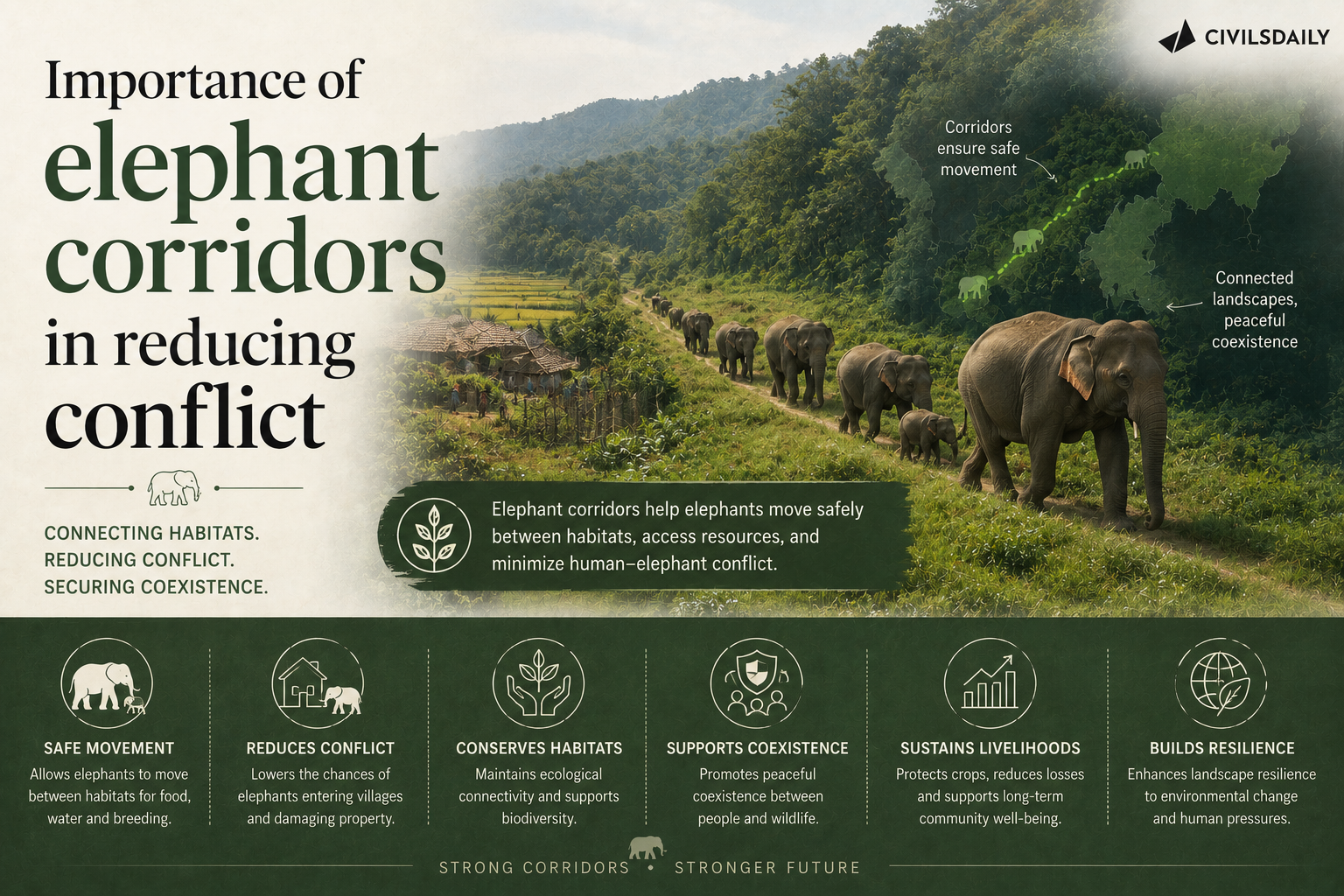
    1. Habitat Fragmentation: Roads, railways, dams, mining, and urbanisation disrupt migratory routes and ecological corridors. Elephants and large mammals increasingly move through agricultural landscapes.
      1. Case Study (India): The Siliguri-Alipurduar railway track in North Bengal acts as a barrier, causing frequent train-elephant collisions.
    2. Agricultural Expansion: Cultivation near forest fringes increases overlap between biodiversity-rich habitats and settlements.
      1. Case Study (India): In the Western Ghats (Kerala, Karnataka, Tamil Nadu), the expansion of tea, coffee, and banana plantations adjacent to protected areas has severely disrupted elephant movement. This has resulted in high crop raiding in districts like Coimbatore and Wynad.
    3. Ecological Imbalance: Decline in natural prey and food sources pushes wildlife towards human settlements.
      1. Case Study (India): In Manas National Park, Assam, the degradation of traditional fodder habitats has led to increased crop raiding. Furthermore, the substitution of native trees with commercial monoculture like Eucalyptus has reduced natural grazing, forcing herds into villages.
    4. Climate Change: Alters vegetation and water availability, intensifying competition for resources.
      1. Case Study (India): During intense summers, elephants in the state of Odisha and in the Kaziranga-Karbi Anglong landscape have been observed moving into human settlements looking for water and raiding paddy fields.
    5. Population Pressure: Expands human settlements near forests and ecologically sensitive regions.
      1. Case Study (India): In Karnataka’s Kodagu region, rapidly growing population and land conversion into ginger and coffee farms have shrunk elephant corridors, forcing them into intense competition with locals for space.
    6. India’s Vulnerability: Elephant encounters, livestock depredation, and crop raiding impose significant economic and social costs.
      1. Livestock Depredation: In Hemis National Park, Ladakh, Snow Leopards preying on sheep and goats are a major source of conflict, with a study finding that they are responsible for 31% of livestock predation in some valleys.

    How does ecological imbalance shape human-wildlife conflict?

    1. Disrupted Corridors: Forest fragmentation interrupts migratory pathways, increasing accidental encounters.
    2. Adaptive Wildlife Behaviour: Wildlife adapts to ecological stress rather than acting aggressively.
      1. Elephants: Raid crops due to disrupted migration and food shortages.
      2. Carnivores: Attack livestock due to prey depletion.
      3. Monkeys and Wild Boars: Exploit food near agricultural zones.
    3. Resource Competition: Scarcity of water and vegetation increases interactions in shared landscapes.
    4. Landscape Transformation: Peri-urban expansion creates interface zones between forests and settlements.

    What lessons do international models offer for coexistence?

    1. Community-Based Conservation (Botswana, Namibia): Shares tourism benefits and local wildlife management rights, reducing hostility towards conservation.
      1. Namibia Example: Communal Conservancies manage trophy hunting and eco-lodges, directly funding local schools and clinics.
      2. Botswana Example: Chobe Enclave Trust uses photographic tourism payouts to offset community crop losses.
    2. Ecological Corridors (Costa Rica): Integrates biodiversity corridors into national development planning.
      1. Costa Rica Example: The National Program of Biological Corridors covers 30% of the country’s landmass.
    3. Technology-Based Monitoring (Finland): Herders use satellite and LoRaWAN GPS collars on over 300,000 free-roaming reindeer.
    4. Participatory Governance: Encourages local participation, ecological data use, and benefit-sharing mechanisms.
      1. Maasai landowners in the Mara North Conservancy lease and consolidate plot boundaries.
    5. Shared Management Model: Treats conflict as a socio-ecological challenge instead of a law-and-order issue.

    What are India’s major policy responses to human-wildlife conflict?

    1. Compensation Mechanisms: Provide relief for crop damage, livestock loss, and human casualties.
    2. Solar Fencing: Deters crop-raiding animals in vulnerable areas.
    3. Early Warning Systems: Facilitate real-time alerts for elephant movement in conflict-prone zones.
    4. Legal Framework:
      1. Wildlife Protection Act, 1972: Ensures legal safeguards for wildlife.
      2. Project Elephant (1992): Strengthens elephant conservation and corridor protection.
      3. National Wildlife Action Plan (2017-2031): Promotes landscape-level conservation.
    5. Implementation Gaps: Delayed compensation, weak accessibility, and uneven implementation reduce effectiveness.

    Why are isolated technical fixes insufficient for resolving conflict?

    1. Habitat Loss: Continues to remain the structural driver of conflict.
    2. Fragmented Landscapes: Disconnected habitats reduce the effectiveness of local interventions.
    3. Fertility Control Debate: Has limited applicability beyond small managed populations.
    4. Reactive Governance: Compensation without ecological restoration limits long-term outcomes.
    5. Planning Deficit: Weak coordination between conservation, infrastructure, and development planning persists.

    How can community-led coexistence models reduce conflict?

    1. Community Participation: Improves ownership and reduces hostility toward wildlife.
    2. Community Forest Management (Bhutan, Nepal): Encourages local stewardship for conservation.
    3. Predator-Proof Enclosures: Reduce livestock losses in vulnerable areas.
    4. Coordinated Grazing: Limits wildlife intrusion into settlements.
    5. Stable Financing: Sustains long-term coexistence efforts.

    Why are education and awareness central to coexistence?

    1. Behavioural Change: Reduces retaliatory actions against wildlife.
    2. Risk Awareness: Promotes safer responses in conflict-prone regions.
    3. Climate Adaptation: Builds preparedness for ecological stress.
    4. Community Partnership: Reframes local populations as conservation stakeholders.

    What should be India’s future strategy for managing human-wildlife conflict?

    1. Habitat Restoration: Improves prey availability and ecosystem resilience.
    2. Ecological Connectivity: Secures wildlife corridors to reduce accidental encounters.
    3. Scientific Land-Use Planning: Integrates biodiversity concerns into development projects.
    4. Rapid Compensation: Strengthens trust among affected communities.
    5. Data-Based Governance: Uses GIS mapping and wildlife monitoring for prevention.
    6. Participatory Conservation: Ensures community involvement and benefit-sharing.

    Conclusion

    Human-wildlife conflict reflects a deeper ecological imbalance rather than isolated wildlife aggression. Sustainable coexistence requires integrating conservation with local livelihoods through habitat restoration, ecological corridors, participatory governance, and scientific planning. India’s long-term success will depend on shifting from reactive mitigation to coexistence-centred conservation.