💥Join UPSC 2027,2028 Mentorship (August Batch) + XFactor Notes & Microthemes PDF

GS Paper: Representation Of People’s Act

  • EC deletes 111 ‘Non-existent’ Parties from List

    The Election Commission has ordered the deletion of 111 registered unrecognized political parties that it found to be “non-existent” and referred three of the parties to the Department of Revenue for legal action for “serious financial impropriety”.

    What is the news?

    • The Representation of the People Act, 1951 provides ECI to register and de-register the political parties.
    • This was the second such action in the recent past against registered parties that have been found violating the RP Act, 1951.

    Registering a Political Party

    • The registration of all political parties is governed by the provisions of the Representation of the People Act, 1951.
    • According to the Election Commission (EC), any party seeking registration has to submit an application to the Commission within a period of 30 days.
    • This is done as per guidelines prescribed by the EC in exercise of the powers conferred by Article 324 of the Constitution and Section 29A of the RP Act, 1951.

    Note: There is no procedure available for de-registration of dormant political parties.

    Process of registration

    • The applicant is asked to publish a proposed party name in two national daily newspapers and two local daily newspapers, and provide two days for submitting objections, if any.
    • The notice for publication is also displayed on the website of the Election Commission.

    Why registering with the EC is important?

    • It is not mandatory to register with the Election Commission.
    • However, registering as a political party with the EC has its advantage in terms of intending to avail itself of the provisions of the RP Act, 1951.
    • The candidates set up by a political party registered with the EC will get preference in the matter of allotment of free symbols vis-à-vis purely independent candidates.
    • More importantly, these registered political parties, over course of time, can get recognition as a ‘state party’ or a ‘national party’.

    How EC recognizes a political party as a state or national party?

    For recognition as a NATIONAL PARTY, the conditions specified are:

    1. a 6% vote share in the last Assembly polls in each of any four states, as well as four seats in the last Lok Sabha polls; or
    2. 2% of all Lok Sabha seats in the last such election, with MPs elected from at least three states; or
    3. recognition as a state party in at least four states.

    For recognition as a STATE PARTY, any one of five conditions needs to be satisfied:

    1. two seats plus a 6% vote share in the last Assembly election in that state; or
    2. one seat plus a 6% vote share in the last Lok Sabha election from that state; or
    3. 3% of the total Assembly seats or 3 seats, whichever is more; or
    4. one of every 25 Lok Sabha seats (or an equivalent fraction) from a state; or
    5. an 8% state-wide vote share in either the last Lok Sabha or the last Assembly polls.

    Benefits for recognized parties

    • This is subject to the fulfilment of the conditions prescribed by the Commission in the Election Symbols (Reservation and Allotment) Order, 1968.

    (a) Reserved Symbol

    • If a party is recognised as a ‘state party’, it is entitled for exclusive allotment of its reserved symbol to the candidates set up by it in the state in which it is so recognised. If a party is recognised as a ‘national party’ it is entitled for exclusive allotment of its reserved symbol to the candidates set up by it throughout India.

    (b) Proposer for nomination

    • Recognised ‘state’ and ‘national’ parties need only one proposer for filing the nomination.

    (c) Campaigning benefits

    • They are also entitled for two sets of electoral rolls free of cost and broadcast/telecast facilities over state-owned Akashvani/Doordarshan during the general elections.


    UPSC 2023 countdown has begun! Get your personal guidance plan now! (Click here)
  • Anti-Defection Law

    Vice-President M. Venkaiah Naidu said that there was a need to amend the anti-defection legislation in the country to plug existing loopholes.

    What did VP notice now?

    • Stating that there was no clarity in the law about the time frame for the action of the House Chairperson or Speaker in anti-defection cases.
    • Some cases are taking six months and some even three years.
    • There are cases that are disposed of after the term is over.

    What is Anti-defection Law?

    • The Anti-Defection Law under the Tenth Schedule of the Constitution punishes MPs/ MLAs for defecting from their party by taking away their membership of the legislature.
    • It gives the Speaker of the legislature the power to decide the outcome of defection proceedings.
    • It was added to the Constitution through the Fifty-Second (Amendment) Act, 1985 when Rajiv Gandhi was PM.
    • The law applies to both Parliament and state assemblies.

    Cases considered under the anti-defection law

    The law covers three scenarios with respect to shifting of political parties by an MP or an MLA.

    (1) Voluntary give-up

    • The first is when a member elected on the ticket of a political party “voluntarily gives up” membership of such a party or votes in the House against the wishes of the party.
    • Such persons lose his seat.

    (2) Independent members

    • When a legislator who has won his or her seat as an independent candidate joins a political party after the election.
    • In both these instances, the legislator loses the seat in the legislature on changing (or joining) a party.

    (3) Nominated MPs

    • In their case, the law gives them six months to join a political party, after being nominated.
    • If they join a party after such time, they stand to lose their seat in the House.

    Powers to disqualification

    • Under the anti-defection law, the power to decide the disqualification of an MP or MLA rests with the presiding officer of the legislature.
    • The law does not specify a time frame in which such a decision has to be made.
    • As a result, Speakers of legislatures have sometimes acted very quickly or have delayed the decision for years — and have been accused of political bias in both situations.

    Significant role of the Speaker/Presiding Officer

    • Pandit Nehru had referred to the Speaker as “the symbol of the nation’s freedom and liberty” and emphasized that Speakers should be men of “outstanding ability and impartiality”.
    • Several judgments on the anti-defection law have been rendered by the Supreme Court.
    • A common factor that shows up in these rulings is the blatant, partisan conduct of speakers in state assemblies.

    Reasons for Speakers’ ambiguous action

    • The Speaker continues to belong to a particular political party.
    • The electoral system and conventions in India have ‘not been developed to ensure protection to the office, there are cogent reasons for Speakers to retain party membership.
    • It would be unrealistic to expect a speaker to completely abjure all party considerations while functioning.
    • There are structural issues regarding the manner of appointment of the Speaker and her tenure in office.

    Way forward

    • Parliament may seriously consider a Constitutional amendment to bring in a permanent Tribunal for dealing with defection cases.
    • It is suggested that a scheme should be brought wherein Speakers should renounce all political affiliations, membership, and activity once they have been elected.
    • We can learn from the UK model. In practice, once elected, the Speaker gives up all-partisan affiliation, as in other Parliaments of British tradition.
    • He/she remains in office until retirement, even though the majority may change and does not express any political views during debates.

    Conclusion

    • Impartiality, fairness, and autonomy in decision-making are the hallmarks of a robust institution.
    • It is the freedom from interference and pressures which provide the necessary atmosphere where one can work with an absolute commitment to the cause of neutrality as a constitutional value.


    UPSC 2022 countdown has begun! Get your personal guidance plan now! (Click here)

  • Postal ballot for NRIs being contemplated

    Chief Election Commissioner, during a recent visit to South Africa and Mauritius, urged Non-Resident Indians (NRIs) to register as overseas electors and told them that a proposal on postal ballots for NRIs was being contemplated by the Election Commission of India.

    Why in news now?

    • CECs interactions with NRIs came after Union Law Minister informed the Lok Sabha in March that the government was exploring the possibility of allowing online voting for NRIs.
    • The ECI had written to the Law Ministry in 2020 proposing that NRIs be allowed to vote through postal ballots, following which the matter has been under consideration by the government.
    • The ECI at present allows NRIs to register as overseas electors as long as they have not acquired the citizenship of another country.
    • They have to reach their respective polling booths to cast their votes in person on voting day.

    Classification of Overseas Indians

    Overseas Indians, officially known as Non-resident Indians (NRIs) or Persons of Indian Origin (PIOs), are people of Indian birth, descent or origin who live outside the Republic of India:

    (A) Non-Resident Indian (NRI)

    • Strictly asserting non-resident refers only to the tax status of a person who, as per section 6 of the Income-tax Act of 1961, has not resided in India for a specified period for the purposes of the Act.
    • The rates of income tax are different for persons who are “resident in India” and for NRIs.

    (B) Person of Indian Origin (PIO)

    Person of Indian Origin (PIO) means a foreign citizen (except a national of Pakistan, Afghanistan, Bangladesh, China, Iran, Bhutan, Sri Lanka and/or Nepal), who:

    • at any time held an Indian passport OR
    • either of their parents/grandparents/great-grandparents were born and permanently resident in India as defined in GoI Act, 1935 and other territories that became part of India thereafter provided neither was at any time a citizen of any of the aforesaid countries OR
    • is a spouse of a citizen of India or a PIO.

    (C) Overseas Citizenship of India (OCI)

    • After multiple efforts by leaders across the Indian political spectrum, a pseudo-citizenship scheme was established, the “Overseas Citizenship of India”, commonly referred to as the OCI card.
    • The Constitution of India does not permit full dual citizenship.
    • The OCI card is effectively a long-term visa, with restrictions on voting rights and government jobs.


    UPSC 2022 countdown has begun! Get your personal guidance plan now! (Click here)

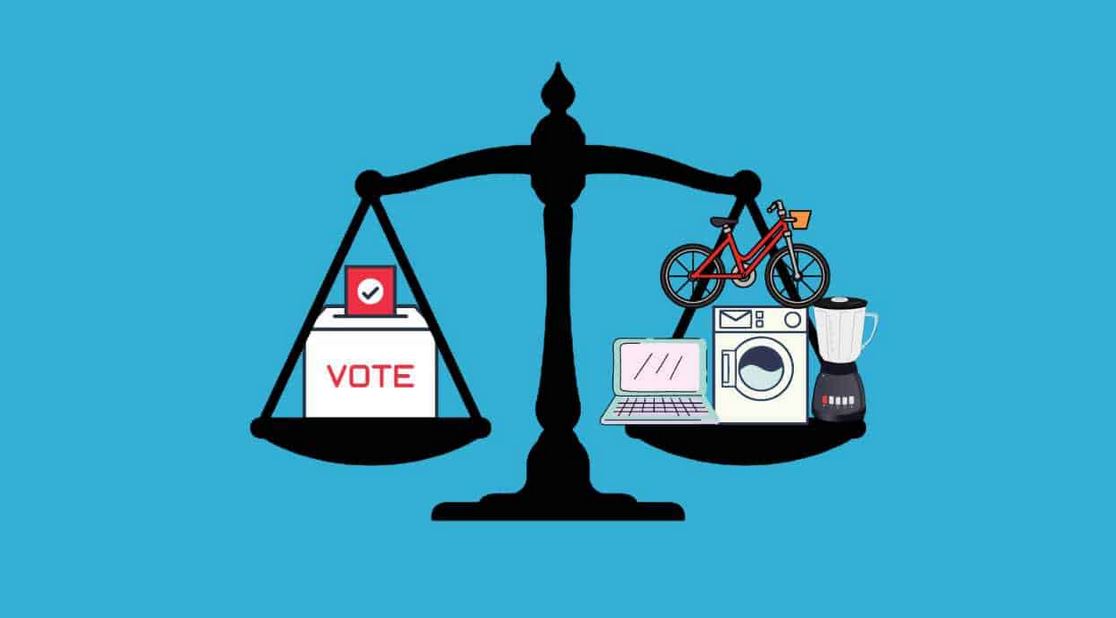
  • Election Freebies and Related Issues

    India could end up facing a Sri Lanka-type economic crisis if it doesn’t stop the “culture of freebies” and subsidies in sectors like agriculture, NITI Aayog member Ramesh Chand has warned.

    What is a Freebie?

    • The term Freebies is not new; rather it is a prevalent culture in Indian politics (in the name of socialism).
    • The political parties are always trying to outdo each other in luring the Indian voters with assorted freebies.
    • From free water to free smartphones the Indian politicians promise everything to attract prospective voters in favour.
    • This trend has gained more momentum in the recent times with the political parties being innovative in their offerings as the ‘traditional free water and electricity’ is no longer sufficient as election goodies.

    Examples of freebies

    1. Promise of Rs 15 lakh in our bank accounts
    2. Free TV, Laptops
    3. Free electricity
    4. Loan waivers
    5. Offering free public transport ride to all women in Delhi

    Why are such policies popular among the public?

    • Failure of economic policies: The answer lies in the utter failure of our economic policies to create decent livelihood for a vast majority of Indians.
    • Quest for decent livelihood: The already low income had to be reoriented towards spending a disproportionately higher amount on education and health, from which, the state increasingly withdrew.
    • Prevailing unemployment:  Employment surveys have shown that employment growth initially slowed down from the 1990s, and then has turned negative over the past few years.
    • Increased cost of living: Real income growth of the marginal sections has actually slowed down since 1991 reforms.
    • Increased consumerism: The poor today also spend on things which appear to be luxuries; cellphones and data-packs are two such examples which are shown as signs of India’s increased affluence.
    • Necessity: For migrant workers, the mobile phone helps them keep in touch with their families back home, or do a quick video-call to see how their infant is learning to sit up or crawl.

    Can Freebies be compared with Welfare Politics?

    • These freebies are not bad. It is a part of social welfare.
    • Using freebies to lure voters is not good.
    • Voter’s greediness may lead to a problem in choosing a good leader.
    • When we don’t have a good leader then democracy will be a mockery.

    Impact of such policies

    • Never ending trail: The continuity of freebies is another major disadvantage as parties keep on coming up with lucrative offers to lure more number of votes to minimize the risk of losing in the elections.
    • Burden on exchequer: People forget that such benefits are been given at the cost of exchequer and from the tax paid.
    • Ultimate loss of poors: The politicians and middlemen wipe away the benefits and the poor have to suffer as they are deprived from their share of benefits which was to be achieved out of the money.
    • Inflationary practice: Such distribution freebie commodity largely disrupts demand-supply dynamics.
    • Lethargy in population: Freebies actually have the tendency to turn the nation’s population into: Lethargy and devoid of entrepreneurship.
    • Money becomes only remedy: Everyone at the slightest sign of distress starts demanding some kind of freebies from the Govt.
    • Popular politics: This is psychology driving sections of the population expecting and the government promptly responds with immediate monetary relief or compensation.

    What cannot be accounted to a freebie?

    • MGNREGA scheme (rural employment guarantee scheme)
    • Right to Education (RTE)
    • Food Security through fair price shops ( under National Food Security Act)
    • Prime Minister Kisan Samman Yojana (PM-KISAN)

    Arguments in favour

    • Social investment: Aid to the poor is seen as a wasteful expenditure. But low interest rates for corporates to get cheap loans or the ‘sop’ of cutting corporate taxes are never criticized.
    • Socialistic policy: This attitude comes from decades of operating within the dominant discourse of market capitalism.
    • Election manifesto: Proponents of such policies would argue that poll promises are essential for voters to know what the party would do if it comes to power and have the chance to weigh options.
    • Welfare: Economists opine that as long as any State has the capacity and ability to finance freebies then its fine; if not then freebies are the burden on economy.
    • Other wasteful expenditure: When the Centre gives incentives like free land to big companies and announce multi-year tax holidays, questions are not asked as to where the money will come from.

    A rational analysis of freebies

    • Winning election and good governance are two different things. The role of freebies to avail good governance is definitely questionable.
    • The social, political and economic consequences of freebies are very short-lived in nature.
    • There are many freebies and subsidies schemes available in many States but we still find starvation deaths, lack of electricity, poor education and health service.
    • Hence the sorrow of the masses of India cannot be solved by freebies or by incentives.

    So are not freebies meant only to attract voters and swing voters by concentrating on a preferential group or community?

    Way forward

    • It can be agreed that a democracy requires popular support for its rule to continue. The sops and freebies to the poor buy it the requisite votes.
    • But the democratic process of election and election promises should be clear. It should not control voters thought.
    • What some people term as ‘populism’ actually constitutes what real economics should be.
    • If you deprive people of what they really need, you will have to throw allurements at them.
    • This can only be stopped if political masters try to follow what economist EA Schumacher had conveyed through his seminal work Small is beautiful – “Treat economics as if people matter.”

    Conclusion

    • There is nothing wrong in having a policy-led elaborate social security programme that seeks to help the poor get out of poverty.
    • But such a programme needs well thought out preparation and cannot be conjured up just before an election.


    UPSC 2022 countdown has begun! Get your personal guidance plan now! (Click here)

  • Delimitation of Constituencies in Jammu and Kashmir

    Members of the Jammu & Kashmir Delimitation Commission faced protests in Jammu as they embarked on a two-day visit to hold consultations with citizens, civil society groups and political parties.

    What is Delimitation and why is it needed?

    • Delimitation is the act of redrawing boundaries of an Assembly or Lok Sabha seat to represent changes in population over time.
    • This exercise is carried out by a Delimitation Commission, whose orders have the force of law and cannot be questioned before any court.
    • The objective is to redraw boundaries (based on the data of the last Census) in a way so that the population of all seats, as far as practicable, be the same throughout the State.
    • Aside from changing the limits of a constituency, the process may result in a change in the number of seats in a state.

    Delimitation in J&K

    • Assembly seats in J&K were delimited in 1963, 1973 and 1995.
    • Prior to August 5, 2019, carving out of J&K’s Assembly seats was carried out under the J&K Constitution and Jammu and Kashmir Representation of the People Act, 1957.
    • Until then, the delimitation of Lok Sabha seats in J&K was governed by the Constitution of India.
    • However, the delimitation of the state’s Assembly was governed by the J&K Constitution and J&K Representation of the People Act, 1957.
    • There was no census in the state in 1991 and hence no Delimitation Commission was set up by the state until 2001 census.

    Why is it in the news again?

    • After the abrogation of J&K’s special status in 2019, the delimitation of Lok Sabha and Assembly seats in the newly-created UT would be as per the provisions of the Indian Constitution.
    • On March 6, 2020, the government set up the Delimitation Commission, headed by retired Supreme Court judge Ranjana Prakash Desai, which was tasked with winding up delimitation in J&K in a year.
    • As per the J&K Reorganization Bill, the number of Assembly seats in J&K would increase from 107 to 114, which is expected to benefit the Jammu region.

    Factors considered during Delimitation

    • The number of districts had increased from 12 to 20 and tehsils from 52 to 207 since the last delimitation.
    • The population density ranged from 29 persons a square km in Kishtwar to 3,436 persons a square km in Srinagar.
    • The remoteness of the place, inaccessibility etc are also considered during the exercise.

    Concerns raised over Delimitation

    • Jammu vs. Kashmir: Concerns had been expressed over how the delimitation process may end up favoring the Jammu region over Kashmir in terms of the seats.
    • Under-representation of Ladakh: Arguments have been made on how Ladakh has been underrepresented, with demands for statehood/sixth schedule.
    • Non-proportionate reservations: It is argued that seats for STs should’ve been divided in both Jammu province & Kashmir province, as the ST population is almost equal.
  • The move to ease Voting for Overseas Citizens

    The Union Government was exploring the possibility of allowing online voting for non-resident Indians (NRI).

    Why in news?

    • The matter of to ease voting for NRIs comes in the wake of a proposal made by the Election Commission of India (ECI).
    • The Law Ministry in November 2020 decided to extend the facility of postal ballots to eligible NRIs for the various State Assembly elections to be held in 2021.
    • The ECI then, had proposed amending the Conduct of Election Rules, 1961, in order to allow this facility.

    NRI vs. OCI

    • The term NRI is a residential status designed by the Income Tax Department of the Indian government and has efficiency only during filing Income Tax returns.
    • On the other hand, OCI is an immigration status or special visa in layman’s language provided to foreign nationals of Indian origin by the Indian government to work or live indefinitely.

    How can overseas voters currently vote in Indian elections?

    • Prior to 2010, an Indian citizen who is an eligible voter and was residing abroad for more than six months, would not have been able to vote in elections.
    • This was because the NRI’s name was deleted from electoral rolls if he or she stayed outside the country for more than six months at a stretch.
    • After the passing of the Representation of the People (Amendment) Act, 2010, eligible NRIs who had stayed abroad beyond six months have been able to vote, but only in person at the polling station where they have been enrolled as an overseas elector.
    • Just as any resident Indian citizen above the age of 18 years) is eligible to vote in the constituency where she/he is a resident, overseas Indian citizens are also eligible to do so.
    • In the case of overseas voters, their address mentioned in the passport is taken as the place of ordinary residence and chosen as the constituency for the overseas voter to enroll in.

    How has the existing facility worked so far?

    • Hike in voters: From merely 11,846 overseas voters who registered in 2014, the number went up to close to a lakh in 2019. But the bulk of these voters (nearly 90%) belonged to just one State — Kerala.
    • Section 20-1A, Part III of the RP Act: It addresses this to some extent by qualifying “a person absenting himself temporarily from his place of ordinary residence shall not by reason thereof cease to be ordinarily resident therein.
    • Proxy provisions: The Bill provided for overseas voters to be able to appoint a proxy to cast their votes on their behalf, subject to conditions laid down in the Conduct of Election Rules, 1961.
    • Electronically Transmitted Postal Ballot System: The ECI then approached the government to permit NRIs to vote via postal ballots similar to a system that is already used by service voters, (a member of the armed Forces of the Union; or a member of a force to which provisions of the Army Act, 1950 (46 of 1950) which is ETPBS. The ECI proposed to extend this facility to overseas voters as well.

    What is ETPBS and how does it function?

    • The Conduct of Election Rules, 1961 was amended in 2016 to allow service voters to use the ETPBS.
    • Under this system, postal ballots are sent electronically to registered service voters.
    • The service voter can then download the ETPB (along with a declaration form and covers), register their mandate on the ballot and send it to the returning officer of the constituency via ordinary mail.
    • The post will include an attested declaration form (after being signed by the voter in the presence of an appointed senior officer who will attest it).
    • The postal ballot must reach the returning officer by 8 a.m. on the day of the counting of results.
    • In the case of NRI voters, those seeking to vote through ETPBS will have to inform the returning officer at least five days after notification of the election.

    Will this facility be available to all overseas voters across countries?

    • There were news reports that the ECI had indicated to the Ministry of External Affairs that it would want postal voting introduced on a pilot basis in non-Gulf countries.
    • But the ECI had asked the Law Ministry to explore the possibility of extending postal ballots to overseas electors and not restrict it to any particular country.
    • In March 2021, the Ministry of External Affairs informed ECI that the implementation could require to overcome “huge logistical challenges” and needs “a realistic assessment of requirements”

    Are postal ballots a viable means of voting?

    • The ETPBS method allowed for greater turnout among service voters in the 2019 Lok Sabha election.
    • With the increasing mobility of citizens across countries for reasons related to work, the postal ballot method has been internationally recognized.
    • A postal ballot mechanism that allows for proper authentication of the ballot at designated consular/embassy offices and an effective postal system should ease this process for NRIs.

    Back2Basics: NRI vs OCI

    Non-Resident Indian (NRI)

    • To mention it, NRI is someone who is not a resident of India.
    • However, the law is much more complicated and must be delved deeper to gain an inclusive insight into the sector.
    • A person is considered a resident of India if he/she has been staying in India for a minimum tenure of 182 days during the previous financial year of a particular year. OR
    • A person living in India for a total of 365 days during the previous four financial years and a minimum of 60 days during the last financial years is considered a citizen for a particular year.
    • Now an NRI or a non-resident of India is eligible to pay charges for only the first two situations, which means either the income received or earned in India.
    • Therefore, the NRI status also influences the enjoyable rights of that person.

    Overseas Citizen of India (OCI)

    • OCI is a card issued by the government of India that denotes that a non-resident or foreigner has been permitted to stay and work within Indian boundaries.
    • Hence, this card provides foreigners with an immigration status without any limited tenure.
    • There are cases where PIOs of specific categories are allowed for OCI cards that have migrated from India to foreign countries (except Pakistan and Bangladesh) if the other government agrees for dual citizenship.
    • An individual holding an OCI card can be an overseas citizen of India in the layman’s language.
    • So an OCI is not a citizen of India, but the Indian government has given the cardholder permission to reside and work within the boundaries of India.
    • Residents migrating from Pakistan and Bangladesh are not eligible for holding the OCI card. Even if their parents are citizens of both countries, the applicants will be denied having an OCI card.


    UPSC 2022 countdown has begun! Get your personal guidance plan now! (Click here)

  • Opinion polls

    Every election season, we find television channels flooded with opinion polls and subsequently exit polls after the casting of votes.

    What are Opinion Polls?

    • Opinion polls are similar to surveys or an inquiry designed to gauge public opinion about a specific issue or a series of issues in a scientific and unbiased manner.
    • This term has got wide recognition for assessing outcomes of elections in India.
    • In most democracies, opinion and exit polls are common during elections.
    • In India, the ECI allows the dissemination of the exit poll results half an hour after the end of polling on the last poll day.

    How are they conducted?

    • Interviewers/reporters ask questions of people chosen at random from the population being measured.
    • Responses are given, and interpretations are made based on the results.
    • It is important in a random sample that everyone in the population being studied has an equal chance of participating.
    • Otherwise, the results could be biased and, therefore, not representative of the population.

    Need of such polls

    • Popular opinion: Polls are simply a measurement tool that tells us how a population thinks and feels about any given topic.
    • Specific viewpoint: Polls tell us what proportion of a population has a specific viewpoint.
    • Opportunity to express: Opinion polling gives people who do not usually have access to the media an opportunity to be heard.

    Issues with such polls (in context to elections)

    • Authenticity: Critics have often questioned their authenticity.
    • Manipulation of voters: This largely manipulates the voting behavior.
    • Sensationalization by media: The media, on the other hand, invariably opposes the idea of a ban as seat forecasts attract primetime viewership.
    • Ridiculing the public mandate: The exit polls largely disrespect public opinions inciting confusion regarding the election mandate.

    Why does it persist in India?

    Ans. Exercise of Free Speech

    • The opposition to the ban in India is mainly on the ground that freedom of speech and expression is granted by the Constitution (Article 19).
    • What is conveniently forgotten is that this freedom is not absolute and allows for “reasonable restrictions” in the same article.

    Limited restrictions that we have in India

    • RP Act: The Indian Penal Code and Representation of the People Act, 1951 do contain certain restrictions against disinformation.
    • Restrictions on A19: While the Constitution allows for reasonable restrictions on freedom of expression, its mandate to the ECI for free and fair elections is absolute.
    • Supreme Court interpretations: The Supreme Court (SC), in a series of judgments, has emphasized this requirement.
    • Basic structure doctrine: It considers free and fair elections is the basic structure of the Constitution (PUCL vs Union of India, 2003; NOTA judgment, 2013).

    Examples of restrictions

    • Restrictions are imposed in many countries, extending from two to 21 days prior to the poll — Canada, France, Italy, Poland, Turkey, Argentina, Brazil, Colombia, to name a few examples.
    • In India, all political parties too have opposed these polls, demanding a ban — except when they are shown as winning.

    Why does the ECI feel that opinion polls interfere with free and fair elections?

    • Prevalence of paid news in India: Having seen “paid news” in action, it apprehends that some opinion polls may be sponsored, motivated and biased.
    • Opacity: Almost all polls are non-transparent, providing little information on the methodology.
    • Propaganda: Subtle propaganda on casteist, religious and ethnic basis as well as by the use of sophisticated means like the alleged poll surveys create public distrust in poll process.
    • Disinformation: With such infirmities, many “polls” amount to misinformation that can result in “undue influence”, which is an “electoral offense” under IPC Section 171 (C). It is a “corrupt practice” under section 123 (2) of the RP Act.
    • Betting: The polling agencies manipulate the margin of error, victory margin for candidates, seat projections for a party or hide negative findings.

    Call for a ban in India

    • The demand for a ban on opinion polls is not new.
    • At all-party meets called by the Election Commission in 1997 and 2004, there was unanimous demand for a ban.
    • The difference of opinion was only on whether the ban should apply from the announcement of the poll schedule or the date of notification.

    Moves by ECI

    • In 1998, the ECI issued guidelines that were challenged in the SC.
    • A five-judge Constitution Bench asked the ECI how it would enforce these decisions in the absence of a law.
    • Realizing its weakness, the ECI withdrew the guidelines.
    • Unfortunately, this left the constitutionality of the issue

    Way forward

    • Independent regulator: Ideally a body like the British Polling Council would be a viable option. India could set up its own professional, self-regulated body on the same lines say Indian Polling Council.
    • Mandatory disclosure: All polling agencies must disclose for scrutiny the sponsor, besides sample size, methodology, time frame, quality of training of research staff, etc.


    UPSC 2022 countdown has begun! Get your personal guidance plan now! (Click here)

  • Jammu and Kashmir Delimitation Commission likely to get another extension

    The J&K Delimitation Commission is likely to get a second extension of its term this month.

    What is Delimitation and why is it needed?

    • Delimitation is the act of redrawing boundaries of an assembly or Lok Sabha seat to represent changes in population over time.
    • This exercise is carried out by a Delimitation Commission, whose orders have the force of law and cannot be questioned before any court.
    • The objective is to redraw boundaries (based on the data of the last Census) in a way so that the population of all seats, as far as practicable, be the same throughout the State.
    • Aside from changing the limits of a constituency, the process may result in a change in the number of seats in a state.

    Delimitation in J&K

    • Assembly seats in J&K were delimited in 1963, 1973 and 1995.
    • Prior to August 5, 2019, carving out of J&K’s Assembly seats was carried out under the J&K Constitution and Jammu and Kashmir Representation of the People Act, 1957.
    • Until then, the delimitation of Lok Sabha seats in J&K was governed by the Constitution of India.
    • However, the delimitation of the state’s Assembly was governed by the J&K Constitution and J&K Representation of the People Act, 1957.
    • There was no census in the state in 1991 and hence no Delimitation Commission was set up by the state until 2001 census.

    Why is it in the news again?

    • After the abrogation of J&K’s special status in 2019, the delimitation of Lok Sabha and Assembly seats in the newly-created UT would be as per the provisions of the Indian Constitution.
    • On March 6, 2020, the government set up the Delimitation Commission, headed by retired Supreme Court judge Ranjana Prakash Desai, which was tasked with winding up delimitation in J&K in a year.
    • As per the J&K Reorganization Bill, the number of Assembly seats in J&K would increase from 107 to 114, which is expected to benefit the Jammu region.

    Factors considered during Delimitation

    • The number of districts had increased from 12 to 20 and tehsils from 52 to 207 since the last delimitation.
    • The population density ranged from 29 persons a square km in Kishtwar to 3,436 persons a square km in Srinagar.
    • The remoteness of the place, inaccessibility etc are also considered during the exercise.

    Concerns raised over Delimitation

    • Jammu vs. Kashmir: Concerns had been expressed over how the delimitation process may end up favoring the Jammu region over Kashmir in terms of the seats.
    • Under-representation of Ladakh: Arguments have been made on how Ladakh has been underrepresented, with demands for statehood/sixth schedule.
    • Non-proportionate reservations: It is argued that seats for STs should’ve been divided in both Jammu province & Kashmir province, as the ST population is almost equal.

    Do not forget to answer this PYQ in the comment box:

    Q.With reference to the Delimitation Commission, consider the following statements:

    1. The orders of the Delimitation Commission cannot be challenged in a Court of Law.
    2. When the orders of the Delimitation Commission are laid before the Lok Sabha or State Legislative Assembly, they cannot affect any modifications in the orders.

    Which of the statements given above is/are correct?

    (a) 1 only

    (b) 2 only

    (c) Both 1 and 2

    (d) Neither 1 nor 2


    [wpdiscuz-feedback id=”alffxgur6b” question=”Please leave a feedback on this” opened=”1″]Post your answers here:[/wpdiscuz-feedback]


  • Electoral bond scheme

    Context

    Ever since its introduction, the electoral bond scheme has envenomed the democratic process, by destroying altogether any notion of transparency in political funding.

    Issue of anonymity in electoral bond

    • The electoral bond scheme is designed to allow an individual, or any “artificial juridical person”, including body corporates, to purchase bonds issued by the State Bank of India during notified periods of time.
    • These instruments are issued in the form of promissory notes, and in denominations ranging from ₹1,000 to ₹1 crore.
    • Once purchased, the buyer can donate the bond to any political party of their choice and the party can then encash it on demand.

    Supreme Court’s opinion

    • The Supreme Court has allowed the scheme to continue unabated and has denied an interim stay on its operation.
    • In one such provisional order, the Court asserted that the bonds were not, in fact, anonymous.
    • According to the Court, since both the purchase and the encashment of bonds are made through banking channels, all it would take for a person to glean the identity of a donor was for her to look through every corporation’s financial statement — these records, the Court said, ought to be available with the Registrar of Companies.
    • What the order ignored was that there is no attendant obligation on political parties to provide details to the public on each donation received by them through electoral bonds.
    • Companies are also under no obligation to disclose the name of the party to whom they made the donation.

    Violation of voter’s right

    •  The Supreme Court has consistently held that voters have a right to freely express themselves during an election and that they are entitled to all pieces of information that give purpose and vigour to this right.
    • Surely, to participate in the electoral process in a meaningful manner and to choose one’s votes carefully, a citizen must know the identity of those backing the candidates.

    Electoral bond does not eliminate the role of black money in funding elections

    • As affidavits filed by the Election Commission of India in the Supreme Court have demonstrated, the scheme, if anything, augments the potential role of black money in elections.
    • It does so by, among other things, removing existing barriers against shell entities and dying concerns from donating to political parties.
    • Moreover, even if the bonds were meant to eliminate the presence of unaccounted currency, it is difficult to see what nexus the decision to provide complete anonymity of the donor bears to this objective.
    • It is for this reason that the Reserve Bank of India reportedly advised the Government against the scheme’s introduction.

    Conclusion

    The worries over the electoral bond scheme, however, go beyond its patent unconstitutionality. This is because in allowing anonymity it befouls the basis of our democracy and prevents our elections from being truly free and fair.

    UPSC 2022 countdown has begun! Get your personal guidance plan now! (Click here)

  • Election Campaign Funding by Political Parties

    With several Assembly elections coming up, the issue of campaigning is back on the track. Campaign funding reforms are one of the biggest issues in electoral reforms worldwide.

    Why in news?

    • Elections are fought with huge funds nowadays.
    • Estimates vary, but a candidate may spend in crores in just one constituency.
    • This vital issue is neglected by voters in the noise of campaigns, leaders, celebrities, and media coverage.

    Caps on Election Expenditure

    The Election Commission of India (ECI) imposes limits on campaign expenditure incurred by a candidate and not political parties.

    The ceiling on poll expenditure varies across States:

    (a) Bigger states

    • With candidates in Assembly Elections in bigger states like Bihar, Uttar Pradesh, and Tamil Nadu now allowed to spend up to 40L (from ₹30.8 lakhs as against ₹28 lakhs earlier.)
    • For a candidate contesting a Lok Sabha Poll in these States, the revised ceiling on poll expenditure is now 90lakh (₹77 lakhs earlier).

    (b) Smaller states

    • While the enhanced ceiling for a Lok Sabha candidate is now 75Lakh (Earlier ₹59.4 lakhs) those contesting an Assembly can spend up to 28 Lakh( earlier ₹22 lakhs.)
    • Goa, Arunachal Pradesh, Sikkim and a few Union Territories (AGMUT states) based on the size of their constituencies and population, have a lower ceiling on poll expenditure.

    How are such ceilings made?

    • Such changes are made by amending the Conduct of Elections Rules.
    • The last time the expenditure ceiling was enhanced was in 2014 just ahead of the Lok Sabha polls.

    What happens when expenditure exceeds the limit?

    • Contesting candidates are required to file a mandatory true account of election expenses with the EC.
    • An incorrect account or expenditure beyond the ceiling can attract disqualification for up to three years as per Section 10A of The Representation of the People Act, 1951.

    What doesn’t account to Election expenditure?

    • The expenditure incurred by leaders of a political party on account of travel by air or by any other means of transport for propagating programme of the political party is not considered to be the election expenditure.
    • Any expenditure which is done for service of the Government and discharge of official duty is also not considered to be election expenditure.

    Why is this issue important for the voter?

    • Voters vote for candidates, political parties and leaders so that they deliver benefits to the citizens.
    • If election funds are obtained from other sources, the Governments in power are obliged to the funders more than the voters.
    • The government may take decisions that benefit the donors rather than the voters.
    • Even if a rich candidate funds his own election, the focus is on recovering the investment made rather on public service.

    Situation in India on Election Funding

    • Transparency in funding is absent after the introduction of Electoral Bonds.
    • Now citizens cannot know who is funding the political parties.

    Way forward

    There is also much to learn from international experience. Broadly there are three classes of remedies.

    • First is to make all election funding completely transparent so that voters know who is funding whom.
    • Second is to prevent private interests from unduly influencing elections or Governments. This is done by a set of rules on limiting funding.
    • Third is to try and have a more level playing field so that good politicians, candidates and parties with less funds also stand a chance of competing in elections.


    UPSC 2022 countdown has begun! Get your personal guidance plan now! (Click here)