💥Join UPSC 2027,2028 Mentorship (July Batch) + XFactor Notes & Microthemes PDF

GS Paper: Salient Features Of World’S Physical Geography

  • A key ocean current is collapsing. This could be devastating for the world and India 

    Why in the News?

    Recent scientific studies have warned that the Atlantic Meridional Overturning Circulation (AMOC), a major ocean current system regulating global climate, could weaken by nearly 59% by 2100 due to rapid Greenland ice melt and global warming. Scientists fear that crossing a critical tipping point may disrupt monsoons, intensify El Niño events, trigger extreme weather, and severely affect agriculture and water security, including in India.

    What is the Atlantic Meridional Overturning Circulation (AMOC)?

    The Atlantic Meridional Overturning Circulation (AMOC) is a vast system of ocean currents that acts as a “global conveyor belt,” circulating water, heat, and nutrients throughout the Atlantic Ocean. It is a critical component of the Earth’s climate system, responsible for transporting warm water from the tropics toward the North Atlantic and returning cold water southward at deeper levels.

    1. Ocean Conveyor Belt: Facilitates circulation of warm saline surface water from tropical regions toward Greenland and returns cold dense water through deep ocean currents.
    2. Thermohaline Circulation: Operates through differences in temperature and salinity that determine ocean water density.
    3. Climate Regulation: Transfers heat from equatorial regions toward higher latitudes, moderating Europe’s climate.
    4. Rainfall Influence: Shapes global precipitation belts, including monsoon systems across Asia and Africa.
    5. Carbon Regulation: Supports oceanic carbon absorption and heat storage, reducing atmospheric warming intensity.

    Why is AMOC Weakening Rapidly?

    1. Greenland Ice Melt: Accelerated melting releases massive freshwater volumes into the North Atlantic.
    2. Salinity Reduction: Freshwater dilution reduces ocean salinity and weakens density-driven sinking of cold water.
    3. Global Warming: Rising atmospheric temperatures increase polar ice loss and ocean heat accumulation.
    4. Circulation Slowdown: Reduced sinking weakens the entire overturning circulation mechanism.
    5. Observed Decline: Scientific studies estimate AMOC has already weakened significantly over the last 50 years.

    How Does AMOC Influence Global Climate Systems?

    1. Heat Redistribution: Transfers tropical heat toward northern latitudes and stabilizes regional climates.
    2. European Climate Stability: The northward transport of warm water acts as a “radiator,” keeping Europe, particularly Western Europe, considerably warmer than other regions at similar latitudes.
    3. Monsoon Regulation: Influences tropical rainfall patterns and seasonal wind circulation.
      1. By shifting heat between hemispheres, it helps define the location of the Intertropical Convergence Zone (ITCZ), a major rain belt. A weaker AMOC can disrupt this, leading to weakened monsoon systems and altered rainfall in Africa, Asia, and South America.
    4. Storm Dynamics: By transporting heat, the AMOC influences the intensity and path of storms and cyclones. It specifically contributes to the formation of the North Atlantic Oscillation (NAO). Changes in its strength can alter the frequency and track of storms across the North Atlantic
    5. Marine Ecosystems: The overturning circulation, which involves deep-sea sinking in the North Atlantic, helps circulate nutrients and oxygen throughout the ocean’s layers, supporting marine biodiversity.

    Why is the Collapse of AMOC Considered a Climate Tipping Point?

    The collapse of the Atlantic Meridional Overturning Circulation (AMOC) is considered a critical climate tipping point because it represents a “point of no return” where melting Arctic ice causes irreversible shutdown of vital ocean currents, triggering catastrophic, self-sustaining changes to global weather, sea levels, and ecosystems.

    1. Irreversibility Risk: Crossing a threshold may push the system into long-term collapse difficult to reverse.
    2. Abrupt Climate Shift: Climate systems may experience sudden disruptions rather than gradual warming patterns.
    3. Non-Linear Impact: Small increases in warming may trigger disproportionately large climatic consequences.
    4. Feedback Mechanisms: Ice melt and circulation slowdown reinforce each other, accelerating instability.
    5. Planetary Consequences: Impacts may extend simultaneously across rainfall, temperature, sea level, and ecosystems.

    How Could AMOC Collapse Affect India?

    1. The “Southern Pull” on Rain: As the Northern Hemisphere cools due to lack of heat transport, the Inter-Tropical Convergence Zone (ITCZ), the belt where monsoon rains form, shifts south. This moves the core rain clouds away from the Indian landmass, leading to the projected 10% to 30% drop in rainfall.
    2. Monsoon Instability: Beyond just “less rain,” the monsoon would become erratic
    3. Agricultural Stress: Irregular rainfall threatens crop productivity and food security.
    4. Extreme Weather: Intensifies droughts, floods, heatwaves, and erratic rainfall events.
    5. Water Insecurity: Alters river recharge patterns and groundwater availability.
    6. Livelihood Vulnerability: Threatens rural populations dependent on agriculture and climate-sensitive occupations.
    7. Disaster Frequency: Increases compound climate events such as simultaneous drought-flood cycles.

    What is the Connection Between AMOC and El Niño?

    The connection between the Atlantic Meridional Overturning Circulation (AMOC) and El Niño is a critical climate interlinkage where a disruption in one ocean basin triggers “chaos” in another.

    1. Climate Interlinkage: AMOC slowdown affects Pacific Ocean circulation patterns.
    2. Global Heat Imbalance: AMOC acts as a “conveyor belt” moving heat north. Its slowdown traps excess heat in the Southern Hemisphere while cooling the North Pacific. This disturbs the delicate temperature gradients that normally regulate El Niño-Southern Oscillation (ENSO) cycles.
      1. El Niño Intensification: Weak AMOC conditions may strengthen El Niño frequency and severity.
    3. Monsoon Suppression: Strong El Niño events historically weaken Indian monsoon rainfall.
    4. Global Weather Extremes: Intensifies droughts, storms, floods, and agricultural disruptions globally.
    5. Atmospheric Feedbacks: Alters temperature gradients and global wind circulation systems.

    What Could be the Global Consequences of AMOC Collapse?

    1. European Cooling: Northern Europe may experience severe winters despite global warming.
    2. Sea-Level Rise: Eastern coast of North America could face accelerated sea-level rise.
    3. Food System Stress: Agricultural productivity may decline due to rainfall instability.
    4. Climate Migration: Large populations may face displacement due to water and livelihood crises.
    5. Economic Disruption: Insurance losses, infrastructure damage, and supply chain instability may increase.
    6. Biodiversity Loss: Marine ecosystems dependent on nutrient circulation may weaken.

    What Measures are Necessary to Prevent or Mitigate the Crisis?

    1. Emission Reduction: Accelerates decarbonisation to limit global warming below critical thresholds.
    2. Climate Adaptation: Strengthens resilient agriculture, irrigation systems, and disaster preparedness.
    3. Polar Protection: Enhances international cooperation on Arctic and Greenland ice conservation.
    4. Scientific Monitoring: Expands ocean observation systems and climate modelling.
    5. Renewable Transition: Reduces dependence on fossil fuels and stabilizes long-term climate systems.
    6. Global Cooperation: Strengthens implementation of the Paris Agreement and climate finance commitments.

    Conclusion

    The weakening of AMOC highlights the growing fragility of Earth’s interconnected climate systems under anthropogenic warming. The issue extends beyond oceanography into food security, economic stability, disaster governance, and geopolitical security. For India, the risks are particularly significant because of the economy’s dependence on monsoon-driven agriculture and climate-sensitive livelihoods. Preventing irreversible tipping points requires rapid emission reduction, climate-resilient development, strengthened scientific monitoring, and coordinated global climate action.

    PYQ Relevance

    [UPSC 2015] Explain the factors responsible for the origin of ocean currents. How do they influence regional climates, fishing and navigation?

    Linkage: This AMOC issue directly relates to the role of ocean currents in regulating global climate, monsoon systems, salinity, and heat transfer. The article expands the conventional oceanography topic into contemporary climate-change dimensions such as tipping points, Greenland ice melt, El Niño linkage, and monsoon instability affecting India.
  • Sakurajima Volcano erupts in Japan’s Kyushu

    Why in the News?

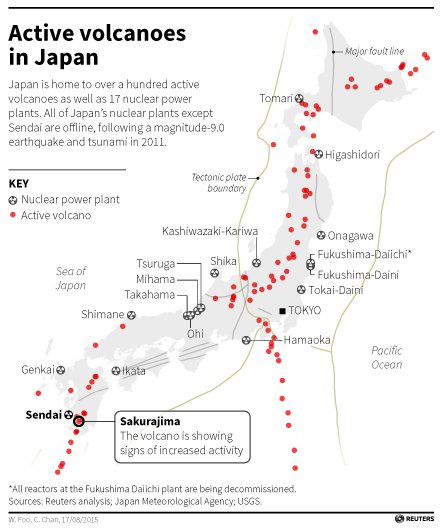
    Japan’s Sakurajima volcano has erupted several times sending ash plumes up to 4.4 km into the atmosphere.

    Sakurajima Volcano erupts in Japan's Kyushu

    About Sakurajima Volcano:

    • Location: Kagoshima Prefecture, Kyushu, sitting on the southern rim of the Aira caldera inside Kagoshima Bay.
    • Geological Origin: Linked to formation of the Aira caldera (22,000–29,000 years ago); Sakurajima developed as a post-caldera cone about 13,000 years ago.
    • Volcano Type: A classic stratovolcano built from alternating lava and ash layers; active vents include Minamidake crater and the Showa flank crater.
    • Physical Features: Height 1,117 m, circumference ≈50 km; originally an island until 1914 lava flows connected it to the Osumi Peninsula.
    • Eruption Style: Dominantly Strombolian eruptions (ash, bombs, lapilli) but historically capable of large Plinian eruptions.
    • Historical Activity: Continuous eruptive record since 963 AD; major episodes in 1471–76, 1779–82, and the 1914 catastrophic eruption.
    • Risk Status: Considered one of Japan’s most dangerous volcanoes due to high activity, caldera-linked magma supply and extreme proximity to inhabited zones.

    What makes it unique?

    • Near-Continuous Activity: Erupts hundreds of times annually, ranking among the world’s most persistently active volcanoes.
    • Caldera System: Built on the Aira caldera, giving it a deep, complex, highly active magma plumbing network.
    • Landform Transformation: The 1914 eruption converted Sakurajima from an island into a peninsula, an unusual event in recorded volcanology.
    [UPSC 2005] Where is the volcanic mountain, Mount St- Helens located?

    Options: (a) Chile (b) Japan (c) Philippines (d) United States of America*


  • What is the Rare Earth Hypothesis?

    Why in the News?

    This newscard is an excerpt from the original article published in The Hindu.

    What is the Rare Earth Hypothesis?

    • About: Proposed by Peter Ward (palaeontologist) and Donald Brownlee (astronomer) in 2000, it suggests that simple life (like microbes) may be common, but complex life (like plants and animals) is extremely rare in the universe.
    • Core Idea: Earth supports advanced life because of a unique mix of conditions such as a stable orbit, a protective magnetic field, active plate tectonics, and giant planets like Jupiter that shield it from asteroids.
    • Meaning: The Earth is not an ordinary planet; it is a special case where everything aligned perfectly to allow complex life to evolve.

    How does it differ from other Theories?

    • Drake Equation / Mediocrity Principle: Say that life should be common since there are billions of stars; the Rare Earth Hypothesis says complex life is rare even if basic life is not.
    • Fermi Paradox: Asks “Where is everybody?” The Rare Earth answer is that complex intelligent life is rare, so we don’t see others.
    • Copernican Principle: Claims Earth is ordinary; the Rare Earth Hypothesis argues Earth is extraordinary and rare in its conditions.

    Evidence supporting the Hypothesis:

    • Exoplanet Studies (Kepler Mission): Thousands of Earth-sized planets found, but few have stable climates or protective atmospheres like Earth.
    • M-dwarf Planets: Many orbit small stars and lose their atmospheres due to strong radiation.
    • No Alien Signals: Breakthrough Listen and other searches found no technosignatures from intelligent civilizations.
    • Earth’s Uniqueness: Plate tectonics and a carbon cycle help Earth keep a stable climate for billions of years; such conditions have not yet been found elsewhere.

    Scientific Outlook and Future Research:

    • Current View: Microbial life might exist on many planets, but stable, complex ecosystems like Earth’s are probably rare.
    • Ongoing Studies:
      • James Webb Space Telescope (JWST) searches for gases like oxygen, methane, and water on distant planets.
      • Planetary models test if other worlds have tectonics or internal heat for climate balance.
      • Technosignature surveys continue for traces of intelligent life.
    • Future Missions: Extremely Large Telescope (ELT) and Habitable Worlds Observatory (HWO) will study exoplanet atmospheres more closely.
    • Significance: The Rare Earth Hypothesis remains plausible but unproven, showing that life may be widespread, but Earth-like complexity could be one of the universe’s rarest achievements.
    [UPSC 2018] Which of the following phenomena might have influenced the evolution of organisms?

    1. Continental drift

    2. Glacial cycles

    Select the correct answer using the code given below.

    Options: (a) 1 only (b) 2 only (c) Both 1 and 2* (d) Neither 1 nor 2


  • Volga River

    Why in the News?

    This newscard is an excerpt from the original article published in the Indian Express.

    Volga River

    About the Volga River:

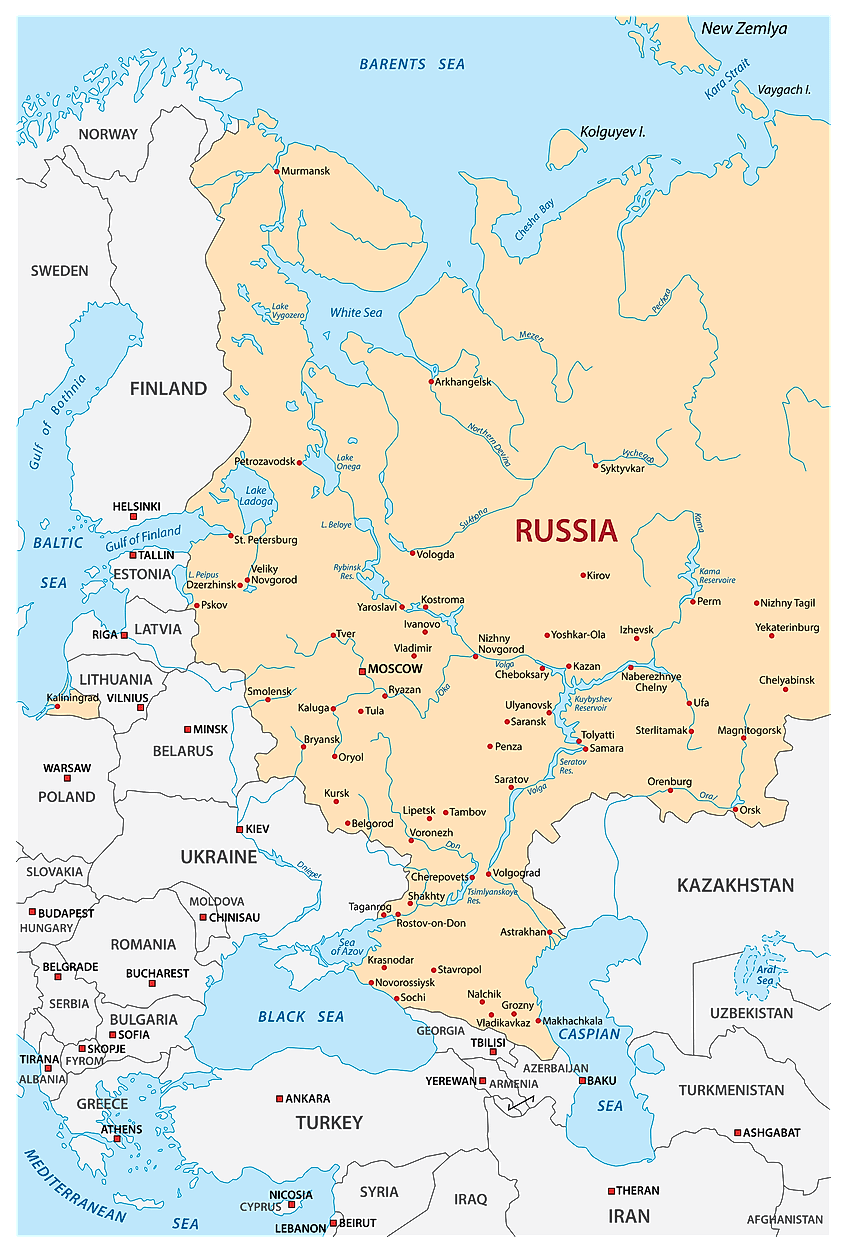
    • Overview: The longest river in Europe (about 3,500 km), originating in the Valdai Hills northwest of Moscow and flowing southeast to the Caspian Sea at Astrakhan.
    • Drainage Basin: Covers around 1.35 million sq. km, among Europe’s largest river systems, with major tributaries, Kama, Oka, Vetluga, and Sura.
    • Historical Role: Served as a critical front during the Battle of Stalingrad (World War II) and remains central to Russian historical and strategic narratives.
    • Cultural Significance: Revered as “Mother Volga”, symbolising Russian unity, resilience, and identity, deeply embedded in folklore and national consciousness.
    • Economic Importance: It contributes one-fourth of Russia’s agricultural output, supports industrial fishing, and sustains key industries, oil refining, shipbuilding, hydroelectric power.
    • Navigation & Connectivity: Linked to the Baltic, Black, and Caspian Seas through an extensive network of canals and reservoirs, forming the backbone of Russia’s inland transport system.
    • Urban & Industrial Corridor: Major cities like Kazan, Samara, Nizhny Novgorod, and Volgograd lie along its course, forming Russia’s industrial-agricultural heartland.
    • Ecological Richness: Supports about 260 bird species and 70 fish species, making it a key biodiversity hotspot within Eurasia.
    [UPSC 2020] Consider the following pairs: River Flows into

    1. Mekong: Andaman Sea

    2. Thames: Irish Sea

    3. Volga: Caspian Sea

    4. Zambezi: Indian Ocean

    Which of the pairs given above is/are correctly matched?

    Options: (a) 1 and 2 only (b) 3 only (c) 3 and 4 only * (d) 1, 2 and 4 only


  • Climate Models and Their Accuracy

    Why in the News?

    The US President Donald Trump called climate change the “greatest con job ever,” disgusted with the predictions based on climate models central to climate science.

    Climate Models and Their Accuracy

    What are Climate Models?

    • Overview: Climate models are computer simulations using mathematical equations to represent the Earth’s climate system, including the atmosphere, oceans, land surface, and ice.
    • Basis: Built on physics, chemistry, and biology, they simulate interactions among Earth’s components.
    • Purpose: Forecast temperature, rainfall, humidity, sea-level rise, and extreme weather under scenarios like high greenhouse gas emissions.
    • Difference from Weather Models: Weather models predict short-term local events, while climate models analyze long-term regional and global patterns.

    How do Climate Models work?

    • Grid System: Earth divided into a 3D grid of cells across land, atmosphere, and oceans.
    • Equations: Each cell governed by equations on energy movement, air, ice, and land processes.
    • Data Input: Observational data (greenhouse gases, ocean conditions, land use) fed into the model.
    • Interactions: Equations simulate changes in each cell and their effects on neighboring cells.
    • Outputs: Provide projections for temperature, precipitation, sea levels, ice cover, and extreme climate events.

    Evolution of Climate Models:

    Model Type What is it? Strengths Limitations
    Energy Balance Models (EBMs) 

    (1960s)

    • The earliest climate models.
    • They treat Earth like a single box system, calculating surface temperature by balancing incoming solar radiation vs outgoing infrared radiation.
    • Essentially, they answer: “How warm should Earth be if X amount of energy comes in and Y amount goes out?”
    • Very simple; first to link CO₂ emissions with global warming.
    • Computationally inexpensive.
    • Oversimplified — ignores atmosphere, oceans, and circulation.
    • Cannot simulate rainfall, winds, or regional climate.
    Radiative Convective Models (RCMs) 

    (1960s–70s)

    • Introduced the vertical structure of the atmosphere.
    • They divide the atmosphere into layers and simulate how radiation (solar + infrared) and convection move heat upward and downward.
    • Show how greenhouse gases trap heat and alter temperatures at different heights.
    • Capture greenhouse effect more realistically;
    • Explain vertical temperature profiles;
    • Useful for studying stratospheric cooling.
    • Still ignore oceans and global circulation;
    • Cannot project regional variations or weather patterns.
    General Circulation Models (GCMs) (Global Climate Models)

    (1970s onwards)

    • The first 3D models of Earth’s climate.
    • Divide the planet into grid cells (100–250 km), each with equations for atmosphere, oceans, ice, and land.
    • Simulate winds, currents, rainfall, temperature, and pressure by solving physical equations of motion, energy, and mass.
    • Comprehensive representation of climate;
    • Simulate monsoon, El Niño, ocean currents; reproduce past climate trends.
    • Very resource-intensive; grid too coarse to capture local detail (cities, villages);
    • Uncertainty in clouds and aerosols.
    Earth System Models (ESMs)

    (1990s–present)

    • Advanced GCMs that integrate biogeochemical cycles (carbon cycle, vegetation, ocean chemistry, aerosols, land-use changes).
    • Show how human activities (deforestation, fossil fuels, pollution) interact with natural systems, feedback loops, and long-term climate.
    • Holistic view of climate–biosphere interactions;
    • Essential for IPCC reports and policy projections.
    • Extremely complex;
    • Uncertainties in carbon feedbacks, aerosols, and long-term ecological processes.
    Regional Climate Models (RCMs)

    (1990s–present)

    • High-resolution versions of GCMs, zoomed into specific regions (25–50 km grids).
    • Use downscaling techniques to provide localised forecasts of rainfall, temperature, droughts, and monsoons.
    • Useful for city- or country-level policy (flood risk, agriculture, urban heat);
    • Capture Indian monsoon and Himalayan glaciers better.
    • Dependent on GCM input;
    • Projections limited to chosen region;
    • Computationally intensive.

    How accurate are Climate Models?

    • Strengths: Modern models predict sea-level rise, polar ice loss, temperature increases, and rainfall trends with high accuracy.
    • Validation: Predictions are compared with historical climate records to confirm reliability.
    • Limitations:

      • Lack of precise data on clouds, volcanic activity, El Niño events.
      • Limited accuracy for regional variations (e.g., urban floods, Indian monsoon extremes).
      • Less accuracy in Global South due to data scarcity and complex climate systems.
      • Grid resolution (100–250 km per cell) causes oversimplification of land–atmosphere interactions.
    [UPSC 2025] The World Bank warned that India could become one of the first places where wet-bulb temperatures routinely exceed 35°C. Which of the following statements best reflect(s) the implication of the above-said report?

    I. Peninsular India will most likely suffer from flooding, tropical cyclones and droughts.

    II. The survival of animals including humans will be affected as shedding of their body heat through perspiration becomes difficult.

    Select the correct answer using the code given below:

    (a) I only      (b) II only      (c) Both I and II      (d) Neither I nor II


  • African Union (AU) and the Mercator Map Debate

    Why in the News?

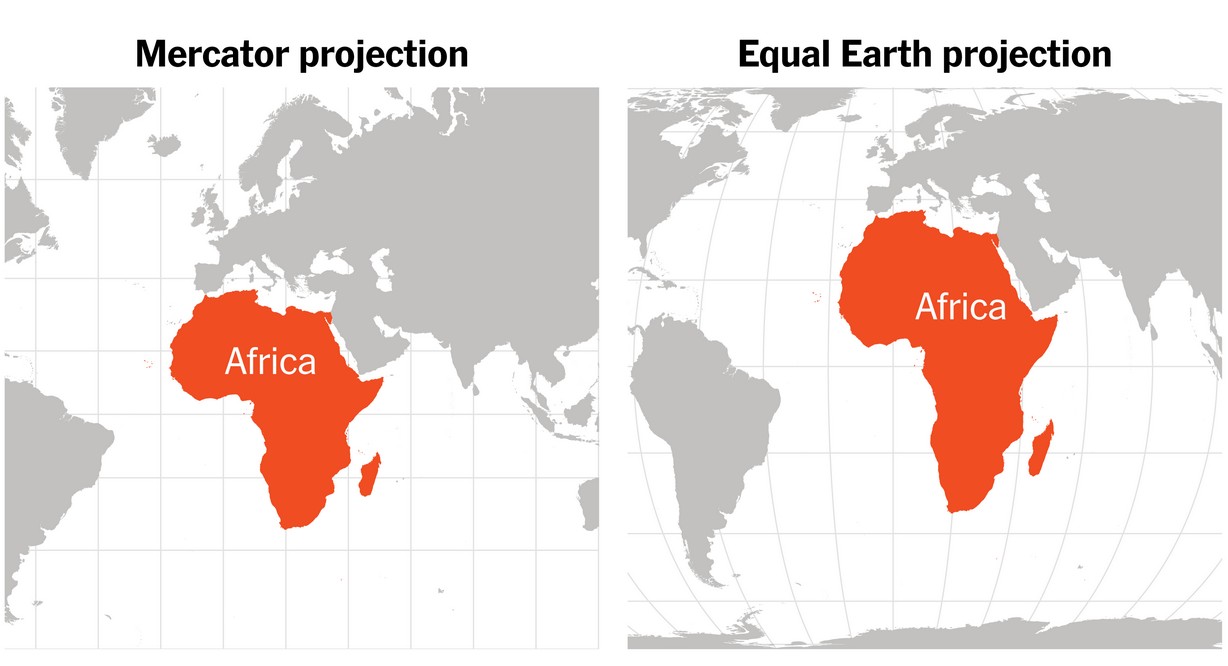
    The African Union (AU) has endorsed the Correct the Map campaign to replace the 16th-century Mercator projection with more accurate maps.

    African Union (AU) and the Mercator Map Debate

    About the African Union (AU):

    • Establishment: Formed in 2002, replacing the Organisation of African Unity (1963).
    • Membership: 55 African countries.
    • Headquarters: Addis Ababa, Ethiopia.
    • Vision: “An Integrated, Prosperous, and Peaceful Africa, driven by its own citizens.”
    • Agenda 2063: Blueprint for socio-economic growth and continental unity.
    • Main Organs: Assembly, Executive Council, AU Commission, Peace and Security Council.

    What is a Mercator Map?

    • Creation: Designed in 1569 by Gerardus Mercator.
    • Projection: Cylindrical map with straight longitude and latitude lines intersecting at 90°.
    • Purpose: Enabled sailors to plot straight-line courses for compass navigation.
    • Adoption: Became the standard map in schools, atlases, and wall charts by the 19th century.

    Issues with the Mercator Map:

    • Distortion: Enlarges high-latitude regions (Europe, Russia, North America) while shrinking Africa and South America.
    • Example: Greenland appears equal to Africa, though Africa is ~14 times larger.
    • Colonial Bias: Reinforced Western dominance narratives and downplayed Africa’s size and importance.
    • Impact: Supported marginalisation and exploitation during colonialism.
    • Alternatives: Gall-Peters (1970s) and Equal Earth (2018) projections show continents in correct proportion.
    • AU Stand: Advocates replacing Mercator maps to restore Africa’s rightful global image.
    [UPSC 2024] The longest border between any two countries in the world is between:

    Options: (a) Canada and the USA * (b) Chile and Argentina (c) China and India (d) Kazakhstan and Russian Federation


  • Disputes over Grand Ethiopian Renaissance Dam (GERD)

    Why in the News?

    The completion of Ethiopia’s Grand Ethiopian Renaissance Dam (GERD) has reignited tensions over Nile water rights, with Egypt and Sudan fearing reduced water flows.

    Disputes over Grand Ethiopian Renaissance Dam (GERD)

    About Grand Ethiopian Renaissance Dam (GERD):

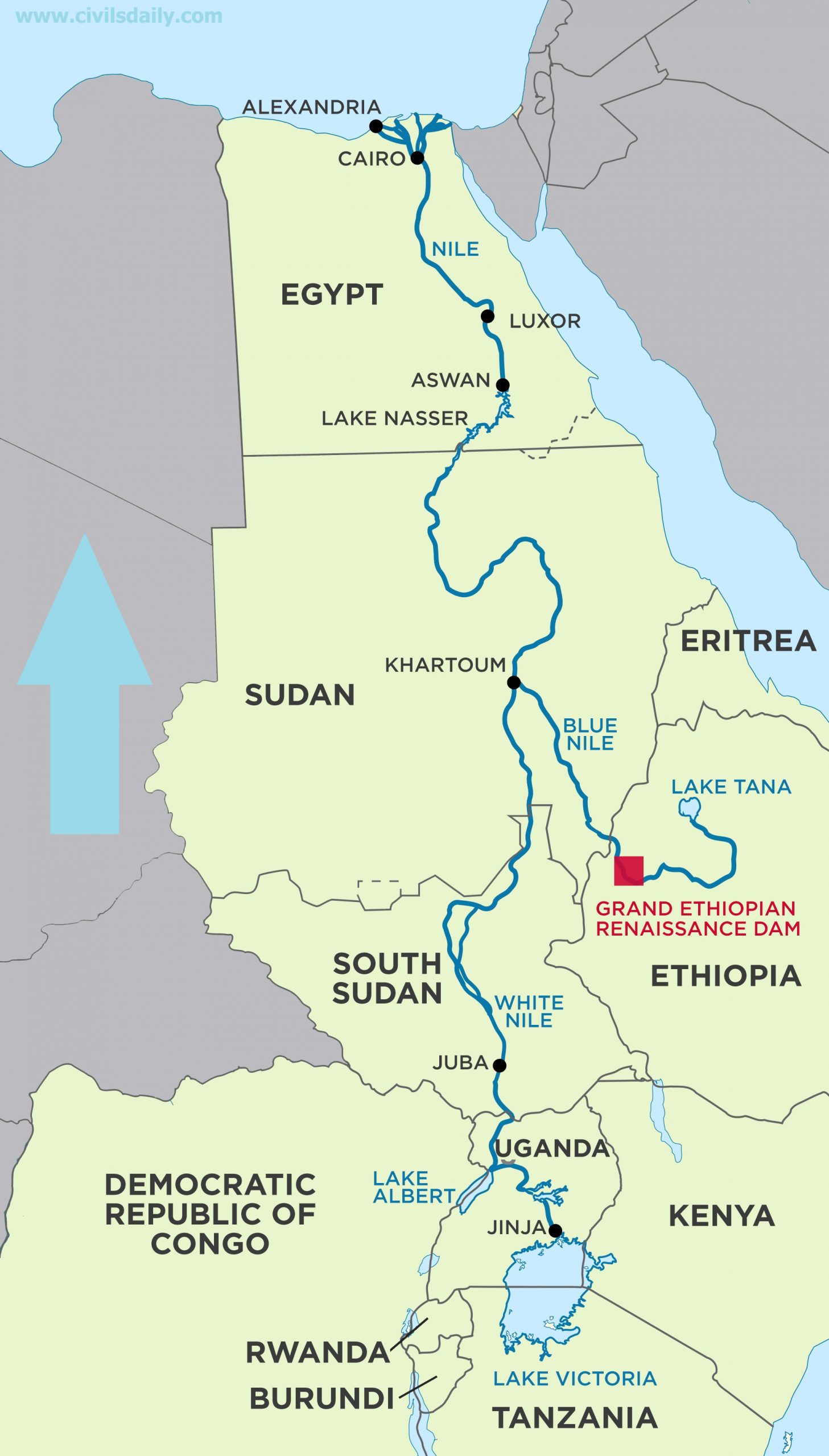
    • Overview: Gravity dam on the Blue Nile near Ethiopia–Sudan border.
    • Construction Timeline: Under construction since 2011, led by Ethiopian Electric Power Corporation.
    • Capacity: Set to become Africa’s largest hydropower plant with 6.45 GW output.
    • Reservoir Size: Holds 74 billion cubic metres; filling may take 5–15 years.
    • Key Features: 145 m tall dam, 16 turbines, and a supporting saddle dam.
    • Purpose: Aims to power Ethiopia (65% population lacks electricity) and export surplus to neighbouring countries.
    • Disputes Around GERD:
      • Egypt’s Concern: Fears reduced water flow; Relies 90% on Nile; demands a binding filling agreement.
      • Sudan’s Worry: Concerns over flood risks and water regulation.
      • Ethiopia’s Stand: Asserts sovereign rights; began filling without consensus.
      • Stalled Talks: Tripartite negotiations have failed; Egypt warns of possible conflict.

    Back2Basics: Nile River

    • Overview: North-flowing, longest river in Africa at ~6,650 km.
    • Drainage Basin: Covers 11 countries—Tanzania, Uganda, Rwanda, Burundi, DRC, Kenya, Ethiopia, Eritrea, South Sudan, Sudan, and Egypt.
    • Main Tributaries:
      • White Nile: Recognized as the headstream, its most remote source is the Kagera River in Burundi, flowing through Rwanda into Lake Victoria. It officially begins at Jinja, Uganda, where it exits Lake Victoria.
      • Blue Nile: Originates from Lake Tana in Ethiopia and merges with the White Nile at Khartoum, Sudan.  Supplies over 80% of total Nile flow by the time it reaches Egypt.
    • Lifeline Status: Vital for Egypt and Sudan’s drinking water, irrigation, and energy needs.


    [UPSC 2008] Ogaden region has been a source of conflict between which countries?

    Options: (a) Morocco and Algeria (b) Nigeria and Cameroon (c) Angola and Zambia (d) Ethiopia and Somalia*


  • Legal mandate for One Nation, One Time 

    Why in the News?

    The Government of India has mandated the use of Indian Standard Time (IST) across all legal, commercial, digital, and administrative sectors.

    About Indian Standard Time (IST):

    • It is the official time zone of India, set at Coordinated Universal Time (UTC) +5:30 and based on the 82.5° E longitude passing through Mirzapur, Uttar Pradesh.
      • Neighbouring countries such as Sri Lanka also use the same UTC+5:30 offset.
    • IST meridian passes through 5 Indian states: Uttar Pradesh, Madhya Pradesh, Chhattisgarh, Odisha, and Andhra Pradesh.
    • It was established in 1906, replacing older regional time zones like Bombay, Calcutta, and Madras Time.
    • It is maintained by the National Physical Laboratory (CSIR-NPL) using ultra-precise atomic clocks, which lose only one second in millions of years.
    • India does NOT observe daylight saving time; IST remains constant throughout the year.

    Back2Basics:

    Greenwich Mean Time (GMT):

    • GMT is the mean solar time at the Prime Meridian (0° longitude) located at the Royal Observatory in Greenwich, London.
    • It was established in 1884 during the International Meridian Conference as the world’s time standard.
    • It is based on astronomical observations, specifically the mean position of the Sun over time.
    • It does not change with the seasons and does not observe Daylight Saving Time (DST).
    • Although now largely replaced by UTC in scientific and civil contexts, GMT is still used in some regions (e.g., the UK during winter months).

    Coordinated Universal Time (UTC):

    • UTC is the primary time standard by which the world regulates clocks and time.
    • It was established in 1960 and is maintained by a network of high-precision atomic clocks worldwide.
    • UTC is adjusted periodically by leap seconds to compensate for the Earth’s irregular rotation speed.
    • It is used in aviation, computing, space science, and by international organisations like the UN and ITU.
    • Unlike GMT, which is purely solar-based, UTC combines atomic time (TAI) with occasional corrections for Earth’s rotation.

    IST in Context:

    • IST = GMT + 5:30
    • IST = UTC + 5:30


    Steps to Implement One Nation, One Time:

    [1] Time Dissemination Project:

    • It is a government initiative to ensure accurate, synchronised, and secure timekeeping across India.
    • It is led by the Department of Consumer Affairs, in collaboration with CSIR-NPL and ISRO.
    • Five Regional Reference Standard Laboratories (RRSLs) are being established in Ahmedabad, Bengaluru, Bhubaneswar, Faridabad, and Guwahati.
    • These labs use atomic clocks and protocols like Network Time Protocol (NTP) and Precision Time Protocol (PTP) to maintain accuracy within microseconds.

    [2] Legal Metrology (IST) Rules, 2025: Key Provisions

    • Mandatory Use of IST: IST, as maintained by CSIR-NPL, becomes the sole legally recognized time standard in India.
    • Prohibition of Foreign Time Sources: Use of foreign systems like GPS time will be banned unless specifically approved by the government.
    • Sync Requirements: All government bodies, financial institutions, power grids, and telecom operators must synchronize their systems with IST.
    • Audit and Compliance: The system will be monitored through periodic audits and penalties will be imposed for violations.
    • Special Exemptions: Activities such as scientific research, astronomy, and national security operations may use alternative time sources after government approval.


    [UPSC 2025] Consider the following countries:

    I. United Kingdom II. Denmark III. New Zealand IV. Australia V. Brazil How many of the above countries have more than four time zones?

    (a) All the five (b) Only four * (c) Only three (d) Only two


  • What if China stops Brahmaputra Water? 

    Why in the News?

    Assam CM Himanta Biswa Sarma dismissed Pakistan’s claim about China blocking the Brahmaputra’s water as a baseless panic tactic with no scientific substance.

    Sarma’s Clarification on the Brahmaputra Issue:

    • Brahmaputra is an Indian river and not fully controlled by China.
    • Only about 30–35% of the river’s flow comes from China, mainly through glacial melt and rainfall on the Tibetan Plateau.
    • A major 65–70% of the river’s volume is generated within India, especially from monsoon rains and Indian tributaries.
    • He explained that the river’s flow increases from 2,000–3,000 cubic metres/second at the Indo-China border to 15,000–20,000 m³/s in Assam during the monsoon.
    • This proves that India plays a dominant role in sustaining the river, not China.
    • Even if China tried to restrict the river’s flow, it could help reduce annual floods in Assam that displace thousands of people.
    • He confirmed that China has never threatened to weaponize the Brahmaputra.

    About Brahmaputra River System:

    • The Brahmaputra River System is one of the major Himalayan drainage systems, along with the Ganga and Indus.
    • Stretch: It stretches over 2,900 kilometres, making it one of the longest rivers in Asia.
    • Origin: It originates in the Chemayungdung glacier in southwestern Tibet, where it is known as the Tsangpo River.
    • Catchment countries:
      • The river flows through Tibet, India (Arunachal Pradesh and Assam), and Bangladesh.
      • In Tibet, the river flows slowly with a wide, navigable channel for about 640 km.
      • Upon entering India through Arunachal Pradesh, it becomes the Dihang, and later merges with Lohit and Dibang rivers to be called the Brahmaputra.
      • In Bangladesh, it is called the Jamuna, which merges with the Ganga (Padma) and Meghna before flowing into the Bay of Bengal.
    • The world’s largest and smallest river islands, Majuli and Umananda, are located on the Brahmaputra in Assam.
    • Important Tributaries:
      • Left-bank tributaries: Lhasa, Nyang, Parlung Zangbo, Lohit, Dhanashri, Kolong
      • Right-bank tributaries: Kameng, Manas, Beki, Raidak, Jaldhaka, Teesta, Subansiri
    • States the River Flows Through in India: Arunachal Pradesh, Assam, Meghalaya, Nagaland, West Bengal, and Sikkim.
    • Major Cities on the River: Dibrugarh, Pasighat, Neamati, Tezpur, and Guwahati.
    • Major Hydel Projects:
      • Arunachal Pradesh: Subansiri, Kameng, Ranganadi, etc.
      • Assam: Kopili
      • Sikkim: Teesta, Rangit
      • Meghalaya, Nagaland, Manipur, Mizoram: Multiple local hydropower stations
    [UPSC 2016] With reference to the Brahmaputra River, which of the following is/are tributary/ tributaries of Brahmaputra?

    1. Dibang

    2. Kameng

    3. Lohit

    Select the correct answer using the code given below.

    Options: (a) 1 only (b) 2 and 3 only (c) 1 and 3 only (d)1, 2 and 3*


  • Bow Echo Storms

    Why in the News?

    New Delhi recently faced a severe thunderstorm with winds up to 100 kmph, forming a bow echo — a crescent-shaped pattern seen on weather radar.

    About Bow Echo:

    • What is it: A bow echo is a storm pattern on radar that looks like a curved bow, similar to an archer’s bow.
    • Storm Type: It forms inside a mesoscale convective system (MCS) — a large group of organised thunderstorms.
    • Origin of Term: The term was first used by Ted Fujita, who also created the Fujita scale for tornadoes.
    • How It Forms:
      • Heavy rain causes cool air to sink and spread out near the ground.
      • This cool air forms a gust front, which pushes warm, moist air upward, creating new storms.
      • A rear inflow jet — strong mid-level winds — pushes the storm forward, bending it into a bow shape.
      • Bookend vortices may form at both ends of the bow, and the northern end can sometimes generate tornadoes.

    Size, Impact, and Dangers:

    • Size and Duration: Bow echoes usually span 20 to 200 km and last 3 to 6 hours.
    • Wind Strength: They often produce straight-line winds over 100 km/h, like those seen in Delhi’s recent storm.
    • Derechos: In severe cases, bow echoes can grow into derechos, which are long-lasting and widespread windstorms.
    • Impacts:
      • Damaging Winds: Knock down trees, power lines, and damage buildings.
      • Brief Tornadoes: May form at the storm’s edges, especially at the northern end.
      • Microbursts and Downbursts: Intense short-lived wind blasts within the storm that cause local destruction.
    [UPSC 2013] During a thunderstorm, the thunder in the skies is produced by the-

    1. Meeting of cumulonimbus clouds in the sky 2. Lightning that separates the nimbus clouds 3. Violent upward movement of air and water particles.

    Select the correct answer using the codes given below.

    Options: (a) 1 only (b) 2 and 3 (c) 1 and 3 (d) None of the above produces the thunder*