Why in the news?
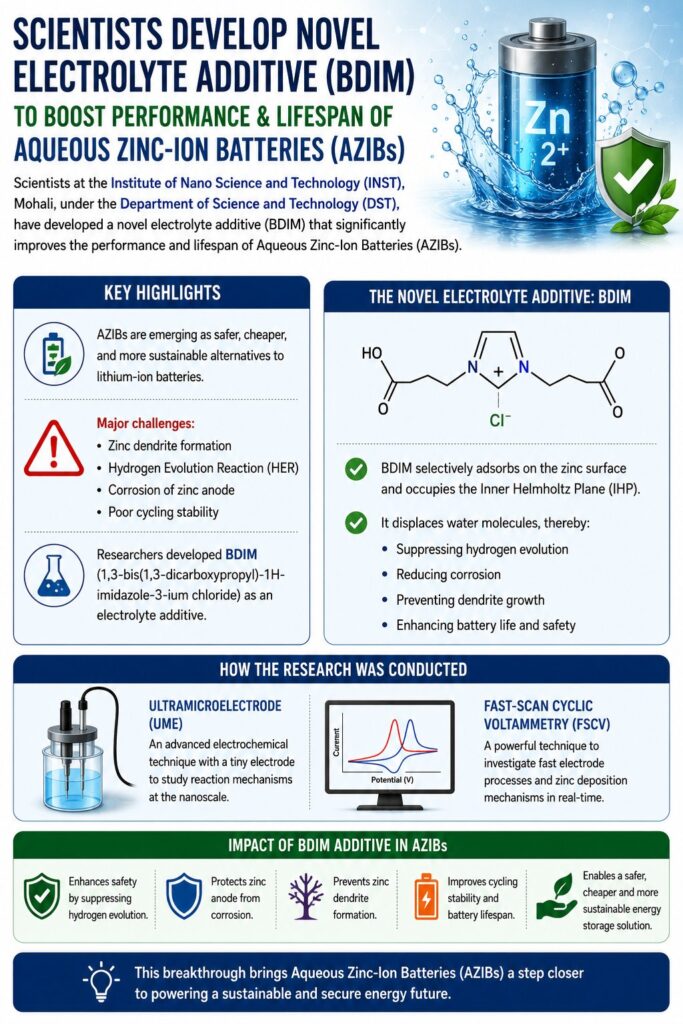
Scientists at the Institute of Nano Science and Technology (INST), Mohali, under the Department of Science and Technology (DST), have developed a novel electrolyte additive (BDIM) that significantly improves the performance and lifespan of Aqueous Zinc-Ion Batteries (AZIBs).
Key Highlights
- AZIBs are emerging as safer, cheaper, and more sustainable alternatives to lithium-ion batteries.
- Major challenges:
- Zinc dendrite formation
- Hydrogen Evolution Reaction (HER)
- Corrosion of zinc anode
- Poor cycling stability
- Researchers developed BDIM (1,3-bis(1,3-dicarboxypropyl)-1H-imidazole-3-ium chloride) as an electrolyte additive.
- BDIM selectively adsorbs on the zinc surface and occupies the Inner Helmholtz Plane (IHP).
- It displaces water molecules, thereby:
- Suppressing hydrogen evolution
- Reducing corrosion
- Preventing dendrite growth
- Enhancing battery life and safety
- Researchers used: Ultramicroelectrode (UME) and Fast-Scan Cyclic Voltammetry (FSCV)
to study zinc deposition mechanisms.
Significance
- Extends battery lifespan without costly material redesign.
- Improves safety and reliability of rechargeable batteries.
- Supports large-scale renewable energy and grid-storage applications.
- Can reduce maintenance costs of energy-storage infrastructure.
Prelims Facts
- AZIB Electrolyte: Water-based, making it non-flammable and safer than lithium-ion batteries.
- Inner Helmholtz Plane (IHP): Region near the electrode surface where electrochemical reactions occur.
- Hydrogen Evolution Reaction (HER): Undesirable side reaction that reduces battery efficiency.
