Why in the News
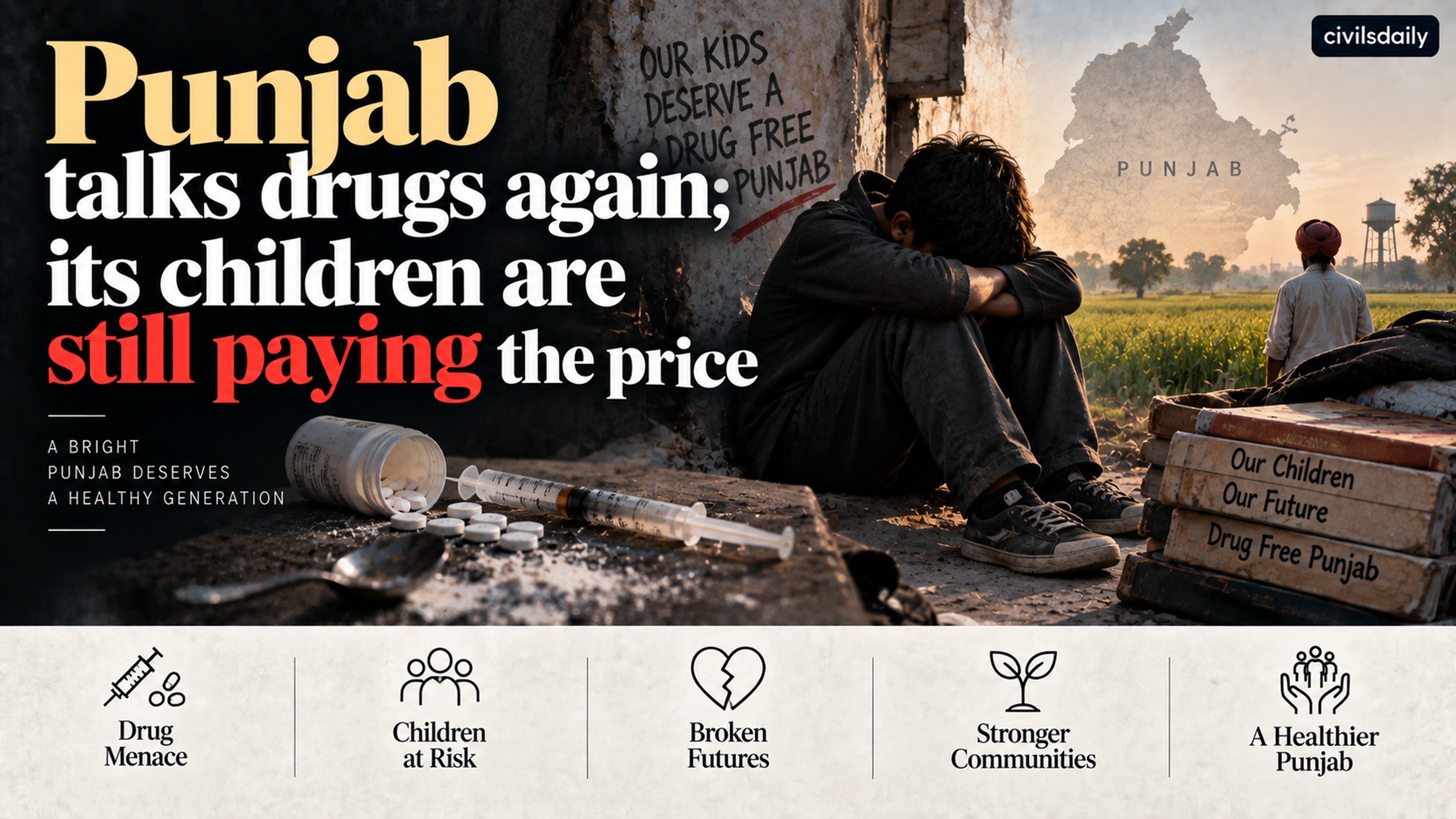
Punjab’s narcotics trade has changed its form without shrinking. A transit route for opium derivatives has hardened into an entrenched narcotics economy, and it now runs on cheaper pharmaceutical drugs, on drone deliveries across the international border and on supply reaching inmates inside prisons. The state police campaign Yudh Nasheyan Virudh, launched in March 2025, has produced large arrest and seizure numbers, and the Punjab Governor has said the trade cannot survive even 10 days without the support of the police and the administration. With Assembly elections approaching, every party has again made drug eradication a campaign promise, which is what the previous three campaigns were as well. The contest is between the scale of enforcement recorded on paper and the availability of the drug on the street.
How has the nature of Punjab’s narcotics trade changed?
- From transit route to economy: The origin of the crisis is traced to Punjab’s geography and its proximity to the Golden Crescent, the major opium producing region spanning Afghanistan, Iran and Pakistan. What began largely as a transit route evolved into a far more entrenched narcotics economy.
- Pharmaceutical substitution: Cheaper pharmaceutical drugs now flood local markets alongside narcotics.
- Misuse of prescription medicine: Chemists speak openly about the misuse of medicines meant for pain relief and neurological disorders. A pharmaceutical company based in Dehradun discontinued a pill, known locally as the “ghodeyanwala capsule”, after widespread allegations of its abuse.
- The vocabulary of the crisis: Words such as “chitta” (heroin), “goliyan” (pills) and “sooiyan” (injectables) have become part of everyday language in the state.
- A shift in public reaction: When the film Udta Punjab was released in 2016, many in the state objected that it tarnished Punjab’s image. That outrage has given way to grim acceptance.
What do the enforcement numbers under the current campaign show?
- Case volume: Between 1 March 2025 and 2 September 2026 the police registered 59,293 FIRs under the Narcotic Drugs and Psychotropic Substances Act, 1985 (NDPS Act).
- Arrests and seizures: 696 major traffickers were arrested, 3,757 kg of heroin and 62 lakh tablets were seized, and Rs 22 crore in drug money was recovered.
- Property action: Punjab also began attaching and demolishing properties allegedly built from drug proceeds, a method taken from Uttar Pradesh.
- Availability unchanged: Voices on the ground insist the supply has not dried up, and that chitta remains as easily available as salt.
What does complicity inside the enforcement machinery do to the campaign?
- The Governor’s assessment: The Punjab Governor, who has walked with Mothers Against Drugs, said the trade cannot survive even 10 days without the support of the police and the administration.
- An admission in court: In an affidavit before the Punjab and Haryana High Court, the police admitted that drugs are available inside prisons.
- What the prison figures show: Inmates registered for opioid treatment rose from 2,540 at the time of entry to 15,768.
- The court’s observation: The Chief Justice of the Punjab and Haryana High Court observed that addiction had multiplied four to five times after incarceration.
How have the supply routes outrun the counter measures?
- Drone deliveries: Drones now ferry drugs and weapons across Punjab’s nearly 500 km international border.
- Daylight runs: Counter drone systems are deployed, and this summer drones still made deliveries in daylight.
- A riverine route: During the 2023 floods the police cracked a case in which a trafficker from Jalandhar sent three swimmers across the Sutlej to retrieve 50 kg of heroin.
- What the run paid: The swimmers were reportedly paid between Rs 1 lakh and Rs 2.5 lakh for every kilogram ferried, and consignments grew larger during last year’s floods.
What is the human cost the enforcement figures do not capture?
- A death in Sangrur: A labourer from Sangrur consumed Celphos tablets after allegedly being threatened by the local sarpanch and others for questioning a sitting minister about rampant drug abuse in the area.
- Compensation still pending: His widow and his sons say they are yet to receive the compensation and the job they were promised.
- Earnings consumed by the drug: One of his sons said he spent every paisa he earned as a daily wage labourer on chitta.
- Children as collateral damage: In Badshahpur village in Kapurthala three children were left alone at home after their father came out on bail in a case under the NDPS Act, their mother went to prison and their elder sister was detained over a video of her allegedly selling drugs.
Why have successive campaigns and political promises left the trade intact?
- The 2014 campaign: The Shiromani Akali Dal and BJP government launched the state’s first anti drug campaign during its tenure in 2014.
- The 2017 pledge: The Congress leader who became Chief Minister in 2017 swore on a holy book to eradicate drugs within four weeks.
- The 2022 promise: The Aam Aadmi Party came to power in 2022 with the Chief Minister promising decisive results within a year.
- Drugs as a campaign asset: In 2017 the Aam Aadmi Party, then in Opposition, gained traction by making drug abuse one of its biggest campaign issues.
- The current round: The Shiromani Akali Dal (Waris Punjab De) made drugs the centrepiece of its speeches at the Rakhar Puniya rally, and the BJP’s Nasha Mukt Yatras begin in mid September and end in a rally to be addressed by the Union Home Minister.
- Treatment through faith: A jailed Member of Parliament built much of his early popularity on promises of rehabilitation centres in gurdwaras, and families have arrived at the gurdwara in his native village of Jallupur Khera with drug dependent relatives.
Challenges to Punjab’s anti narcotics effort
- Arrests that do not become convictions: Cases collapse at trial over procedural lapses in search, seizure and sampling, so enforcement volume does not produce deterrence. Eg. Section 50 of the NDPS Act requires a search to be offered before a gazetted officer or a magistrate, and failures there have repeatedly voided recoveries.
The Fix: Route every commercial quantity case through dedicated NDPS special courts with trained prosecutors and time bound forensic reporting. - Users charged in place of suppliers: Most registered cases are small quantity cases against consumers, which fills prisons without reaching the supply chain. Eg. Section 64A of the NDPS Act offers immunity from prosecution to an addict who volunteers for treatment, and it is rarely invoked.
The Fix: Divert small quantity cases into treatment under Section 64A and judge the campaign on trafficker convictions rather than on FIR counts. - Treatment capacity expanding faster than supervision: Opioid substitution treatment scales up without dispensing controls, so the substitute itself leaks into the market. Eg. Buprenorphine tablets dispensed at treatment centres are resold outside them.
The Fix: Move outpatient opioid substitution to daily supervised dosing with a digital dispensing record at every centre. - A state campaign against an interstate supply chain: Diverted pharmaceutical stock and precursor chemicals enter from manufacturing states that a state police campaign cannot reach. Eg. Tramadol and similar opioid formulations move in from units outside Punjab.
The Fix: Place licensed pharmaceutical distributors in the border districts on a common online sales trail audited against prescription records.
Conclusion
Punjab’s drug problem is not one of not knowing what to do. Successive campaigns have named the same targets, produced the same pledges and left the trade to change its form rather than its size. What has never been tested is action against the part of the machinery the Governor named, and that is the one variable the state fully controls. The measure to watch after the election is not the weight seized but the number of major traffickers convicted and the number of enforcement personnel prosecuted.
Drug trafficking in India
- Narco terrorism: The use of drug trafficking by terrorist organisations or insurgent groups to fund, sustain and expand their operations, so proceeds from the narcotics trade finance violence and subversion against the state.
- Financing of terror groups: Narcotics profits are a major source of funding for terrorist groups. Eg. Lashkar e Taiba, Babbar Khalsa International and Hizbul Mujahideen have used drug revenues to sustain operations.
- The eastern corridor: Porous borders with Myanmar carry both drug trafficking and insurgent financing. Eg. The Moreh corridor in Manipur.
- Maritime exposure: A long coastline with limited marine policing enables sea based narcotics trafficking into Indian ports.
Government Initiatives for drug trafficking control
- Narcotics Control Bureau: The central agency that coordinates drug law enforcement across state and central agencies and handles trafficking cases with an interstate or international reach.
- Four tier NCORD mechanism: The Narco Coordination Centre integrates effort from the national level down to the district level, bringing enforcement and intelligence agencies onto a single platform.
- Seizure Information Management System: A portal developed under the NDPS Act to coordinate seizure data across all drug law enforcement agencies.
- Anti Narcotics Task Forces: Dedicated State and Union Territory units led by senior police officers, set up to implement anti drug strategies and strengthen local enforcement.
- National Policy for Drug Demand Reduction: Run by the Ministry of Social Justice and Empowerment to reduce addiction among users rather than to police supply.
- Nasha Mukt Bharat Abhiyaan: A demand reduction campaign of the same Ministry, focused on the most affected districts and combining awareness, community outreach and linkage to treatment facilities.
Back2Basics: Narcotic Drugs and Psychotropic Substances Act, 1985
- India’s principal anti drug legislation, criminalising the production, manufacture, possession, sale, transport and trafficking of narcotic drugs and psychotropic substances.
- Penalties are graded by the quantity involved, with the harshest reserved for commercial quantity offences.
- Bail in a commercial quantity case is barred unless the court records satisfaction that the accused is not guilty and is unlikely to offend again.
- An addict charged with a small quantity offence may seek immunity from prosecution by volunteering for treatment.
Matching Previous Year Question
“[2018, GS3, 15 marks] India’s proximity to two of the world’s biggest illicit opium-growing states has enhanced her internal security concerns. Explain the linkages between drug trafficking and other illicit activities such as gunrunning, money laundering and human trafficking. What counter-measures should be taken to prevent the same?”
