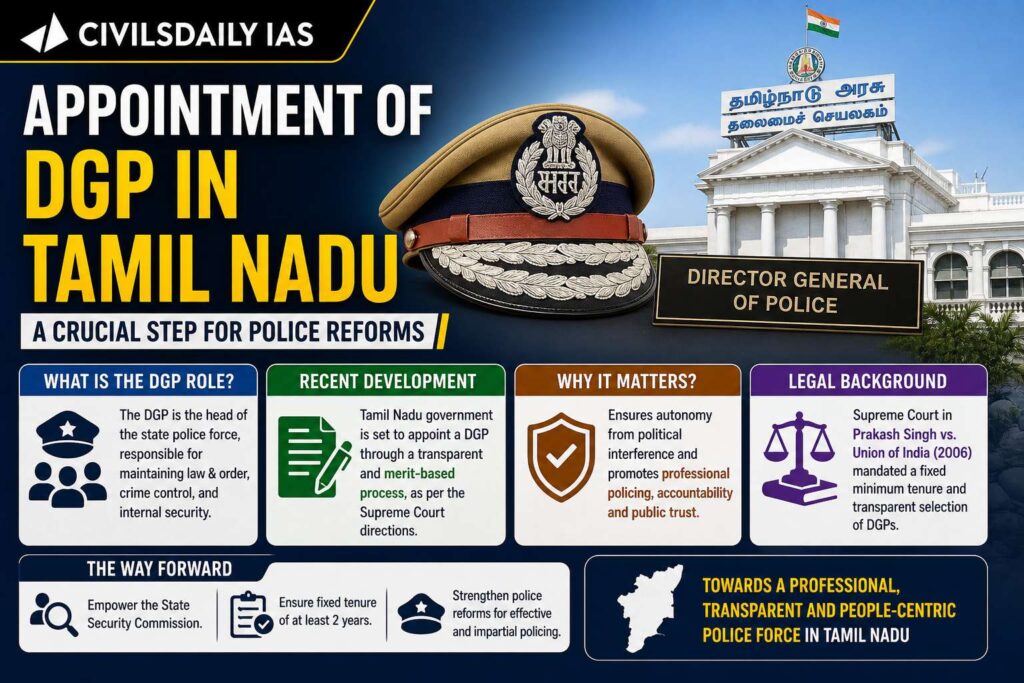
Why in the News
The Union Public Service Commission is set to convene a panel to shortlist candidates for the post of Director General of Police (DGP) in Tamil Nadu, following Supreme Court guidelines on police reforms.
What is DGP
- Director General of Police (DGP) is the highest ranking police officer in a State
- Heads the State Police Force
- Also referred to as Head of Police Force (HoPF)
Appointment Process
- UPSC forms a panel of three senior IPS officers
- Panel sent to State Government
- State selects one officer as DGP
Role of UPSC
- Ensures merit based and transparent selection
- Conducts Empanelment Committee Meeting (ECM)
Key Supreme Court Guidelines
(From Prakash Singh v Union of India, 2006)
- DGP should have a minimum tenure of 2 years
- Selection from panel prepared by UPSC
- Officers should have minimum residual service
- Appointment should not be made just before retirement
Important Terms
- Empanelment Committee Meeting (ECM): Meeting conducted by UPSC to shortlist eligible officers
- Residual Service: Remaining service period before retirement
Key Issues Highlighted
- Delays in appointment process
- Debate over extension beyond retirement
- Ensuring independence and stability of police leadership
Significance
- Strengthens police reforms and accountability
- Ensures professional and merit based appointments
- Reduces political interference in policing
| [2019] With reference to the Chief Secretary of a state, consider the following statements: 1. Chief Secretary is appointed by the Governor of the state for a fixed tenure of two years. 2. The Central government has the power to approve extension of service of Chief Secretary for a period not exceeding six months. Which of the statements given above is/are correct? [A] 1 only [B] 2 only [C] Both 1 and 2 [D] Neither 1 nor 2 |
