Why in the News
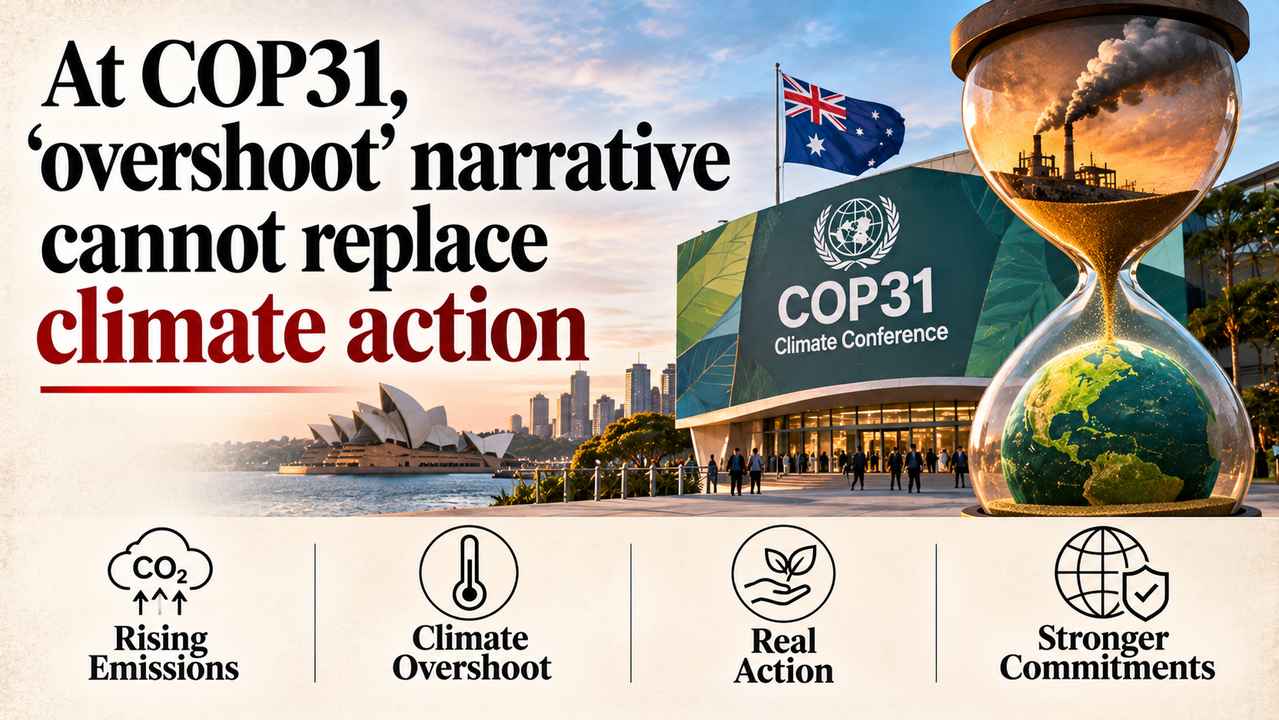
“Overshoot” has become the buzzword of COP31 to the United Nations Framework Convention on Climate Change (UNFCCC), which opened in Antalya, Türkiye, as “net-zero” was at COP26 in Glasgow. It arrives as the world prepares to officially accept warming above 1.5 degrees Celsius, and it lets developed countries sidestep their obligations.
What is “overshoot”, and why has it replaced the real debate?
- What it is: A 1.5 degrees Celsius overshoot means crossing that warming level soon and returning below it by the century’s end. It is like overspending a budget now and promising to repay later.
- Origin: The term came from climate modelling. Countries now use it in talks to keep 1.5 degrees alive on paper.
- The real task: Countries should keep warming as little over 1.5 and as far below 2 degrees as possible. This needs scientific assessment of trade-offs.
- The takeaway: Overshoot moves attention from cutting emissions now to removing carbon later, which delays real action.
How are developed countries still expanding fossil fuels?
- Fossil dependence: Fossil fuels still supply most primary energy in the US and the European Union (EU).
- US offshore drilling: Having exited the Paris Agreement twice, the US has proposed opening nearly 1.3 billion acres of its waters to offshore drilling.
- Norway and the UK: Norway has offered 70 new oil and gas blocks, including in the Arctic. The UK has approved the Jackdaw gas field.
- Wadden Sea drilling: Germany and the Netherlands have cleared gas drilling near the Wadden Sea, a UNESCO World Heritage site.
- COP31 presidency: Australia, which presides over COP31, has approved 37 fossil fuel projects since 2022.
How is climate finance falling short?
- Inflated reporting: Developed countries reported about $137 billion of climate finance for 2024, but its true value is an estimated quarter to a third.
- Loans over grants: About 65% of public climate finance came as loans, adding to developing countries’ debt.
- Withdrawn pledges: The US rescinded $4 billion in pledges to the Green Climate Fund, and the UK almost halved its contribution.
- Adaptation gap: Adaptation finance fell to $26 billion in 2023, a small fraction of the yearly need.
- Trade penalties: The EU’s Carbon Border Adjustment Mechanism (CBAM), a charge on the carbon content of imports, targets iron, steel, cement and aluminium, sectors central to Global South industry.
Why does overshoot shift the burden onto the Global South?
- Scale of removal: The United Nations Environment Programme (UNEP) report *Limiting Overshoot* finds that reversing 0.1 degree of warming needs permanent removal of 220 billion tonnes of carbon dioxide (CO2).
- Removal capacity: The world removes about 2.2 billion tonnes of CO2 a year, almost entirely through forests and soils. Direct air capture, machines that pull CO2 from the air, removes barely 2 million tonnes.
- Land claims: National pledges rely on nearly 1.2 billion hectares of land for CO2 removal, mostly in the Global South. UNEP does not say who pays, or on whose land.
- Outsourced mitigation: Switzerland plans to meet up to one-third of its 2030 target by buying carbon credits from projects abroad, such as cookstoves in rural Ghana.
Challenges
- Carbon budget ignored: No COP decision has referred to the remaining carbon budget, the CO2 the world can still emit within a warming limit, or to who spent most of it.
- Costly, uncertain removal: Direct air capture could cost up to $600 a tonne, and removing a tonne may not undo the warming it caused.
- Technology barriers: Intellectual property barriers keep clean technology at a premium, so it is not transferred cheaply.
Way Forward
- Deep domestic cuts: Developed countries should reach net-zero well before 2050 and net-negative emissions within their borders.
- Grant-based finance: Provide predictable, grant-based public finance, not loans or private investment.
- Article 9.1 guidance: The Climate Finance Work Programme agreed at Belém should guide COP31 on Article 9.1 of the Paris Agreement, the duty of developed countries to finance developing ones.
Conclusion
Overshoot keeps the 1.5 degree goal alive on paper and moves the cost of correction onto future removals and the Global South’s land. The test for COP31 is whether its decisions account for past emissions and delivered finance.
Key numbers
- True value of 2024 climate finance: $33 to 45 billion.
- Adaptation finance need: at least $310 to 365 billion a year by 2035.
- Fossil fuel share of primary energy, 2025: 83% (US), 73% (EU).
- Swiss emissions, 2024: only 22% below 1990 levels, against a 50% cut targeted by 2030.
Matching Previous Year Question
“[2025] Consider the following statements: Statement I: Article 6 of the Paris Agreement on climate change is frequently discussed in global discussions on sustainable development and climate change. Statement II: Article 6 of the Paris Agreement on climate change sets out the principles of carbon markets. Statement III: Article 6 of the Paris Agreement on climate change intends to promote inter-country non-market strategies to reach their climate targets. Which one of the following is correct in respect of the above statements? (a) Both Statement II and Statement III are correct and both of them explain Statement I (b) Both Statement II and Statement III are correct but only one of them explains Statement I (c) Only one of the Statements II and III is correct and that explains Statement I (d) Neither Statement II nor Statement III is correct ANSWER: (a)”
