Why in the News
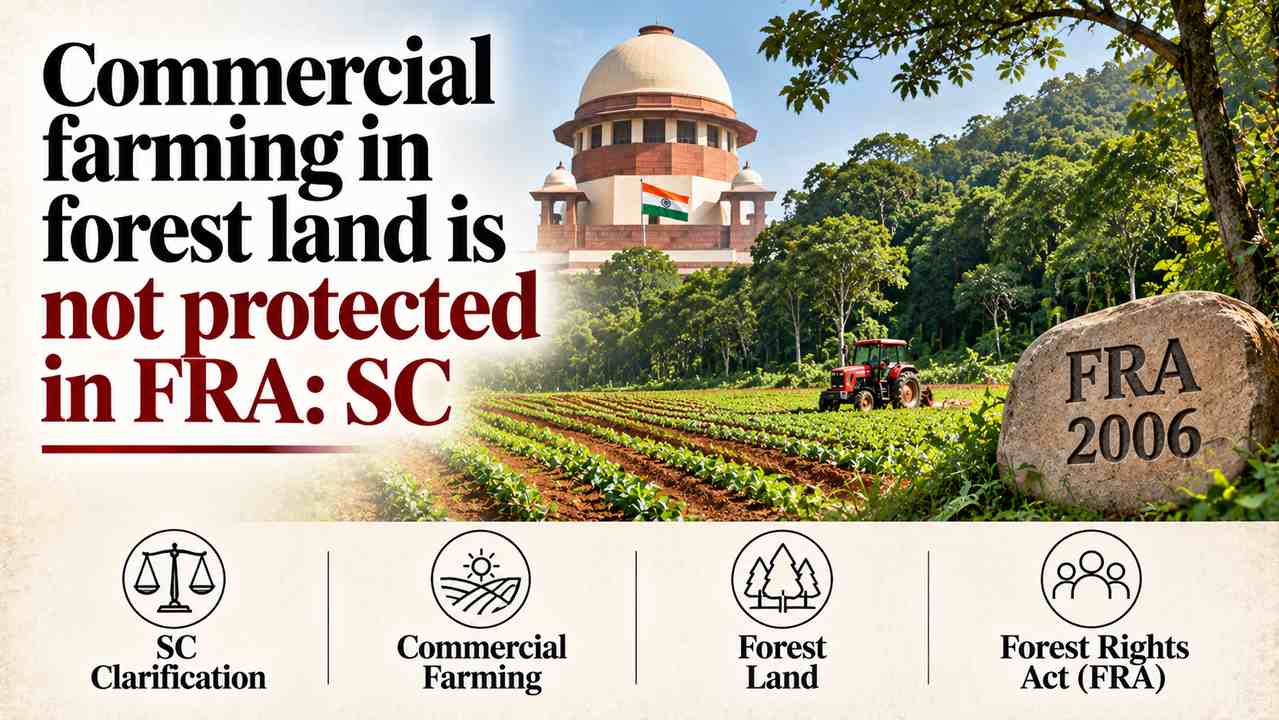
Tamil Nadu’s claim of historical silk cotton cultivation inside reserve forests has met the Supreme Court‘s prima facie view, a first view before a final ruling, that commercial crop cultivation is not a right under the Scheduled Tribes and Other Traditional Forest Dwellers (Recognition of Forest Rights) Act, 2006 (FRA). A two-judge Bench recorded this in an order on extensive silk cotton plantations in the reserve forests of the Agasthyamalai Biosphere Reserve.
Whom does the FRA protect, and what forest right does it give?
- What the FRA protects: The FRA protects the rights of forest-dwelling Scheduled Tribes and Other Traditional Forest Dwellers who have lived in forests for generations and depend on them for their livelihood.
- Minor forest produce right: Section 3(1)(c) recognises the right to collect, use and dispose of minor forest produce, the non-timber produce of plant origin that occurs naturally in forests.
What has the Court now held on commercial cultivation in forests?
- Commercial cultivators excluded: The Court distinguished these communities from commercial cultivators and plantation owners, whose activity the Act does not protect.
- No right to plant: Since the Act recognises no right to cultivate a commercial crop, such cultivation cannot justify occupying or staying on forest land.
- State-sponsored crop: The government’s own affidavits show “promotion and sponsored cultivation of silk cotton as a commercial crop”. The Bench held such planned or promoted cultivation inside forests “completely impermissible“.
- Against the idea of forest produce: The Court noted that planting a commercial crop on purpose is “totally contrary” to the concept of minor forest produce, which grows naturally in the forest.
Why does the Agasthyamalai order matter, and what happens next?
- Scale of cultivation: Silk cotton covers about 3,638 of the 5,073 hectares of forest land in question.
- Change in forest character: The judge who wrote the order warned that if commercial crops are allowed in forest areas, “the very nature of the forest is bound to change”.
- The takeaway: The FRA protects people who live off the forest, not businesses that turn forest land into plantations.
- Reference to the CEC: The Court directed the Central Empowered Committee (CEC), a standing body that examines forest violations and reports to the Court, to examine Tamil Nadu’s view that silk cotton is minor forest produce.
Conclusion
The Court’s prima facie view is that the FRA protects forest dependence, not plantation farming promoted by the State. The CEC’s finding on whether silk cotton counts as minor forest produce is the next step that will decide the plantations’ future.
Back2Basics: Agasthyamalai Biosphere Reserve
- Location: It lies at the southern end of the Western Ghats, straddling the Tamil Nadu and Kerala border, and is named after the Agasthyamalai peak.
- Designation: It was designated a biosphere reserve in 2001 and added to the UNESCO World Network of Biosphere Reserves in 2016.
- Protected areas: It includes the Kalakad-Mundanthurai Tiger Reserve and the Neyyar, Peppara and Shendurney Wildlife Sanctuaries.
- People and species: The Kani tribal community lives in the landscape, which also shelters the endemic lion-tailed macaque and the Nilgiri tahr.
Matching Previous Year Question
“[2019] Consider the following statements: 1. As per recent amendment to the Indian Forest Act, 1927, forest dwellers have the right to fell the bamboos grown on forest areas. 2. As per the Scheduled Tribes and Other Traditional Forest Dwellers (Recognition of Forest Rights) Act, 2006, bamboo is a minor forest produce. 3. The Scheduled Tribes and Other Traditional Forest Dwellers (Recognition of Forest Rights) Act, 2006 allows ownership of minor forest produce to forest dwellers. Which of the statements given above is / are correct? (a) 1 and 2 only (b) 2 and 3 only (c) 3 only (d) 1, 2 and 3 ANSWER: (b)”
