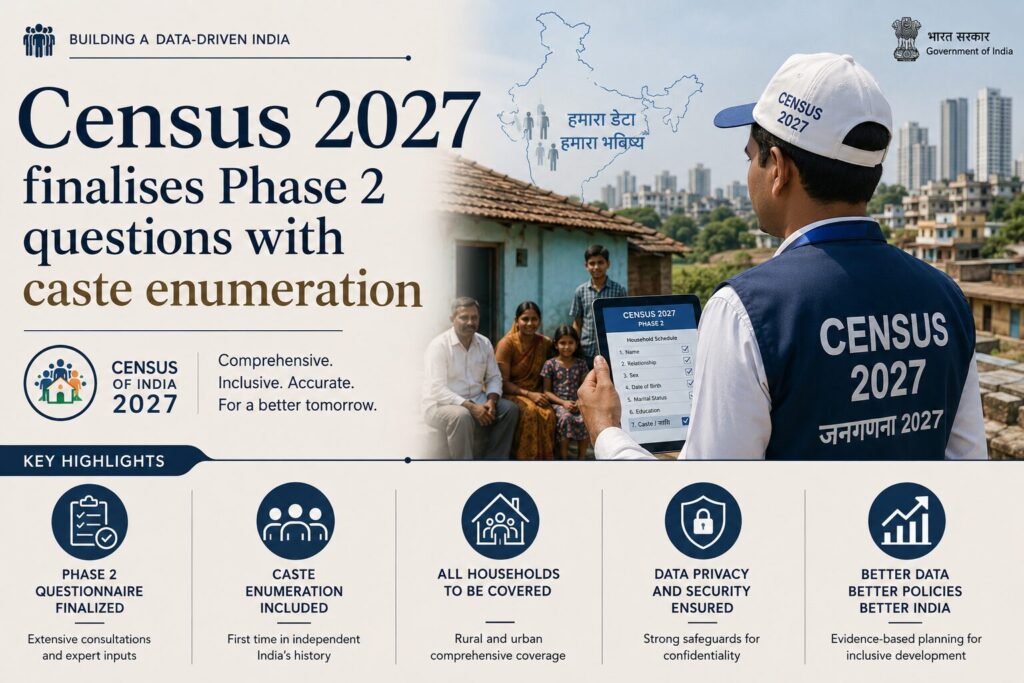
Why in the News
Around 28 questions have been finalised for the Population Enumeration phase of Census 2027, which will record caste for all residents for the first time in decades. The enumeration begins on 17 August in Ladakh and snow bound areas ahead of the rest of the country.
What is the Census in India?
- Constitutional and legal basis: The Census is conducted under the Census Act, 1948 by the Registrar General and Census Commissioner of India, and Census is a Union subject in the Seventh Schedule.
- Decadal count: It is a decennial enumeration of the entire population covering demographic, social and economic characteristics.
What are the two phases of Census 2027?
- Houselisting phase: The first phase records houses, household amenities and assets.
- Population Enumeration: The second phase counts every individual and records personal and household particulars, and is where caste will be captured.
What is new in Census 2027?
- Caste for all: For the first time in decades, the caste of every resident is to be recorded, not only Scheduled Castes and Scheduled Tribes.
- Questionnaire: The final questionnaire is likely to carry 28 questions for the Population Enumeration phase.
- Phased timing: Snow bound areas of Ladakh, Jammu and Kashmir, Himachal Pradesh and Uttarakhand are counted from 17 August, and the rest of the country in February 2027.
Why does caste enumeration matter?
- Evidence for policy: Caste data informs reservation, welfare targeting and assessment of backwardness beyond SC and ST groups.
- Filling a data gap: The last full caste count outside SC and ST dates to 1931, leaving current policy reliant on dated estimates.
Challenges to caste enumeration in the Census
- Classification complexity: Caste names run into thousands with regional and spelling variations, complicating standardised recording.
- Self identification: Responses depend on self reporting, which can be inconsistent or strategically stated.
- Enumerator training: Accurate capture of caste needs trained enumerators and a controlled code list.
- Political sensitivity: Publication of caste numbers can intensify demands for revised reservation shares.
- Data privacy: Handling granular caste data raises confidentiality and misuse concerns.
Census Act, 1948
- Central legislation empowering the government to conduct the decennial Census.
- Administered by the Registrar General and Census Commissioner of India under the Ministry of Home Affairs.
- Makes public cooperation compulsory and guarantees confidentiality of individual records.
- Census information is not admissible as evidence in court, protecting respondent data.
[2009] Consider the following statements:
1. Between Census 1951 and Census 2001, the density of the population of India has increased more than three times.
2. Between Census 1951 and Census 2001, the annual growth rate (exponential) of the population of India has doubled.
(a) 1 only
(b) 2 only
(c) Both 1 and 2
(d) Neither 1 nor 2
