Why in the News
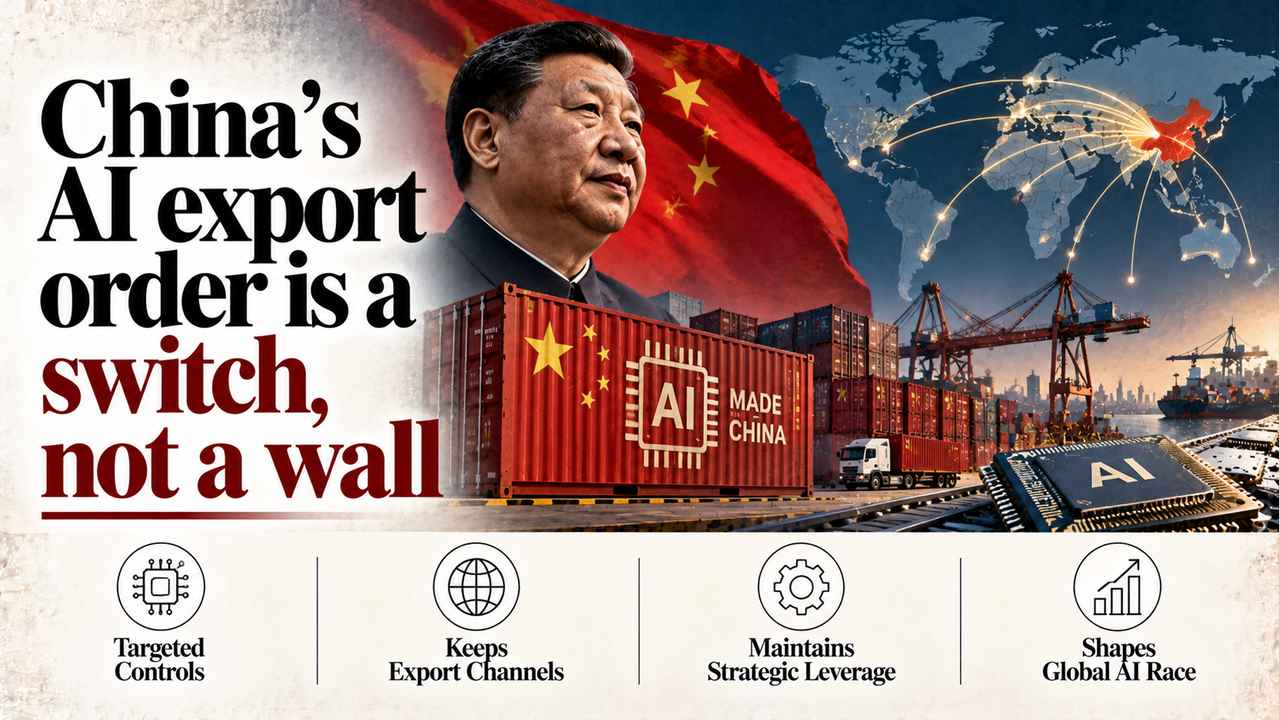
China has moved from treating its foundation models as freely transferable abroad to a licensing gate that can monitor, slow or stop their flow. Its Ministry of Commerce (MOFCOM) has issued a draft list adding 23 artificial intelligence (AI) items to its export controls, alongside a registration rule. Little changes today, but the design serves control more than safety.
What has China’s export order changed?
- What it is: An export control means a technology needs government permission to leave the country. It works like a customs permit for know-how.
- Draft catalogue: A draft revision of the Catalogue of Technologies Prohibited or Restricted from Export lists the AI items among 40 technologies, including biotech and solar. Restricted items will need an export licence; prohibited ones cannot leave.
- Model weights: Model weights are the learned values that make a trained AI model work. Whoever holds them can run, modify and copy the model.
- Advance registration: A temporary rule, already in force, requires prior disclosure of any transfer of weights, code, architecture or hardware optimisations.
- The takeaway: Both measures cover technology transfers, not AI services, so Beijing now decides who may own a Chinese model, not who may use one.
Which AI models fall inside the net?
- Compute threshold: A model’s core technologies are restricted if its training used 10^26 floating-point operations (FLOPs), a measure of total computing work.
- Size and ranking: A model with 2 trillion parameters, the internal settings it learns, or a top-10 global ranking on a qualifying measure is also restricted.
- Data-based controls: Models trained on “important data” under China’s Data Security Law, 2021 are restricted. Those trained on “core data” are prohibited.
- Automatic licensing: Widely adopted open-weight models, whose weights anyone can download, get “automatic licensing”. A licence is still required, but approval is meant to be quick.
Why is the order a tool of control rather than safety?
- Wide, discretionary net: MOFCOM cites safety and risk, but the criteria target capabilities, not the riskiest systems. They would catch almost any Chinese frontier model.
- Services left open: Foreign users keep application programming interface (API) access, calling the model online. That keeps them dependent on a Chinese provider. A weights transfer would instead hand over control.
- Change-of-control clause: The order covers shifts in foreign ownership or control even if no code crosses a border. Eg. Chinese regulators blocked Meta’s purchase of Manus, an agentic AI startup building systems that complete tasks on their own.
- Economic targeting: The other controls cover economically valuable technologies, not just high-risk ones.
What does the order mean for India?
- No immediate effect: Developers fine-tuning Qwen or DeepSeek are unaffected, as released weights are already public.
- Future leverage: New releases crossing the thresholds will need a licence Beijing can withhold.
- Chinese and American controls: China now gates open releases, and the United States (US) has shown it can abruptly cut off closed frontier models.
Challenges
- Dependence on foreign models: Indian builders lean on Chinese open and US closed models, so either country can disrupt their products.
- Vendor lock-in: Products tied to one model or agentic framework are costly to switch when access is cut.
- Compute shortage: Adapting large models needs scarce graphics processors and data centre capacity.
Way Forward
- Open ecosystem consortium: Companies and governments from India, Europe and the Gulf should jointly add contenders to the open model ecosystem.
- Diverse jurisdictions and vendors: Source models from several countries and vendors, so no single licence can halt a product.
- Lock-in-free stacks: Indian builders should design technology stacks that can swap models or agentic frameworks easily.
- Diffusion capacity: Invest in the talent and compute to fine-tune, distil and adapt whichever open model is best and available.
Conclusion
China’s order gives Beijing a switch over who may own its advanced models. Whether India builds the talent, compute and partners to adapt open models from many sources will decide if that switch ever binds its builders.
Government Initiatives for Artificial Intelligence in India
- IndiaAI Mission: Approved in 2024 with Rs 10,371 crore, it is run under the Ministry of Electronics and Information Technology (MeitY) across seven pillars.
- IndiaAI Compute: A national grid of over 38,000 graphics processing units (GPUs) offers eligible users up to 40% cheaper compute.
- Indigenous foundation models: The mission backs Indian models from firms such as Sarvam AI and Gnani AI, alongside the government-funded BharatGen multimodal model.
- AIKosh: A national AI repository holding over 3,000 datasets and 243 models.
Matching Previous Year Question
“[2026, GS3, 15 marks] What is agentic Artificial Intelligence (AI)? Explain its working. Describe its applications with suitable examples. Discuss the advantages, risks and challenges associated with agentic AI systems.”
