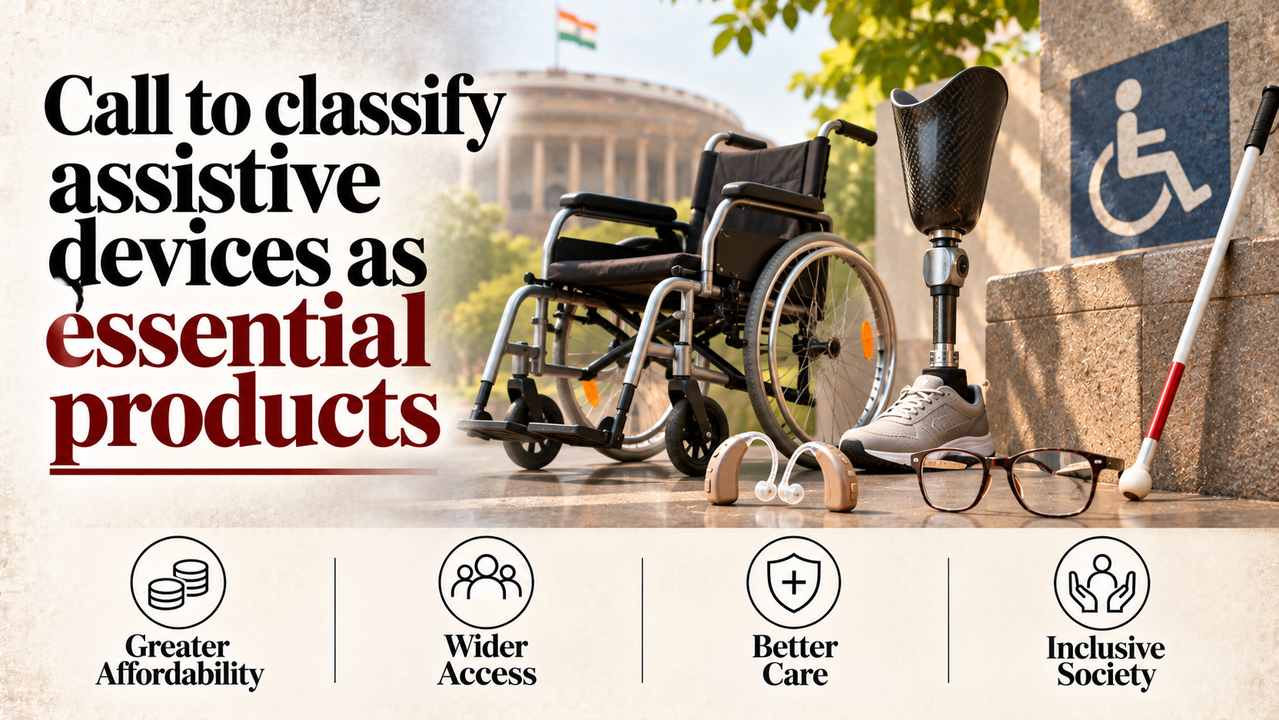
Why in the News
Draft disability rules would place augmentative and alternative communication (AAC) devices and prostheses in a “specialised” category of assistive products rather than the “essential” one, a label that could weaken their insurance and public funding. Doctors with Disabilities: Agents of Change (DwDAoC) has asked the Centre to classify both as essential under the draft Rights of Persons with Disabilities (Amendment) Rules, 2026.
What are assistive products, and why does their category matter?
- What it is: An assistive product helps a person do what an impairment makes hard, such as speaking, walking or hearing. Spectacles are the everyday example.
- AAC devices: They help people who cannot rely on speech to communicate. They include picture-based communication boards, speech-generating devices and apps that turn text or symbols into speech.
- Prostheses: A prosthesis is an artificial body part, such as an artificial limb, fitted to replace a missing one.
- What the label decides: The group warns that the “specialised” label could create uncertainty over:
- access to insurance coverage;
- public financing;
- replacement and maintenance of devices.
- The takeaway: A category in a rulebook decides whether a voice or a limb is paid for, so the label matters as much as the device.
What do the draft rules propose, and why now?
- Framework for assistive products: The draft rules, issued under the Rights of Persons with Disabilities (RPwD) Act, 2016, propose standards and accessibility requirements for assistive products and technology.
- Supreme Court directive: The notification follows a Supreme Court call for clear, “non-negotiable” accessibility requirements under Section 40 of the Act, which empowers the Centre to frame accessibility rules.
- Consultation stage: The draft invites objections and suggestions before it is finalised.
Why does the group want these devices classed as essential?
- Who is asking: DwDAoC is an organisation of health professionals who themselves have disabilities. It wrote to the Department of Empowerment of Persons with Disabilities, the Health Ministry and the Indian Council of Medical Research (ICMR).
- Need, not process: The group argues that a product needing specialist assessment, customisation, fitting or rehabilitation is still essential. That extra step should not push it into the specialised category.
- Rights recognition: The UN Convention on the Rights of Persons with Disabilities (UNCRPD) and the RPwD Act both recognise augmentative and alternative modes of communication.
- WHO list: The World Health Organization (WHO) Priority Assistive Products List includes communication aids and artificial limbs.
- ICMR list: ICMR’s National List of Essential Assistive Products counts prostheses among its prioritised products.
Challenges
- High device costs: Assistive devices are expensive and few insurance products cover them, which pushes families into “disability poverty”.
- Replacement cycles: Prostheses wear out and children outgrow them, so a one-time grant does not meet lifetime need.
- Scarce fitting services: Custom devices need trained prosthetists and therapists, who are concentrated in cities and large hospitals.
- Slow implementation: Many States have not notified rules for District Disability Committees, which delays grievance redressal under the Act.
Way Forward
- Function-based classification: The Centre should classify products by the function they restore, so communication and mobility aids count as essential.
- Aligned national lists: Match the final rules with the WHO and ICMR priority lists the group cites.
- Insurance and replacement cover: Link essential products to the Assistance to Disabled Persons for Purchase/Fitting of Aids and Appliances (ADIP) scheme, with periodic replacement.
- District fitting centres: Expand assessment and fitting services at district hospitals.
Conclusion
The amendment rules are at the draft stage, open for objections, and no date for their finalisation has been stated. Whether the final text lists AAC devices and prostheses as essential will decide if mandatory accessibility covers the ability to speak and to move.
Back2Basics: Rights of Persons with Disabilities Act, 2016
- Purpose: It replaced the Persons with Disabilities Act, 1995, and gives effect to India’s obligations under the UNCRPD.
- Specified disabilities: It raised recognised categories from 7 to 21, including acid attack victims and Parkinson’s disease.
- Benchmark disability: A person with at least 40% of a specified disability qualifies for benefits such as reservation.
- Reservation: It mandates 4% reservation in government jobs and 5% in higher education for persons with benchmark disabilities.
Matching Previous Year Question
“[2026] Which of the following statements with regard to the persons with disabilities in India is/are correct? 1. The Rights of Persons with Disabilities Act, an Act passed by the Parliament of India in 2018, mandates reservation in education and employment, places a legal duty on Governments to ensure accessibility and non-discrimination. 2. The Sugamya Bharat Abhiyan focuses on achieving universal accessibility for Persons with Disabilities across three key domains — built infrastructure, transport systems and information and communication technology. 3. The National Divyangjan Finance and Development Corporation (NDFDC) is a public sector organisation set up by the Ministry of Corporate Affairs as a not-for-profit company to promote entrepreneurship among Persons with Disabilities (PwDs). Select the answer using the code given below: (a) 1 and 2 (b) 2 only (c) 1 and 3 (d) 1 only ANSWER: B”
