Why in the News
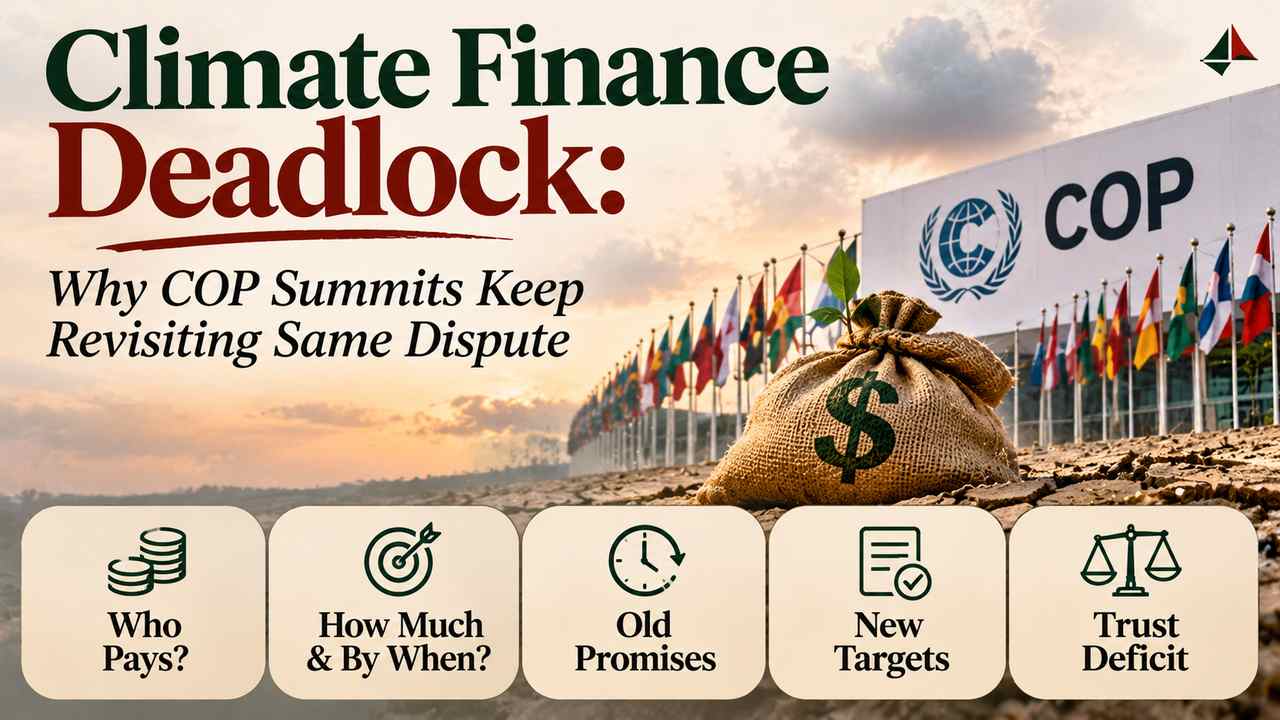
Developed countries report climate finance above the $100 billion a year they once pledged, but developing countries say far less reaches them as money they can use. The dispute has returned at the annual United Nations climate summit, the 31st Conference of the Parties (COP31), in Antalya, Türkiye. The stake is whether new finance is additional, affordable and accessible.
Why do developed countries owe climate finance?
- What it is: Climate finance is money that helps developing countries cut emissions (mitigation) and cope with climate impacts (adaptation). It works like a shared repair fund, where those who caused more damage pay more.
- Origin of the duty: Under the United Nations Framework Convention on Climate Change (UNFCCC), developed countries accepted an obligation to finance developing countries, given their greater historical responsibility and capacity.
- Paris Agreement: The 2015 treaty reaffirmed that wealthy countries should lead in providing climate finance, with public money and grants for the most vulnerable.
- The takeaway: The quarrel is less about how much is pledged and more about whether the money is a real transfer of resources.
How far does finance fall short of need?
- Adaptation need: Developing countries will need about $305 billion a year by 2035 for adaptation, estimates the United Nations Environment Programme (UNEP) in its Adaptation Gap Report.
- Adaptation supply: In 2024, developed countries provided only about a tenth of that need as public money for adaptation.
- Tripling still short: Even a tripling of this finance, as agreed at the previous summit in Brazil, would cover only 20% to 29% of the need.
- Copenhagen pledge: Wealthy nations pledged $100 billion a year at the 2009 Copenhagen summit, but first met it only two years after the deadline.
- Baku goal: At the Baku summit in Azerbaijan, developed countries agreed to lead in providing at least $300 billion a year by 2035. This New Collective Quantified Goal left the grant and loan split open.
Why do the two sides count the same money differently?
- OECD count: The Organisation for Economic Co-operation and Development (OECD), a club of rich countries, puts 2024 climate finance at $136.7 billion. It includes export credits and private investment, and counts loans at full value, ignoring that they must be repaid.
- Oxfam’s count: Oxfam, an international non-profit, puts the 2024 total at only $32.7 billion to $44.7 billion, because it counts loans at less than full value and excludes some sources.
- No common method: The UN climate finance committee says there is no common accounting method for the $100 billion goal.
- Loans dominate: Loans made up 67% of public climate finance and grants only 29%.
Why does the form of finance matter?
- Grant versus loan: A grant need not be repaid. A low interest loan is cheaper than commercial borrowing but is still debt.
- Limits of private capital: Investors back projects that earn money, such as solar and wind power. Coastal protection, urban drainage and early warning systems rarely earn a return, so public grants remain essential.
- India’s position: India sought at least $1 trillion a year from developed countries, mainly as grants and low cost loans, so that support is affordable, predictable and accessible.
Challenges
- Debt as support: With loans dominating public climate finance, poorer countries take on more debt to deal with climate impacts.
- Access barriers: Complex applications, limited technical capacity and lengthy approvals keep countries from using funds that are nominally available.
- Open grant share: The Baku goal fixes no share for grants, so the same dispute returns at every summit.
Way Forward
- Common accounting method: UNFCCC Parties should agree on one method that counts only the grant value of loans, not their full value.
- Grant share in the goal: Developed countries should state what share of the Baku goal will come as grants.
- Simpler access: Climate funds should simplify applications and fund project preparation in low capacity countries.
Conclusion
Climate finance has crossed its old headline target, yet developing countries still question how much of it is additional, affordable and accessible. Until the grant share and the accounting method are settled, the dispute will return at every summit.
Key numbers
- Public adaptation finance, 2024: $28.2 billion to $31.7 billion from developed countries (UNEP Adaptation Gap Report 2026).
- Public climate finance by instrument, 2024: Loans $68.5 billion; grants $29.7 billion.
- Wider Baku ambition: $1.3 trillion a year from all public and private sources.
- Key years: Copenhagen goal deadline 2020, first met in 2022; Baku goal agreed in 2024.
Matching Previous Year Question
“[2010] The United Nations Framework Convention on Climate Change (UNFCCC) is and international treaty drawn at (a) United Conference on the Human Environment, Stockholm, 1972 (b) UN Conference on Environment and Development, Rio De Janerio, 1992 (c) World Summit on Sustainable Development, Johannesburg, 2002 (d) UN Climate Change Conference, Copenhagen, 2009 ANSWER: (b)”
