Why in the News?
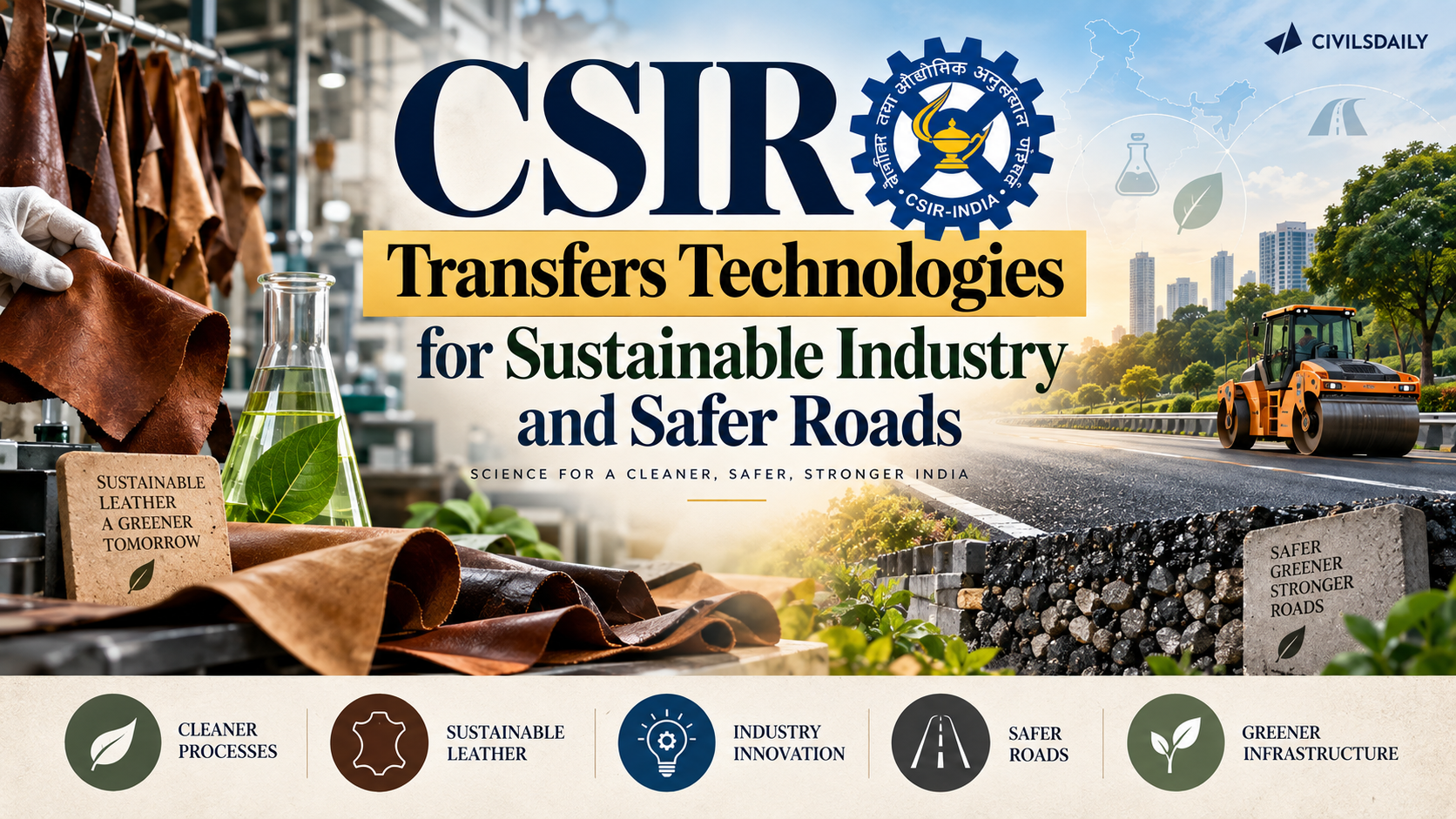
CSIR transferred indigenous technologies developed by CSIR-CLRI and CSIR-CRRI to industry, focusing on waste valorisation, circular economy, road safety and sustainable infrastructure.
Key Technologies
1. Protein-based Syntans from Chrome Shavings
- Developed by CSIR-CLRI, Chennai.
- Converts collagen-rich chrome shavings from leather waste into protein-based syntans.
- Syntans can be reused in leather retanning.
- Demonstrated at 100-200 kg pilot scale and validated at 1,500 kg commercial scale.
- Can reduce Total Dissolved Solids (TDS) in post-tanning wastewater by up to 50%.
2. Spent Pickling Acid Valorisation
- Recovers iron and chloride from spent pickling acid.
- Produces pigment-grade iron oxide and ammonium chloride.
- Converts hazardous industrial waste into useful products.
- Supports circular economy and waste utilisation.
3. ClariVisor
- Developed by CSIR-CRRI, New Delhi.
- In-vehicle glare mitigation device for four-wheelers.
- Designed to fit within the footprint of the vehicle’s original OEM sun visor.
4. Two Pack Onsite Pothole Filling Mix
- Cold-application road repair technology.
- Two components are mixed on-site before application.
- Does not require a hot-mix plant or heating.
- Reduces energy consumption and emissions.
- Enables faster pothole repair and reopening of roads.
Important Full Forms
- CSIR: Council of Scientific and Industrial Research
- CLRI: Central Leather Research Institute
- CRRI: Central Road Research Institute
- DSIR: Department of Scientific and Industrial Research
- TDS: Total Dissolved Solids
- OEM: Original Equipment Manufacturer
- SDGs: Sustainable Development Goals
Prelims Quick Revision
- CSIR-CLRI: Chennai, leather research.
- CSIR-CRRI: New Delhi, road research.
- Chrome shavings: Used to recover collagen-based material for syntans.
- Spent pickling acid: Can yield iron oxide and ammonium chloride.
- Two Pack Pothole Mix: Cold application, no heating required.
- ClariVisor: Glare mitigation for four-wheelers.