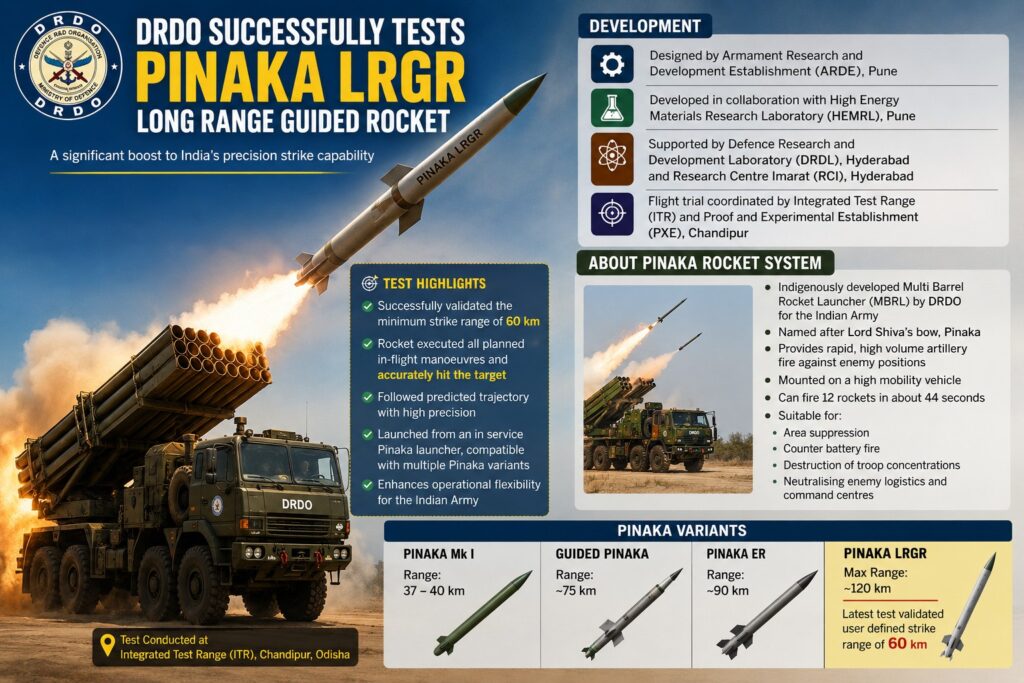
Why in News?
The Defence Research and Development Organisation (DRDO) successfully conducted a flight test of the Pinaka Long Range Guided Rocket (LRGR) from the Integrated Test Range (ITR), Chandipur, Odisha. The test validated its user defined minimum strike range of 60 km and demonstrated high precision strike capability.
Key Highlights
- Successfully validated the minimum strike range of 60 km.
- The rocket executed all planned in flight manoeuvres and accurately hit the designated target.
- It followed the predicted trajectory with high precision.
- Launched from an in service Pinaka launcher, demonstrating compatibility with multiple Pinaka rocket variants.
- This enhances operational flexibility for the Indian Army.
Development
- Designed by the Armament Research and Development Establishment (ARDE), Pune.
- Developed in collaboration with the High Energy Materials Research Laboratory (HEMRL), Pune.
- Supported by the Defence Research and Development Laboratory (DRDL), Hyderabad and Research Centre Imarat (RCI), Hyderabad.
- Flight trial coordinated by the Integrated Test Range (ITR) and Proof and Experimental Establishment (PXE), Chandipur.
About Pinaka Rocket System
- Pinaka is an indigenously developed Multi Barrel Rocket Launcher (MBRL).
- Developed by DRDO for the Indian Army.
- Named after Lord Shiva’s bow, Pinaka.
- Provides rapid, high volume artillery fire against enemy positions.
- Mounted on a high mobility vehicle.
- Can fire 12 rockets in about 44 seconds.
- Suitable for: Area suppression, Counter battery fire, Destruction of troop concentrations, and Neutralising enemy logistics and command centres
Pinaka Variants
- Pinaka Mk I: Range of about 37 to 40 km.
- Guided Pinaka: Precision guided rocket with a range of about 75 km.
- Pinaka Enhanced Range (ER): Range of about 90 km.
- Pinaka Long Range Guided Rocket (LRGR): Maximum range of about 120 km, while the latest test validated a user defined strike range of 60 km.
[2023] Consider the following statements
1. Ballistic missiles are jet-propelled at subsonic speeds throughout their fights, while cruise missiles are rocket-powered only in the initial phase of fight.
2. Agni-V is a medium-range supersonic cruise missile, while BrahMos is a solid-fuelled intercontinental ballistic missile.
Which of the statements given above is/are correct?
[A] 1 only
[B] 2 only
[C] Both 1 and 2
[D] Neither 1 nor 2
