Why in the News
India has achieved nearly 20% ethanol blending (E20) in petrol by 2025, making it one of the world’s largest biofuel programmes. As the blending target is achieved, attention is shifting from quantity to the programme’s water use, life cycle emissions and energy efficiency.
What is the E20 Ethanol Blending Programme?
- Definition: E20 is petrol blended with 20% ethanol.
- Progress: Ethanol blending increased from about 1.5% in 2013-14 to nearly 20% in 2025, with annual consumption of around 700 crore litres.
- Benefits: Reduces crude oil imports, boosts farmers’ income and strengthens energy security. Ethanol is often described as a low-carbon fuel because sugarcane absorbs atmospheric carbon dioxide during growth.
What is Energy Return on Energy Invested (EROEI)?
- Definition: EROEI measures the usable energy obtained from a fuel relative to the energy spent producing it.
- Sugarcane Ethanol: EROEI of about 2 to 4 due to efficient bagasse based distilleries.
- Grain Ethanol: EROEI ranges from 1.2 to 2 because of higher fossil fuel inputs.
- Significance: Higher EROEI indicates a more energy efficient fuel.
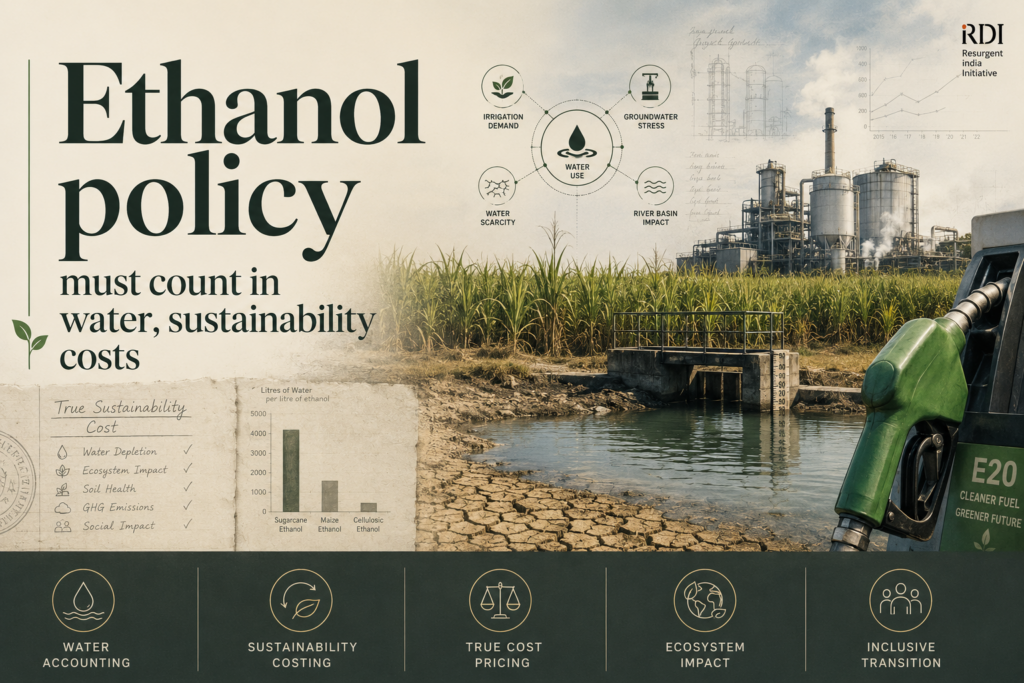
Why is water the biggest concern?
- High Water Demand: Estimates by the Commission for Agricultural Costs and Prices and NITI Aayog suggest that sugarcane requires 1,500 to 2,500 mm of water during cultivation.
- Large Water Footprint: Producing one litre of sugarcane ethanol may consume 2,000 to 3,500 litres of water.
- Groundwater Stress: Major sugarcane growing states already face groundwater depletion.
- Resource Trade-off: Excessive ethanol production may replace oil dependence with freshwater dependence.
- Distorting Subsidies: Subsidised electricity and fertilisers encourage over extraction of groundwater and excessive fertiliser use. Subsidised urea promotes overuse of nitrogen fertilisers.
What are the other challenges?
- Lower Energy Density: Ethanol contains about 21 MJ/litre, compared to 32 MJ/litre for petrol, reducing fuel efficiency by about 6 to 7% under E20 blends. However, ethanol has a much higher octane rating, allowing engines specifically calibrated for higher ethanol blends to achieve more efficient combustion and partially offset this disadvantage. The overall outcome depends on engine design rather than fuel properties alone.
- Life Cycle Emissions: Sugarcane ethanol can reduce emissions by 50 to 70%, while grain ethanol offers 20 to 50% reduction, depending on production methods.
- Vehicle Compatibility: E20 can corrode certain engine components in older vehicles. Vehicles manufactured from April 2023 onwards are required to be E20 compatible.
Conclusion
India’s ethanol programme represents an important step towards greater energy security, but its long-term success will depend on aligning environmental objectives with sound economics. A resilient biofuel strategy must be guided by transparent life-cycle carbon accounting, rigorous assessment of water use, technology-neutral incentives and market signals that reflect the true value of natural resources.
PYQ Relevance
[2020] According to India’s National Policy on Biofuels, which of the following can be used as raw materials for the production of biofuels?
1. Cassava
2. Damaged wheat grains
3. Groundnut seeds
4. Horse gram
5. Rotten potatoes
6. Sugar beet
Select the correct answer using the code given below:
(a) 1, 2, 5 and 6 only (b) 1, 3, 4 and 6 only (c) 2, 3, 4 and 5 only (d) 1, 2, 3, 4, 5 and 6