Why in the News
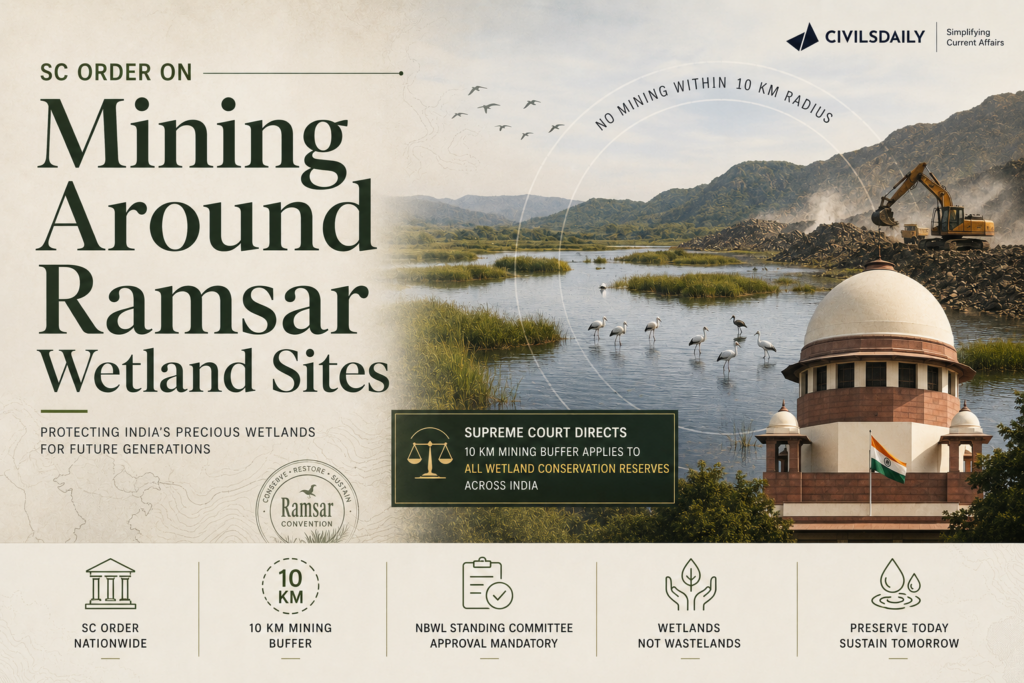
The Supreme Court has clarified that its earlier direction restricting mining within a 10 km radius of the Asan Wetland Conservation Reserve now applies to all Wetland Conservation Reserves across India. Mining in such areas will require prior approval from the competent authority.
What did the Supreme Court clarify?
- Nationwide Application: The 10 km mining safeguard around the Asan Wetland Conservation Reserve will now apply to all Wetland Conservation Reserves.
- Uniform Principle: The Court held that the protection should apply uniformly across the country.
- Case Background: The clarification came while hearing an application filed by the Himachal Pradesh Government.
- State’s Argument: Himachal Pradesh contended that Wetland Conservation Reserves do not have a statutory buffer zone unlike national parks.
- Further Direction: The Court asked the National Board for Wildlife (NBWL) or the Ministry of Environment, Forest and Climate Change (MoEFCC) to examine whether the Asan Wetland extends into Himachal Pradesh.
What is the Asan Wetland Conservation Reserve?
- Location: Situated at the confluence of the Asan and Yamuna rivers in Uttarakhand.
- Ramsar Status: Declared a Ramsar Site in 2020.
- Ecological Importance: Supports migratory waterbirds and rich aquatic biodiversity.
- Judicial Protection: Mining within a 10 km radius requires prior clearance from the NBWL or MoEFCC.
What are Ramsar Sites?
- Definition: Wetlands designated under the Ramsar Convention on Wetlands (1971) for their international ecological importance.
- India’s Membership: India became a party to the Convention in 1982.
- Current Status: India has 101 Ramsar Sites, the highest in Asia.
- Significance: Ramsar designation commits countries to maintain the ecological character of wetlands but does not itself create a separate statutory protection regime.
What is the legal position on mining near wetlands?
- No Statutory Buffer: The Ramsar Convention and the Wetlands (Conservation and Management) Rules, 2017 do not prescribe a fixed buffer zone around wetlands.
- 2010 Rules: Earlier rules listed prohibited activities and required prior approval for activities within the wetland’s zone of influence.
- 2017 Rules: Replaced the earlier framework with a decentralised system led by State Wetland Authorities.
- Judicial Safeguard: The Supreme Court’s ruling fills this regulatory gap by requiring prior clearance for mining near Wetland Conservation Reserves.
[2022] Consider the following pairs: Wetland/Lake — Location
1. Hokera Wetland — Punjab
2. Renuka Wetland — Himachal Pradesh
3. Rudrasagar Lake — Tripura
4. Sasthamkotta Lake — Tamil Nadu
How many pairs given above are correctly matched?
(a) Only one pair
(b) Only two pairs
(c) Only three pairs
(d) All four pairs