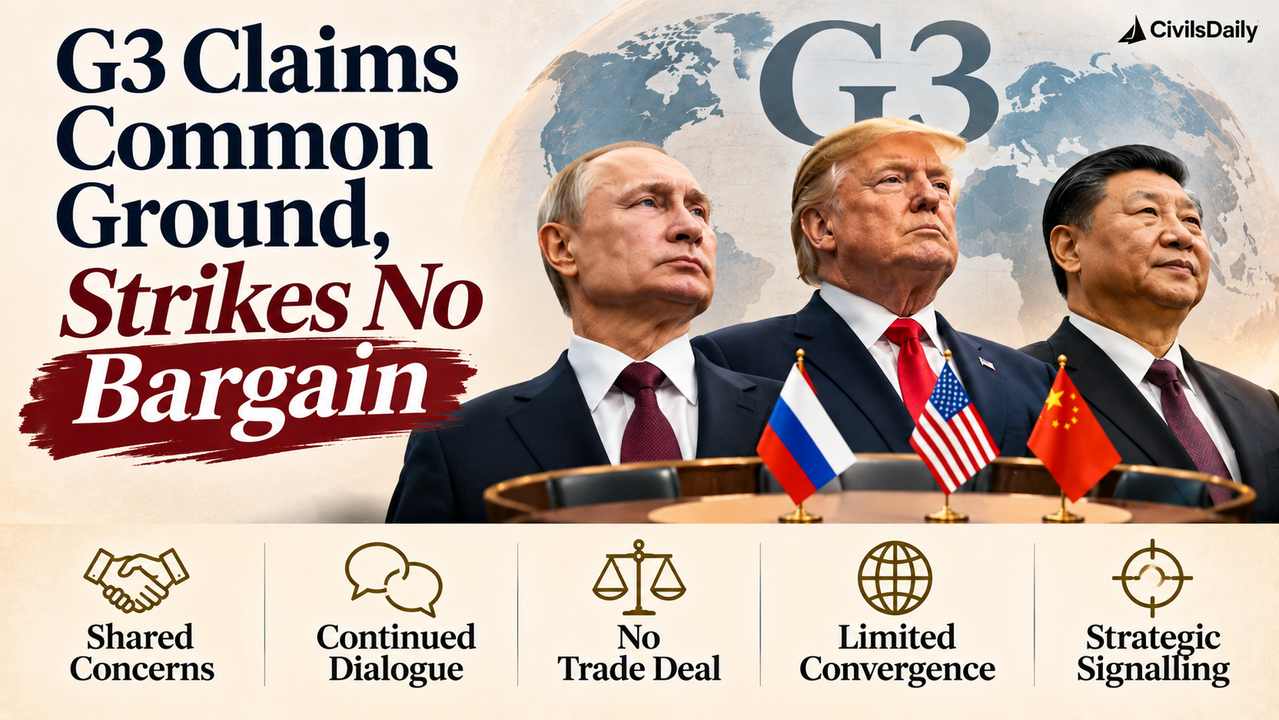
Why in the News
Great-power summitry has moved from the Yalta Conference of 1945, where three powers shaped a post-war order, to a US, China and Russia trio seeking only common ground amid intensifying rivalries. The three Presidents met in Shenzhen and issued a joint statement on four issues, stopping short of a grand bargain. The question for India is whether this “Shenzhen troika” turns into great-power hegemony.
Why is the Shenzhen meeting no Yalta?
- What Yalta was: At the Yalta Conference, American, British and Soviet leaders met to shape the post-World War II order. A period of cooperation among the Allied Powers followed.
- What Shenzhen was: The US, Chinese and Russian Presidents met amid sharpening rivalry. Their statement “committed themselves to maintaining strategic stability and international security”, echoing the Chinese President’s language.
- Common ground, not a bargain: The wording shows the aim was to find shared positions, not to settle all disputes in one package deal.
- Memory of the war: The Chinese President called it the “backbone of the world’s anti-fascist struggle”, a message to Japan. The Russian President called the three “victorious countries”, a message to Europe.
- The takeaway: The three powers still frame their relationship through the Second World War, yet they met to manage rivalry rather than to build an order.
What did the joint statement agree on?
- UN reform: The leaders backed “promoting UN reform so that it may respond more effectively to global challenges”. The UN, as set up in 1945, no longer reflects today’s balance of power. The statement does not say what reform means.
- Refined fuel supply: The three plan to increase the production and supply of refined petroleum products. This is likely a signal to Ukraine, which has been attacking Russian oil refineries.
- International Criminal Court (ICC): The statement says the ICC and “similar bodies must not abuse their jurisdiction”. This serves the Russian President, who faces an ICC arrest warrant over alleged war crimes.
- Outside the court: None of the three powers is a member of the Rome Statute, the ICC’s founding treaty, so none accepts its jurisdiction.
- Nuclear dialogue: The leaders agreed to “engage in dialogue on reducing nuclear risks and preventing nuclear proliferation”. This is not a commitment to cut their own arsenals:
- the US President said “once you have the nuclear weapons it’s very hard to not have them”;
- the non-proliferation reference was aimed at Iran.
What does the troika mean for India?
- Energy exposure: India is one of the world’s largest refining hubs and has flagged the impact of disrupted global energy supplies, so a change in refined fuel supply affects it directly.
- Risk of hegemony: The danger for India and other states is that three powers decide questions that affect everyone, turning the troika into great-power hegemony.
- Strength within: India should focus on what it controls: partnerships with like-minded countries and stronger domestic industrial and technological capabilities.
Challenges
- Weakened accountability: Pressure on the ICC from three major non-members reduces the chance that leaders accused of war crimes face trial.
- No disarmament track: Risk talks without arsenal cuts leave the Treaty on the Non-Proliferation of Nuclear Weapons (NPT) bargain, disarmament in return for non-proliferation, unbalanced.
- Fuel as leverage: Linking refined fuel output to the Ukraine war makes importers’ energy security depend on great-power bargaining.
- Excluded voices: Middle powers have no seat when three powers set the terms on questions such as UN reform.
Way Forward
- Concrete UN reform: India should press, with the G4 of India, Brazil, Germany and Japan, for expanded permanent membership of the UN Security Council.
- Diversify fuel sources: India should spread crude and refined product imports across suppliers so no single bloc controls its supply.
- Shape the nuclear agenda: India should back risk reduction talks that include nuclear-armed states outside the three powers.
Conclusion
The Shenzhen statement manages rivalry among three powers but sets no rule that other states can rely on. Whether its call for UN reform takes a concrete form, or remains a slogan that suits the three, is what India should watch.
Back2Basics: International Criminal Court
- What it is: A permanent international tribunal that prosecutes individuals, unlike the International Court of Justice, which settles disputes between states.
- Founding: It began functioning when the Rome Statute entered into force in 2002, and it sits at The Hague, Netherlands.
- Crimes covered: Genocide, crimes against humanity, war crimes and the crime of aggression.
- India’s position: India is not a party to the Rome Statute.
Matching Previous Year Question
“[2015] Consider the following countries : (1) China (2) France (3) India (4) Israel (5) Pakistan Which among the above are Nuclear Weapons States as recognized by the Treaty on the Non Proliferaion of Nuclear weapons, commonly known as Nuclear Non-Proliferation Treaty (NPT)? (a) 1 and 2 only (b) 1, 3, 4 and 5 only (c) 2, 4 and 5 only (d) 1, 2, 3, 4 and 5 ANSWER: (a)”
