Why in the News
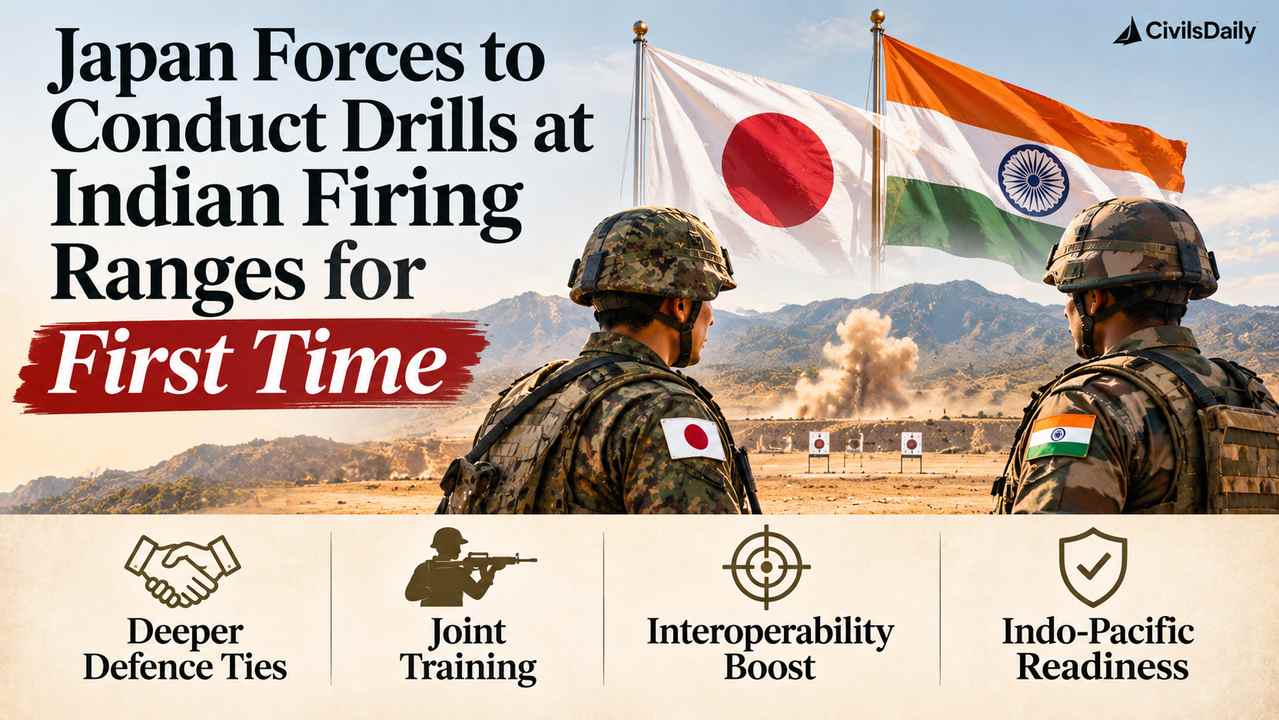
For the first time, Japan’s Self-Defence Forces, its military, will conduct live-fire training, including with surface-to-ship missiles, at firing ranges in India. India and Japan signed a Letter of Intent (LoI) on this at the fourth India-Japan 2+2 Dialogue in Tokyo. Both sides welcomed a “growing defence and security partnership” at a time of rising uncertainty in the international environment.
What does the firing range agreement do?
- Letter of Intent: An LoI records what two governments intend to do before the final arrangement is settled. It works like a signed promise to complete the details later.
- What it allows: Japanese forces will train with live ammunition and missiles at Indian ranges. Both sides agreed to speed up coordination between their defence authorities so this happens early.
- Dialogue track: The previous 2+2 round was held in New Delhi in August 2024. The next will be held in India at a mutually convenient date.
- Anniversary year: Both sides will mark 75 years of diplomatic relations in 2027 as the India-Japan Year of Shared Horizons.
- The takeaway: Hosting another country’s live-fire training shows that India-Japan defence ties now rest on operational trust, not only on statements and exercises.
What did the two sides agree on defence technology and industry?
- Niche technologies: Both sides agreed to accelerate cooperation in underwater and missile technologies.
- Design with Japan, Make in India: The two will deepen defence industrial cooperation under this framework, pairing Japanese design with manufacturing in India.
- UNICORN agreements: Both expect early conclusion of the agreements on UNICORN, the co-development of integrated antenna masts for Indian Navy warships.
What did they agree on maritime security?
- Maritime Security Cooperation: Both will turn the recently signed Memorandum of Arrangement on Maritime Security Cooperation into concrete collaboration.
- Ship repair: They agreed on the need for an early Maritime Ship Repair Arrangement, under which each side would repair the other’s ships at its own facilities.
- Mine countermeasures: They will enhance mine-countermeasure capabilities, meaning the ability to detect and clear naval mines.
- Coast guards: India will host the 5th Coast Guard Global Summit (CGGS) in February 2027, a framework the Japan Coast Guard started.
What strategic message did the joint statement send?
- Trusted partnerships: The External Affairs Minister said two major ongoing conflicts are felt even in distant regions, which makes trusted and substantive partnerships more valuable.
- Rules-based order: The ministers backed a free, open order based on the rule of law. They asked all countries not to unilaterally change the status quo, an oblique reference to China’s conduct in the Indo-Pacific.
- Undersea cables: They agreed to cooperate on trusted, redundant and high-speed undersea cable networks, redundant meaning backed by spare routes.
- Economic coercion: They voiced “grave concerns” over coercion through arbitrary export restrictions. They also flagged non-market policies that cause overcapacity, meaning output far beyond demand, which disrupts supply chains.
- Terrorism: They condemned cross-border terrorism and named UN-listed groups including Lashkar-e-Tayyiba (LeT) and Jaish-e-Mohammad (JeM).
Challenges
- Legal limits on Japan’s forces: Japan’s post-war Constitution renounces war, so training its forces abroad with live missiles needs careful political handling in Japan.
- Pending agreements: The UNICORN and ship repair arrangements are still unsigned, so expectations run ahead of contracts.
- Trade lags strategy: Bilateral trade of about USD 25 billion in 2024-25 is a fraction of Japan’s trade with China.
Way Forward
- Date the first drill: The two defence ministries should fix a date for the first live-fire exercise to turn the LoI into practice.
- Close pending deals: Both sides should conclude the UNICORN and ship repair arrangements before the next 2+2 meeting.
- Co-production projects: Back the Design with Japan, Make in India framework with named projects for joint manufacture.
Conclusion
India-Japan relations now rest as much on operational defence cooperation as on shared diplomatic positions. The test is whether the LoI and the pending industrial agreements turn into actual drills and signed contracts before the next 2+2 meeting.
Back2Basics: India-Japan 2+2 Dialogue
- What it is: A format that brings the foreign and defence ministers of both countries to one table, held since 2019.
- What it does: It aligns the diplomatic and defence tracks, so security decisions are taken with the foreign policy position in the room.
- Where it sits: It belongs to the Special Strategic and Global Partnership, the top tier of India’s partnerships, conferred on ties with Japan in 2014.
Matching Previous Year Question
“[2026] The Chancellor of Germany visited India in January 2026. Which of the following is/are NOT correct in terms of outcomes? 1. MoU between All India Institute of Ayurveda and University of Hamburg 2. MoU on Youth Hockey Development between Hockey India and German Hockey Federation 3. Establishment of a bilateral dialogue mechanism on the Indo-Pacific 4. Opening of an Honorary Consul of Germany in Lucknow (a) 2 and 3 (b) 1 and 4 (c) 3 and 4 (d) 1 only ANSWER: B”
