Why in the News
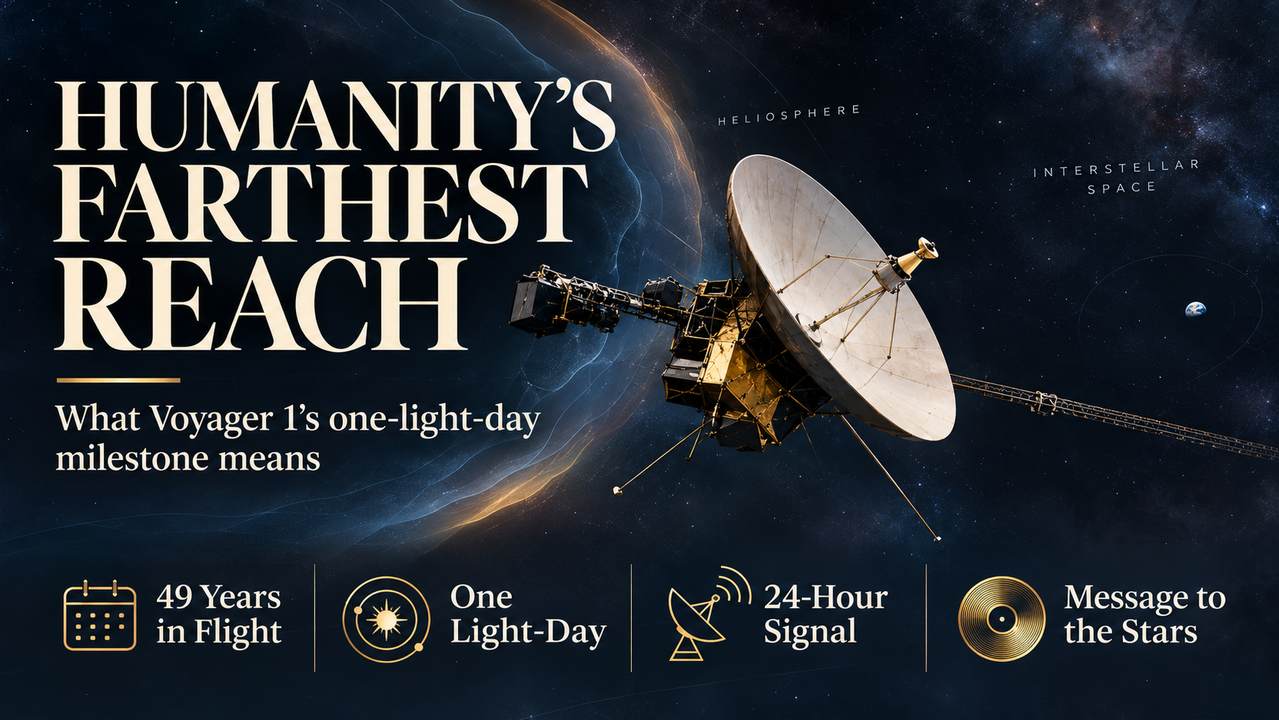
For the first time, a human-made object is one light-day from Earth, so a signal takes a full day to travel each way. The National Aeronautics and Space Administration (NASA)‘s Voyager 1 reaches this distance, about 26 billion km, on November 18, nearly 50 years after its launch. NASA calls it “a celebration of humanity’s farthest reach”.
What are the Voyager missions?
- Fly-by missions: NASA launched two Voyager spacecraft in 1977 to fly past the outer planets and study them on the way out. Voyager 2 left a few weeks before Voyager 1.
- Mission aim: Both were to study the outer solar system and search for the heliopause, the outer edge of the heliosphere, the Sun’s protective bubble of particles and magnetic fields. Interstellar space begins beyond it.
- Outliving the plan: Their planned life was about four years, yet both still cruise. Voyager 1 is expected to keep working for a few more years.
- Golden Records: Each carries an identical gold-plated copper disc with Earth’s location, greetings in 55 languages and about 35 sounds, meant for any extraterrestrial finders.
- The takeaway: A four-year planetary tour became a five-decade probe of the Sun’s boundary, which is why the craft still yields science.
What has Voyager 1 found?
- Jupiter and Saturn: It showed Jupiter’s atmosphere to be far more turbulent than known and found a thin ring around the planet. At Saturn it discovered five new moons.
- Accidental cosmic ray detector: Its ultraviolet spectrometer was built to study ultraviolet light. A 2014 study showed it had also been recording galactic cosmic rays, high-energy particles from beyond the solar system.
- Heliopause crossing: The same data gave independent evidence that Voyager 1 crossed the heliopause in 2012, and suggested the solar wind slows just inside that boundary.
- Test of Einstein: Saturn flyby data confirmed Einstein’s prediction that the frequency of light shifts in a gravitational field, to 1% accuracy, as reported in 1990.
- Saturn’s rings and Titan: Radio signals passing through the rings and Titan’s atmosphere revealed ring gaps and Titan’s temperature and pressure, groundwork for the Cassini-Huygens mission.
Where does Voyager 1 stand now?
- Farthest mission: It has been the farthest spacecraft from Earth since 1998, and travels at 61,000 km an hour.
- Barely out of the solar system: The Sun’s gravitational and magnetic fields reach billions of km, so even at this distance the craft is only just beyond its influence.
- Instruments still working: Only a few of its science instruments still send data, and the number keeps falling as the spacecraft ages.
- Voyager 2’s longer route: Voyager 2 is the only spacecraft to fly by Uranus and Neptune. It found 10 new moons and two new rings around Uranus, and its longer route delays its light-day milestone.
- Pale Blue Dot: Astronomer Carl Sagan, a member of the imaging team, had a Voyager camera photograph Earth from afar, showing it as a tiny, fragile speck.
Conclusion
Voyager 1 is now the farthest and oldest working space mission, still reporting from beyond the heliopause. Its signals will grow dimmer and its instruments will fall silent, so the next markers are how long its remaining instruments keep reporting and when Voyager 2 reaches the same distance.
Key numbers
- Launch dates: Voyager 2 on August 20, 1977; Voyager 1 on September 5, 1977.
- Farthest since: February 17, 1998.
Back2Basics: Deep Space Network
- What it is: A network of large dish antennas with ultra-sensitive receivers, tuned to detect the faint radio signals of distant spacecraft.
- Who runs it: NASA’s Jet Propulsion Laboratory (JPL) manages the network.
- Three sites: Antenna complexes in California, Madrid and Canberra keep contact continuous as Earth rotates.
- Role: It sends commands to and tracks spacecraft, including the Voyagers in interstellar space.
Matching Previous Year Question
“[2014] Which of the following pairs is/are correctly matched ? Spacecraft Purpose 1. Cassini-Huygens : Orbiting the Venus and transmitting data to the Earth. 2. Messenger : Mapping and investigating. 3. Voyager 1 and 2 : Exploring the outer solar system. Select the correct answer using the code given below. (a) 1 only (b) 2 and 3 only (c) 1 and 3 only (d) 1, 2 and 3 only ANSWER: (b)”
