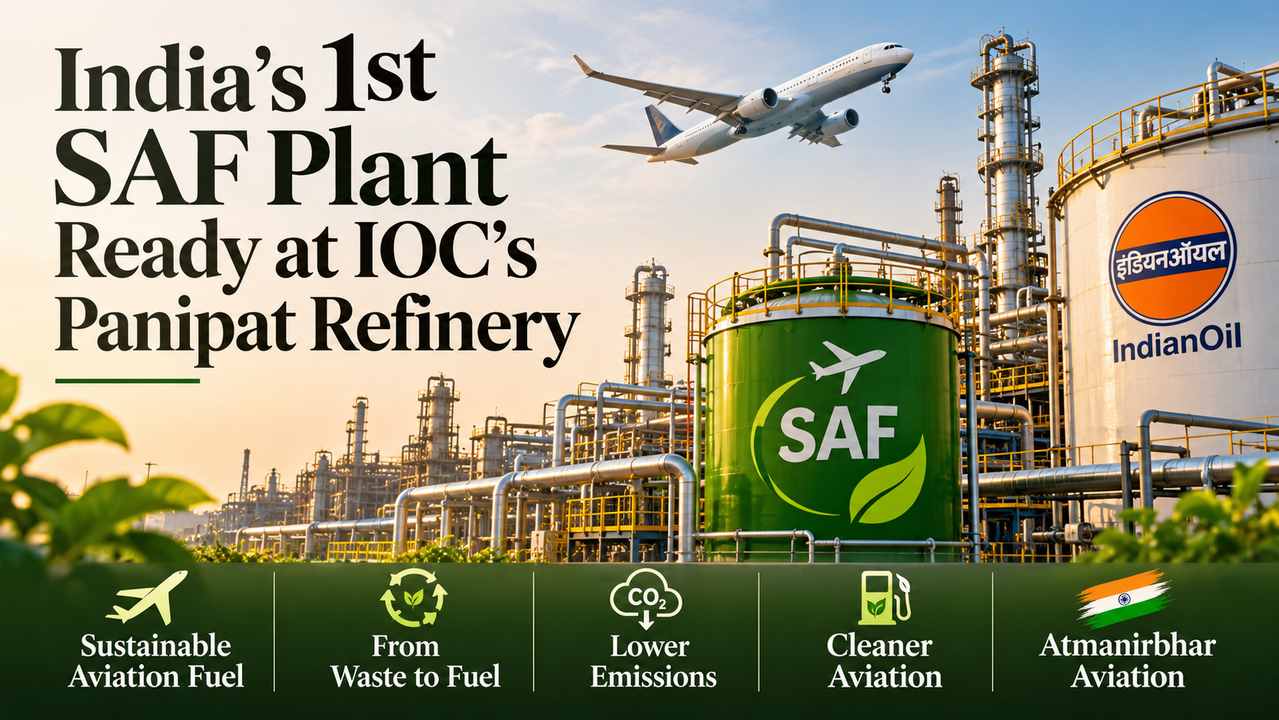
Why in the News
For the first time, India has a commercial-scale plant that makes sustainable aviation fuel (SAF), a jet fuel made from waste or renewable feedstock instead of crude oil. Indian Oil Corporation (IOC)‘s 30,000 tonnes per annum unit at its Panipat refinery produced its first batch from used cooking oil on Monday. It comes ahead of likely SAF blending mandates for international flights from January.
What is SAF, and why does aviation need it?
- What it is: SAF is jet fuel made from renewable or waste feedstock, such as used cooking oil, instead of crude oil. Like ethanol in petrol, it is blended into conventional fuel.
- Why aviation needs it: Long-haul aircraft cannot run on batteries, so a cleaner liquid fuel is the main route to cutting aviation emissions.
- Blending mandate: A blending mandate requires a fixed share of SAF in jet fuel. India’s proposed target is 1% for international flights in 2027.
- The takeaway: Domestic SAF supply lets airlines flying from India meet the coming mandate without depending on imported green fuel.
What does the Panipat plant change?
- Waste to fuel: The unit turns used cooking oil, a waste product, into jet fuel at commercial scale.
- Approvals: It has received all requisite approvals, including from the Directorate General of Civil Aviation (DGCA), the aviation safety regulator, and government clearance to supply SAF commercially.
- Meeting 2027 demand: Its output would meet nearly the entire SAF requirement India faces in 2027 under the proposed mandates.
- Demand-led expansion: IOC will sign supply agreements with airlines before committing investment to more SAF projects.
Why does it matter for India?
- Global production hub: IOC’s chairman sees India becoming a global SAF production hub, since airlines worldwide will increase their use of the fuel.
- More refiners following: Other public sector refiners are in advanced stages of SAF projects. Bharat Petroleum Corporation Limited (BPCL) expects its 41,000 tonnes per annum unit at its Mumbai refinery to be ready next month.
- Safer food oil use: Collecting used cooking oil for fuel also keeps it from being reused in food, where repeated frying makes it a health hazard.
Challenges
- Scattered feedstock: Used cooking oil is spread across households, eateries and food processors, so collecting it at scale is difficult.
- Cost premium: SAF costs more than fossil jet fuel, which raises airline costs and, in turn, fares.
- Uncertain offtake: Without long-term airline contracts, further SAF plants carry investment risk.
- International flights only: The proposed mandates cover international flights, leaving domestic flying outside them.
Way Forward
- Organised collection: Build used cooking oil collection chains with food businesses and urban local bodies.
- Long-term contracts: Airlines and refiners should sign multi-year supply agreements to de-risk new plants.
- Diverse feedstocks: Develop other SAF pathways, such as agricultural residue, to avoid dependence on one waste stream.
- Phased domestic mandate: Extend blending targets to domestic flights once supply grows.
Conclusion
India now has domestic SAF output ahead of its first blending obligation, which moves aviation decarbonisation from target to production. Whether airlines sign supply deals and the next refinery units arrive on time will show if India can grow from meeting its own mandate to supplying others.
Matching Previous Year Question
“[2017] It is possible to produce algae based biofuels, but what is/are the likely limitation(s) of developing countries in promoting this industry? 1. Production of algae based biofuels is possible in seas only and not on continents. 2. Setting up and engineering the algae based biofuel production requires high level of expertise/technology until the construction is completed. 3. Economically viable production necessitates the setting up of large scale facilities which may raise ecological and social concerns. Select the correct answer using the code given below: (a) 1 and 2 only (b) 2 and 3 only (c) 3 only (d) 1, 2 and 3 ANSWER: (b)”
