Why in the News
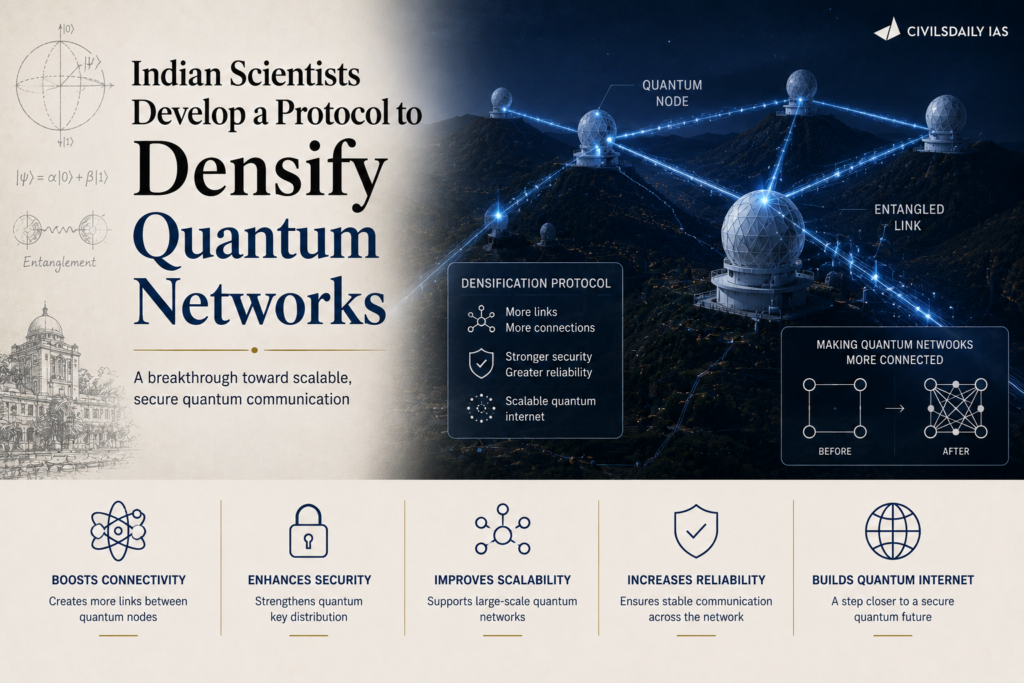
Indian scientists have developed a new routing protocol called General Concurrence Percolation (GCP) to improve the efficiency and connectivity of quantum networks, marking a significant advance in quantum communication.
What is the General Concurrence Percolation (GCP) Protocol?
- Innovation: A routing protocol designed to strengthen quantum entanglement across a quantum network.
- Approach: Uses localized geometric routing to identify the shortest communication paths.
- Key feature: Preserves intermediate network nodes instead of disconnecting them, improving network stability.
- Outcome: Simulations show the protocol reduces the minimum entanglement required to connect an entire quantum network.
What is Quantum Entanglement?
- Definition: A quantum phenomenon in which two or more particles remain correlated so that the state of one is intrinsically linked to the state of the other, regardless of distance.
- Challenge: Entanglement weakens over long distances, making reliable quantum communication difficult.
- Importance: It is the foundation of quantum communication, quantum cryptography, and quantum computing.
Why is the Development Significant?
- Improves the efficiency of long distance quantum communication.
- Reduces the amount of entanglement needed for network connectivity.
- Makes future quantum internet infrastructure more robust and scalable.
- Supports secure communication through quantum encryption technologies.
- Strengthens India’s capabilities in advanced quantum technologies.
[2026] Which of the following statements with regard to the National Quantum Mission (NQM) is/are correct?
1. It aims at developing intermediate-scale quantum computers with 50 – 1000 physical qubits.
2. Its implementation includes setting up of four Thematic Hubs (T-Hubs) in academic and national R&D institutes across India.
Select the answer using the code given below :
[A] 1 only
[B] 2 only
[C] Both 1 and 2
[D] Neither 1 nor 2