Why in News?
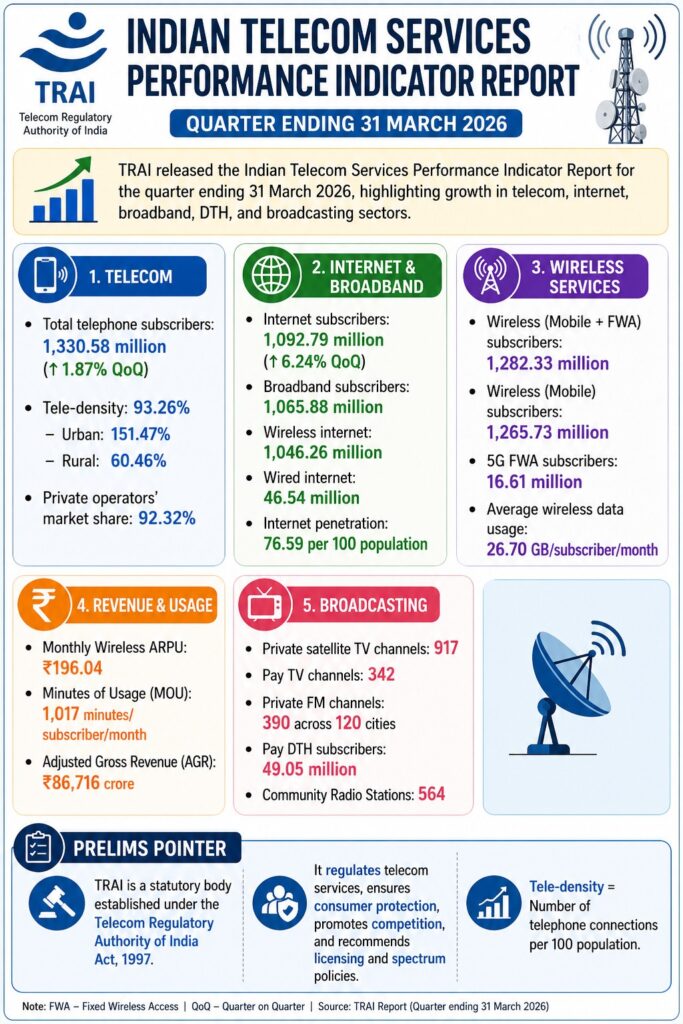
TRAI released the Indian Telecom Services Performance Indicator Report for the quarter ending 31 March 2026, highlighting growth in telecom, internet, broadband, DTH, and broadcasting sectors.
Telecom
- Total telephone subscribers: 1,330.58 million (↑1.87% QoQ).
- Tele-density:93.26%: Urban: 151.47% and Rural: 60.46%
- Private operators’ market share: 92.32%.
Internet & Broadband
- Internet subscribers: 1,092.79 million (↑6.24% QoQ).
- Broadband subscribers: 1,065.88 million.
- Wireless internet: 1,046.26 million.
- Wired internet: 46.54 million.
- Internet penetration: 76.59 per 100 population.
Wireless Services
- Wireless (Mobile + FWA) subscribers: 1,282.33 million.
- Wireless (Mobile) subscribers: 1,265.73 million.
- 5G FWA subscribers: 16.61 million.
- Average wireless data usage: 26.70 GB/subscriber/month.
Revenue & Usage
- Monthly Wireless ARPU: ₹196.04.
- Minutes of Usage (MOU): 1,017 minutes/subscriber/month.
- Adjusted Gross Revenue (AGR): ₹86,716 crore.
Broadcasting
- Private satellite TV channels: 917
- Pay TV channels: 342
- Private FM channels: 390 across 120 cities
- Pay DTH subscribers: 49.05 million
- Community Radio Stations: 564.
Prelims Pointer
- TRAI is a statutory body established under the Telecom Regulatory Authority of India Act, 1997.
- It regulates telecom services, ensures consumer protection, promotes competition, and recommends licensing and spectrum policies.
- Tele-density = Number of telephone connections per 100 population.
[2019] With reference to communications technologies, what is/are the difference/differences between LTE (Long-Term Evolution) and VoLTE (Voice over Long-Term Evolution)?
1. LTE is commonly marketed as 3G and VoLTE is commonly marketed as advanced 3G.
2. LTE is data-only technology and VoLTE is voice-only technology.
Select the correct answer using the code given below.
[A] 1 only
[B] 2 only
[C] Both 1 and 2
[D] Neither 1 nor 2
