Why in the News
- A study published in Environmental Research: Climate suggests that India’s forests could nearly double carbon storage by 2100 under current emission trends.
Key Findings
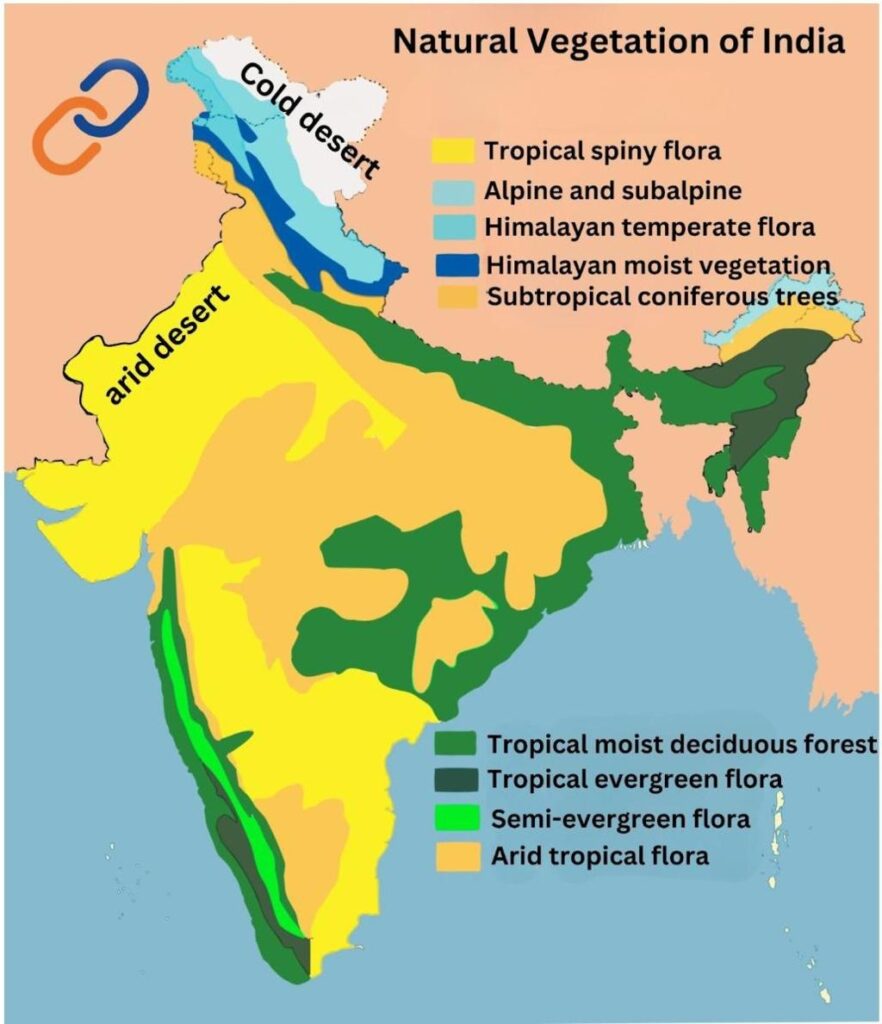
- Vegetation carbon increase:
- 35 percent under low emissions
- 62 percent under medium emissions
- 97 percent under high emissions
- Growth pattern:
- Similar till about 2030
- Rapid increase after 2050
Key Drivers
1. Increased Rainfall
- More moisture availability
- Enhances vegetation growth
2. Higher Atmospheric CO2
- Improves photosynthesis
- Increases water-use efficiency
3. Time Lag Effect
- Forest response is delayed:
- About 2 years (low and medium emissions)
- About 4 years (high emissions)
Regional Trends
Highest Increase
- Desert and semi-arid regions: Rajasthan, Gujarat, and Western Madhya Pradesh
Moderate Increase
- Trans-Himalayas
- Gangetic plains
- Deccan Plateau
Lower Increase
- Western Ghats
- Himalayas
Reason:
- Ecological saturation
- Climatic limitations
Important Institution
- Forest Survey of India: Official body for forest and tree cover data.
| Consider the following statements: (2019) 1. As per the Law, the Compensatory Afforestation Fund Management and Planning Authority (CAMPA) exists at both National and State levels. 2. People’s participation is mandatory in the compensatory afforestation programmes carried out under the Compensatory Afforestation Fund Act, 2016. Which of the statements given above is/are correct? (a) 1 only(b) 2 only(c) Both 1 and 2(d) Neither 1 nor 2 In the context of mitigating the impending global warming due to anthropogenic emissions of carbon dioxide, which of the following can be potential sites for carbon sequestration? (2017) 1. Abandoned and uneconomic coal seams. 2. Depleted oil and gas reservoirs.Subterranean deep saline formations. Select the correct answer using the code given below: (a) 1 and 2 only(b) 3 only(c) 1 and 3 only(d) 1, 2 and 3 |
