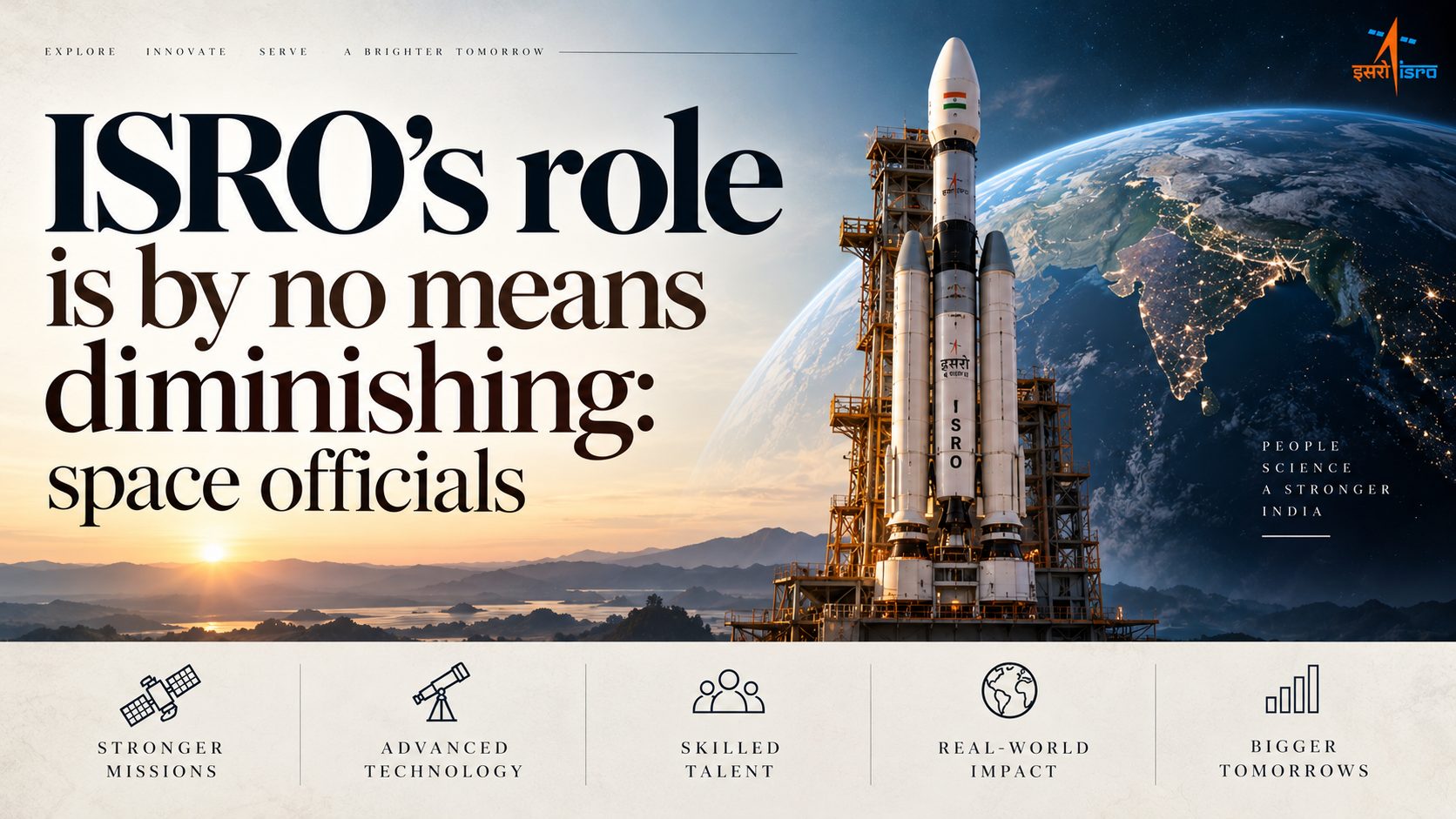
Why in the News
Nine Indian Space Research Organisation (ISRO) employee associations have written a joint letter dated 4 September seeking written clarification on whether the government intends to transfer the agency’s launch vehicle and satellite manufacturing to private firms.
What did the employee associations actually ask?
- Whether the position is an approved decision: They asked whether the stated future of ISRO not manufacturing launch vehicles represents an approved Space Commission decision.
- What happens to the workforce: They asked what would happen to sanctioned strength and recruitment over the next five to 10 years.
- Whether they will be consulted: They asked whether the associations would be consulted before irreversible decisions are taken.
- Where the letter went: It was addressed to the Secretary, Department of Space and Chairman, ISRO, and copied to the Confederation of Central Government Employees and Workers.
What is the official position on ISRO’s role?
- The role is stated as undiminished: IN-SPACe’s chairman said the direction is not a smaller ISRO but a larger Indian space ecosystem, with ISRO pushing the technological frontier.
- Privatisation is denied outright: ISRO’s clarification stated that the agency will neither be privatised nor have its importance reduced.
- Transfer is distinguished from withdrawal: Handing over a mature technology does not amount to leaving that domain, on the agency’s stated reasoning.
- Ownership stays public: Critical national space infrastructure will remain owned by the government.
How is the division of labour defined?
- The 2020 reforms set the structure: The reforms were aimed at expanding the overall ecosystem, with IN-SPACe authorising non-government participation and NewSpace India Limited (NSIL) commercialising mature capabilities.
- Industry takes the mature end: Industry is to increasingly manufacture and scale launch vehicles and satellites whose technology is settled.
- The agency keeps the unsettled end: ISRO is to concentrate on advanced research and development, scientific and strategic missions, and infrastructure too complex for private developers.
- The policy instrument: The arrangement is described as an ISRO-led national space ecosystem, institutionalised through the Indian Space Policy 2023.
What does the reform record show so far?
- Firm formation: India now has over 450 space start-ups, against a handful in 2020.
- The revenue target: The space economy is roughly $8.4 billion and the stated aim is to grow it to $44 billion by 2033.
- The retained programmes: The Bharatiya Antariksh Station by 2035 and an Indian crewed lunar mission by 2040 are named as the missions ISRO itself will build toward.
Why could employees only raise this as associations?
- They are outside the industry definition: Department of Space employees are exempted from the statutory definition of industry.
- They cannot unionise: That exemption means they cannot form trade unions to bargain on employment terms.
- The available channel is narrower: They organise instead as service associations recognised under the Central Civil Services (Recognition of Service Associations) Rules, 1993, which permits representation rather than negotiation.
Challenges to an ISRO-led national space ecosystem
- Government remains the anchor customer: Private launch and satellite demand is thin, so firms depend on public orders for volume. Eg. NewSpace India Limited awarded the Polar Satellite Launch Vehicle industrial production contract for five vehicles to a Hindustan Aeronautics Limited and Larsen and Toubro consortium in 2022.
The Fix: Publish a multi-year public launch and satellite procurement calendar, so firms can size capacity against committed demand rather than announcements. - Technology transfer terms decide whether industry can compete: A transferred design without production know-how and test infrastructure leaves the recipient dependent on the agency. Eg. ISRO transferred the Small Satellite Launch Vehicle technology to Hindustan Aeronautics Limited in 2025.
The Fix: Attach test facility access and a defined hand-holding period to every transfer agreement, with milestones the recipient must independently clear. - Long-gestation capital is scarce: Launch and propulsion ventures need patient capital across development cycles that outlast most venture fund horizons. Eg. The Union Budget for 2024-25 announced a Rs 1,000 crore venture capital fund for the space sector for this reason.
The Fix: Route that fund through milestone-linked tranches tied to qualification tests, rather than as equity at a single valuation point. - Foreign investment rules still differ by segment: Investment caps vary across launch vehicles, satellites and components, which complicates raising capital for an integrated firm. Eg. The 2024 foreign direct investment revision set different automatic-route thresholds for satellite manufacturing, launch vehicles and component supply.
The Fix: Publish a single classification note stating which activity falls in which segment, so a firm knows its cap before it raises capital.
Conclusion
Both sides agree that industry should build what is settled and the agency should build what is not. The disagreement is over where that boundary currently sits and who has the authority to move it. The workforce question the associations raised is the one neither reply engaged with. Until the Department of Space states its recruitment intent in numbers, the assurance rests on stated direction rather than on anything an employee can verify.
Back2Basics
- NewSpace India Limited: The commercial arm of the Department of Space, incorporated in March 2019 as a central public sector enterprise.
- Predecessor: It took over the commercial role earlier held by Antrix Corporation, which now handles a narrower marketing mandate.
- Business model: It operates on a demand-driven model, owning and operating satellites and launches for identified customers rather than only marketing surplus capacity.
- Headquarters: It is based in Bengaluru and reports to the Department of Space.
[2026] Consider the following statements about involvement of private entities in India’s space programme:
1. IN-SPACe is an autonomous agency formed to facilitate participation of private entities.
2. Agnikul Cosmos launched the world’s first flight using 3D-printed rocket engine.
3. Skyroot Aerospace has developed liquid fuel for GSLV.
(a) 1 only (b) 2 and 3 only (c) 1 and 2 only (d) 1, 2 and 3
