Why in the News
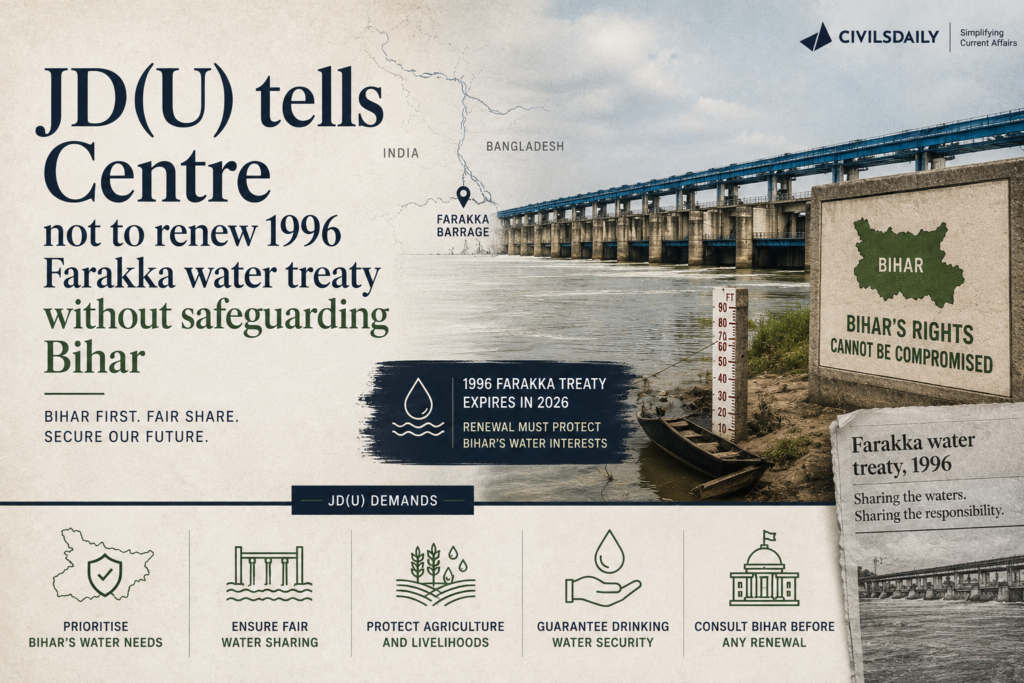
The 1996 Farakka Water Treaty between India and Bangladesh is set to expire on 12 December 2026. The JD(U) has urged the Centre not to renew the treaty unless Bihar’s long term water security and developmental needs are adequately addressed.
What is the 1996 Farakka Water Treaty?
- Definition: A bilateral agreement between India and Bangladesh for sharing the Ganga’s dry season flow at the Farakka Barrage.
- Objective: To allocate Ganga waters during the lean season between the two countries.
- Duration: Signed in 1996 for 30 years, expiring on 12 December 2026.
What is the Farakka Barrage?
- Location: Built across the Ganga River in West Bengal.
- Purpose: Diverts water into the Hooghly River.
- Objective: Flushes silt to maintain the navigability of Kolkata Port.
Why has Bihar opposed the treaty’s renewal?
- Reduced Water Availability: Bihar argues that diversion at Farakka reduces lean season water availability within the state.
- Development Concerns: Seeks greater consideration of Bihar’s long term irrigation, drinking water and development needs.
- Demand for Renegotiation: JD(U) has called for safeguards before any extension of the treaty.
- Federal Dimension: Highlights the need to balance state interests with India’s international water sharing commitments.
Why is the treaty sensitive for India and Bangladesh?
- Shared Rivers: India and Bangladesh share numerous transboundary rivers, making water sharing politically significant.
- Dry Season Scarcity: Limited lean season flows often lead to competing demands.
- Related Issue: The Farakka dispute exists alongside the unresolved Teesta Water Sharing Agreement, another key bilateral concern.
[2013, GS2, 10 marks] The protests in Shahbag Square in Dhaka in Bangladesh reveal a fundamental split in society between the nationalists and Islamic forces. What is its significance for India?
[2017] With reference to river Teesta, consider the following statements:
1. The source of river Teesta is the same as that of Brahmaputra but it flows through Sikkim.
2. River Rangeet originates in Sikkim and it is a tributary of river Teesta.
3. River Teesta flows into Bay of Bengal on the border of India and Bangladesh.
Which of the statements given above is/are correct?
[A] 1 and 3 only
[B] 2 only
[C] 2 and 3 only
[D] 1, 2 and 3