Why in News?
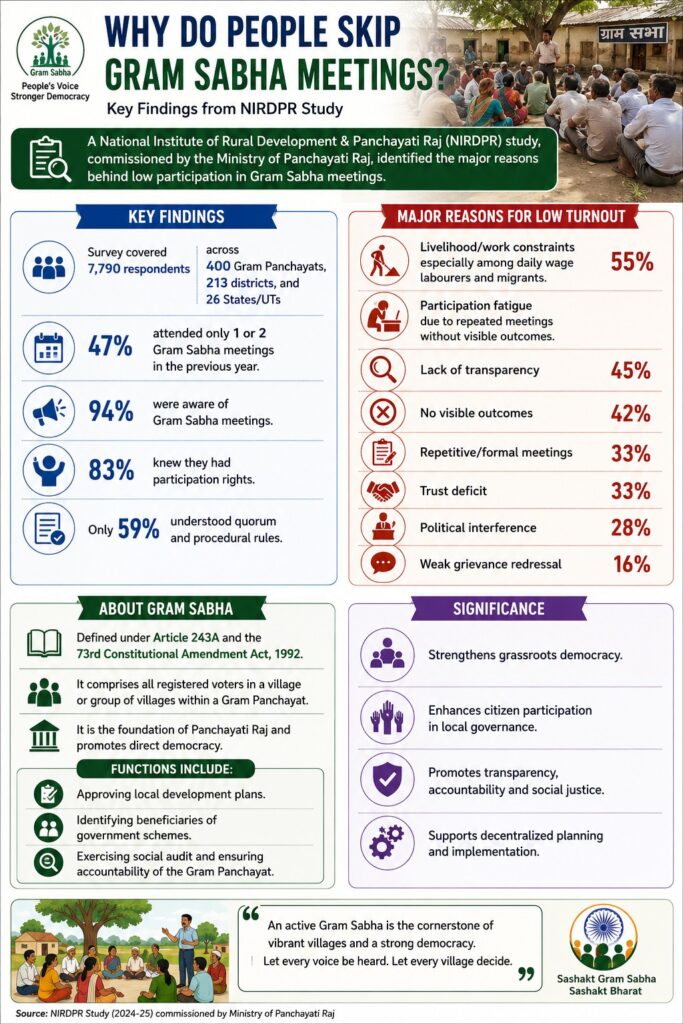
A National Institute of Rural Development & Panchayati Raj (NIRDPR) study, commissioned by the Ministry of Panchayati Raj, identified the major reasons behind low participation in Gram Sabha meetings.
Key Findings
- Survey covered 7,790 respondents across 400 Gram Panchayats, 213 districts, and 26 States/UTs.
- 47% attended only 1 or 2 Gram Sabha meetings in the previous year.
- 94% were aware of Gram Sabha meetings.
- 83% knew they had participation rights.
- Only 59% understood quorum and procedural rules.
Major Reasons for Low Turnout
- Livelihood/work constraints (55%) especially among daily wage labourers and migrants.
- Participation fatigue due to repeated meetings without visible outcomes.
- Lack of transparency (45%).
- No visible outcomes (42%).
- Repetitive/formal meetings (33%).
- Trust deficit (33%).
- Political interference (28%).
- Weak grievance redressal (16%).
About Gram Sabha
- Defined under Article 243A and the 73rd Constitutional Amendment Act, 1992.
- It comprises all registered voters in a village or group of villages within a Gram Panchayat.
- It is the foundation of Panchayati Raj and promotes direct democracy.
- Functions include:
- Approving local development plans.
- Identifying beneficiaries of government schemes.
- Exercising social audit and ensuring accountability of the Gram Panchayat.
Significance
- Strengthens grassroots democracy.
- Enhances citizen participation in local governance.
- Promotes transparency, accountability and social justice.
- Supports decentralized planning and implementation.
[2017] Local self-government can be best explained as an exercise in
a) Federalism
b) Democratic decentralization
c) Administrative delegation
d) Direct democracy
