Why in News?
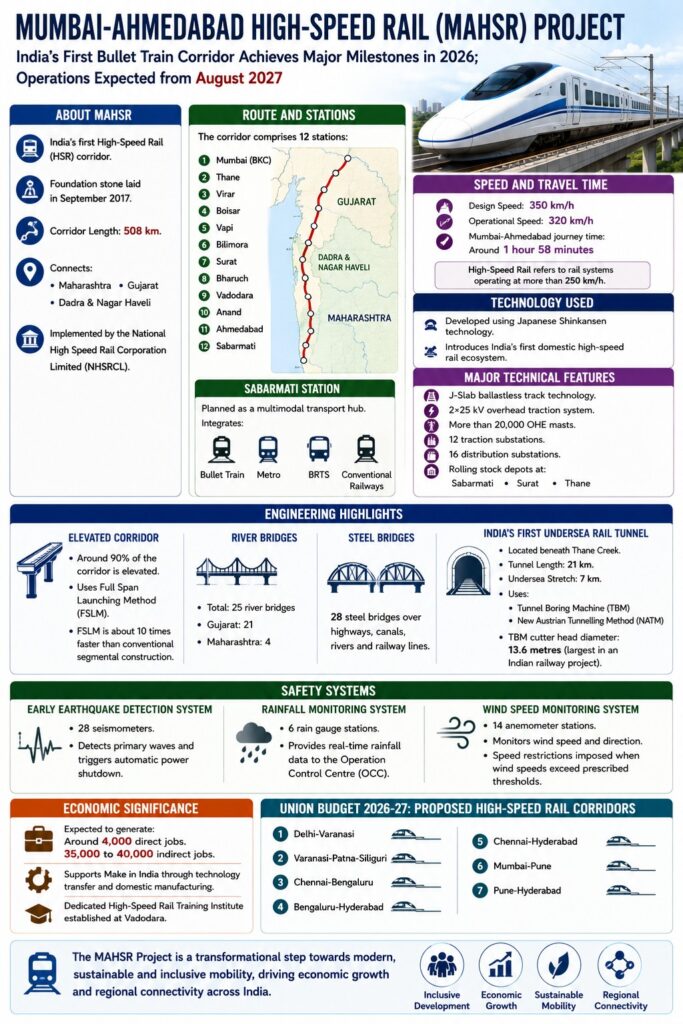
The Mumbai-Ahmedabad High-Speed Rail (MAHSR) Project, India’s first bullet train corridor, has achieved major construction milestones in 2026 and is expected to commence operations from August 2027.
About MAHSR
- India’s first High-Speed Rail (HSR) corridor.
- Foundation stone laid in September 2017.
- Corridor Length: 508 km.
- Connects: Maharashtra, Gujarat, and Dadra & Nagar Haveli
- Implemented by the National High Speed Rail Corporation Limited (NHSRCL).
- The corridor comprises 12 stations
- Sabarmati Station: Planned as a multimodal transport hub.
- Integrates: Bullet Train, Metro, BRTS, and Conventional Railways.
Speed and Travel Time
- Design Speed: 350 km/h
- Operational Speed: 320 km/h
- Mumbai-Ahmedabad journey time: Around 1 hour 58 minutes
- High-Speed Rail refers to rail systems operating at more than 250 km/h.
Technology Used
- Developed using Japanese Shinkansen technology.
- Introduces India’s first domestic high-speed rail ecosystem.
Major Technical Features
- J-Slab ballastless track technology.
- 2×25 kV overhead traction system.
- More than 20,000 OHE masts (Overhead Equipment Mast) is a vital vertical steel support used in railway electrification
- 12 traction substations (electrical substation that converts power from the public electricity grid into the specific voltage, current, and frequency required to power railways, trams, or trolleybuses)
- 16 distribution substations (electrical facility that receives high-voltage power from transmission or sub-transmission systems and “steps down” the voltage to medium levels).
- Rolling stock depots at: Sabarmati, Surat, and Thane.
Engineering Highlights
Elevated Corridor
- Around 90% of the corridor is elevated.
- Uses Full Span Launching Method (FSLM).
- FSLM is about 10 times faster than conventional segmental construction.
- River Bridges: Total: 25 river bridges: Gujarat: 21. Maharashtra: 4.
- Steel Bridges: 28 steel bridges over highways, canals, rivers and railway lines.
India’s First Undersea Rail Tunnel
- Located beneath Thane Creek.
- Tunnel Length: 21 km.
- Undersea Stretch: 7 km.
- Uses: Tunnel Boring Machine (TBM) and New Austrian Tunnelling Method (NATM).
- TBM cutter head diameter: 13.6 metres (largest in an Indian railway project).
Safety Systems
- Early Earthquake Detection System: 28 seismometers. Detects primary waves and triggers automatic power shutdown.
- Rainfall Monitoring System: 6 rain gauge stations. Provides real-time rainfall data to the Operation Control Centre (OCC).
- Wind Speed Monitoring System: 14 anemometer stations. Monitors wind speed and direction. Speed restrictions imposed when wind speeds exceed prescribed thresholds.
Economic Significance
- Expected to generate: Around 4,000 direct jobs. 35,000 to 40,000 indirect jobs.
- Supports Make in India through technology transfer and domestic manufacturing.
- Dedicated High-Speed Rail Training Institute established at Vadodara.
Union Budget 2026-27: Proposed High-Speed Rail Corridors
- Delhi-Varanasi, Varanasi-Patna-Siliguri, Chennai-Bengaluru, Bengaluru-Hyderabad, Chennai-Hyderabad, Mumbai-Pune, and Pune-Hyderabad
[2023] Consider the following statements :
1. In a seismograph, P waves are recorded earlier than S waves.
2. In P waves, the individual particles vibrate to and fro in the direction of wave propagation, whereas in S waves, the particles vibrate up and down at right angles to the direction of wave propagation.
Which of the statements given above is/are correct?
[A] 1 only
[B] 2 only
[C] Both 1 and 2
[D] Neither 1 nor 2
