Why in the News?
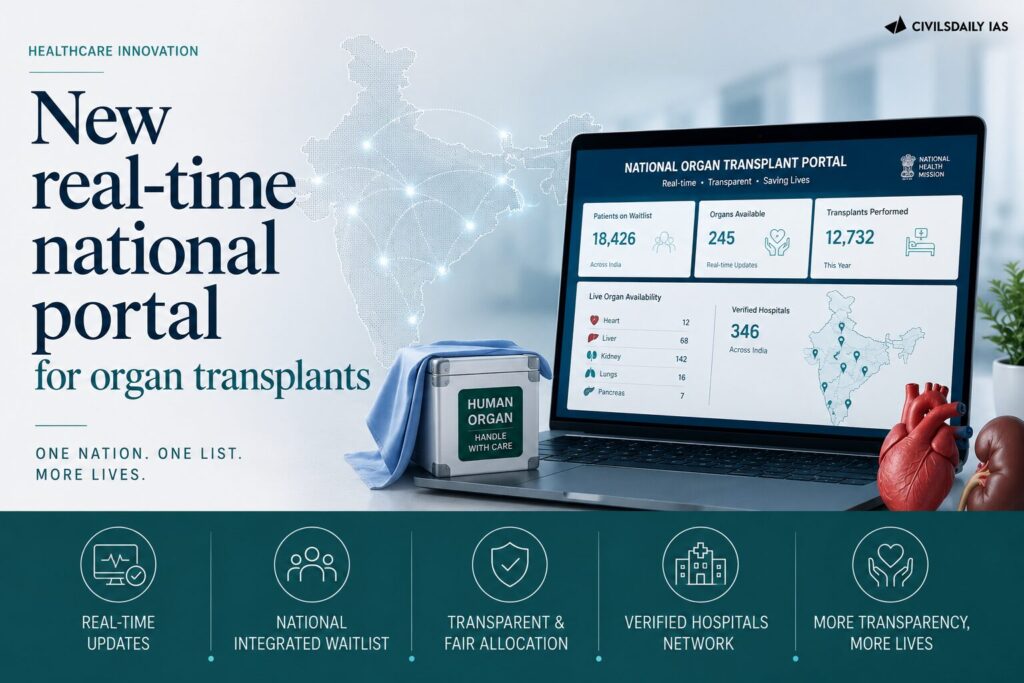
The National Organ and Tissue Transplant Organisation (NOTTO) has launched a real-time national portal and mobile application to streamline organ transplantation by creating a unified waiting list, enabling national swap donations, and improving transparency.
Key Features
- National Waiting List: Creates hospital, State, regional and national waiting lists.
- Real-time Allocation: Enables transparent organ allocation across India.
- National Swap Donor Pool: Matches incompatible donor-recipient pairs across the country.
- Aadhaar-linked Organ Pledge: Links donor pledges with Aadhaar for better verification.
- Outcome Tracking: Hospitals upload follow-up data to monitor transplant outcomes.
How does the Portal Work?
- Patients are registered by authorised transplant hospitals.
- Allocation follows the sequence: Hospital → State → Regional → National pool.
- Kidney Allocation: Donor hospital retains one kidney and sends the other to the nearest matching government hospital.
- Supports super-urgent transplant requests through the portal.
Significance
- Improves transparency and equity in organ allocation.
- Expands the pool for compatible donor matching.
- Reduces dependence on manual coordination.
- Creates a national transplant database for better monitoring.
Challenges
- Different States follow different organ allocation policies.
- NOTTO cannot mandate uniform allocation rules.
- Low deceased organ donation rates remain a major constraint.
- Portal effectiveness depends on accurate hospital data entry.
Back2Basics
- NOTTO: National Organ and Tissue Transplant Organisation.
- Parent Body: Directorate General of Health Services (DGHS), Ministry of Health and Family Welfare (MoHFW).
- Legal Basis: Transplantation of Human Organs and Tissues Act, 1994 (THOTA).
- Network: Works with Regional Organ and Tissue Transplant Organisations (ROTTOs) and State Organ and Tissue Transplant Organisations (SOTTOs).
[2023] Consider the following statements:
Statement-I: India’s public sector health care system largely focuses on curative care with limited preventive, promotive and rehabilitative care.
Statement-II: Under India’s decentralized approach to health care delivery, the States are primarily responsible for organizing health services.
Which one of the following is correct in respect of the above statements?
[A] Both Statement-I and Statement-l are correct and Statement-II is the correct explanation for Statement-I.
[B] Both Statement-I and Statement-II are correct and Statement-is not the correct explanation for Statement-l.
[C] Statement-l is correct but Statement-II is incorrect.
[D] Statement-I is incorrect but Statement-Il is correct.
