Why in the News
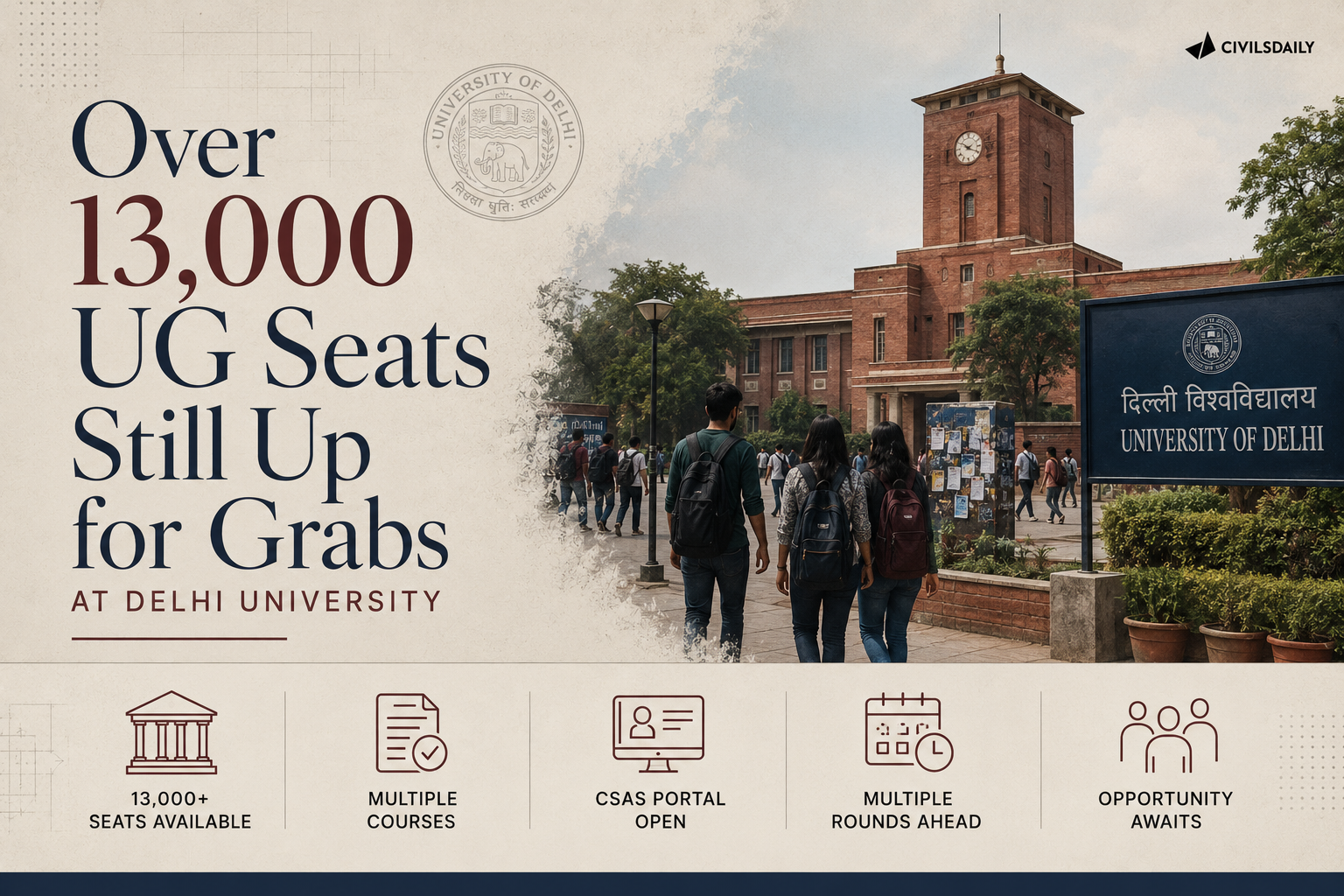
The University of Delhi has declared 13,344 undergraduate seats vacant for the 2026-27 intake and invited students to a spot admission round on the Common Seat Allocation System (CSAS) portal. The vacancies survive multiple rounds of allocation run on Common University Entrance Test (CUET) scores. The first round of seat allocation began on 16 July and the academic session commenced on 28 July. The university has separately opened undergraduate admission on Class 12 Central Board of Secondary Education (CBSE) scores instead of CUET results, at a list of colleges that has been expanded three times since 20 August. A single national entrance test built to standardise central university admission is being set aside mid-session by the largest of those universities.
What is the Common Seat Allocation System (CSAS)?
- A single centralised admission portal: CSAS is the online platform through which the University of Delhi allocates undergraduate seats across all its colleges from one common applicant pool.
- Preference plus score based allocation: An applicant registers once, submits a ranked list of college and programme combinations, and is allotted a seat by merit against those preferences.
- Multiple rounds with a spot round at the end: Allocation runs in successive rounds as candidates accept, decline or upgrade. A spot round is opened at the close to fill seats no earlier round could clear.
Where are the vacant seats concentrated?
- Scale against total intake: The university has approximately 71,600 undergraduate seats, so the vacancy stands at 13,344 as of 1 p.m. on Sunday.
- Reserved categories carry the largest share: Other Backward Classes-Non-Creamy Layer accounts for 4,133 vacant seats, Scheduled Tribes for 2,476 and Scheduled Castes for 2,038.
- General and Economically Weaker Section vacancies: The general category has 2,113 seats available and the Economically Weaker Section 1,791.
- Minority quota vacancies: The Sikh minorities category has 566 vacant seats and the Christian minorities category 316.
- Language programmes dominate the gap: Most vacant seats sit in BA (Hons) courses in various languages, including Sanskrit, Tamil and Bengali.
- North Campus colleges are not insulated: St. Stephen’s College, Hindu College, Hansraj College and Kirori Mal College all carry seats available in BA and B.Sc. (Hons) science subjects, in languages and in the BA programme.
What does the shift to Class 12 CBSE score based admission signal?
- A second entry route opened mid-session: The university introduced undergraduate admission based on Class 12 CBSE scores as an alternative to CUET results, after the session had already commenced.
- The eligible college list keeps widening: A list of 11 colleges with vacant seats admitting on CBSE results was released on 20 August, four more colleges were added on 21 August, and the list was expanded again on 23 August.
- Established women’s colleges have joined: Indraprastha College for Women and Gargi College commenced admission to the BA (Hons) Sanskrit programme on CBSE results.
- The entrance test is not the binding constraint: Seats remain empty at colleges with high demand, so the shortfall reflects programme preference rather than an absence of qualified applicants.
- Administration reads it as a scheduling matter: The Dean of Admissions stated that the spot admission round was announced on schedule and that the university expects to fill all remaining seats.
Challenges to the Common Seat Allocation System
- Preference locking traps candidates in low demand programmes: An applicant who ranks a prestigious college above a preferred subject can be allotted a course they will not join, which converts an accepted seat into a later vacancy. Eg. Language honours programmes at North Campus colleges carry the bulk of this year’s vacancies. Fix. Allow a subject first preference stream alongside the college first stream, so a candidate declares which of the two is binding.
- Multi-round upgrades leave seats stranded late in the cycle: Every upgrade vacates a seat downstream, and seats vacated in the final rounds arrive after the session has begun. Eg. The academic session commenced on 28 July while allocation continued past 23 August. Fix. Cap the number of upgrade rounds and hold a mandatory physical reporting deadline before the session opens.
- Reserved category seats do not migrate: Unfilled Scheduled Caste, Scheduled Tribe and Other Backward Classes seats cannot be converted to other categories, so they persist across rounds. Eg. Other Backward Classes-Non-Creamy Layer alone accounts for 4,133 of this year’s vacancies. Fix. Publish category wise applicant to seat ratios before allocation opens, so candidates can target categories with genuine headroom.
- A single test date compresses the eligible pool: Candidates who miss or underperform in one CUET sitting have no second attempt in the same cycle, unlike the multiple sittings offered by other national tests. Eg. The Joint Entrance Examination (Main) is conducted in two sessions a year with the better score counted. Fix. Move CUET to two sittings a year with the higher score taken.
- Parallel admission routes weaken the common merit standard: Admitting to the same programme on CUET in one college and on Class 12 board marks in another creates two different entry bars for one degree. Eg. BA (Hons) Sanskrit is now open on CBSE results at colleges where CUET based rounds could not fill it. Fix. Notify in advance the vacancy threshold at which a board score route opens, so the fallback is a published rule rather than a mid-session decision.
Conclusion
Delhi University’s undergraduate seat vacancy survived its CUET based rounds, and it has opened both a CSAS spot round and a parallel Class 12 board score route to clear it. The immediate status is that admission continues past the start of the academic session, with the CBSE score based college list still being extended. The next milestone is the close of the spot admission round and the university’s final seat matrix for 2026-27. Whether a single national entrance test can allocate seats in a university of this size within one session remains the open question.
“[2022, GS2, 15 marks] The Right of Children to Free and Compulsory Education Act, 2009 remains inadequate in promoting incentive-based system for children’s education without generating awareness about the importance of schooling. Analyse.”
