Why in the News
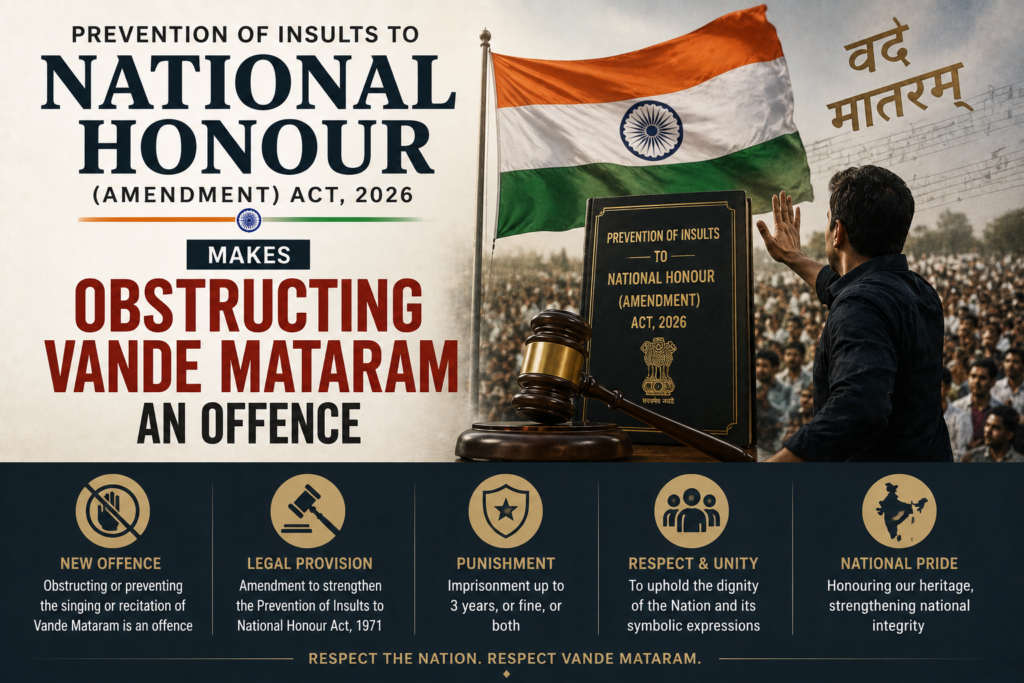
Parliament passed the Prevention of Insults to National Honour (Amendment) Act, 2026 in the recently concluded Monsoon Session, making it an offence to attempt to stop or prevent the singing or playing of Vande Mataram. The amendment lands on a live political dispute over whether public rendition may be confined to the first two stanzas, a practice the principal Opposition party traces to a 1937 Congress Working Committee resolution and the ruling party contests against the Constituent Assembly declaration of 24 January 1950. A statute now attaches criminal liability to conduct around a symbol whose status rests on a Presidential declaration in the Constituent Assembly rather than on any article of the Constitution.
What is the Prevention of Insults to National Honour Act, 1971?
- Purpose: The Prevention of Insults to National Honour Act, 1971 penalises insults to India’s national symbols, and is the parent statute the 2026 amendment modifies.
- Protection of the Flag and the Constitution: Section 2 penalises burning, mutilating, defacing, defiling, disfiguring, destroying or showing contempt to the Indian National Flag or the Constitution of India.
- Protection of the National Anthem: Section 3 penalises intentionally preventing the singing of the National Anthem or causing disturbance to any assembly engaged in singing it.
- Punishment: Contravention attracts imprisonment of up to three years, or a fine, or both.
- Disqualification for repeat offenders: Section 3A provides for disqualification from contesting elections to Parliament and State legislatures for a specified period on a second or subsequent conviction.
- Earlier amendments: The Act has been amended previously, including in 2003 to extend the prohibition on improper use of the Flag and in 2005 to permit specified respectful uses.
What does the 2026 Amendment change?
- New offence created: The amendment makes it an offence to attempt to stop or prevent the singing or playing of Vande Mataram.
- Extension of the Section 3 principle to the national song: The parent Act protected the National Anthem from obstruction, and the amendment extends comparable protection to the national song.
- Trigger for the amendment: The controversy over the national song began after Parliament passed the amendment in the recently concluded Monsoon Session.
- The conduct targeted is obstruction, not abstention: The offence attaches to attempts to stop or prevent rendition, which distinguishes it from a duty to sing.
What other provisions of the parent framework does the amendment sit alongside?
- The Flag Code of India, 2002: Governs display and use of the National Flag, and was amended in 2021 to permit polyester and machine made flags and in 2022 to permit display by night.
- The Orders relating to the National Anthem of India: Issued by the Ministry of Home Affairs, they specify the occasions for the full and short versions and the playing time of 52 seconds.
- The Emblems and Names (Prevention of Improper Use) Act, 1950: Bars improper commercial and professional use of specified names and emblems, including the National Flag.
- The State Emblem of India (Prohibition of Improper Use) Act, 2005: Regulates use of the State Emblem, adapted from the Lion Capital of Ashoka at Sarnath.
- No parallel protection exists for the national song in the parent Act: Before this amendment, the 1971 Act protected the Flag, the Constitution and the National Anthem, but not Vande Mataram.
Why does the two stanza convention exist?
- The 1937 resolution: The Congress Working Committee passed a resolution in 1937 on the public rendition of the national song.
- The stated reason: Leading figures of the freedom movement, including Mahatma Gandhi and Rabindranath Tagore, backed limiting public rendition to the first two stanzas to avoid verses containing specific religious imagery.
- Continuity claimed: The Congress president stated that the version sung was the same one sung by Mahatma Gandhi, Jawaharlal Nehru, Sardar Vallabhbhai Patel and former Prime Minister Atal Bihari Vajpayee.
- The 90 year framing: The party position is that it has continued a practice in place for 90 years, and that a governing party’s preference does not by itself set a national standard.
- State units following the same line: The Karnataka unit stated that only the first two stanzas would be sung at its programmes, in keeping with existing practice.
- The counter allegation: The ruling party alleged that the Congress entered into a pact with the Muslim League in 1936-37, under whose pressure only two stanzas were to be sung.
What did the Constituent Assembly decide on 24 January 1950?
- The declaration: Dr Rajendra Prasad, as President of the Constituent Assembly, declared on 24 January 1950 that Jana Gana Mana would be the National Anthem and Vande Mataram the national song.
- Equal honour, unequal legal treatment: The declaration accorded the national song honour equal to the anthem, without conferring on it the same statutory protection the anthem later received in 1971.
- The source of authority: The status of both symbols rests on this declaration and subsequent executive practice, not on any article of the Constitution.
- Historical lineage invoked: The contributions of Bankim Chandra Chattopadhyay, Rabindranath Tagore and Bal Gangadhar Tilak were recalled, with the song described as a major source of inspiration during the freedom struggle.
- The political point pressed: The ruling party emphasised that the person who made the declaration was himself a Congress member and later the President of India.
- The broader charge: The Congress was accused of compromising national symbols and the core values of its own freedom movement.
Why does criminalising obstruction of a national song raise a free speech question?
- The anthem precedent cuts both ways: Section 3 of the 1971 Act penalises preventing the singing of the anthem, and the Supreme Court has separately held that respectful silence is not an offence.
- Bijoe Emmanuel v. State of Kerala, 1986: The Court held that expelling students who stood respectfully but did not sing the anthem violated Article 19(1)(a) and Article 25.
- The definitional problem of attempt: An offence framed around an attempt to stop or prevent rendition turns on intention, which is inferred from conduct at a charged political event.
- Partial rendition is not obstruction: Singing two stanzas of a five stanza song is a choice about what to sing, distinct from preventing others from singing.
- Article 19(2) is the test: Any restriction must fall within the enumerated grounds, and the sustainability of this offence depends on locating it within public order or decency.
- The unresolved consequence: The dispute has moved from a convention about rendition into a question about who can be prosecuted at a public event, without the constitutional status of the national song itself being settled.
Challenges to enforcing the amended Act
- Proving intention to obstruct: Distinguishing deliberate obstruction from ordinary disorder at a crowded event is evidentially difficult, e.g. complaints under Section 3 of the 1971 Act arising from cinema hall incidents have frequently collapsed for want of proof of intent.
- Risk of politically motivated complaints: A criminal provision attached to a contested symbol invites first information reports as a campaign instrument, e.g. the current dispute arose from rendition at an Independence Day event at a party headquarters and a subsequent event in Goa.
- Conflict with the respectful silence doctrine: Enforcement can slide from obstruction into compelled participation, e.g. Bijoe Emmanuel v. State of Kerala, 1986 protected students who declined to sing while standing in respect.
- No settled authoritative text or duration: Unlike the anthem, the national song has no notified official version or playing time, e.g. the Orders relating to the National Anthem fix a playing time of 52 seconds with no counterpart for Vande Mataram.
- Judicial reversal risk from over enforcement: Courts have withdrawn mandatory rendition directions when enforcement produced harassment, e.g. the 2016 direction making the anthem compulsory in cinema halls was made optional in 2018.
- Federal enforcement variation: Police being a State subject, prosecution practice will differ across States, e.g. identical conduct at party events in different States can attract different responses.
Conclusion
The amendment converts a ninety year old convention about how much of a national song is sung in public into a matter capable of criminal prosecution, without resolving the underlying question of what legal status the national song holds. The 1971 Act protected the Flag, the Constitution and the National Anthem because each has a notified form, and the national song has none, so the offence rests on a symbol defined only by the Constituent Assembly declaration of 24 January 1950. The stage reached is that Parliament passed the Prevention of Insults to National Honour (Amendment) Act, 2026 in the recently concluded Monsoon Session. The source names no commencement date, rules or further milestone, so the next step on the record is notification bringing the amendment into force.
