Why in the News
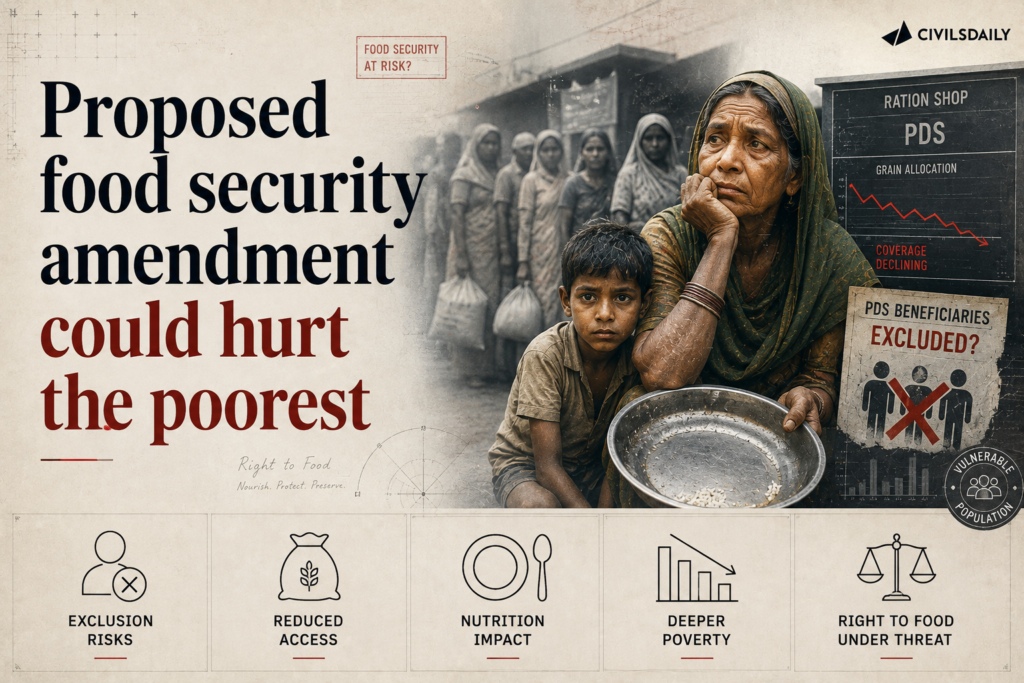
The Union government has proposed replacing the fixed 35kg monthly foodgrain quota for Antyodaya Anna Yojana households with a 7kg per-person entitlement. This proposed amendment to the National Food Security Act, 2013 could hurt the poorest households by converting a fixed household ration into a per capita entitlement. The tension is between per capita fairness on paper and the real needs of small, elderly, and vulnerable households.
What is the Antyodaya Anna Yojana (AAY)?
- Targeting: AAY covers the poorest of the poor households under the food security system.
- Entitlement: Each AAY household currently receives 35 kg of foodgrain per month, regardless of size.
- Zero Cost: Foodgrains are provided completely free of charge to all AAY beneficiaries.
- Distribution Channel: Handled via the Targeted Public Distribution System (TPDS) through local fair price shops.
- Portability: Access is supported nationwide via systems like One Nation One Ration Card
Key Beneficiary Groups
- Widows, terminally ill, disabled persons, or persons aged 60+ with no support
- Single women or men with no regular income or livelihood
- Primitive tribal groups
- Landless agricultural laborers, marginal farmers, and rural artisans
- Daily wage earners and slum dwellers in the informal sector
What does the proposed amendment change?
- Per capita shift: The household entitlement would be replaced by a per capita quota of about 7 kg per person. But the total family support cannot go over 35 kg.
- Small household hit: A one or two member household would receive far less than the current 35 kg.
What are the issues with the proposed amendment?
- Large families may lose out: The 35-kg ceiling can reduce the effective per-capita entitlement of AAY households with more than five members, weakening the rationale of a family-size-based allocation.
- Unequal regional impact: States with relatively larger household sizes, particularly parts of northern India, could face a greater impact from the 35-kg ceiling.
- Cereal-centric approach: Linking food security primarily to cereal quantities overlooks the need for protein, pulses, fats and dietary diversity for nutritional security.
- No wider concerns addressed: The amendment does not address wider concerns over outdated NFSA coverage, biometric failures and access barriers in the Public Distribution System.
- Exclusion remains unaddressed: Revising the entitlement formula does not resolve the larger problem of eligible beneficiaries remaining outside the PDS due to outdated population estimates and identification gaps.
Who is most exposed to the change?
- Elderly and widows: Single member and elderly headed households lose the most.
- Vulnerable groups: Particularly Vulnerable Tribal Groups (PVTGs) and small families face sharp cuts.
- Large AAY households among the poorest sections: Particularly families with six or more members, are likely to face the greatest disadvantage.
What principle is at stake?
- Adequacy over arithmetic: A per head formula ignores that small poor households have high fixed food needs.
- Substantive equality in food security is at stake: A uniform ceiling may appear administratively simple, but it can produce unequal outcomes for households with different sizes and vulnerabilities.
Conclusion
The central idea is that a per capita rule can look equal yet strip protection from the smallest households. Whether the amendment proceeds, and with what safeguard for small households, remains open.
PYQ Relevance
[UPSC 2021] What are the salient features of the National Food Security Act, 2013? How has the Food Security Bill helped in eliminating hunger and malnutrition in India?
Linakge: The PYQ examines the NFSA’s role in ensuring food security and addressing hunger and malnutrition. The proposed AAY reform raises questions about whether changes in foodgrain entitlements can preserve the NFSA’s objective of adequate and equitable food security for vulnerable households.
