Why in the News
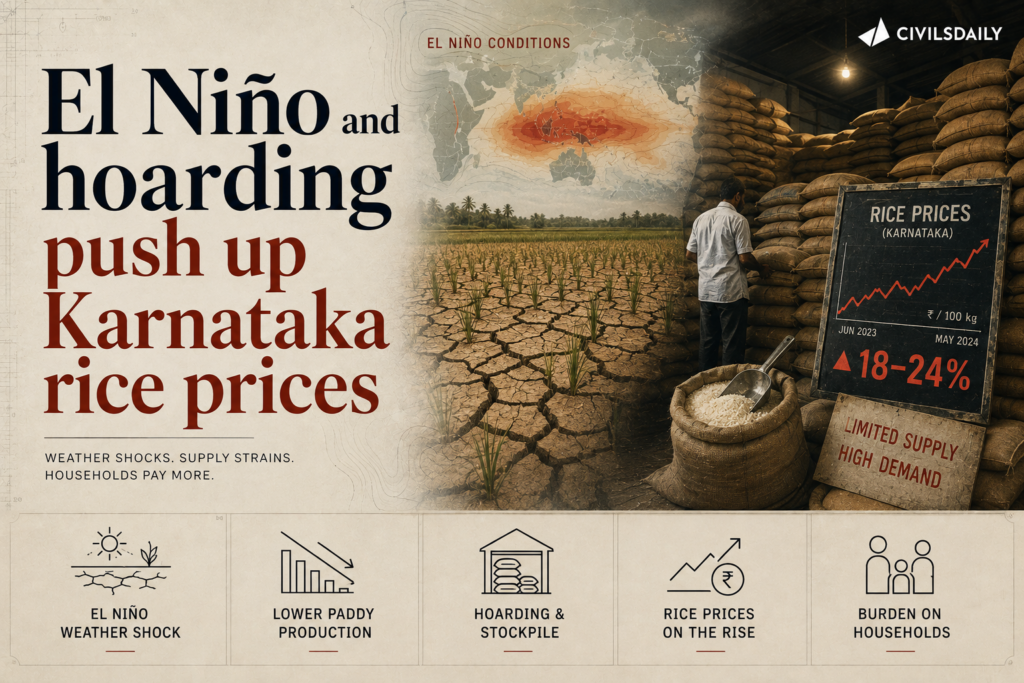
Deficit June to July rainfall, linked to El Niño, along with hoarding and war driven demand, pushed up rice prices in Karnataka while kharif paddy sowing remained below target. The episode highlights the vulnerability created by water intensive paddy cultivation during drought conditions.
What drove the shock?
- Rainfall deficit: El Niño associated dry conditions affected monsoon rainfall.
- Low sowing: Paddy acreage remained below the kharif target.
- Reservoir stress: Low storage reduced irrigation availability.
- Tungabhadra canal breach: Further disrupted water supply.
Why is Paddy Water Intensive?
- Conventional transplanted rice requires substantial water, particularly during crop establishment.
- Dependence on irrigation reservoirs makes paddy cultivation vulnerable to drought and declining storage.
- Concentration of paddy in water stressed regions can create a water-energy-food nexus problem.
Sustainable Alternatives
1. Direct Seeded Rice (DSR)
- Seeds are sown directly instead of raising and transplanting seedlings.
- Reduces water and labour requirements.
- Avoids prolonged standing water associated with conventional transplantation.
2. Crop Diversification
- Shift from paddy towards relatively less water intensive crops such as jowar, bajra, pulses and oilseeds.
- Can improve water-use efficiency and climate resilience.
3. Micro-irrigation and Water Management
- Efficient irrigation, laser land levelling, rainwater harvesting and improved farm water management can reduce water wastage.
MSP Dimension
- Paddy receives MSP support, providing farmers with a price assurance mechanism.
- For 2026-27, the MSP for paddy (common) is ₹2,441/quintal.
- However, assured prices can also influence farmers to continue cultivating water intensive crops even in water stressed regions.
“[2019] With reference to the cultivation of Kharif crops in India in the last five years, consider the following statements:
1. Area under rice cultivation is the highest.
2. Area under the cultivation of jowar is more than that of oilseeds.
3. Area of cotton cultivation is more than that of sugarcane.
4. Area under sugarcane cultivation has steadily decreased.
Which of the statements given above are correct?
(a) 1 and 3 only
(b) 2, 3 and 4 only
(c) 2 and 4 only
(d) 1, 2, 3 and 4
Answer: (a)”
